
ANIME 101 · REAL PLACE, FICTIONAL BRANCH · HUANGSHAN
Huangshan in Stitch & Ai: Home, Landscape, Tourism, and What the Cartoon Invented
Ai is not defending a pretty backdrop. She is defending the place where grief, skill, family, work, and memory have already taught her who she is.
Start with the real place before calling the scenery mystical
Mount Huangshan is a protected mountain landscape in Anhui Province, China. UNESCO describes massive granite peaks, ancient pines, cloud and mist effects, waterfalls, caves, lakes, and hot springs shaped by complex geology. Seventy-seven peaks exceed 1,000 meters, and Lianhua Peak reaches 1,864 meters. The facts are already dramatic. The guide does not need to add the word mystical every time fog appears.
Stitch & Ai uses Huangshan as the broad home region for Ai Ling and her community. The series combines recognizable mountain imagery with fictional streets, households, schools, festival spaces, and adventure routes. A painted peak that resembles Huangshan is not proof that every building occupies a mappable real address. Animation selects and rearranges geography for story movement.
Why the peaks look like Chinese landscape painting
Huangshan has influenced Chinese art and literature for centuries. UNESCO traces the mountain’s cultural prominence to the Tang period and notes the later importance of the landscape to shanshui, or mountain-and-water, painting. Peaks rising through a sea of clouds became more than scenery. Painters and poets used the landscape to think about scale, solitude, movement, human presence, and the relationship between built and natural space.
The series inherits that visual history whether every storyboard artist intends a direct quotation or not. Vertical stone forms, suspended paths, pines gripping rock, and mist hiding depth already carry centuries of representation. The cartoon often translates those forms into television readability: cleaner silhouettes, shorter travel time, broader color separation, and a village route that can support comedy and chase scenes.
Ai knows the mountains as a life rather than an image
Daiyu sees the mountains through dirt, distance, limited opportunity, and the fear that Ai will remain socially provincial. Visitors may see beauty. Ai sees routines, school, drum practice, family memory, shortcuts, neighbors, and the confidence that comes from knowing where a path leads. Home is accumulated competence.
That knowledge explains why relocation feels like dispossession rather than a simple upgrade. Ai would lose the environment where her skills make sense. She would also lose ordinary authority. In Huangshan, she can recognize danger and guide Stitch. In the city Daiyu imagines, the adult who arranged the move would control the rules, schedule, and explanation of what counts as proper.
The Wang household is fictional and emotionally specific
The series presents Ai and Jiejie’s home as part of a mountain community, but the household should not be mistaken for an ethnographic model of every family living near Huangshan. The architecture, interior layout, roads, tea shop, and school serve a thirteen-episode television story. Production design can draw from real regional forms and still create a composite town.
The emotional geography is clearer than the literal map. The house contains the sisters’ life after parental loss. Daiyu’s arrival turns rooms into packing space and household surfaces into targets for fumigation. Stitch’s arrival turns the same building into shelter, hiding place, laboratory problem, and chosen-family territory. Meaning changes faster than walls.
Stone paths are beautiful because somebody has to climb them
Huangshan’s famous routes and viewpoints can look effortless in art. Real mountain access involves steep paths, changing weather, maintenance, crowds, physical risk, and the work of people supporting tourism. UNESCO identifies visitor pressure as a major management concern and describes the need to balance conservation with tourism and local community interests.
The cartoon uses steps and narrow routes for adventure, especially when Ai demonstrates confidence that outsiders lack. The series rarely pauses for maintenance labor or visitor management. A fandom guide can appreciate the design and restore the missing reality: every scenic path exists inside decisions about safety, preservation, access, and human impact.
Pines, mist, and granite are not decorative coincidences
Ancient pines growing from rock, granite formations, and cloud seas are central to Huangshan’s recognized visual identity. The environment creates silhouettes animation can use immediately. A twisted pine tells viewers about wind and endurance. Mist hides depth and permits surprise. Granite pillars make characters look small without needing dialogue.
Those features also resist the idea that location is a replaceable background. Hawaii, Okinawa, and Huangshan shape Stitch differently because movement, weather, color, architecture, and local stories change what a chase can do. A production can reuse a character model. The world around that model should alter the rhythm.
Tourism and the danger of an empty postcard
A postcard removes labor, conflict, and crowded management from a place. Stitch & Ai sometimes approaches postcard framing when the mountain appears as an untouched fantasy waiting for an alien adventure. Other episodes restore social life through school, tea work, drumming, festivals, family arguments, and public performance.
The difference matters because Ai is defending a community rather than private access to pretty scenery. If Huangshan were only a view, Daiyu could promise another view in the city. The argument gains weight through people. Jiejie’s job, Dahu’s teaching, Meiying’s rivalry, and local performance turn the landscape into a network of obligations.
The city-versus-mountain argument is written too cleanly
Daiyu associates the city with education, culture, cleanliness, and opportunity. Ai associates the mountains with freedom, family, skill, and belonging. The conflict works emotionally and risks becoming a false binary. Cities can contain family and heritage. Rural communities can contain ambition, technology, and constraint. Children can want movement without agreeing to permanent removal.
A stronger continuation would let Ai visit the city on terms that preserve her home and let Daiyu encounter mountain life without treating the experience as punishment. Mobility should not require declaring one place superior. The family needs options, not a custody battle disguised as geography.
What the cartoon invents
The series invents alien conflicts, Jumba’s Chinese experiments, qi-related mechanics, creature encounters, compressed travel, and a town capable of supporting each episode’s premise. Local legendary forms are adapted into franchise biology. Festivals become settings for action. A viewer should not use the show as a field guide to Anhui ritual or mountain ecology.
Fictional invention is not a flaw. Problems begin when invented material is presented as cultural fact or when viewers assume every dragon, mask, scroll, and pavilion belongs to one interchangeable tradition. CVM Sekai separates episode evidence from sourced cultural context so the fantasy can remain fantasy without swallowing the place.
Tea work keeps the mountain economy visible
Jiejie’s job at Mr. Ding’s tea shop gives the branch an ordinary economic anchor. Tea is not presented through a full agricultural or trade history, and the workplace still matters. The household depends on labor connected to the local community. Daiyu’s city proposal therefore does not move Ai away from scenery alone. The proposal would separate the sisters across a working life already organized around the mountains.
The series could have followed the chain further: cultivation, processing, transport, visitors, wages, and the way tourism changes what local shops sell. Those missing details belong to analysis because a mountain community does not survive on atmosphere. People work inside the landscape other people travel to admire.
Mr. Ding’s ability to pour tea with theatrical distance turns service into comedy and skill. The visual gag also reminds viewers that everyday competence can be spectacular without becoming alien magic. Jiejie’s workplace deserves the same attention as the mythical creatures because ordinary labor is part of what Ai is fighting to keep nearby.
Conservation pressure complicates the fantasy of staying unchanged
Ai wants home to remain hers, but no protected landscape remains frozen. UNESCO identifies tourism pressure, pests affecting pine trees, storm damage, landslides, fire risk, water shortages, and the need for sustainable management. Loving a place does not exempt the place from change. Love creates obligations around how change is managed and who carries the cost.
A future season could have used those pressures without turning an environmental problem into a lecture. A damaged path, crowded festival, threatened pine, or conflict over visitor development could force Ai and Daiyu to argue about preservation and opportunity with better evidence. The mountain would become an active responsibility rather than a perfect alternative to the city.
The existing episodes offer the emotional foundation. Ai knows the place and deserves a voice in its future. Daiyu has resources and connections that could help without taking custody. Jiejie and Dahu belong to the labor and cultural network. Conservation would give the family a shared problem that cannot be solved by tricking one relative onto a train.
How to read Huangshan across the thirteen episodes
Watch for the difference between landscape shots and lived-space scenes. A misty peak establishes scale. Ai navigating a route establishes knowledge. Jiejie returning from work establishes routine. Daiyu spraying the house establishes judgment. A parade establishes public participation. Each use makes a different claim about home.
Also watch who gets to explain the environment. Ai’s knowledge carries authority because she lives there. Jumba’s classifications carry technical power. Daiyu’s assumptions carry class power. The camera can support or challenge each viewpoint through what the background reveals after the character speaks.
Sources and limits
The real-place foundation comes from the UNESCO World Heritage Centre record for Mount Huangshan, including geology, peak heights, pines, biodiversity, art history, conservation, tourism pressure, and the Anhui location. The guide uses the television episodes for fictional geography and clearly labels inference.
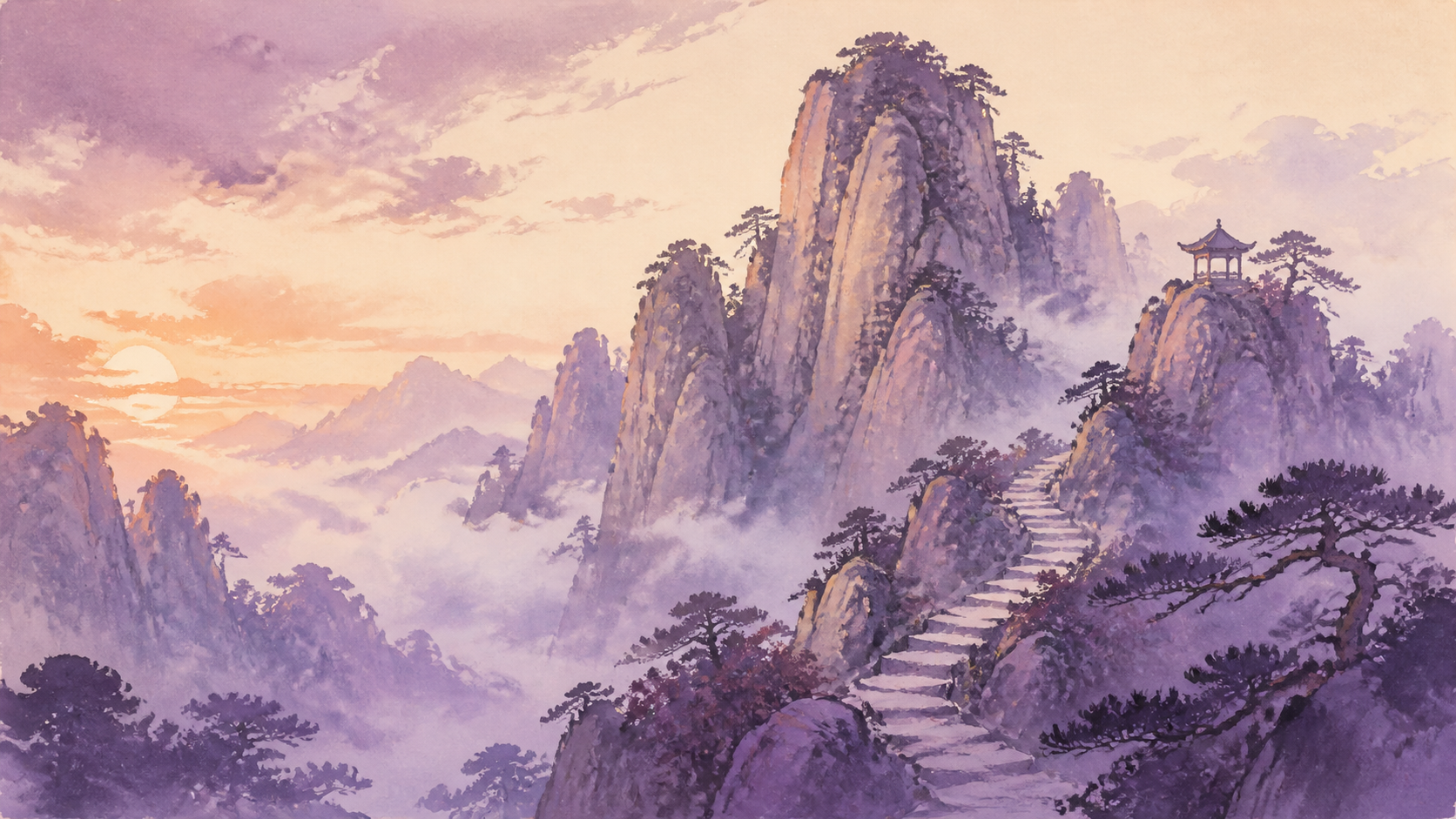
CVM Sekai’s hero is original editorial landscape art created for this guide with no franchise characters, logos, or copied scene. The image draws on the documented granite, pine, stair, and mist vocabulary while remaining an interpretation rather than an official still or a claim of exact topography.
Keep exploring
Return to the Stitch & Ai hub, read the full series review, or continue to Ai Ling’s character profile.
Start with the map before the mist starts doing emotional labor
Mount Huangshan is in southern Anhui Province. UNESCO lists a protected World Heritage property of 16,060 hectares with a much larger buffer zone, and identifies Lotus Flower Peak as the highest summit at 1,864 meters. The mountain is not a generic stand-in for all of China, and Huangshan City is not identical to the protected scenic area. A guide should keep those scales separate.
Stitch & Ai compresses travel, settlements, family spaces, mountain paths, and dramatic scenery into an animated world built for thirteen episodes. That compression can produce a recognizable visual identity without functioning as a reliable itinerary. Readers should treat the series as a fictional branch set around Huangshan, then use official geographic sources for the real place.
Granite, water, and weather built the famous silhouette
UNESCO describes imposing granite peaks, boulders, caves, waterfalls, lakes, hot springs, ancient pines, and the cloud and mist effects that repeatedly transform visibility. Those are not separate decorative attractions pasted together by tourism marketing. Geology, elevation, water, climate, and vegetation interact to produce the landscape people recognize.
The animation borrows the vertical drama because it gives Stitch instant scale. A small blue body against cliffs, cloud seas, and narrow routes looks vulnerable and chaotic at once. The visual joke should not erase physical risk. Real mountain weather, steep paths, visitor management, and conservation rules belong to a different reality than a character who can survive falls no human visitor should attempt.
The sea of clouds is atmosphere and a weather condition
The cloud sea gives Huangshan its most otherworldly image, with peaks appearing like islands above moving mist. In the series, fog can hide creatures, reveal paths, change mood, and make a legend feel physically present. That is effective visual storytelling. It is not evidence that every cloud bank carries supernatural meaning.
A cultural-context guide can appreciate symbolic use while naming the meteorology underneath it. Humid air, elevation, temperature, wind, and terrain shape the conditions. The responsible distinction is not science versus wonder. Understanding why a landscape behaves this way can increase wonder and keep fictional symbolism from replacing observation.
Ancient pines are living organisms before they become icons
Huangshan pine forms appear throughout photography, painting, tourism imagery, and the visual vocabulary people associate with the mountain. Twisted trunks and branches shaped by exposed conditions can look composed for a camera even when the tree is responding to wind, rock, soil, and time.
The series can use a pine as a meeting place or a visual shorthand for location, but the guide should resist treating old trees like immortal set pieces. UNESCO identifies botanical richness and threatened or endemic species as part of the property’s value. Conservation includes living systems that can be damaged by pests, storms, fire, crowding, and careless visitors.
Huangshan entered art history long before animation arrived
UNESCO traces Huangshan’s importance in Chinese art and literature across centuries, including its association with shanshui, often translated as mountain-and-water landscape painting. The official record describes the mountain drawing hermits, poets, painters, and later photographers. The scenery became a subject through sustained cultural practice, not because modern media discovered a useful fantasy background.
Stitch & Ai joins that long afterlife from a commercial animation context. Its backgrounds may echo visual ideas audiences already associate with Chinese landscape art, but resemblance is not the same as direct citation. A careful guide identifies documented production sources where available and labels visual comparison as interpretation when the artists did not publicly confirm a specific influence.
The name carries legend and administrative history
UNESCO records a tradition connecting the mountain’s name to a Tang-era legend about the elixir of immortality and the Yellow Emperor. Huangshan’s own management history also documents religious sites, paths, inscriptions, visitors, and changing institutions. Legend, place-name history, and modern administration occupy different kinds of evidence.
The cartoon is free to combine legendary possibility with science-fiction experiments. The guide still needs to say when a creature or mechanism comes from Disney’s plot rather than from a documented Huangshan tradition. “Inspired by” should never become “people here believe” without a source. That shortcut turns a creative borrowing into fake cultural authority.
Tourism is part of the modern landscape, not a neutral camera angle
UNESCO identifies visitor pressure as a major management issue and describes the need to balance conservation, tourism, and local community needs. Cableways, paths, viewpoints, lodging, labor, waste, fire risk, and crowd control shape how millions of people encounter the mountain. The postcard image depends on work and regulation that the postcard usually crops out.
A series centered on local children could have used tourism more directly. Who works in visitor services? Which routes become crowded? How do school routines, family income, prices, or conservation rules change during peak periods? Even when the show stays light, those questions prevent Huangshan from becoming an empty magical park waiting for imported characters.
World Heritage status does not mean frozen in time
Mount Huangshan was inscribed on the World Heritage List in 1990 under both cultural and natural criteria, and its protected boundaries and management have continued to be reviewed. Heritage designation creates responsibilities and monitoring. It does not turn every building, practice, or image into an unchanged relic.
The guide should avoid using “ancient” as a flavor word for anything the episode wants to make mysterious. Contemporary residents, workers, managers, tourists, researchers, and children live with heritage in the present. A setting can carry long history and still contain phones, schools, commerce, policy arguments, and ordinary bad moods.
Huangshan is not interchangeable with every Chinese mountain image
Popular media often combines peaks, temples, dragons, clouds, bamboo, village roofs, and martial-arts imagery into one generalized China. Some elements may belong to Huangshan, some to other regions or artistic conventions, and some to a production designer’s fantasy. Visual familiarity is not proof of geographic accuracy.
Readers can ask three questions: Is the element documented at Huangshan? Is it part of a broader tradition being adapted? Or is it an invention of Stitch & Ai? The categories can overlap, but naming them stops the series from becoming the source for claims it never researched or intended to make.
The branch should let local knowledge disagree with Jumba
Jumba interprets strange phenomena through experiment science because that is his expertise and because the franchise needs continuity. Local characters may interpret the same event through experience, story, ecology, or community memory. The strongest episodes would let those knowledge systems test one another instead of making science automatically correct and tradition automatically mystical.
Disagreement also prevents Ai Ling from carrying every cultural explanation alone. Elders, guides, teachers, workers, officials, and other children can know different things. Nobody needs to become the all-purpose native informant for a blue alien. Knowledge becomes credible when it has sources, limits, and people willing to revise it.
How to use the official episode art responsibly
The Stitch & Ai episode directory uses official local title-card images stored in WordPress. Those images help identify the exact animated setting and keep the hero, featured image, and card consistent. They do not become documentary photographs simply because they are official Disney material.
Alt text should describe what appears on the card without claiming a fictional building or mountain path exists in that form. Captions can identify the episode and source. Metadata should preserve the original location of the still and the editorial-use note so the site’s visual receipts remain auditable.
What the show invents and what the guide can safely say
The series invents characters, incidents, creature encounters, technology, and family circumstances for its story. It may stylize or combine real-world visual references. The guide can compare those choices with UNESCO and Huangshan government records, but it should not reverse the evidence and use the cartoon to prove local history.
When a production claim lacks a primary source, say so. When a landscape observation comes from the screen, identify it as a screen observation. When a cultural or geographic fact comes from an institution, link that institution. Clear sourcing allows RaeRae’s interpretation to stay opinionated without becoming careless.
Sources and further reading
Primary geographic and heritage facts in this guide are checked against the UNESCO World Heritage Centre record for Mount Huangshan, including its statement of outstanding universal value, conservation concerns, and property boundaries. Local history and visitor context are cross-checked against the Huangshan Scenic Area Management Committee and Huangshan Municipal Government.
The animated branch is checked against the released thirteen episodes, official local title cards, and Disney production and distribution records available for Stitch & Ai. Where official production documentation is incomplete, the guide labels the gap instead of filling it with fandom repetition.