
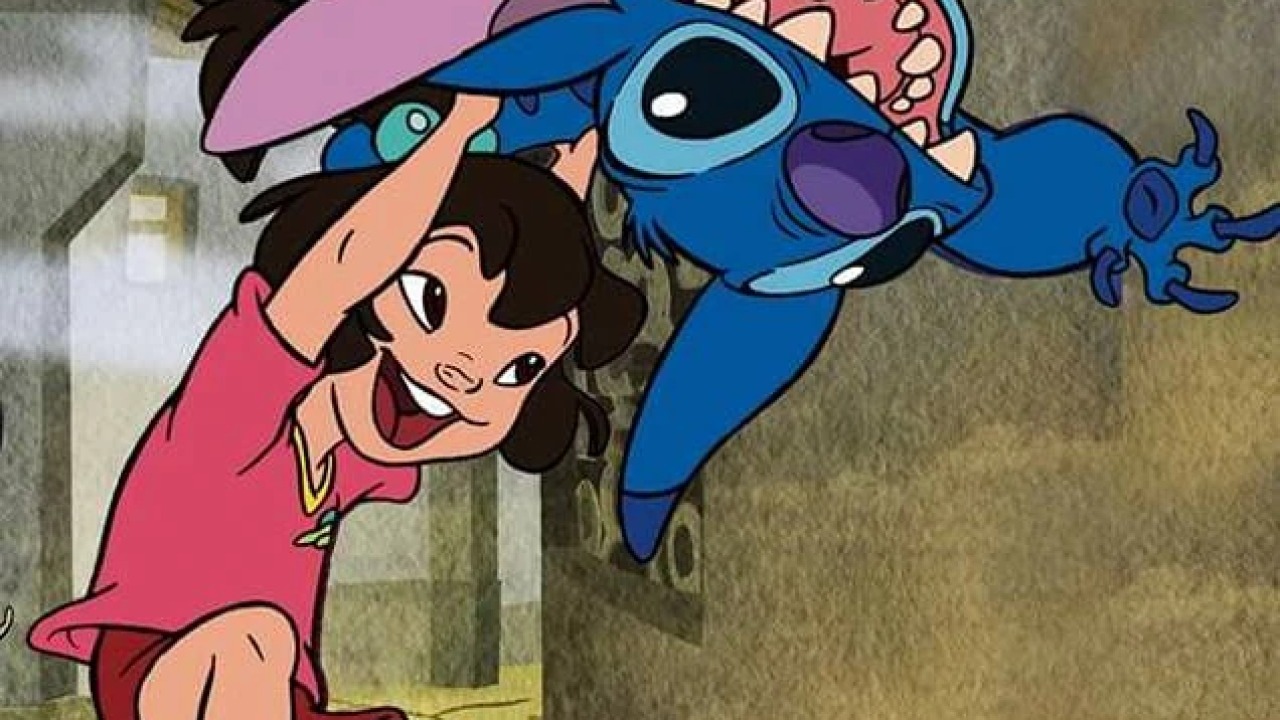
FULL SERIES REVIEW · 13 EPISODES · COMPLETE CHINESE BROADCAST ORDER · SPOILERS
Stitch & Ai Review: Another Home Should Not Mean Erasing the First One
A displaced alien and a girl fighting relocation recognize the same wound. The friendship works. The silence around Lilo does not. Both truths belong in the review.
The Stitch sequel most people never knew existed
Stitch & Ai begins with an almost rude amount of confidence. Stitch is kidnapped out of Hawaii, two alien factions immediately start arguing over who gets to weaponize him, and the escape drops him into the Huangshan mountains before the audience has time to ask what happened to Lilo. That opening creates the problem the entire series has to solve. A franchise built around one particular child and one particular alien has removed half of its emotional equation. Wang Ai Ling cannot be a replacement Lilo wearing different geography. She has to earn a relationship with Stitch while the memory of Lilo remains visible enough to make every new promise feel complicated. The show understands that pressure more often than its reputation suggests. Ai does not win Stitch by performing a familiar script. She wins him because she is stubborn about her home, furious when adults plan her future without her, and willing to protect a creature whose first instinct is still to run.
The series has thirteen episodes, which gives the story the shape of a sprint and the emotional appetite of something that expected more time. Villains arrive, local legends become living experiments, family tensions keep interrupting alien warfare, and an unfinished larger mythology hangs behind the finale. Some episodes feel packed enough for three separate cartoons. Others slow down for a village argument, a school humiliation, or one of Ai’s relatives quietly deciding what kind of life would be best for her. That unevenness is part of the experience. Stitch & Ai is trying to prove that the franchise can travel without turning China into a decorative postcard. The show succeeds whenever Huangshan affects the choices people make. The series becomes thinner whenever local culture works as a costume for an ordinary chase.
Western viewers got an especially strange version of this already strange branch. The original Chinese run included thirteen episodes in broadcast order. The former American DisneyNOW release carried twelve and omitted “The Phoenix,” leaving a cultural creature story and an important piece of the season’s rhythm outside the official United States route. That absence matters when judging the series. A short show already struggling to introduce a family, a setting, several villains, new experiments, and Stitch’s hidden programming cannot casually lose an episode without feeling even more abrupt. CVM Sekai follows the complete original run because regional availability should never be allowed to rewrite the production record.
My verdict is affectionate, irritated, and more serious than I expected. Stitch & Ai is not the clean continuation that people waiting for Lilo deserved, but it is also far more than a disposable localization. The series keeps asking whether home belongs to the person who loves you, the place that formed you, or the authority powerful enough to move you. Ai is threatened with relocation. Stitch is treated as portable military property. Both characters keep refusing other people’s definitions of a better destination. The writing does not resolve every contradiction, especially the missing bridge between Hawaii and China, but the central refusal has teeth. You can love the family who saved you and still form another bond. You can need protection and still deserve a voice in where you live. The show’s best episodes understand that those two claims belong together.
Ai Ling is fighting for a home before Stitch ever arrives
Ai’s first major conflict is painfully ordinary beside the spaceships. Her aunt Daiyu thinks life in the mountains is limiting and wants to bring Ai into the city. The argument is presented as concern, which makes the pressure harder to dismiss. Daiyu is not twirling a villain mustache while announcing that children should be miserable. She has an adult idea of opportunity and enough family authority to turn that idea into a decision. Ai experiences the same plan as an eviction from the world that contains her memories, routines, friendships, and sense of competence. The series gives her a loud personality, but the volume should not distract from the vulnerability underneath. She keeps asserting that Huangshan is home because the adults around her keep treating that answer as temporary childhood sentiment.
That conflict makes Ai a useful companion for Stitch. Lilo met an alien who believed destruction was his only purpose and taught him that family could be chosen. Ai meets the same alien after he has already learned the language of belonging, then catches him during another forced removal. Stitch understands captivity immediately. He understands people discussing a body as property. Ai understands the softer version, the family conversation where everybody insists the relocation is for her benefit while her own answer carries the least weight. Their situations are not equal, and the show wisely avoids pretending that they are. What connects them is the experience of being managed. They recognize the anger before they fully recognize each other.
Ai can be impulsive, jealous, proud, and spectacularly bad at explaining herself when embarrassed. Those flaws rescue her from becoming a cultural ambassador with perfect manners. “Teacher’s Pet” lets her competitiveness curdle into resentment. “Gotcha!” turns her need to prove herself into an escalating mess. “Tell the World” exposes how quickly attention can distort a private friendship. Her mistakes usually come from a recognizable fear that somebody else will take her place, dismiss her knowledge, or control the story. The episodes work when consequences reach beyond a lecture. Ai has to look at the person she hurt, sit inside the embarrassment, and choose whether being right still matters after trust has been damaged.
The character loses some specificity in action-heavy plots because the scripts often need her to point, shout, and keep pace with Stitch. Even then, her best quality survives. Ai refuses to admire power for its own sake. She likes Stitch because his chaos feels alive, funny, and loyal, but she will confront him when strength becomes carelessness. She also refuses the opposite trap. She does not require Stitch to become harmless before he deserves a home. That distinction carries the franchise’s original moral argument into a different household. Safety comes from relationship, accountability, and purpose. It does not come from sanding every dangerous edge off a person until adults feel comfortable.
Stitch arrives with a history the series cannot erase
The opening abduction creates immediate suspense and an emotional debt. Stitch was living with Lilo. The series knows viewers know that, shows enough of the separation to activate the memory, and then moves forward without giving Lilo meaningful space inside the thirteen-episode story. I do not think the problem is that Stitch forms another friendship. The franchise has always argued that family can expand. The problem is the missing emotional paperwork. Stitch does not spend enough time grieving, worrying about Lilo, or planning how to get back. A character whose deepest wound is abandonment should feel the rupture even while adapting. The show sometimes treats continuity like a door it needs to close quickly before the new adventure can begin.
Yet Stitch remains recognizably Stitch in the details. He tests limits. He performs innocence after causing a disaster. He uses physical comedy as both weapon and shield. He can read fear in another child faster than most adults, then create an entirely new emergency because patience is still not his gift. The animation occasionally stretches him into a broader television shape, but the emotional timing is familiar. A tiny pause before he chooses Ai over escape can carry more meaning than a speech. A smug expression after solving the wrong problem reminds us that goodness did not replace mischief. Love gave the mischief somewhere to return.
The Chinese experiments deepen his history by revealing another layer of Jumba’s work. Fenghuang, Qilin, Nian, and the other creatures draw on Chinese mythic forms while remaining connected to the genetic-experiment logic of the franchise. The idea could have become a cheap parade of recognizable symbols. Instead, the strongest creature stories use the legends to pressure Stitch’s identity. He is no longer the only impossible being whose body contains a purpose imposed by a creator. He meets beings associated with luck, protection, fear, renewal, and ritual, then has to decide whether power determines character. That question has followed him since Experiment 626 first landed on Kauai.
Episodes 12 and 13 push the issue into his body. Scratch and Yong activate a metamorphosis program that transforms Stitch into the kind of monster his enemies always claimed he was. The finale is messy, rushed, and emotionally effective because the threat is internal. Stitch is not merely fighting an enemy. He is losing control of the body Ai trusts. The story returns to the franchise’s oldest fear: what if affection cannot outrun programming? Ai’s answer is not a technical cure delivered from a safe distance. She stays close enough to insist that the person she knows is still present. The execution needs more room, but the choice lands. Family is tested when recognition becomes difficult, not when everybody is behaving beautifully.
A Chinese setting has to be more than scenery
Huangshan gives the series cliffs, mist, stone paths, old villages, and a visual silhouette instantly distinct from Hawaii or Okinawa. The backgrounds often do more than the scripts have time to explain. Mountains crowd the horizon. Built spaces feel shaped around slopes and narrow passages. Mist hides threats and makes ordinary travel feel mythic. When Ai argues that the mountains are her home, the art department supports her. The place has texture, inconvenience, beauty, and social memory. The series looks strongest when characters move through the environment instead of posing in front of a scenic location.
The danger comes whenever Chinese identity is compressed into dragons, festivals, masks, and wise elders without enough ordinary life between them. A franchise localization earns trust through breakfast tables, school grudges, family teasing, work, boredom, and the small rules everybody in the community already understands. Stitch & Ai includes several of those details, especially through Jiejie’s household and Ai’s conflicts with adults, but the thirteen-episode limit keeps pulling the story toward spectacle. “Dragon Parade” and “Nuo Opera” are useful examples. Both can open a door into cultural practice. Both also risk presenting culture as the exciting thing that happens when the plot needs a themed set piece.
“Nuo Opera” works best when the masks and ritual atmosphere are treated as part of a living community rather than an exotic mystery box. The episode’s former American title, “Creatures,” flattened the specific reference before viewers even pressed play. Naming matters because a title teaches an audience what to notice. “Creatures” tells us to look for monsters. “Nuo Opera” tells us that the performance tradition and its relationship to protection, spirits, and communal ritual belong in the frame. The local title does not automatically make the episode culturally profound, but it preserves the direction of attention.
The series should also be judged for what it does not explain. A child audience outside China may need context, while a Chinese audience does not need every familiar reference translated into a classroom speech. Good localization refuses both extremes. The story should not treat cultural specificity as a barrier, and it should not demand that every custom stop the plot for a glossary. Stitch & Ai sometimes finds that balance through action and family conversation. At other times, the pacing rushes past an idea that deserved another quiet scene. Those gaps are exactly why the branch needs lore guides around it. The episodes provide the encounter. Editorial coverage can provide the receipts without making the characters sound like tour guides.
The family argument is stronger than the alien conspiracy
Scratch, Yong, and the competing alien interests give the season a serial threat, but the villains rarely feel as emotionally dangerous as Daiyu’s relocation plan. A spaceship can be escaped. A relative who loves you and still refuses to hear you is harder to defeat because the relationship has to survive the argument. The show repeatedly returns to adults interpreting control as care. Ai’s resistance is dismissed as childish stubbornness, even when she understands her own community better than the people planning her future. That is the conflict I kept thinking about after the lasers stopped.
Jiejie provides the household with a steadier center. She is protective without becoming a saint, tired without becoming cruel, and practical enough to recognize that Stitch creates problems no ordinary family plan covers. Her relationship with Ai carries some of the emotional labor that Nani performed in the original film, although the circumstances and generational position differ. The comparison is unavoidable, but copying Nani would have weakened the new family. Jiejie’s authority comes through a different arrangement of age, responsibility, and community. The show could have given her more interior life. Even so, her presence keeps Ai’s story attached to human consequences when the alien plot tries to fly away.
Dahu gives the series an adult male figure whose value is not measured by command. He can be silly, confused, supportive, and useful without taking ownership of the household. Meiying and the wider community help establish that Ai belongs to a network rather than a sealed nuclear family. That network matters because relocation would change more than an address. It would interrupt the people who know her history, the places where her confidence makes sense, and the daily exchanges that produce belonging. The script does not always articulate the full cost, but the ensemble lets us see it.
Daiyu deserves better writing than simple obstruction. Her concern about Ai’s future is plausible. Rural and urban opportunity, education, work, and family obligation are serious pressures, and a richer season could have allowed two loving people to disagree without appointing one as the designated problem. The show occasionally lets her care show through, then snaps back to conflict because an episode needs momentum. I wanted more scenes where Ai had to acknowledge the fear inside Daiyu’s plan and Daiyu had to acknowledge the violence inside making that plan without Ai. That conversation would have made the finale’s family promises feel earned rather than merely declared.
Thirteen episodes are enough for a story and too few for this story
A compact season can be a blessing. There is little filler in Stitch & Ai, and even the lighter episodes usually advance a relationship or introduce a piece of the branch’s world. The problem is density. The show wants episodic creature adventures, a relocation drama, Stitch continuity, new genetic mythology, two alien factions, school comedy, family development, Chinese cultural material, and a transformation finale. Thirteen installments cannot give every thread the same patience. The result feels less like a complete limited series and more like the first half of a longer plan whose second half never arrived.
The early run moves through introductions quickly. “Hello – Goodbye” has to sever one home, establish a kidnapping, stage an escape, introduce Ai, establish Huangshan, and create the new bond. “Teacher’s Pet” and “Gotcha!” then carry the burden of making Ai’s everyday flaws visible before viewers mistake her for a plot device. By “The Scroll,” the show is already expanding its mythology. “Spirals,” “The Lock,” and “Dragon Parade” keep adding creatures and family complications. The pace can be fun, but emotional consequences sometimes disappear because another premise is waiting at the door.
The middle episodes reveal what a longer version could have been. “Tell the World” examines attention and ownership of a story. “The Phoenix” links renewal and cultural imagery to the show’s growing experiment mythology. “Dream On” uses interior desire rather than another chase as its engine. “Nuo Opera” places fear, performance, and communal practice in the same room. These episodes do not all land equally, but they widen the emotional vocabulary before the finale narrows everything into survival. With thirteen more episodes, the series could have returned to each idea and shown how Ai changed.
The ending confirms the production problem. “Brothers” and “Monstrosity” are one crisis split across two installments. Stitch’s transformation, Ai’s faith, the villains’ ambitions, and the family’s future all collide, then the season stops with enough unresolved material to make the absence of a continuation feel louder than a conventional cancellation. I can accept an open future. I struggle more with an emotional arc that reaches its biggest question and then rushes through the answer. The finale proves the branch deserved more room at the exact moment the branch runs out of it.
The animation carries beauty, strain, and several production histories at once
The visual identity of Stitch & Ai sits in an awkward but interesting place. Stitch has to remain recognizable across a new production pipeline, while the human cast and landscape need enough distinction to prevent the series from looking like recycled Hawaiian television assets. The backgrounds often win that negotiation. Huangshan’s stone, mist, roofs, cliffs, and vegetation create a coherent physical world. Character animation varies more. Some scenes have lively poses and expressive timing. Others flatten movement or hold a face longer than the emotion can support.
Ai’s design communicates energy immediately. Her silhouette, hair, and bright clothing read cleanly against muted village backgrounds, and her movement often leads with the whole body. She does not merely stand beside Stitch while he performs. She lunges into plans, recoils from embarrassment, and occupies space with the confidence of a child who knows every path in her environment. The show occasionally overuses broad expressions, but restraint would have been the wrong correction. Ai needs enough visual force to share a frame with one of animation’s most aggressively readable creatures.
The new experiments are where design ambition becomes most visible. Chinese legendary creatures offer rich shapes, symbolic associations, and expectations. The series translates those references into the franchise language of numbered or engineered beings with specialized abilities. The best designs preserve a recognizable cultural silhouette without feeling copied from a museum label. The weaker designs lean on a familiar creature outline and let dialogue carry the difference. Either way, their presence changes what a Stitch experiment can look like. Jumba’s laboratory is no longer the only visual grammar in the room.
Production collaboration is visible in both strengths and seams. The series was made through Chinese companies in association with Disney, with additional animation work spread across studios. That history does not excuse weak frames, and it does make the finished object more interesting than a simple foreign dub of an American show. This branch was built for a Chinese broadcast context, then carried into other markets through a fragmented release. Every rough transition sits beside the fact that artists were negotiating a global character, local setting, television schedule, and corporate franchise identity at once. The review has to hold craft accountable without pretending those conditions were invisible.
What the series understands about children and authority
Children in this franchise are often treated as problems to be managed until an adult finally notices the system around them is failing. Lilo’s grief was read as bad behavior. Ai’s attachment to Huangshan is read as resistance to opportunity. The details differ, but the institutional reflex is familiar. Adults describe a child from the outside, create a plan, and then measure cooperation as proof that the plan is correct. Stitch & Ai becomes sharp whenever Ai refuses that evaluation without becoming magically articulate about her own pain.
Ai’s messiness matters. A perfectly reasonable child would let viewers agree with her too easily. She lies, competes, jumps to conclusions, and can be selfish when frightened. Those choices give adults evidence for dismissing her, which is how the trap usually works. A child reacts badly to losing control, then the reaction is used to justify removing more control. The show does not phrase the cycle in policy language. It stages the cycle through arguments, escapes, broken trust, and a small blue alien who responds to confinement with even less subtlety.
Stitch changes the balance because adults cannot pretend he is powerless. He can break a wall, outrun a vehicle, and turn surveillance into slapstick. His protection gives Ai physical room to resist, but the series does not claim force solves the underlying family decision. Ai still needs to be heard as a person rather than defended as property. Stitch’s presence makes the hidden coercion visible. When a kidnapping spaceship and a family relocation plan occupy the same season, viewers are invited to notice how often authority uses benevolent language while deciding where somebody else belongs.
The series also recognizes that children can misuse power. Ai sometimes treats Stitch as proof of her own importance, expects loyalty without explanation, or allows jealousy to guide a decision. Their friendship works because neither character remains an innocent mascot for the other. Stitch can refuse her. Ai can call him back. Repair requires embarrassment, apology, and changed behavior. The lessons are rarely subtle, but the relationship is reciprocal enough to keep the moral from becoming a lecture delivered by the human child to the alien pet.
The first three episodes build the friendship through friction
“Hello – Goodbye” has the thankless job of making separation and arrival happen in the same breath. Stitch’s capture confirms that his body is still valuable to anybody interested in engineered power. His escape restores agency, but the landing in Huangshan replaces one vulnerability with another. He is injured, displaced, and unable to know whether the first human who approaches will offer shelter or another cage. Ai’s decision to help is immediate enough to feel impulsive and specific enough to feel earned. She recognizes a fugitive before she recognizes an alien. Their first bond is less a sweet introduction than an agreement between two creatures who hate being told where they belong.
The episode title carries more emotional accuracy than the plot can fully process. Hello and goodbye happen together. Ai says hello to a friendship she did not know she needed while Stitch’s relationship with Hawaii is pushed into a goodbye the series refuses to complete. That unresolved tension keeps surfacing under the comedy. Every time Stitch relaxes into the Wang household, the viewer who remembers Lilo has to hold two truths. The new affection is real. The missing conversation is also real. A stronger premiere would have let him attempt contact, fail, and consciously choose temporary safety rather than letting momentum make the choice for him.
“Teacher’s Pet” moves from cosmic displacement to school embarrassment, which is exactly the kind of scale change the franchise needs. Ai’s jealousy is petty, recognizable, and connected to her fear of being replaceable. A child who has recently discovered that adults can move her life without consent becomes especially sensitive to losing status in the spaces she still controls. The episode lets that sensitivity make her unfair. Stitch cannot solve the problem by attacking a villain because the villain is a story Ai is telling herself about attention. Her repair has to involve humility rather than force.
“Gotcha!” turns competition into performance. Ai wants proof that she understands Stitch, understands danger, and belongs at the center of the adventure. The escalating pursuit reveals how badly she can confuse courage with control. The episode is funny because plans keep collapsing, but the comedy also establishes a useful boundary. Ai is not Lilo with a new name, and Stitch cannot recreate an old partnership by assigning her the same role. They have to learn each other’s limits. Friendship becomes believable through misread signals, annoyed pauses, and the decision to return after both characters have made the day worse.
The Scroll, Spirals, and The Lock open the mythology
“The Scroll” begins expanding the series beyond an alien chase in a Chinese location. A scroll can hold history, instruction, authority, art, or a claim somebody wants to control. The episode uses that object to connect the local world with the experiment plot, although the connection moves faster than the cultural material deserves. What interests me is the argument underneath the adventure. Knowledge is treated as something people can inherit, steal, misread, and weaponize. Stitch’s strength is useful, but strength cannot tell him what an object means. Ai’s local knowledge becomes operational rather than decorative.
The episode also exposes one of the branch’s recurring production compromises. An object associated with cultural memory is easy visual shorthand for “ancient secret.” That shorthand can reduce a living tradition to a clue in somebody else’s scavenger hunt. The script partially avoids the trap by keeping Ai and her community attached to the meaning, yet the pace leaves little room for disagreement over who owns the story. A longer season could have made the scroll matter again after the chase, perhaps through Jiejie or a village elder explaining why preservation is more complicated than keeping an artifact away from villains.
“Spirals” is visually playful and more psychologically interesting than the title suggests. Spirals imply repetition, loss of orientation, and motion that returns near its starting point without truly arriving. That pattern describes Stitch’s franchise life. He keeps finding family, being removed, and proving his loyalty again. The episode’s creature action gives the animators room for circular movement, while the emotional pattern asks whether another rescue can actually break the cycle. Ai believes an immediate victory means safety. Stitch has lived long enough to know that somebody else will eventually want the weapon inside him.
“The Lock” makes containment literal. Locks protect, imprison, hide, and announce that someone has authority over access. In a season where Ai’s future and Stitch’s body are both being negotiated by other people, the object becomes an unusually tidy symbol. The episode does not squeeze every implication out of the premise, but the placement is smart. By this point, Ai and Stitch have enough trust to face a barrier together, and not enough maturity to agree on which barriers should remain closed. Curiosity is part of their bond. So is the damage caused when curiosity refuses context.
Dragon Parade treats spectacle as both invitation and risk
“Dragon Parade” is the episode most likely to become a promotional clip because the ingredients are immediate: movement, color, a recognizable creature form, and Stitch inserted into public celebration. The parade gives Huangshan social density. People gather, perform, watch, and recognize one another. Ai is not exploring an empty heritage site built for her adventure. She is moving inside a community event whose meaning exceeds her individual crisis. That crowded frame helps the setting feel inhabited.
The dragon image carries a difficult translation burden. Western family animation has often used a single generic “Chinese dragon” as a visual shortcut for an entire civilization. Chinese dragon traditions are diverse, regionally shaped, and connected to ideas that cannot be collapsed into a Western monster category. The episode is more fun than a lecture, as it should be, but the surrounding editorial needs to clarify what the show compresses. A parade dragon, a legendary long, and a genetic experiment inspired by dragon imagery are related signs, not interchangeable objects.
Stitch fits the parade because he has always been a creature whose public interpretation changes with framing. Seen from the wrong angle, he is a monster. Introduced as a dog, he becomes an odd pet. Named as family, he becomes a cousin. Placed inside a parade, his disruptive movement can read as celebration until the consequences arrive. The episode uses comedy to show how communities negotiate unfamiliar bodies. People decide whether chaos belongs by interpreting intention, context, and who is willing to claim responsibility afterward.
The date clue associated with this episode also helps situate the branch close to its production era rather than in a vague franchise present. That detail complicates attempts to force every Stitch series into a perfectly straight timeline. Stitch & Ai acknowledges the earlier Hawaiian continuity, yet the emotional and chronological bridge toward the Japanese anime remains unstable. I prefer treating the branch as canon that contains unresolved connective tissue rather than inventing an off-screen explanation and pretending the contradiction disappeared.
Tell the World understands the danger of making friendship into content
“Tell the World” feels unexpectedly current because Ai discovers that sharing a remarkable friend can become a form of ownership. Attention promises validation. If everybody sees Stitch, then everybody sees that Ai’s life matters. The problem is that Stitch becomes the evidence in her argument. His privacy, safety, and control over his own story become secondary to the pleasure of being believed. The episode turns a familiar children’s lesson about bragging into a sharper question about who gets to publish another person’s difference.
Stitch has spent most of his life being described by institutions. Experiment 626 is a file name and a sentence. The Galactic Federation records his offenses. Jumba knows his specifications. Lilo gives him a name and a family story that he can inhabit rather than endure. Ai’s urge to broadcast him accidentally returns him to the condition of being observed before being understood. She does not intend to betray him. Intent does not erase exposure. That is the episode’s strongest moral pressure.
The series aired before children’s media fully absorbed the language of viral content, but the dynamic is already present. A private encounter becomes proof, proof becomes attention, and attention attracts people whose motives are impossible to control. Ai learns that visibility can produce danger faster than solidarity. The lesson has grown more relevant as every unusual moment can be filmed, clipped, captioned, and distributed before the person inside the moment agrees. Stitch’s fictional alien status makes the risk comic. The structure is painfully human.
The repair works because Ai has to value the relationship after losing the status it could provide. She cannot protect Stitch and continue treating him as a secret trophy. She has to choose the boring, invisible work of trust. That choice connects directly to the show’s release history. Stitch & Ai itself became difficult to see outside parts of Asia, and Western franchise conversation often ignored it. Visibility would help the series. Careless circulation, incomplete orders, and context-free clips can still distort what viewers think they saw. Being available and being understood are separate victories.
The Phoenix episode should never have vanished from the American order
“The Phoenix” occupies a strange position in the franchise because the complete Chinese run includes it and the former United States DisneyNOW release did not. The omission was not a harmless numbering inconvenience. A thirteen-episode season lost one thirteenth of its body, and the missing installment carries one of the clearest Chinese mythic references in the branch. American viewers were offered a version of the Chinese series with part of its Chinese cultural architecture removed. Even if the reason was scheduling or delivery rather than editorial discomfort, the effect deserves scrutiny.
The fenghuang is often labeled a “Chinese phoenix” for convenience, but the translation imports assumptions from a different mythic tradition. Rebirth through fire is the dominant Western phoenix association. Fenghuang traditions involve sovereignty, harmony, virtue, auspicious order, gendered symbolism that shifted across periods, and relationships with other cosmological creatures. The episode cannot carry that entire history, and viewers should resist treating its animated experiment as an encyclopedia entry. The design is an adaptation inside a franchise mythology.
What the episode contributes to the season is an idea of renewal that cannot be separated from conduct. Stitch’s story has always been about a created destroyer becoming capable of care. Ai’s story is about a child learning that resistance without reflection can reproduce the control she hates. A fenghuang-inspired being places transformation inside a broader symbolic field. Change is not a personality makeover performed for approval. Change affects the order of relationships. The person who returns from a crisis has obligations to the people who survived the old version.
Removing the episode also damages the season’s progression toward Stitch’s forced metamorphosis. “The Phoenix” lets viewers consider transformation through a creature associated with renewal before “Brothers” and “Monstrosity” turn transformation into bodily terror. One change can be auspicious, chosen, or restorative. Another can be triggered by enemies who want to extract power. The contrast adds meaning to the finale. Without Episode 9, the transformation theme appears more suddenly and the local mythic sequence becomes thinner.
Dream On gives desire enough room to embarrass everybody
“Dream On” slows the series by moving danger into desire. Dreams are useful in children’s animation because they remove the social filters characters use while awake. A child who insists she is fearless can reveal the fear without choosing a confession. A creature built to destroy can imagine safety without having to explain why he wants it. The episode uses that permission to expose what Ai and Stitch cannot comfortably request from each other or their family.
Ai’s central desire is not simply adventure. Adventure is the language she uses when staying still would make her confront uncertainty. She wants her home to remain recognizable, her family to respect her knowledge, and Stitch to choose her without requiring her to become somebody else. Those wants can become possessive. She risks measuring Stitch’s loyalty through his willingness to center her. The dream logic allows the show to exaggerate that impulse until the insecurity becomes visible.
Stitch’s desire remains tied to family across locations. The series could have used the dream premise to address Lilo more directly, and the failure to do so is one of the episode’s missed opportunities. A dream can hold contradictory homes without requiring a continuity lecture. Hawaii and Huangshan could have occupied the same emotional space, showing that Stitch’s affection for Ai does not erase his history. The absence feels deliberate enough to notice and unexplained enough to frustrate.
Even with that gap, the episode matters because it interrupts the creature-of-the-week rhythm. Nobody can punch a wish into becoming honest. The characters have to wake up carrying knowledge they did not intend to reveal. That is a richer consequence than another captured villain. The series needed more episodes built around interior conflict, especially for Jiejie and Daiyu, whose choices shape Ai’s world while their private fears remain mostly inferred.
Nuo Opera asks whether fear can be performed safely
“Nuo Opera” brings masks, ritual performance, protective traditions, and animated danger into the same episode. The material is visually irresistible, which creates a responsibility problem. A mask can become spooky decoration for viewers who have never encountered the cultural practice around it. The episode’s local title helps keep the performance tradition visible. The former DisneyNOW label “Creatures” did the opposite, reducing a specific form into a generic monster promise.
Nuo traditions vary by region and community, and no single cartoon episode can stand in for them. Broadly, performances have been connected to exorcistic ritual, protection, seasonal observance, ancestral memory, and theatrical practice. Masks do not merely hide a performer. They can mark a role whose authority comes from the ritual frame. When a franchise about genetic creatures enters that space, the story needs to distinguish a being, a symbol, and a performed presence. The episode sometimes blurs those categories for speed.
The blur also produces an interesting question. Stitch is constantly mistaken for the role assigned to his appearance. Monster, pet, weapon, cousin, and mascot are frames other people place around the same body. Nuo performance makes the relationship between face and role impossible to ignore. A mask can permit transformation without claiming the wearer has disappeared. The finale will soon ask whether Stitch remains himself when his body becomes monstrous. “Nuo Opera” quietly prepares that argument through performance.
I wanted the episode to spend longer with the people who sustain the tradition. Cultural practice becomes emotionally legible through practitioners, preparation, rules, and disagreement. A brief adventure can show spectacle. A deeper story shows labor. Who makes the masks? Who teaches the movements? Who decides when performance becomes disrespect? Ai knows the community, which gives the script a route into those questions. The production schedule rarely lets her walk far enough down it.
Brothers and Monstrosity turn programming into body horror
“Brothers” introduces Scratch and Yong, two antagonists whose relationship offers a dark reflection of the season’s family language. Brotherhood can describe care, rivalry, obligation, shared origin, or a hierarchy enforced through fear. The episode refuses the comforting assumption that belonging automatically makes people good to one another. A family word can shelter violence as easily as affection when nobody is allowed to challenge the person with power.
Their attack activates Stitch’s metamorphosis program, changing the finale from an external rescue into an identity emergency. The visual transformation is frightening because Stitch has spent the franchise learning that he is more than his design. Hidden programming suggests the creator’s intention can still seize the body after years of chosen behavior. Every act of care becomes vulnerable to a switch somebody else knows how to press. The horror is especially sharp for a character whose earliest history was written as a technical specification.
“Monstrosity” continues without an emotional reset. Ai has to recognize Stitch while his familiar appearance and behavior collapse. Her loyalty is important, but loyalty alone should not become a magical command that solves involuntary transformation. The episode works when her presence creates a route back rather than a cure delivered by affection. Love can help a person remember relationships, accept help, and resist isolation. Love cannot make every biological or psychological crisis disappear because the script needs a hug.
The two-part ending rushes its aftermath. Stitch’s body has been violated, Ai has watched a friend become dangerous, and the household has survived a conflict tied to powers they barely understand. A complete season would give them an episode after the battle. Trauma needs a morning after. Is Stitch afraid to sleep? Does Ai become overprotective? Does Jiejie reconsider whether sheltering him endangers the family? Does Stitch finally speak about Lilo after nearly losing himself? The absence of those scenes leaves the emotional bill unpaid.
The villains keep confusing creation with ownership
The alien factions pursue Stitch because they see engineered potential. Their language may differ, but the claim is familiar: somebody made this body, somebody understands the mechanism, therefore somebody has the right to use it. The franchise has rejected that logic since the original film. Jumba created Stitch and still had to learn that creation does not equal moral ownership. The Galactic Federation could imprison him and still failed to understand the person forming inside the experiment.
Stitch & Ai extends the argument through hidden programs and Chinese-inspired experiments. A body can contain a purpose assigned before consent. The existence of that purpose does not settle what the person owes the creator. Stitch’s destructive capacity remains real. The series never needs to deny his design in order to defend his freedom. He becomes ethically interesting because he can acknowledge capacity and choose how to use it.
Scratch and Yong are less memorable as personalities than as agents of extraction. They want access to power without relationship, history, or responsibility. That makes them effective thematic villains and sometimes thin dramatic ones. A richer story would explain how each brother understands loyalty. Does one believe obedience is love? Does the other resent being treated as an instrument? Their shared label creates possibilities the finale only sketches.
The human relocation conflict echoes the ownership theme at lower volume. Daiyu does not view Ai as a weapon, and the emotional harm still comes from deciding that authority grants control over another person’s future. The series is strongest when those plots illuminate one another without pretending they are identical. Consent can be violated through a kidnapping beam or a family decision made in a calm room. Scale changes. The need to recognize personhood does not.
Sound, voices, and the problem of hearing one production through another
The series exists across Mandarin and English performances, which means many viewers meet a localized voice track before they understand where the production began. Voice direction changes rhythm. A pause that reads as hesitation in one track can become empty space in another. A joke built around speed, address, or social register can arrive as a simpler line. Reviewing the branch requires acknowledging that “the performance” is not one stable object available to every audience.
Ai needs a voice that can move from confidence to panic without turning every emotion into the same shout. Her strongest scenes depend on the crack between the front she presents and the fear she is hiding. Stitch creates a different challenge. His vocal identity is globally familiar, highly stylized, and tied to a specific balance of alien language, physical sound, comic timing, and sudden tenderness. A replacement performance can reproduce the surface and miss the emotional weight inside a small noise.
Music does much of the location work that dialogue cannot. Instrument choices, melodic gestures, and rhythmic cues can create atmosphere quickly, but they can also slide into a generic idea of “China” assembled for outside ears. Stephen James Taylor’s scoring participates in a franchise tradition where musical identity helps Stitch travel between tones. The best cues support landscape and tension without announcing cultural authenticity as a special effect. The weaker moments underline an image viewers already understand.
The soundscape deserves credit whenever Huangshan feels inhabited rather than painted. Footsteps on stone, village activity, wind, performance noise, and environmental space keep the setting from becoming a silent backdrop behind character dialogue. Television mixing can compress those textures, especially across platform transfers. That makes local preservation and accurate release information part of criticism. A missing episode is obvious. A flattened audio track can erase location more quietly.
Continuity is messy because family does not behave like a timeline chart
Fans naturally ask where Stitch & Ai belongs. The series references the Hawaiian continuity and places Stitch’s new life after the earlier adventures, while its relationship to the Japanese Stitch! anime remains difficult to reconcile cleanly. Dates, character ages, separation explanations, and emotional behavior refuse to form one perfect line. The temptation is to invent an answer with enough confidence that the uncertainty disappears. I would rather keep the contradiction visible.
Canon is often treated as a courtroom verdict when it is also a record of production decisions. Different teams inherit a character, different markets shape the premise, and corporate owners prefer recognizable continuity without always funding the connective scenes continuity requires. A story can be officially part of a franchise and emotionally incompatible with another branch. That does not make every interpretation equally supported. It means the evidence includes seams.
My working reading places Stitch & Ai after the Hawaiian series and acknowledges that the later transition to the Japanese anime remains underexplained. I do not accept the idea that Stitch’s bond with Ai proves he forgot Lilo, nor do I accept that caring about Lilo makes every later family false. The franchise’s own word is ohana, and the original claim was that family does not leave people behind. Expansion should be possible. Silence about the people left off screen is still a storytelling failure.
The mess can become productive fandom material when the goal is interpretation rather than correction. Why does Stitch adapt so quickly? Is survival teaching him to attach before he can grieve? Does each branch represent a different answer to the portability of a global character? What changes when a franchise about Hawaiian family is localized into Chinese and Japanese settings? Those questions are more valuable than a fabricated month-by-month chronology pretending the scripts supplied facts they did not.
Easter eggs, returning DNA, and the details worth watching twice
The most important returning element is Stitch’s behavior rather than a hidden logo. Watch how often he scans an exit before settling into a room. Watch the delay between hearing a command and deciding whether the speaker has earned obedience. Watch the way food, physical affection, and comic performance become tools for testing safety. Those habits connect the Chinese branch to the original character more convincingly than a repeated catchphrase.
Jumba and Pleakley carry franchise memory whenever they appear or are invoked, but the new experiment mythology is the larger inheritance. The series takes the old “cousins” structure and asks what happens when design language enters a different cultural field. Fenghuang, Qilin, Nian, Mo, and other inspired beings are not numbered reruns wearing themed accessories. Their shapes and abilities create new arguments about luck, fear, renewal, and the boundary between legend and laboratory.
Background details reward attention because Huangshan is doing narrative work. Paths, roofs, walls, domestic spaces, festival preparation, and mountain weather establish what Ai would lose if relocation were treated as a simple upgrade. The setting is beautiful, and beauty is not the whole case. Familiarity matters. Ai knows how people move through the place. She knows which adults will interfere and which route can hide a blue alien. Home appears as accumulated competence.
The title cards deserve attention too. They preserve the series’ local visual identity and provide a cleaner record than the fragmented American availability once did. CVM Sekai therefore uses the official local title-card image for each episode React, featured image, hero, and directory card. Consistency is not decorative housekeeping. The image lets readers recognize the same episode across every part of the site, and the local art prevents an American platform omission from becoming the visual history of the whole production.
What I would keep, what I would rewrite, and why the branch matters
I would keep Huangshan, Ai’s refusal to relocate quietly, the Wang household, the culturally inspired experiments, and the decision to make Stitch’s body the final battleground. I would keep the messier version of Ai rather than sanding her into a polite guide for international viewers. I would keep the short season’s willingness to move from school jealousy to ritual performance to biological horror. The branch has an identity because those elements collide.
I would rewrite the transition from Lilo with much more care. One message, one failed rescue attempt, or one dream acknowledging Hawaii would change the emotional contract. I would give Daiyu a full episode from her perspective without making Ai’s resistance disappear. I would let Jiejie carry a plot whose stakes were not borrowed from Ai. I would slow the finale enough to show recovery. Most of all, I would order another season so the creature mythology and family argument could develop consequences instead of ending at maximum pressure.
The branch matters because global franchises reveal their values when they travel. Moving Stitch to China could have produced a mascot pasted onto scenery. At its best, the series makes geography affect family, authority, myth, movement, and the meaning of home. At its weakest, it rushes cultural specificity into a chase and expects recognition to substitute for depth. Both results deserve preservation because criticism needs the complete object, including the episode a former American release left behind.
I finished the season wanting more and wanting better, which is different from wanting the experiment erased. Stitch & Ai earns its place through an emotionally credible friendship, a child whose anger contains a real political question about who controls her future, and a setting that changes the franchise’s visual and mythic vocabulary. The series does not replace Lilo. Ai should never have been asked to. She proves something harder: another child can love Stitch without becoming a copy, and Stitch can build another home without making the first one disposable.
Final verdict: a beautiful unfinished argument about who gets to choose home
As a complete television season, Stitch & Ai is rushed, uneven, and visibly unfinished. As a franchise branch, it is brave enough to create new emotional and cultural problems instead of repeating the Hawaiian episode formula with altered backgrounds. The relocation conflict gives Ai a reason to understand Stitch that belongs to her own life. The experiment mythology lets Chinese legendary forms change what the franchise can imagine. The finale turns imposed purpose into a bodily threat. Those choices carry weight.
The weakest decision remains the emotional silence around Lilo. A series can expand family without staging a competition between children, but the script has to acknowledge the existing bond. Avoiding the conversation protects the new premise for a few episodes and damages Stitch’s continuity for the entire season. Viewers who feel betrayed are responding to something real. Viewers who love Ai are also responding to something real. The franchise created the false choice by refusing to put both relationships in the same emotional frame.
My rating lives in that contradiction. The season is better than its obscurity, more thoughtful than its abrupt premise, and less complete than its biggest ideas deserve. I recommend watching all thirteen episodes in original Chinese broadcast order, including “The Phoenix,” and treating Episodes 12 and 13 as one finale. Skipping the omitted episode reproduces a platform accident. Watching the final pair separately breaks the transformation story in half.
The last feeling is frustration with affection still inside it. Ai and Stitch belong together because both are fighting people who confuse authority with the right to choose somebody else’s destination. Huangshan belongs in the franchise because home should have texture beyond one island and one production market. Lilo still belongs in Stitch’s emotional life because expansion is not erasure. The series never balances all three claims cleanly. It gives us enough evidence to insist that a future continuation should try.
The release history became part of the criticism
A television series does not stop changing when production ends. Platforms rename episodes, alter order, omit installments, swap artwork, compress audio, and eventually remove the whole thing. Those decisions shape memory. A person who encountered Stitch & Ai through the former United States DisneyNOW release could reasonably believe the series contained twelve episodes because the official interface presented twelve. A person seeing scattered clips might assume the production was an unlicensed imitation because the Chinese branch was barely explained in Western franchise marketing. Distribution created confusion and then left fans to repair the record.
The absence of a stable complete legal route in the United States makes careful documentation more important and viewing advice more delicate. I will not pretend an unavailable platform still carries the series. I will not point readers toward an unauthorized upload because convenience does not turn somebody else’s work into public property. The episode guide records what exists, preserves original order, and distinguishes historical availability from current access. That is less exciting than a bright “watch now” button, but honest service information is part of respecting an audience.
Episode 9 shows how an omission can distort interpretation. “The Phoenix” is not a bonus short or production fragment. It is a regular episode inside the original thirteen-part run. Removing it changes the sequence of mythic creatures, shortens Ai and Stitch’s development, and weakens the transformation motif before the finale. Calling the American set “complete enough” would make the regional release more authoritative than the production. The archive should work in the other direction.
The release problem also explains why this review spends time on titles, images, and broadcast order. Those details can look like metadata until they disagree. Then metadata becomes the map readers need to identify the work. The local official title cards used across CVM Sekai are not substitutes for legal viewing. They are visual citations that keep each React attached to the correct episode. The directory is not a streaming mirror. It is a criticism and preservation layer built around a branch the distributor allowed to become difficult to recognize.
Localization can move a character without making culture interchangeable
Stitch is unusually portable because his core conflict is legible across languages: a created being wants to choose what his life means. Portability can tempt a franchise into treating every location as a replaceable theme. Put Stitch beside a landmark, give him a new child, add local creatures, and the product appears finished. Stitch & Ai sometimes approaches that formula and often pushes against it. Ai’s relocation conflict ties the premise to a specific argument about home, opportunity, family authority, and rural belonging. Huangshan affects why she needs Stitch rather than merely where she finds him.
The distinction between localization and replacement becomes crucial around Lilo. Localizing a premise for a Chinese production does not require declaring the Hawaiian child emotionally obsolete. The story could preserve the original relationship while building a new one, but doing so requires time and uncomfortable dialogue. Corporate storytelling often avoids that discomfort because a clean entry point is easier to market. The result asks viewers to perform emotional deletion on the franchise’s behalf.
Ai also should not carry the burden of representing Chinese girlhood as a whole. She is one loud, impulsive child in one stylized family and setting. Her errors belong to her characterization, not to a national lesson. The series is healthiest when other girls and women complicate the frame. Jiejie, Daiyu, Meiying, and the wider community create competing ideas about responsibility, mobility, respect, and care. More screen time for those differences would have protected Ai from becoming the only answer the show can offer.
Cultural exchange becomes meaningful when specificity survives the trip. Viewers outside China do not need every reference converted into the nearest Western myth. Viewers inside China should not have to watch familiar material flattened for export. The branch’s strongest choices leave names, practices, places, and family dynamics intact enough to invite further learning. Its weakest choices rely on generalized visual signs and assume recognition equals understanding. The work is worth discussing because both tendencies exist in the same thirteen episodes.
Why Ai is allowed to be difficult
A fandom can be unforgiving toward the child who arrives after a beloved child. Ai enters a story where Lilo already established the emotional grammar, then receives scripts that do not give her the courtesy of a proper handoff. Every selfish choice risks being read as proof that she is an inferior replacement. Every similarity risks being called imitation. Every difference risks being called betrayal. The production created that comparison trap, and the character still deserves to be judged for what she actually does.
Ai is difficult because her life is being discussed around her. Anger gives her a way to remain present in conversations designed to conclude without her consent. That does not make every outburst wise or every scheme defensible. It makes the behavior legible. The show earns more trust when consequences address the harm she caused without teaching her that obedience was the missing virtue. A child can owe an apology and still be right that adults ignored her.
Her friendship with Stitch makes room for mutual correction. She does not rescue him once and become morally superior forever. Stitch exposes her vanity, jealousy, and need for control. Ai exposes the fear behind his aggression and refuses to let past heroism excuse present damage. They annoy each other because the bond has enough weight to survive annoyance. A perfectly soothing relationship would feel manufactured. Their friction produces the evidence that both characters are choosing to stay.
The final case for Ai is simple. She knows the mountains as a life rather than a backdrop. She loves her family while resisting their decisions. She wants attention and learns that attention can endanger the person who made her feel visible. She looks at Stitch during his worst transformation and addresses the person inside the frightening body. None of that requires her to replace Lilo. Ai’s success should expand the franchise’s capacity for family. The unresolved sadness belongs to the writers who refused to let the two bonds acknowledge each other.
Keep exploring
Return to the Stitch & Ai hub, open the complete episode directory, or return to the full Lilo & Stitch franchise.
The branch cannot call relocation a fresh start and skip the grief
Stitch & Ai works best when it admits that another home does not arrive on a blank page. Stitch has already been named, adopted, forgiven, corrected, loved, and placed inside a family history. Moving him to Huangshan can create new obligations and affection without deleting Hawaiʻi, Lilo, Nani, or the experiment cousins. The emotional problem is not whether Ai Ling deserves him. She does. The problem is whether the franchise thinks one child must disappear before another child can matter.
A continuation should let Stitch carry memory as part of his character instead of treating recognition as inconvenient continuity. He can miss Lilo while choosing to protect Ai. He can love two homes and resent the circumstances that separated him from one of them. Children understand divided attachment better than executives sometimes do. The story becomes larger when love accumulates. It becomes cruel when a new market requires an old relationship to be quietly buried.
Ai Ling is not a replacement part
Ai Ling enters with her own family crisis, stubbornness, intelligence, and fear of being moved without consent. Those traits deserve attention independent of any resemblance to Lilo. Reducing her to the next girl assigned to Stitch repeats the same ownership logic the series criticizes when villains treat experiments as transferable property. Ai is not a slot in a franchise machine. She is a child negotiating adults who keep presenting relocation as opportunity while refusing to hear what she would lose.
Her strongest scenes happen when she interrupts plans made around her. She searches, argues, follows evidence, and insists that affection does not erase the right to information. Stitch recognizes that refusal because his own life began with authorities defining his purpose. Their bond has meaning when it grows from shared resistance to being managed, not when the script asks viewers to forget every earlier relationship so the new pair can look exclusive.
The Chinese setting needs more than beautiful mountains
Huangshan gives the series mist, stone, pine, villages, tourism, and a visual identity far removed from Kauaʻi or Izayoi Island. Scenery alone is not cultural context. A branch set in China needs people whose routines, language, family structures, local stories, labor, and disagreements shape the plot. Otherwise the mountains become an export background, impressive enough for a trailer and too passive to challenge anybody.
The episodes become more specific when landscape affects movement, risk, tourism, family business, and the stories characters tell about creatures. The production also needs humility about what it combines. Chinese legendary beings are not experiments in different costumes. Science fiction can meet folklore, but the writing should name where the traditions differ and let local knowledge do more than decorate Jumba’s explanation.
Scratch proves personhood cannot depend on good behavior
Scratch is designed through manipulation, false kinship, and a program meant to break Stitch. That origin does not make every later action inevitable. Created people remain accountable, but accountability is different from declaring them defective property. The finale becomes morally interesting when Scratch begins noticing the gap between the role assigned to him and the relationships forming around him. A conscience does not arrive as a factory setting. It develops through evidence, attachment, fear, and choice.
Stitch should recognize more of himself in that conflict. He was also introduced to the world as a weapon whose destructive behavior supposedly proved the creator’s description correct. Lilo offered boundaries and belonging without pretending the damage did not matter. Scratch deserves the same difficult possibility. Rehabilitation should include repair, protection from the people who programmed him, and room to choose an identity that is not limited to brother, rival, monster, or failed prototype.
The release history is part of the review
Stitch & Ai reached different audiences through an uneven chain of Chinese broadcast, regional dubbing, DisneyNOW availability, omissions, and later scarcity. That history changes how the series is discussed because many English-speaking viewers encountered twelve episodes without the ninth, while summaries and unofficial episode orders kept circulating as if the gap were intentional. A review needs to preserve the thirteen-episode production record instead of treating the easiest regional catalog as universal truth.
Availability also shapes reputation. A show that is difficult to watch legally becomes vulnerable to screenshots without context, incomplete dubs, and secondhand claims repeated until they look official. That does not excuse weak writing, but it does require clean receipts. Titles, broadcast order, local title cards, and the two-part finale belong in the criticism because a viewer cannot evaluate continuity honestly when the platform itself has rearranged or omitted the evidence.