
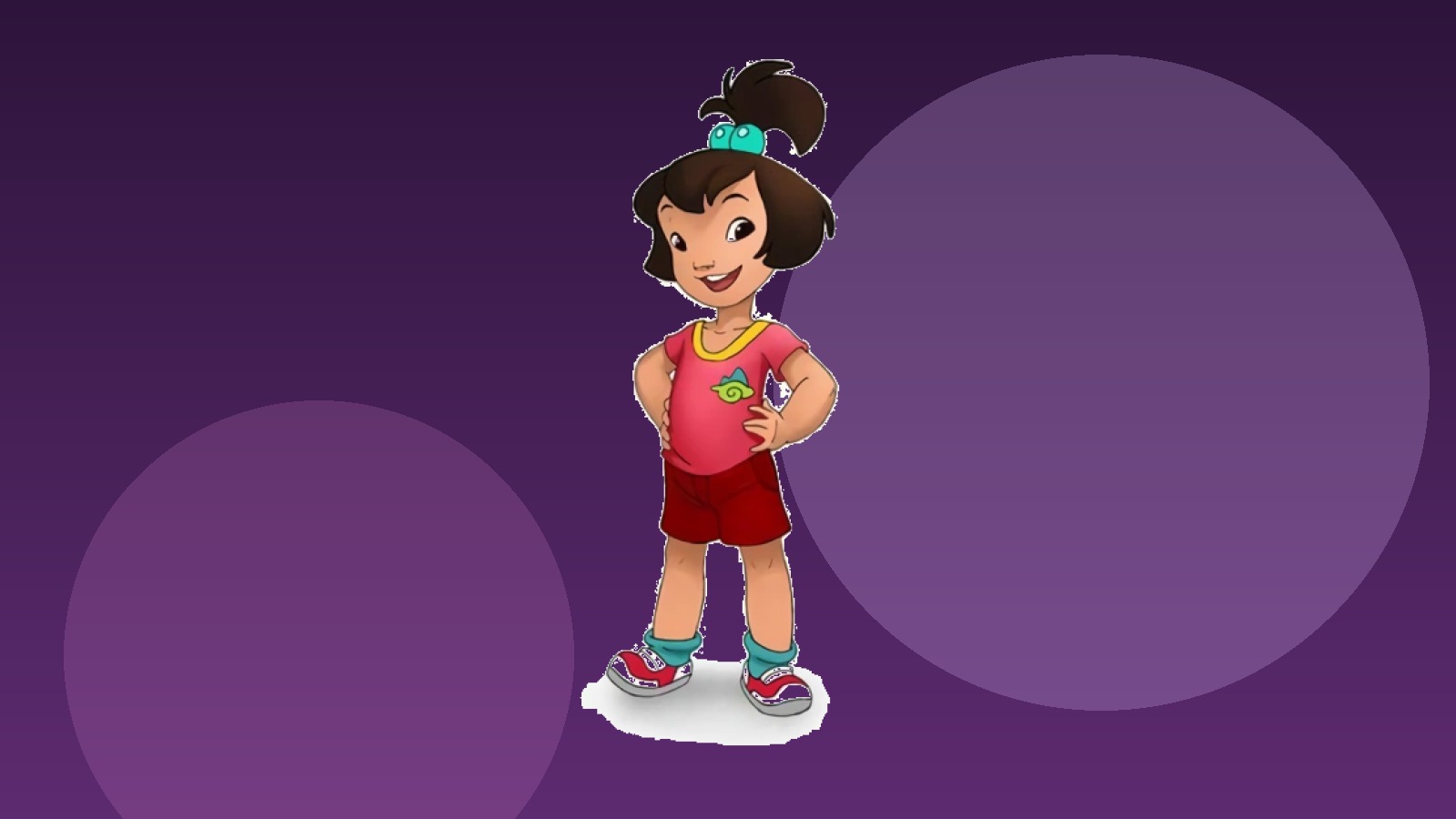
STITCH & AI CHARACTER PROFILE · HUANGSHAN · ALL 13 EPISODES
Wang Ai Ling Character Profile: The Girl Who Refused to Be Relocated Quietly
Ai does not need to become Lilo to matter. She needs adults to stop deciding that love gives them the right to relocate her without listening.
Profile record
Full name: Wang Ai Ling (王安玲; Wáng Ān Líng)
Preferred name: Ai
Species: Human
Home: Huangshan mountains, Anhui, China
Family: Wang Jiejie, older sister; Wang Daiyu, aunt; Bao, cousin; unnamed deceased parents
Known skills: Drumming, mountain navigation, cultural knowledge, improvisation under pressure
Mandarin voice: Jiang Sun Chengwei
English voice: Erica Mendez
Appears in: All 13 episodes of Stitch & Ai
Who Ai Ling is before Stitch falls out of the sky
Wang Ai Ling is a child living in the Huangshan mountains with her older sister, Wang Jiejie, after the deaths of their parents. The alien adventure does not create the crisis in her life. The crisis is already sitting inside the family. Her aunt Daiyu intends to move Ai to the city, reshape her into what Daiyu calls a proper young lady, and limit the relationship between the sisters after the move. Ai’s first defining action is refusal. She does not politely accept an adult plan because the adult calls the plan an opportunity.
That refusal makes her loud, evasive, and difficult to manage. The behavior is often used as proof that Daiyu’s intervention is necessary, even though the behavior is also a response to being discussed as if she were luggage. Ai knows the mountain paths, participates in local drumming, attends school, argues with rivals, and understands the community around her. The city may offer resources. The series never proves that resources require severing the life she already has.
Ai prefers the shorter name because she wants control over how people address her. Her Chinese name is written 王安玲, with Wang as the family name and Ai Ling as the given name. The English materials sometimes compress or rearrange the name, so the profile keeps the complete form visible. A child fighting over where she belongs should at least be allowed to keep the order of her own name.
The grief the series leaves mostly between the lines
Ai and Jiejie lost both parents before the series begins. The scripts rarely stop for a formal grief scene, but the loss shapes every argument about relocation. Huangshan contains the last version of family life Ai remembers. Leaving would not mean changing scenery alone. The move would separate her from routines, neighbors, practice spaces, objects, and paths that hold memory without requiring her to narrate it for an adult.
Her attachment to Stitch develops in that emotional climate. He arrives displaced, hunted, and unable to guarantee that another separation will not happen. Ai recognizes the panic before she understands the science. She gives him shelter because she knows what it feels like to have people with more power decide the next destination. Their experiences are not identical. The shared refusal creates a bridge.
The show could have written the grief more directly. Ai’s anger sometimes gets presented as personality without enough room for viewers to see the bereaved child underneath. That omission makes her easier to dismiss as a copy of Lilo’s volatility. The stronger reading notices that both girls have lost parents and refuses to treat grief as a universal costume. Ai’s losses occur inside a different household, culture, production, and argument about rural versus urban life.
Ai and Jiejie: love does not erase a failure to act
Jiejie is Ai’s primary caregiver and emotional home. She works, maintains the household, worries about her sister, and initially fails to stop Daiyu. Ai calls out the failure because silence from the person who loves you can feel like agreement with the person taking control. Jiejie’s hesitation is understandable. Daiyu has money, authority, confidence, and a prepared story about Ai’s future. Understanding the pressure does not make Ai wrong to feel abandoned.
Their relationship grows when Jiejie becomes more assertive. In “The Scroll,” she demands Ai’s return and argues that Stitch restored happiness to a child whose life had narrowed after loss. Jiejie does not suddenly become fearless. She begins acting before fear grants permission. That development matters because Ai needs more than affection expressed in private. She needs somebody willing to defend the household in front of the adult trying to dismantle it.
Ai also has responsibilities inside the relationship. She hides danger, improvises plans that increase Jiejie’s burden, and sometimes treats protection as a service her sister should deliver without complete information. The bond remains credible because both characters can fail. Jiejie learns that gentleness without advocacy is insufficient. Ai learns that independence does not mean forcing loved ones to clean up every secret.
Why Daiyu gets under Ai’s skin
Daiyu represents a future designed from the outside. She values city culture, cleanliness, social status, and the ability to provide material opportunity. Ai hears the offer as a judgment that her current life, clothes, habits, community, and sister are inadequate. The conflict becomes especially cruel when Daiyu plans to prevent Jiejie from visiting. At that point, improvement is no longer a persuasive label. The plan uses family authority to isolate a grieving child from her remaining immediate family.
Ai responds with tricks, escape, and help from Stitch. The comedy can hide how desperate the situation is. Stitch impersonates Ai during a car ride. Later, Ai and Stitch make Daiyu think she has seen an impossible transformation. Those schemes are ethically messy. They also emerge because straightforward refusal has already failed. When adults monopolize legitimate decision-making, children reach for illegitimate methods that still produce an effect.
Daiyu’s later support for rebuilding the Nuo opera materials reveals that she is capable of valuing culture and community. Ai benefits from a profile that preserves that contradiction. The aunt is not wrong about every object she values. She is wrong to treat those values as a license to remove Ai’s voice. A richer continuation could have forced both characters into an honest conversation instead of letting repeated tricks postpone the decision.
Ai and Stitch build trust by making mistakes in public
Ai invites Stitch into the household quickly, but trust develops through thirteen episodes of friction. She believes him when others blame him for damage. She also becomes angry when his destruction threatens people or the home she fought to keep. She does not require him to become harmless. She requires him to recognize consequences. That expectation carries the original franchise argument into a new relationship without turning Ai into Lilo with a Chinese setting pasted behind her.
“Teacher’s Pet” and “Gotcha!” establish that Ai can be jealous, competitive, and eager to prove that she controls the unusual friendship. “Tell the World” pushes the flaw further. Attention makes Stitch useful as evidence that Ai is interesting and important. The danger arrives when his privacy and safety become secondary to her need to be believed. Ai repairs the damage by choosing the relationship after the public reward disappears.
Physical affection has its own boundaries. Ai kisses Stitch on the head in “Dream On” and “Nuo Opera,” while Stitch visibly dislikes the gesture. The moment is played for comedy, but the recurring reaction should still count. Love does not make every touch welcome. Ai is learning that closeness includes reading discomfort, not merely expressing what she feels in the way she prefers.
Drumming, competition, and the need to be seen as capable
Ai plays drums under Qian Dahu’s instruction and practices alongside Meiying and other girls. The activity places her inside a community discipline where timing, coordination, physical force, and public performance all matter. Drumming also gives the series a way to show that Ai’s knowledge of Huangshan is active. She is not a small tour guide reciting facts. She has skills, rivals, and obligations that only make sense because she participates in local life.
Meiying’s presence exposes Ai’s sensitivity to status. Their rivalry is less vicious than Lilo and Mertle’s relationship, although the franchise comparison is easy to make. Meiying can be dismissive, competitive, friendly, or willing to join the same game depending on the episode. Ai sometimes interprets every shift as a referendum on her worth. That insecurity fuels mistakes and makes moments of cooperation meaningful.
The “Brothers” double-Dutch sequence gives Ai, Meiying, Yong, Scratch, and Stitch a brief image of uncomplicated play before the deception is exposed. Ai wants the new boys and Meiying to fit into one group because belonging feels abundant for a moment. The scene becomes painful in retrospect. Scratch and Yong are performing roles designed to activate Stitch’s destructive programming. Ai’s genuine welcome becomes material inside somebody else’s mission.
Knowledge of creatures is part of Ai’s agency
Ai recognizes or explains local legendary creatures that become entangled with Jumba’s Chinese experiments. That knowledge can be mishandled if the script uses her as a walking glossary. The better episodes let her understanding change the action. She notices a meaning, identifies a danger, or understands why a creature cannot be treated as another random monster. Her expertise matters because Stitch’s strength cannot supply cultural context.
The series draws on dragon, fenghuang, qilin, Nian, Mo, and other traditions while translating them into the genetic-experiment world. Ai does not make that translation neutral. Her relationship to the stories comes from place and community, while Jumba approaches creatures through design and classification. Their different knowledge systems can cooperate and collide. The show only begins exploring the tension before the short season ends.
Calling Ai knowledgeable should not imply she represents all Chinese traditions. Huangshan is not the whole country, and one child is not a cultural authority for every region or historical period. Her profile separates what the episodes show from broader guide material. The character provides a viewpoint. The lore posts provide sourced context around the traditions the franchise adapts.
The finale asks Ai to recognize Stitch inside a frightening body
Scratch and Yong enter as wished-for brothers, build trust through play, and activate Stitch’s hidden metamorphosis program. The transformation turns his body into proof for every enemy who described him as a weapon. Ai faces a friend whose appearance, movement, and destructive force no longer match the person she expects. Her scream in “Brothers” and “Monstrosity” is fear, anger, and an attempt to reach the relationship under the programming.
Ai does not defeat transformed Stitch through superior force. She stays in the path of danger, uses memory and familiarity, and tries bingtanghulu as a sensory route back to him. The sweet is not a magic symbol that solves body horror. The object belongs to their shared experience and helps create a pause in the destructive loop. Ai uses what she knows about the person rather than what the villains know about the mechanism.
The finale gives her courage and withholds recovery. A child who watched her closest companion become dangerous would carry fear after the city stopped shaking. Ai might become watchful, controlling, or afraid to let Stitch out of sight. Stitch might fear sleeping near the family. The series ends before those consequences can complicate their bond. Her profile keeps the unanswered emotional cost visible instead of treating the return to normal size as a complete repair.
Ai is not Lilo, Yuna, or a replacement slot
Ai is Stitch’s third principal human companion after Lilo Pelekai and Yuna Kamihara. That production position invites comparison, but comparison becomes lazy when every trait is sorted into borrowed and original columns. Lilo’s story is grounded in Kauai, Hawaiian family, grief, social services, and a specific sister relationship. Yuna’s story belongs to the Japanese anime’s Okinawan island setting, good-deed system, yokai, and later relocation. Ai’s story belongs to Huangshan, a Chinese co-production, family authority, cultural experiments, and an unfinished thirteen-episode arc.
The three girls share stubbornness because Stitch needs companions capable of opposing force. They share family disruption because the franchise repeatedly places belonging under threat. Similar narrative functions do not erase different social contexts. Ai becomes herself when the profile follows what she chooses: defending the mountains, trusting Stitch during public blame, mishandling attention, competing with Meiying, resisting Daiyu, and recognizing Stitch during metamorphosis.
The more useful continuity question concerns Stitch. Why does a character whose first family taught him that nobody gets left behind adapt to a new companion without enough visible grief for Lilo? Ai should not absorb blame for the script’s silence. Her affection is real. The missing bridge is a franchise decision. Both judgments can coexist without forcing a ranking between children.
Voice performances and production-language record
Ai is voiced in Mandarin Chinese by Jiang Sun Chengwei and in English by Erica Mendez. The production history complicates the usual original-versus-dub label because the series was developed and recorded through an English-language production pipeline before the Mandarin broadcast premiered in China. The profile therefore identifies the language of each credited performance and avoids treating one actor as an afterthought.
Mendez gives the English Ai a bright attack that can turn defensive quickly. The strongest moments arrive when confidence breaks rather than when volume increases. Ai needs to sound like a child inventing certainty during a crisis, not an adult delivering a lesson through a young voice. The performance finds that nervous speed in arguments with Jiejie and the sudden softness required when Stitch becomes frightened.
Reliable Mandarin credit documentation is thinner in English-language franchise archives, which is a reason to preserve the verified name without inventing episode-level claims. Future updates should use production credits or licensed release records. A full character profile is allowed to say where evidence ends. Pretending an unsourced cast list is complete would create more text and less information.
What Ai changes in the franchise
Ai proves that the franchise’s chosen-family argument can travel, but travel exposes what the owner must preserve. Stitch can form a new bond without repeating the exact Lilo dynamic. The setting can introduce different creatures, family pressures, and performance traditions. The move works when Huangshan affects the story. The move becomes shallow when local culture is reduced to a themed chase or a scenic backdrop.
Her strongest contribution is the connection between home and consent. Adults frame relocation as protection. Alien factions frame ownership of Stitch as strategic necessity. Ai and Stitch respond at different scales to the same moral failure: authority assumes it can decide where another person belongs. Their friendship becomes political without turning into a speech. They help each other remain subjects inside plans designed to make them objects.
Ai’s story remains unfinished. Daiyu’s position softens without a complete reckoning. Jiejie becomes more assertive but still deserves her own future. Scratch and Yong expose new vulnerabilities in Stitch’s body. Lilo remains emotionally absent. A continuation could deepen every thread. Until then, Ai should be remembered as the girl who fought for her mountain home, welcomed an alien fugitive, made several selfish mistakes, repaired some of them, and kept calling her friend back when his own programming tried to erase him.
Keep exploring
Return to the Stitch & Ai hub, browse all thirteen episode Reacts, or read the full series review.
Ai Ling is allowed to hate a plan adults call practical
Ai Ling’s conflict begins before Stitch arrives. Adults discuss moving her as if a better school or safer household automatically cancels attachment to place, routine, friends, and the life she already recognizes. A child can understand the financial or educational logic and still experience the plan as removal. Her refusal is not proof that she cannot imagine a future. It is evidence that nobody gave her meaningful power over which future becomes hers.
The profile needs to preserve that distinction because “stubborn” is often the label adults use after consultation has already become theater. Ai asks questions, resists deadlines, hides information, and makes risky choices. Those actions require consequences. They also reveal a family process built around presenting a decision rather than making one together. Respecting her agency does not mean a child controls every household choice. It means adults tell the truth, listen before the crisis, and explain what alternatives were genuinely considered.
Huangshan is home because she has relationships there
The landscape matters to Ai because it holds memory and practical knowledge. Paths, weather, family spaces, tourist movement, local stories, and familiar adults give her competence. Moving her would not only change scenery. It would take away the network through which she knows how to act. That is why her bond with Stitch develops through movement across a known place. She can guide him before she can fully understand what he is.
A profile should avoid turning Huangshan into mystical proof that Ai belongs in one location forever. Places change, children grow, and opportunities can require movement. The point is consent and continuity. If relocation happens, how does she maintain relationships? Who helps her return? Which parts of local identity travel with her? Adults owe a bridge, not a speech about gratitude. Ai’s attachment becomes mature when she can name what must be protected without pretending change itself is betrayal.
Stitch recognizes the sound of somebody being reassigned
Stitch was designed, cataloged, sentenced, adopted, placed, and repeatedly transferred by institutions that described each move as necessary. He understands Ai’s anger before he understands every family detail because both characters know what it feels like to become the object of somebody else’s plan. Their alliance works when it grows from that recognition. It fails when the story uses him as a magical reason the relocation issue no longer requires adult repair.
Neither child should become the other’s only support. Stitch needs connection to Lilo, his cousins, Jumba, Pleakley, and the wider history that formed him. Ai needs family honesty, peers, education, and adults who can carry responsibility. Their friendship can make resistance less lonely. It cannot replace the systems and conversations that should have existed before an alien arrived. The most loving outcome expands both support networks instead of sealing two vulnerable people inside an exclusive bond.
Curiosity becomes courage when she follows evidence
Ai does not accept the first explanation for unusual events. She watches Stitch, follows clues, interprets behavior, and keeps moving when adults would prefer a simpler story. Curiosity puts her in danger because the branch often rewards discovery with another chase. It also prevents villains and relatives from controlling the narrative completely. She builds knowledge through contact rather than waiting for an authority to decide which facts she can handle.
That strength needs discipline. Following evidence is different from assuming the most dramatic theory is true. Ai should compare accounts, ask who benefits from secrecy, protect physical evidence, and recognize when an investigation requires adult help. Giving her better methods would not make the episodes less adventurous. It would show a child learning how to turn suspicion into judgment instead of treating recklessness as the only available form of agency.
Her temper protects her and can still hurt people
Ai’s anger gives her energy when the family conversation becomes suffocating. It helps her say no, defend Stitch, and refuse to perform cheerful compliance. The same anger can narrow what she hears and push her toward choices that frighten people who care about her. A complete profile does not sand that contradiction into a “feisty girl” label. It asks what the anger is protecting and what repair becomes necessary after it lands badly.
She needs adults who can tolerate emotion without surrendering every boundary or escalating the fight. Telling a child to calm down before answering the substance teaches that only pleasant pain deserves attention. Letting every outburst control the household teaches that fear is power. Ai’s growth lies between those failures. She can learn to name the threat, ask for time, apologize for specific harm, and keep the original concern on the table after the volume drops.
The dragon and phoenix material should not swallow the girl
Stitch & Ai surrounds its lead with Chinese legendary imagery, metamorphosis programs, dragons, phoenix language, and a landscape already treated as extraordinary. Those elements can make Ai appear chosen by the setting rather than shaped through ordinary life. Her character still needs homework, family jokes, jealousy, boredom, chores, friendships, embarrassment, and decisions with no supernatural witness. A child becomes believable through the moments that would matter even if the ancient mechanism stopped glowing.
Cultural material also needs specificity. Ai should not function as a universal translator for every Chinese tradition the show wants to borrow. Different regions, eras, stories, languages, and religious practices cannot be compressed into one child’s intuition. She can know local accounts, misunderstand other material, ask elders, and learn. Allowing gaps in her knowledge respects both the character and the culture more than magical fluency ever could.
Leadership means sharing the plan before the chase starts
Ai often becomes the person willing to act first. That instinct can rally a group, especially when adults hesitate or information is incomplete. Leadership becomes more than boldness when she explains the goal, asks what others know, assigns work according to ability, and changes course after new evidence. Stitch’s power makes reckless plans look successful because he can survive mistakes that would injure everybody else. Ai needs standards that do not depend on an indestructible friend.
Her best future would let her practice leadership in ordinary spaces as well as emergencies. A school project, family decision, tourism conflict, or community event can reveal whether she listens when no villain forces unity. The franchise already gives her conviction. It should give her the slower skills that make conviction useful: preparation, delegation, consent, follow-through, and the humility to admit somebody else understood the problem better.
The ending should preserve more than physical location
If Ai remains in Huangshan, the story still owes answers about why the relocation pressure existed and what changed materially. Did the family solve money, caregiving, schooling, or work problems? Did an adult abandon an opportunity, and if so, who carries the cost? A happy image of Ai at home cannot substitute for the household plan. Otherwise the next crisis is waiting just outside the final episode.
A durable resolution would document agreements and responsibilities. Ai deserves to know who decides future moves, how early she will be told, what education options remain, and how conflict will be handled. The adults deserve honesty about risk and resources. Staying becomes meaningful when it is a supported choice rather than a temporary victory won through chaos. Home is not protected by refusing every change. It is protected when the people inside it stop treating one another as luggage.
Profile verdict
Wang Ai Ling is most compelling when the branch lets her be more than Stitch’s new human partner. She is a child resisting relocation, a local guide with incomplete knowledge, an investigator whose courage outruns her method, and a family member whose anger carries information adults tried to avoid. Those pieces create a lead who can stand beside Lilo and Yuna without replacing either of them.
Her future should keep Huangshan specific, restore the franchise history around Stitch, and make the adults finish the conversation that launched the plot. Give Ai friends who challenge her, family members who tell the truth, cultural knowledge with real sources, and decisions whose consequences last. Then her refusal to be moved quietly becomes the beginning of agency rather than the only character note the series remembers.