
Memory, Sorrow, and Thorn · Canonical Character Profile
Sangfugol
Josua’s harper enters with an ashwood lute, an empty cup, and enough charm to make a castle boy forget he is serving wine at a funeral. Then the kingdom collapses, and the pretty court musician proves he can carry far more than a tune.
At a Glance
The man behind the very good feathered cap
- Name
- Sangfugol; Isgrimnur notoriously mangles it into “Zong-vogol”
- Calling
- Harper, singer, court musician, oral historian, and professional reader of dangerous rooms
- Primary allegiance
- Prince Josua’s household and the community that survives Naglimund
- First appearance
- Prester John’s funeral feast in The Dragonbone Chair
- Signature instrument
- Ashwood lute; a second lute is later buried with Towser
- End-of-series status
- Alive and present within the restored Great Table community
The Visual Receipt
Handsome is canon. Generic tavern bard is not.
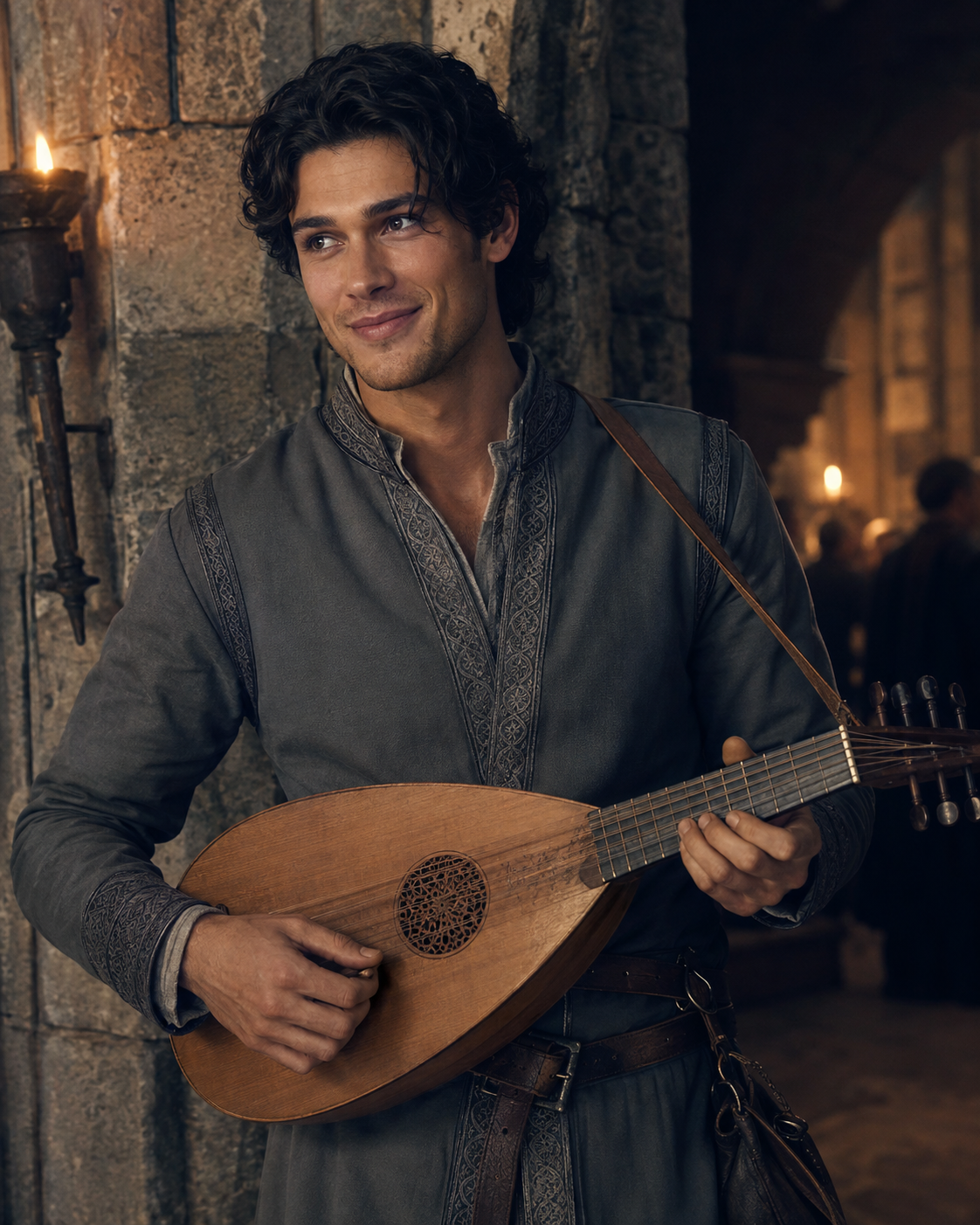
Sangfugol first appears as a smiling, dark-haired, clean-shaven young man in pigeon gray, carrying an ashwood lute and producing a cup from his clothes with practiced mischief. At Naglimund, Simon finds him in richer gray velvet or lavender with a matching feathered cap. The clothes are not evidence of shallowness. Presentation is part of a court performer’s work: Sangfugol has to know where the eye lands before he can decide where the room’s attention should go.
His canonical face must remain young, attractive, warm, and watchful across every later milestone. The fall of Naglimund can dirty the velvet, lose the feather, hollow the cheeks, and injure the leg. It cannot turn him into a bearded pirate, point his ears, swap the lute for a random fantasy instrument, or mistake “musician” for “man nobody would trust with a real task.”
The Complete Journey
The hall burns down. The work survives.
Book 1 · The Dragonbone Chair
Kindness at a funeral becomes witness after a massacre
Simon nearly trips over Sangfugol while serving wine at John’s funeral feast. Instead of making rank another thing the boy can fail, the harper turns the encounter into a joke and introduces himself as Josua’s musician. When Simon asks about Pryrates, Sangfugol reports the priest’s reputation as alchemist and possible black magician, then warns him not to believe every drunken minstrel’s story about witches and demons. Seconds later Pryrates crushes a starving puppy. Sangfugol’s rumor is not upgraded into proof; the villain supplies his own moral evidence.
At Naglimund, court polish becomes practical attention. Sangfugol helps free Qantaqa, pulls Simon back when the Dream Road nearly walks him off the battlements, explains Nail-fort and its Thousand Nails, and recounts the inherited story of Hylissa’s death with its uncertainty still attached. He recognizes Cadrach as a rogue because one professional performer can spot another man managing an audience.
Then Naglimund falls. A black-and-white Norn arrowhead lodges in Sangfugol’s leg, poisoning or corrupting it until he cannot walk unaided. The man built for halls has to cross Aldheorte as an injured refugee. Deornoth drags him; when the knight nearly gives up after a blow to the head, Sangfugol pulls back. Rescue becomes a circuit. By the Thrithings cattle pen, he is crippled and openly terrified, yet he sings and joins the resistance plan. Courage is not the sudden disappearance of fear. It is refusing to become unavailable to everyone else.
Book 2 · Stone of Farewell
He cares for the man who once taught him how to belong
Sangfugol remains close to Towser as the old jester’s mind and body fail. He explains the loyalty without decorating it: Towser taught and encouraged him when he was young and owed him nothing. The apparent comic elders of John’s court become a lineage of performance, memory, and care. Sangfugol understands the indignity and tenderness of the reversal, describing how the people who once raised us may become like children without ceasing to be themselves.
He also gives Simon one of the clearest readings of Josua. The prince suffers beneath John’s shadow and feels every wound too deeply to find happiness in a crown; a ruler must care without lying down beside every injury. The observation is affectionate and critical at once. Sangfugol serves Josua without turning loyalty into flattery.
Towser dies naturally on the night of reunion. Sangfugol gathers snowflowers with Simon and buries his second lute with the old man’s motley. Later he finds Ti-tuno among Towser’s possessions and hides the horn because he cannot bear to lose the keepsake. Shame turns grief into secrecy. Simon refuses to accept a lie that would make himself the hero and accompanies him to confess. Josua responds with mercy. Sangfugol’s worst act is small beside the war, which is exactly why it works: character is also what people do with a private mistake nobody needed to discover.
Book 3 · To Green Angel Tower, Part I
The campfire is still infrastructure
At New Gadrinsett, Sangfugol’s music creates one of the few spaces where the scattered company can briefly become a community instead of a war machine. Miriamele accepts Simon’s invitation to his campfire singing, a small opening carrying much larger pressure beneath it. This is the work the fact box misses. Music does not stop the Talons, feed the army, or solve the swords. It gives frightened people a shared present long enough to remember why surviving together matters.
Sangfugol also remains part of the living information network around Josua. His history with Towser, Naglimund, the Hayholt, and court performance makes him a witness whose knowledge crosses formal archives and ordinary memory. The trilogy never promotes him into an all-knowing lore machine. It lets him remain useful precisely because he labels what he saw, what he heard, and what people merely say.
Book 4 · To Green Angel Tower, Part II
He watches the legend from Swertclif and reaches the table afterward
During Josua’s assault on the Hayholt, Sangfugol and Strangyeard watch from Swertclif, unable to convert distant shapes into certainty. He rejects the suggestion that he impersonate Josua because Baron Brindalles already serves as the visible decoy. The joke exposes the siege’s real problem: every side is reading performances under conditions designed to make the wrong story look true.
After Green Angel Tower falls, Sangfugol is present within the restored Great Table community beside Simon, Miriamele, Rachel, Tiamak, Strangyeard, Sludig, Jeremias, Eolair, and the other survivors. The ending does not make him a general or lord to prove he mattered. He remains what he became across the series: musician, keeper of portable memory, witness to destroyed households, and one of the people whose continued presence turns a political settlement into a human room.
The People Around Him
Patron, pupil, teacher, fellow performer, fellow survivor
Prince Josua
Josua gives Sangfugol a political and artistic household. Sangfugol returns loyalty strong enough to survive the household’s destruction, but not so obedient that he stops seeing the prince’s paralysis, grief, and unsuitability for uncomplicated kingship.
Simon / Seoman Snowlock
Their bond begins when Sangfugol treats a servant boy as a person. He becomes guide, rescuer, storyteller, and eventually a fellow mourner gathering snowflowers for Towser. Simon’s rise proves the harper’s early kindness was also excellent judgment.
Towser / Cruinh
Towser once taught the young musician without obligation. Sangfugol repays that gift through care, companionship, burial, and one shameful attempt to keep a physical relic of the man he lost. The second lute in Towser’s grave makes artistic inheritance personal rather than decorative.
Cadrach
Both men improvise, charm, and read audiences. Sangfugol recognizes Cadrach’s cutpurse performance because he understands technique from inside. One uses charm to connect; the other often uses it to postpone accountability.
Deornoth
Deornoth carries the injured harper through disaster. Sangfugol’s answering tug when the knight falters makes the rescue mutual: strength moves the body, but the wounded man’s response tells the exhausted rescuer that somebody is still there to reach.
Why He Works
Do not call him “just the bard” unless you enjoy being wrong in public
Sangfugol’s instrument does not make him less practical than the men carrying swords. It makes him responsible for the part of a cause steel cannot remember on its own. Court musicians survive by reading attention: who wants praise, which joke can finish safely, which name lowers the room’s voice, and when a story has crossed from entertaining uncertainty into warning. That social intelligence helps him notice Simon, identify risk, preserve court memory, and keep frightened people connected after architecture and office stop doing the job.
The series never requires Sangfugol to become ugly, humorless, or invulnerable before respecting him. He can care how the feather sits and still pull a boy from a battlement. He can panic and still sing. He can need carrying and still pull Deornoth back. He can make a foolish, grief-driven choice about Ti-tuno and then confess it. Beauty and charm are not obstacles the story must strip away to reveal a serious man. They are tools inside a larger, messier competence.
On the Record
Scope, spoilers, and the face we do not casually swap
This is Sangfugol’s one canonical profile across all four owned Kindle volumes. It is intentionally full-spoiler. Franchise and volume directories must surface this same post with scope-aware labels rather than clone his biography.
This portrait is Sangfugol’s canonical identity across the franchise: a handsome young dark-haired face, clean-shaven warmth, gray-to-lavender wardrobe language, and the ashwood lute that makes his work visible before the page explains it. Later milestone art preserves the same face while allowing travel wear, grief, age, and injury to accumulate honestly.