
Memory, Sorrow, and Thorn · Canonical Character Profile
Lector Ranessin
Born Oswine of Stanshire, Ranessin becomes the first Erkynlander to lead Mother Church in five centuries: a slender, handsome old man with alert eyes, a mischievous smile, and considerably more steel than his gentle manner advertises. He spends one book trying to counsel kings and the next deciding that, when diplomacy has become camouflage for evil, the Church must finally say the unforgivable thing aloud.
At a Glance
The diplomat who learns that peace without truth is only a prettier surrender
- Birth name
- Oswine of Stanshire
- Office
- Lector and head of Mother Church
- Distinction
- First Erkynlander Lector in five centuries
- Closest aide
- Father Dinivan, his private secretary and trusted student
- Political method
- Mediation, counsel, evidence, and institutional legitimacy
- End status
- Dead; murdered by Pryrates after excommunicating him and Elias
The Visual Receipt
Nearly seventy, still handsome, and absolutely not getting into that ridiculous litter
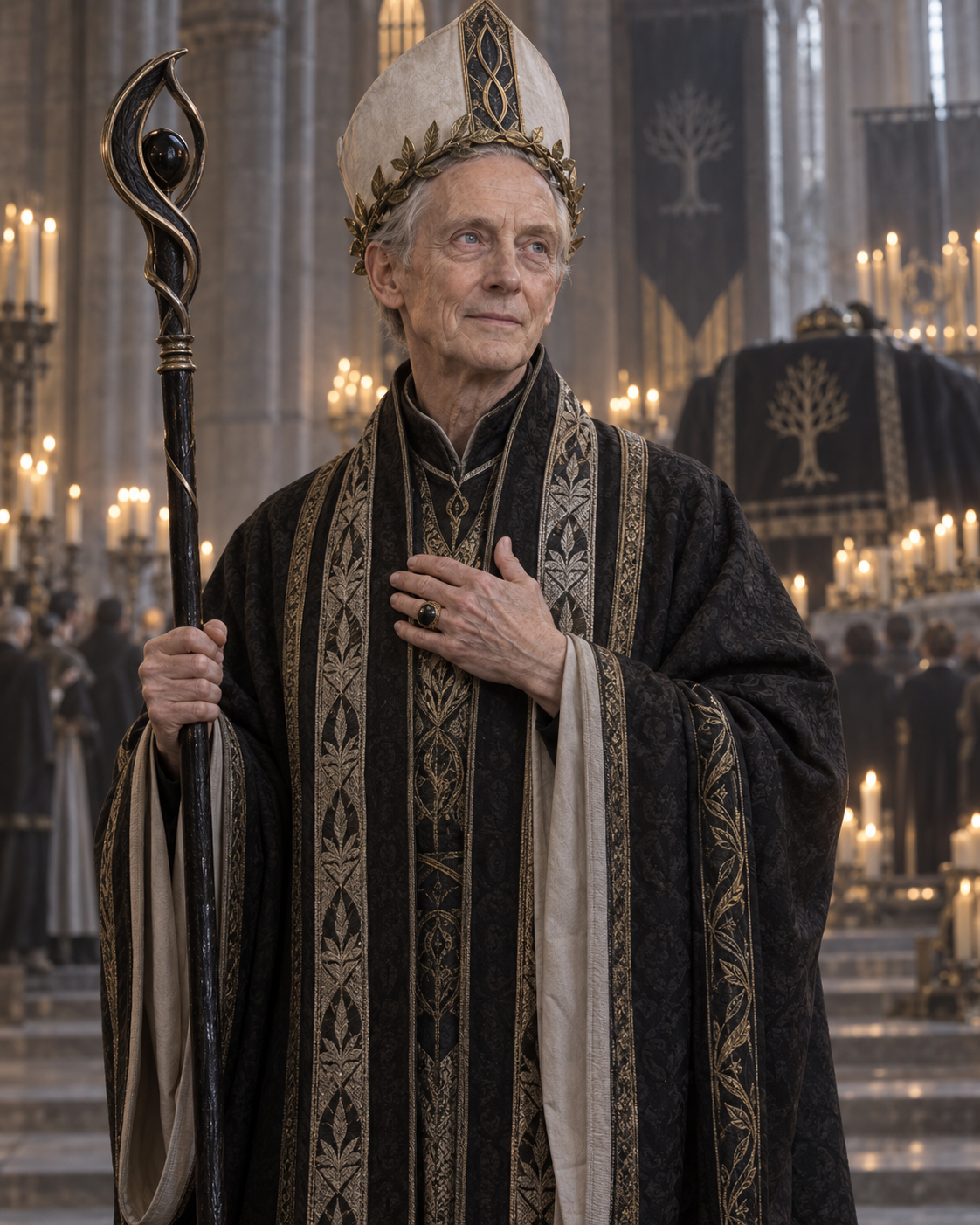
Ranessin is slender and pale, with thin gray hair, a handsome face, and bright, almost childlike eyes that remain sharply observant. When he arrives at Kynslagh, he is nearly seventy and the wind and crowd make the climb dangerous. A gaudy covered litter waits to carry him apart from the people. He dismisses it and walks.
His ceremonial presence is precise rather than gaudy for gaudiness’s sake. At Prester John’s funeral he wears black, silver, and gold, a wreath of sacred citian leaves, and a tall pale hat. He carries a censer and black-onyx crozier. The clothing must communicate the head of an enormous institution; the man inside it should still look capable of laughing at the institution’s furniture.
The approved portrait locks his near-seventy face, slender pale build, thin gray hair, bright blue-gray eyes, citian-leaf wreath, and black, silver, and muted-gold ceremonial vocabulary. The exact facial structure, hat geometry, textile patterns, cathedral interior, and abstract crozier finial are editorial reconstruction where the novels do not specify them. Future art must preserve this identity without turning him into a generic wizard or disguising his age.
Book 1 · The Dragonbone Chair
He buries a friend while calculating what the friend’s son may become
Ranessin comes to Erchester for Prester John’s funeral on a white ship whose azure sail bears Mother Church’s white Tree and golden Pillar. The crowd welcomes him more loudly than the military delegation and surges hard enough to knock people into freezing water. His popularity is not abstract background. It tells us that spiritual authority can still command public affection at the moment royal authority begins to curdle.
John’s death is personal. The old king’s influence helped raise Oswine of Stanshire through the Church until the Erkynlander took the Nabbanai name Ranessin and reached its highest office. Gratitude, grief, and institutional calculation therefore occupy the same body when he studies Elias.
Ranessin sees courage, decisiveness, and boldness in the new king. He also recognizes the temper, carelessness, violent young nobles, and Bishop Domitis’s foolish influence. His first instinct is reform through counsel: find Elias a trustworthy adviser who can balance the court. He considers Escritor Velligis and even Dinivan, then admits to himself that he cannot bear to surrender his secretary.
The Funeral
He refuses to make one kingdom’s grief erase everybody else’s language
Ranessin opens the Death Mass in formal vestments, but after the company rises for the Cansim Falis, he surprises the court by speaking in the common tongue instead of Nabbanai. Accessibility becomes part of ritual rather than a concession beneath it.
His sermon recounts Pelippa giving the dying Usire water from her rich scarf and golden bowl after the disciples are driven away. He then acknowledges that John’s people imagine the afterlife differently: some believe the king remains to watch Erchester, Aedonites place him in a heaven of light and blue mountains, and Hernystiri subjects see him among heroes in the stars. Ranessin does not use the pulpit to flatten those beliefs. He returns to the shared image of John looking into God’s face.
That pastoral generosity matters later. The man who can make room for several visions of death will not make room for a political lie simply because the lie is institutionally convenient.
Mediator of a Breaking Alliance
Every dispute looks containable until the same red priest appears behind all of them
Ranessin attempts to keep the High Ward from splintering. He sends Bishop Anodis to mediate between Elias’s brothers and prevent Aedonite bloodshed. When Nabbanai ships are seized in a Hernystiri harbor, he works between Duke Leobardis and King Lluth. Velligis carries Church authority into the dispute and warns that marching armies sow catastrophe.
This is Ranessin’s normal political craft: keep doors open, slow armed men, demand proof, and preserve enough legitimacy for adversaries to step backward. It is neither cowardice nor omniscience. Dinivan tells Eolair that he shares the fear that something larger is happening, yet cannot speak for the Lector. The secretary can investigate shadows; the head of the Church must act in public on evidence he can defend.
Ranessin and Dinivan
The series gives its loveliest mentor bond to two men who argue like affection is a clerical duty
Dinivan protects Ranessin’s arm in the Kynslagh wind while joking that Escritor Velligis would not understand allowing the Lector to fall. Ranessin teases him for fussing like a seminary boy. Dinivan privately sees his master as hard and careful, but sufficiently respectful to earn fierce loyalty.
Their trust has limits because responsible office requires them. Dinivan protects the source who revealed Benigaris’s treachery against Leobardis; Ranessin cannot denounce a ruler on rumor, even when the rumor fits everything he fears. That separation is not betrayal. Dinivan preserves a vulnerable witness while Ranessin preserves the Church’s ability to make an accusation that means something.
Ranessin taught Dinivan that hope remains. Dinivan eventually returns the lesson at exactly the moment his teacher has run out of comforting versions of it.
Book 2 · Stone of Farewell
Miriamele brings him the pattern, not one more isolated scandal
At Sancellan Aedonitis, Miriamele finds Ranessin pale and slender in his workroom, the gentle exterior concealing formidable intelligence. A marked illustration shows a black-handed, antlered figure beneath the Conqueror Star. The Church’s archive and the princess’s testimony finally begin speaking to each other.
Miriamele tells him about Elias’s deterioration, Pryrates, Josua’s imprisonment, the Norn hounds, Simon and Binabik, Geloë, and Jarnauga. Ranessin explicitly chooses painful knowledge over cheerful ignorance. That choice is the hinge of his profile. He is not converted from a fool into a believer; he is a careful institutional leader accepting that caution can no longer mean treating connected evidence as separate inconveniences.
Only Ranessin and Dinivan know Miriamele is inside the Sancellan. Pryrates is due the next day on an important mission from Elias. Sanctuary becomes a countdown.
Hlafmansa Eve
When Pryrates demands obedience, Ranessin spends the Church’s entire voice at once
Nabban debates whether Ranessin will legitimize Benigaris’s succession. Priests praise his diplomacy while fearing he may denounce the new duke over Leobardis’s betrayal and Naglimund. Pryrates arrives with the king’s ultimatum: Mother Church may claim souls, but it may not interfere with a legitimate monarch’s control of bodies.
Ranessin rejects the division. A Church that blesses souls while looking away from what power does to bodies would be offering decoration, not moral authority. He formally excommunicates Pryrates, King Elias, and everyone who knowingly follows them.
Afterward he admits to Dinivan that resistance may change nothing. Someone must still name evil when it appears. Dinivan answers with the teaching Ranessin once gave him: there is always hope.
Murder and Cover Story
Pryrates cannot answer the Church’s judgment, so he destroys the witnesses
Pryrates magically immobilizes Ranessin’s guards, invokes the Words of Changing, and becomes a vast cold shadow. He invades Dinivan’s mind, crushes the priest’s body, and murders Ranessin and a young servant with deliberate brutality. Isgrimnur finds the Lector mutilated and Dinivan dying.
The official story blames Fire Dancers for Ranessin’s murder and the Sancellan fire. Elias later receives a courier report that negotiations are progressing even though Ranessin is already dead. The lie works because authoritarian power does not need a persuasive story; it needs a story that frightened institutions will repeat.
Ranessin’s body is destroyed, but his judgment survives in Dinivan’s final instructions, Miriamele’s escape, Isgrimnur’s mission, and every later recognition that Elias’s rule has crossed from contested kingship into declared evil.
Connections
The people who reveal the distance between office and conscience
Father Dinivan
Private secretary, investigator, student, protector, and the man who returns Ranessin’s own lesson about hope before both are murdered.
Prester John
Friend and benefactor whose death brings Ranessin home and whose influence helped an Erkynlander reach the Lector’s seat.
Miriamele
Protected witness whose testimony lets scattered horrors become one political and supernatural pattern.
King Elias
A ruler Ranessin initially hopes good counsel can steady, then formally casts outside the Church for knowingly serving evil.
Pryrates
The threat Ranessin identifies early, excommunicates publicly, and cannot physically survive.
Benigaris
A disputed successor whose legitimacy exposes the cost of acting on truth that everyone whispers but few can prove.
Why He Matters
He makes institutional caution look human—and then shows where it must end
Ranessin’s story refuses two easy fantasies. Institutions do not become righteous merely because decent people lead them, and decent leaders cannot act responsibly on every suspicion. He needs evidence. He protects mediation. He worries about legitimacy because public judgment without standards becomes another weapon.
But procedure is not his god. Once Miriamele’s testimony, Dinivan’s work, Pryrates’s demand, and Elias’s conduct form a coherent pattern, Ranessin acts. He does not know that excommunication will win. He knows silence would tell every frightened priest that evil becomes legitimate when it is sufficiently armed.
His later-volume presence is consequence rather than resurrection. Recaps carry the loss forward; Nabban’s captured Church, false reports, and the resistance’s missions show the vacancy left when moral authority is murdered and administratively replaced with a lie.
On the Record
Scope, status, names, and evidence boundaries
This is Ranessin’s one canonical full-spoiler profile. Direct action spans The Dragonbone Chair and Stone of Farewell; Books 3 and 4 retain directory scope for recap, institutional consequence, and the continuing political meaning of his murder. He is alive through Book 1 and deceased from Book 2 onward.
Ranessin’s birth name is Oswine of Stanshire. He adopts a Nabbanai name while rising through a Church in which an Erkynlander Lector is rare. The record supports intelligence, gentleness, humor, caution, and courage; it does not support treating him as secretly omniscient. Dinivan withholds a protected source, and Ranessin’s inability to act without proof is an explicit boundary.
The approved funeral-state portrait is now the canonical visual identity for hero, directory, social, Kynslagh, Sancellan, testimony, excommunication, and later consequence imagery. Future scenes must retain his exact face, age, build, eyes, and ceremonial language. Any depiction of his murder must communicate Pryrates’s assault on moral authority without turning an elderly man’s mutilation into decorative spectacle.