
Memory, Sorrow, and Thorn · Canonical Character Profile
Nessalanta
Duchess Nessalanta is stern beauty, dynastic appetite, maternal control, and political survival in one exquisitely managed room. She reads marriages as roads between crowns, backs Benigaris after Leobardis’s murder, trusts a horoscope that promises a new order, and discovers that the son built for her ambition has a will violent enough to turn on her.
At a Glance
The duchess who treats family as the most powerful political institution in Nabban
- Title
- Duchess of Nabban
- Family
- Wife of Leobardis; mother of Benigaris, Varellan, and Antippa; sister of Hylissa
- Political reach
- Second only to Leobardis in Nabban before his death; strongest supporter of Benigaris afterward
- Method
- Marriage strategy, family pressure, court intelligence, maternal authority
- Strategic error
- Dismisses Camaris’s return and trusts Xannasavin’s favorable reading
- End status
- Alive at last direct report; authority fractured after Benigaris rejects her survival plan
The Visual Receipt
Sternly beautiful, mature, and visibly built to own the room
Nessalanta is a beautiful older woman, younger than her elderly husband Leobardis, whose political power ranks just beneath his in Nabban. The text gives command and maturity more securely than coloring or exact measurements.
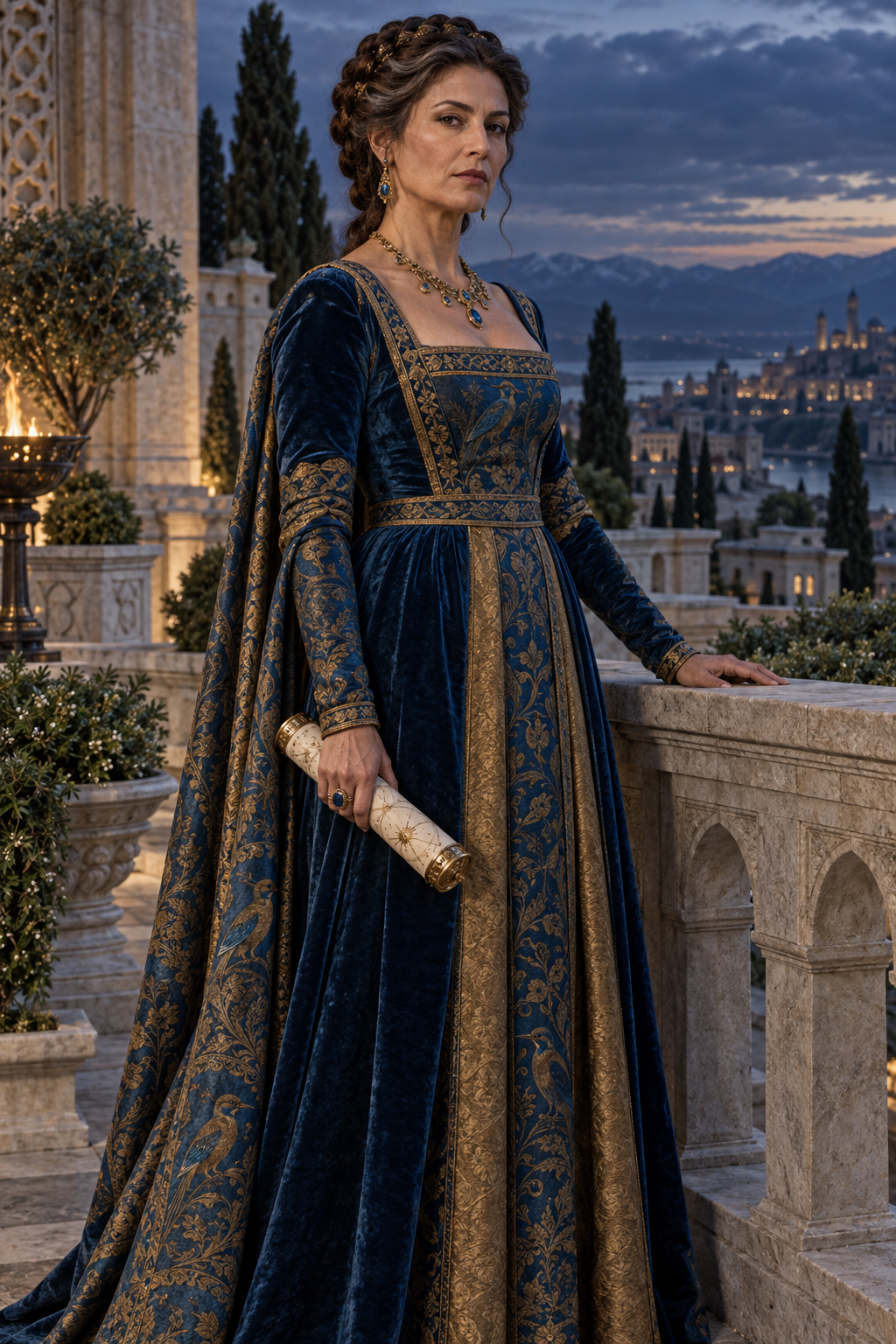
Her approved identity gives that authority an age-honest face: a glamorous woman in her late forties to early fifties, with strong refined features, warm olive skin, deep brown eyes, and dark auburn-brown hair naturally threaded with a little silver. Kingfisher-blue velvet, old-gold embroidery, court jewelry, the astrological scroll, and Sancellan rooftop garden make her political world legible without pretending the novels specify each visual detail.
The exact face, age within that mature range, coloring, hairstyle, body proportions, gown, jewelry, scroll, garden, city, and twilight are editorial reconstruction. The locked canon is stern mature beauty, visibly younger than Leobardis, and unmistakable command. This same face must persist across the Sancellan household, rooftop garden, succession court, confrontation with Benigaris, and every family-history image. Attractive does not mean pretending the mother of grown sons is twenty-five; her age, authority, beauty, and danger belong together.
Book 1 · The Dragonbone Chair
Aunt, duchess, and marriage strategist—though the page must label inference as inference
At supper in Nabban, Nessalanta questions Eolair about Miriamele. She learns the princess has gone toward Meremund after illness and physicians’ recommendation of sea air. She emphasizes Miriamele’s Nabbanese blood and pays close attention to the postponed marriage with Fengbald.
Eolair infers a dynastic possibility: if Miriamele cannot or will not marry Fengbald, Nessalanta may promote her daughter Antippa and bind Nabban more tightly to Erkynland. That reading is politically plausible, but it remains Eolair’s interpretation. Nessalanta does not deliver a villain monologue confirming the scheme.
This distinction defines the profile’s method. Nessalanta plainly understands marriage as political infrastructure and Antippa as a dynastic resource. The specific Fengbald substitution must stay attributed until the text proves more.
Leobardis’s alliance with Josua divides the family. Devasalles reports that Nessalanta and Benigaris resist the duke’s position. The sealed embassy and military movement therefore occur against opposition inside the Kingfisher House, not merely pressure from Elias.
After Leobardis
Maternal loyalty becomes political armor around a patricide
Benigaris murders Leobardis from behind during the Bullback Hill trap, performs grief, retreats with the army, and returns to Nabban’s throne. Nessalanta becomes his strongest supporter. Dinivan believes she likely suspects the truth, but the evidence boundary matters: suspicion is not a witnessed confession of knowledge.
Her support still has consequence. Family legitimacy, court access, and the duchess’s authority make it harder for whispers to become public action. Ranessin lacks proof he can use; the Sancellan debates whether Mother Church will recognize the new ruler.
Nessalanta’s politics cannot be reduced to a mother foolishly believing a son. She understands power, danger, and family interest. Supporting Benigaris may protect her household in the immediate crisis even while consolidating the crime that broke it.
A Sky Full of Beasts
The rooftop garden turns astrology into a private strategy room
Count Stréawe is carried into Nessalanta’s ornamental rooftop garden on a cold Nabban evening. Xannasavin reads the Conqueror Star before the duchess, Benigaris, and Stréawe, predicting a new order born through conflict and collapse.
Once servants leave, Stréawe delivers intelligence about Elias and Josua. Beauty, sky, illness, and controlled hospitality conceal a political chamber. The garden is not an escape from rule; it is where rule becomes harder to observe.
Nessalanta trusts the favorable horoscope as Benigaris prepares to reinforce Varellan at the Onestrine Pass. She minimizes Josua’s coalition and rejects the report that Camaris leads it. Her dismissal has a basis in remembered character: the Camaris she knew was too honest, vain, and interventionist to have hidden through later wars. The inference is reasonable and wrong.
The Kingfisher House
She shapes her children for power, then discovers shaping is not ownership
Benigaris
Eldest son, duke, patricide, and political project. Nessalanta shields his rule until he rejects her survival strategy and nearly turns his violence on her.
Varellan
Younger son pushed into military life despite priestly inclination. Leobardis recognizes that both parents helped smother what the boy wanted.
Antippa
Daughter pledged to Devasalles and potentially available within broader marriage strategy. Her arm-wrestling with Benigaris hints at life beyond the dynastic slot.
Leobardis
Husband, duke, and political partner whose Josua alliance she opposes. His murder makes her maternal strategy inseparable from succession.
Hylissa
Sister and Miriamele’s mother, making the princess’s Nabbanese blood a genuine family connection as well as political instrument.
Miriamele
Niece, childhood visitor, and possible dynastic bridge. Nessalanta’s attention contrasts with Miriamele’s repeated refusal to be allocated by other people.
The Rupture
Benigaris becomes too much the man her system asked him to be
Military failure makes Camaris’s return undeniable. Aspitis defeats Benigaris’s forces and Eadne falls. Nessalanta’s strategy and maternal control fracture in public.
She stops Benigaris from attacking her and says she wished she had been born a man because no local man possessed enough strength for her will. The admission names a gendered political order that forced her power through husband, children, and marriage rather than giving it direct office.
It also exposes the damage of that route. Benigaris refuses her survival plan, chooses combat, and leaves saying he does not want to see her again. The son she helped build for patriarchal power will not remain a vessel for maternal intention.
Why She Matters
She is both constrained by patriarchy and skilled at using its machinery on everyone else
Nessalanta’s complaint about being born a woman is real. Nabban gives formal rule to men while she possesses will and political intelligence equal to any of them. Her influence must travel through marriage, motherhood, private rooms, and the legitimacy of male relatives.
Constraint does not absolve her. She pressures children toward roles, evaluates women as alliance material, opposes Leobardis’s resistance, supports Benigaris’s succession, and trusts a cosmic reading that flatters her desired future. A person can be denied direct power and still exercise harmful power over others.
That tension makes her better than a standard ambitious duchess. She sees the trap around herself and reproduces versions of it for Antippa, Varellan, and Miriamele. Her tragedy is not merely that the men fail her. It is that she invests in a system whose violence eventually refuses her management.
Books 2–4 · Political Afterlife
Her decisions persist through the succession crisis even when she is not in every room
Miriamele’s mission, Dinivan’s warnings, the Church debate, Camaris’s return, and the Nabban campaign all move through a landscape Nessalanta helped shape. Her support gives Benigaris time to consolidate. Her earlier dismissal of Camaris makes the real claimant’s battlefield arrival more destabilizing.
Camaris eventually restores the Kingfisher House through kinship, truth about Leobardis, and an offer that gives defeated soldiers agency. The method rebukes both Benigaris’s violence and the assumption that Nessalanta’s family management is the only path to survival.
The ledger does not stage her response to the restored order, so the profile leaves that reckoning open instead of scripting a convenient defeat scene.
Evidence Discipline
“Likely knew” and “proved guilty” are not interchangeable
The ledger preserves several layers: Eolair infers a marriage strategy; Dinivan believes Nessalanta likely suspects Benigaris’s treachery; her public support is observable; her private knowledge of the murder is not directly confessed.
A comprehensive profile gets stronger by keeping those layers visible. Calling every inference fact would make the page louder and less trustworthy.
On the Record
Scope, status, and evidence limits
This is Nessalanta’s one canonical full-spoiler profile across all four published volumes. She is alive at the final direct report; later scope follows the Nabban succession, Camaris campaign, and Kingfisher restoration without inventing an unrecorded death.
The visual record confirms a sternly beautiful mature woman, younger than Leobardis, and politically commanding; it does not fix coloring, precise age, or body details. Those boundaries remain visible even after approval. The same local attachment now supplies the profile’s featured image, visible hero, social image, and every referring directory card.
Every future card, court portrait, family scene, rooftop garden, confrontation, and legacy image must use this exact approved mature identity. Clothing and setting may change with the chronology; her face, age, beauty, and authority may not. Miriamele/Antippa marriage claims remain clearly attributed where they are Eolair’s inference.