Folklore, Buddhism & Japanese Myth
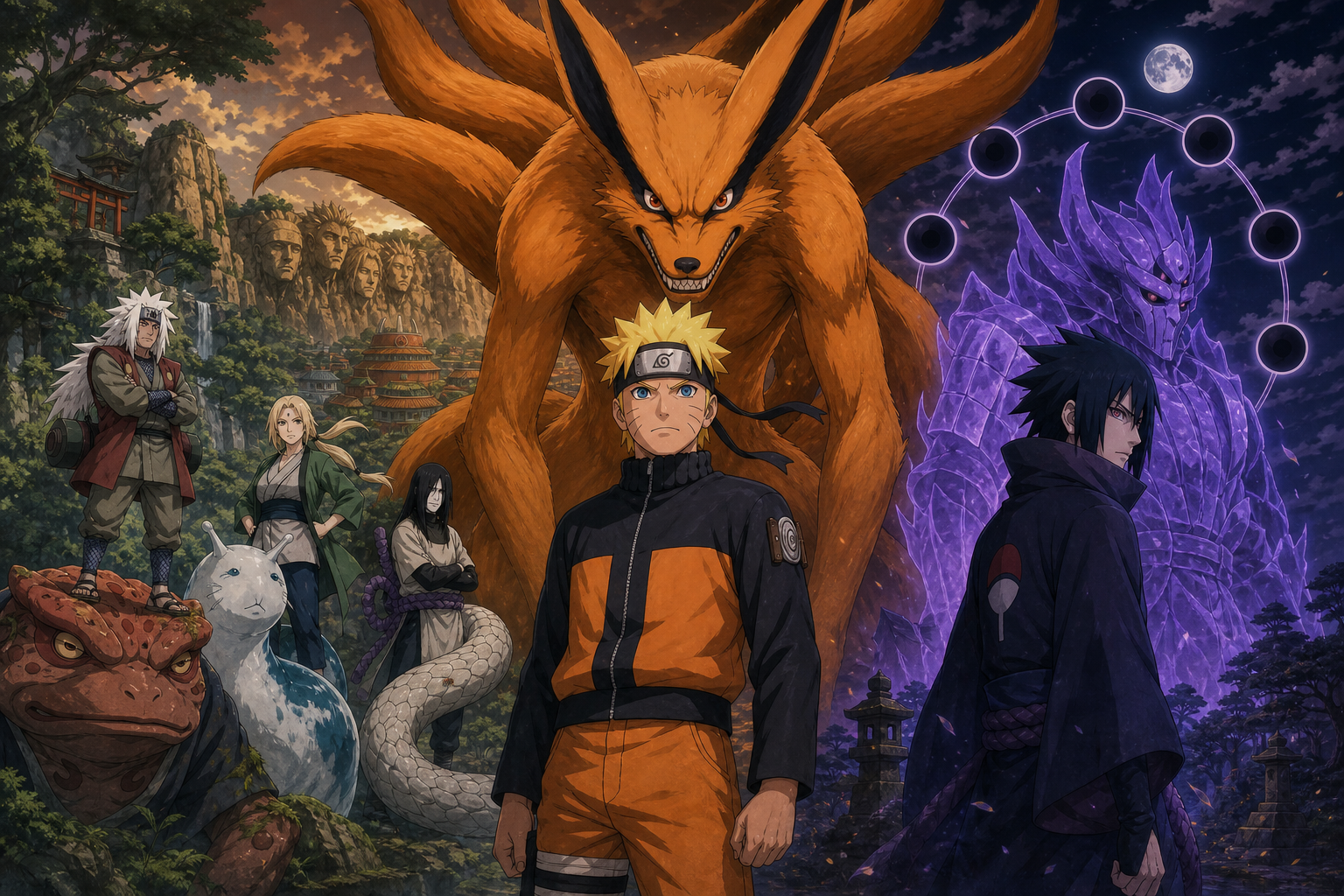
Nine-tailed foxes, giant toads, white snakes, wrathful guardian forms, death gods, reincarnating brothers and a moon created as a prison: Naruto does not copy one mythology. It builds a new ninja cosmology from centuries of stories already transformed across India, China and Japan.
The one-sentence truth
Naruto uses religious names and folkloric images as narrative vocabulary, not doctrinal instruction. Every parallel becomes useful only when we track the resemblance, the transformation, and the boundary.
Direct name
A technique or character explicitly borrows a mythic name, such as Amaterasu, Susanoo, Izanagi, Izanami, Indra, or Asura.
Visual echo
A design resembles religious art or folklore without reproducing the source’s full story, such as multi-armed chakra forms.
Structural adaptation
The series transforms a relationship pattern, as feuding divine names become a cycle of shinobi reincarnation.
Fandom inference
A plausible reading not explicitly confirmed. Strong analysis labels uncertainty instead of turning resemblance into fact.
Naruto is a remix machine. Indian religious vocabulary reaches Japan through centuries of Buddhist transmission. Chinese novels and cosmology enter Japanese popular culture. Japanese chronicles preserve multiple versions of kami stories. Modern manga then adds war states, chakra genetics, giant monsters, and teenage rivalry. There is no untouched source sitting behind the series like an answer key.
This means “based on” can describe several relationships. A name may carry prestige. A visual may trigger recognition. A plot may reverse an older story. A creator may borrow from earlier fiction that already transformed myth. The receipt is strongest when we specify which relationship we mean.
Respect also requires refusing spiritual tourism. Buddhism, Shinto, Hindu traditions, Daoist material, and folklore are not one Asian mythology smoothie. Their histories overlap, travel, and change. The series can mix them. Our explanation still has to name the ingredients.
A map of the biggest source families
| Naruto element | Major source association | How the series transforms it |
|---|---|---|
| Kurama and the tailed beasts | East Asian fox lore; Buddhist/Daoist number symbolism; modern monster fiction | Folkloric animal power becomes partitioned chakra, military deterrence and eventually personhood. |
| Jiraiya, Tsunade, Orochimaru | The Japanese tale Jiraiya Gōketsu Monogatari | Toad, slug and snake magic become rival ninja summon traditions and a broken team. |
| Sharingan techniques | Shinto kami and creation myths | Amaterasu, Tsukuyomi, Susanoo, Izanagi and Izanami become ocular powers with altered relationships. |
| Six Paths cosmology | Buddhist realms, samsara and Indic divine names | Spiritual categories become bodies, techniques, reincarnation and political history. |
| Monkey King Enma | Sun Wukong from Journey to the West | The rebellious pilgrim-hero becomes Hiruzen’s staff-transforming summon and trusted combat partner. |
| Shinigami and soul sealing | Japanese death-spirit vocabulary and modern visual invention | A death god becomes the mechanism of a sacrificial sealing technique. |
Kurama: the nine-tailed fox becomes a person
Fox spirits appear across Chinese, Korean, and Japanese traditions. Japanese kitsune can be tricksters, shapeshifters, possessors, lovers, messengers associated with Inari, or beings whose age and power are marked by multiple tails. There is no single universal fox doctrine.
Naruto begins by presenting the Nine-Tails as disaster: enormous, hateful, and sealed inside a child. The name Kurama arrives later, emphasizing that monster is a political category imposed on a being with memory.
Possession folklore echoes in Naruto’s changing eyes, chakra cloak, altered voice, and feared loss of control. Yet the story gradually replaces exorcism with relationship. The host does not become pure by eliminating the fox; both become freer by recognizing one another.
Kurama’s name may also remind readers of Mount Kurama, famous in Japanese religious and legendary associations including tengu and the childhood training traditions around Minamoto no Yoshitsune. The series does not publish a one-line official equation, so this remains a name association rather than proven creator intent.
That boundary makes the stronger point possible. Naruto takes a fox image already capable of carrying fear, seduction, intelligence, age, and sacred association, then places it inside a modern military-deterrence story. Folklore becomes state policy, and state policy eventually has to answer to the fox.
For the political system built around that relationship, see Jinchūriki and Tailed Beasts Explained.
Why nine tails?
Nine often signals culmination, age or extraordinary power in East Asian symbolic systems. Multi-tailed fox stories can treat additional tails as evidence of accumulated spiritual potency.
Naruto extends the number into an apparent one-through-nine sequence of tailed beasts, then reveals that all are portions of Ten-Tails chakra shaped and named by Hagoromo.
The numerical ladder invites power ranking, but Hagoromo’s act complicates it. Individuality is not discovered by measuring tails; it is created through names, relationships and separate histories.
The Sannin and Jiraiya’s older story
The names Jiraiya, Tsunade, and Orochimaru predate Naruto. They are strongly associated with the nineteenth-century Japanese popular tale Jiraiya Gōketsu Monogatari, where Jiraiya uses toad magic, Tsunade is linked to slug magic, and Orochimaru to snake magic.
Jiraiya, Tsunade, and Orochimaru inherit that triangle, but Naruto makes them former teammates shaped by war, grief, and incompatible responses to mortality.
The borrowing is not a hidden Easter egg that explains every trait. It is cultural scaffolding. Readers familiar with the older tale recognize animal magic and rivalry before the manga builds a new emotional history.
Naruto also passes the triangle forward. Naruto signs with toads, Sakura trains under Tsunade and summons Katsuyu, and Sasuke enters Orochimaru’s snake lineage before renegotiating that inheritance. Team 7 does not merely cosplay the Sannin. They inherit a broken adult pattern and decide which parts deserve continuation.
The title Sannin itself belongs to Hanzo’s naming of three surviving Konoha shinobi, not the older story. The series layers a modern war honorific onto literary names. Cultural source and in-world history cooperate without becoming the same thing.
Toad, snake and slug as philosophies
Toads
Mount Myōboku combines martial training, prophecy, natural energy and comic earthiness. Toads are teachers and partners, not disposable summoned equipment.
Snakes
Orochimaru’s snakes evoke shedding, poison, subterranean knowledge and repeated rebirth. His desire to escape mortality turns renewal into consumption.
Slug
Katsuyu divides without losing coordination, transmits information and heals many people simultaneously. Her form suits Tsunade’s distributed model of battlefield care.
Three-way deadlock
Popular Japanese rock-paper-scissors-like lore places slug, snake and frog in a cycle of advantage. Naruto turns balance into team tension and inherited student lineages.
Amaterasu, Tsukuyomi and Susanoo
In the Kojiki and Nihon Shoki traditions, Amaterasu is a solar kami, Tsukuyomi a lunar kami, and Susanoo a storm-associated kami. A major account presents them as siblings born through Izanagi’s purification, though mythic texts preserve variations.
Naruto assigns their names to Mangekyō Sharingan techniques. Amaterasu becomes inextinguishable black flame. Tsukuyomi becomes extreme illusion and subjective time. Susanoo becomes an enormous protective warrior surrounding the user.
The techniques do not reproduce the kami’s biographies. Amaterasu is not solar worship every time black flame appears. Tsukuyomi does not retell a complete moon myth. Susanoo’s armored form borrows divine scale more than one fixed iconographic body.
The naming does create family. All three techniques emerge through Uchiha eyes, trauma, and sibling history. Mythic sibling names make the repertoire feel cosmically related before the plot explains every mechanic.
The cultural irony matters. Divine vocabulary attaches to a clan the village stigmatizes and destroys. State history treats Uchiha power as dangerous inheritance; technique names give that inheritance the prestige of cosmic order. The eyes carry both suspicion and gods.
Izanagi and Izanami: creation names turned inward
Izanagi and Izanami are central creator figures in Japanese myth. Their union generates islands and deities; Izanami’s death and Izanagi’s failed retrieval of her from Yomi establish a profound boundary between life and death.
In Naruto, Izanagi allows the user to rewrite injury or death as illusion at the cost of an eye. Izanami traps a target in a repeating sensory loop until they accept reality and change.
The transformation is elegant. A creation-associated name becomes reality revision; a paired name becomes a corrective loop designed to stop those abusing revision. The techniques are related, but the manga is not retelling the full creation myth.
Kusanagi: a legendary sword becomes a category
Kusanagi-no-Tsurugi is one of Japan’s imperial regalia and appears in myth through Susanoo’s defeat of the eight-headed serpent Yamata no Orochi. He discovers the sword inside the serpent’s tail.
Orochimaru wields a Sword of Kusanagi and produces it through a snake-associated body. Sasuke later uses a sword also identified with the Kusanagi name.
The mythic knot,Susanoo, serpent and sword,does not map neatly onto one Naruto character. Instead, its pieces are redistributed through the Uchiha and Orochimaru systems.
The Six Paths: Buddhism becomes chakra cosmology
Buddhist cosmology describes six realms of rebirth: devas, asuras, humans, animals, hungry ghosts, and hell beings. The exact emphasis varies by tradition, but all belong to samsara, cyclic existence conditioned by ignorance, craving, and karma.
Pain’s Six Paths distribute abilities among six controlled bodies: Deva, Asura, Human, Animal, Preta, and Naraka Paths. The names align with the six realms, while their combat abilities are original inventions rather than literal religious descriptions.
Nagato controls corpses through chakra receivers, placing one consciousness behind multiple faces. The arrangement resembles a divine judge while revealing a traumatized human hidden outside the battlefield. The god is a network operated by a suffering body.
Preta Path absorbs chakra rather than embodying every hungry-ghost teaching. Naraka Path summons the King of Hell for interrogation and restoration. Deva Path controls attraction and repulsion. The names create cosmological organization, not a Buddhist move list.
Six Paths later expands into Hagoromo’s legacy, chakra history, and special power. Sacred vocabulary makes shinobi history feel older than states. It also tempts characters to treat inherited conflict as cosmic necessity.
Buddhism enters most powerfully through the moral problem, not the label. Pain believes suffering can control desire by teaching the world fear. Naruto responds with relationship and refusal to continue revenge. Both are arguing about cycles, attachment, memory, and whether pain must reproduce itself.
Asura and Indra: divine names become brothers
Deva and asura identify classes of beings across Indic traditions, with complex histories in Hinduism and Buddhism. Indra is a major Vedic deity and appears within Buddhist cosmology as well. No one-paragraph summary can flatten those traditions honestly.
Naruto makes Indra and Asura the sons of Hagoromo. Indra values individual power; Asura develops through cooperation. Their conflict reincarnates through Madara and Hashirama, then Sasuke and Naruto.
This is not faithful transmission of one scripture. The series borrows names carrying divine power and rivalry, then builds a family theory of leadership. Which son inherits the father’s work? Is talent self-sufficient? Can love become favoritism? Does an unresolved succession dispute have the right to colonize descendants?
Asura’s multi-armed visual forms can recall asura imagery, but the character is not a doctrinal portrait of one religious being. Indra’s name adds authority and martial resonance without importing every Vedic narrative.
The names make the rivalry feel destined. The ending matters because Naruto and Sasuke refuse that feeling. They inherit history fully and still produce a different relationship. Myth supplies the pressure; choice supplies the consequence.
Samsara, reincarnation and the possibility of refusal
Samsara is not merely “coming back to life.” It describes conditioned cyclic existence. Naruto literalizes a repeating conflict through chakra reincarnation, but its moral emphasis remains recognizable: attachment to a pattern reproduces suffering.
Naruto and Sasuke do not escape by discovering they are unrelated to the past. They inherit it fully. Freedom arrives when they refuse to finish the inherited script in the expected way.
The Valley of the End becomes a ritual site where the same conflict is staged again. Their final reconciliation matters because repetition produces difference.
Enma and the Monkey King
Hiruzen Sarutobi summons Enma, the Monkey King, who transforms into an adamantine staff. Sarutobi evokes monkey jumping, and the staff-wielding monkey king strongly recalls Sun Wukong from the Chinese novel Journey to the West.
Enma is not a direct adaptation of every Sun Wukong episode. The weapon transformation, simian title, formidable independence, and staff concentrate recognition into a combat partner.
The relationship also reverses simple ownership. Enma criticizes Hiruzen, recognizes Orochimaru’s danger, and participates by judgment. A summon contract is not a mute prop license.
The name Enma separately evokes the Japanese Buddhist judge of the dead, derived from Yama traditions. Naruto naming often layers associations rather than preserving one source boundary. Monkey King design and death-judge name can occupy the same character without becoming one ancient mythic biography.
Hiruzen’s own name cluster matters too. Sarutobi recalls the legendary ninja Sarutobi Sasuke, while his father’s name Sasuke links the association into the series’ broader naming history. Naruto pulls from literary ninja, Chinese pilgrimage epic, and Buddhist vocabulary, then hands the result a Konoha uniform.
Shinigami and the Reaper Death Seal
Shinigami literally means “death kami” or “death spirit,” but the familiar robed reaper category in modern Japanese fiction is not simply an ancient fixed deity equivalent to the European Grim Reaper.
The Reaper Death Seal summons a terrifying being that consumes the target’s soul along with the caster’s. Its mask and beads produce ritual authority while its mechanics serve the series’ sealing system.
The technique’s cultural effect comes from hybridity: recognizable death imagery, Buddhist-adjacent ritual texture and an original sacrificial contract. For mechanics and ethics, see Seals and Fūinjutsu Explained.
Hand seals, mudrā and the zodiac
Naruto’s hand seals are named after twelve zodiac animals: Rat, Ox, Tiger, Hare, Dragon, Snake, Horse, Ram, Monkey, Bird, Dog and Boar. The system borrows the East Asian earthly-branch animal cycle.
The visual practice also recalls mudrā, ritual hand gestures used across Buddhist and Hindu traditions, including Japanese esoteric Buddhism. Historical ninja lore and popular media have long associated hand signs with esoteric practice.
The manga transforms these sources into a rapid executable grammar for molding chakra. A familiar Tiger seal does not retain one complete religious meaning every time a character uses Fire Release.
Chibaku Tensei and the moon as prison
Chibaku Tensei creates a gravitational core that draws surrounding matter into a satellite-like sphere. Nagato uses it against Naruto; later mythology connects a far greater version to the creation of the moon as Kaguya’s prison.
The image combines cosmic imprisonment, divine-scale power and the Buddhist-labeled Deva Path. It resembles mythmaking more than engineering even though the story explains it through chakra.
The moon becomes evidence that political violence can be monumentalized as natural landscape. Future generations look up at a prison and call it part of the world.
Kaguya and the moon-princess echo
Kaguya Ōtsutsuki’s name evokes Princess Kaguya from The Tale of the Bamboo Cutter, one of Japan’s oldest surviving prose narratives. The folktale Kaguya is discovered inside bamboo, grows into an extraordinary woman, receives impossible suitors, and ultimately returns to the Moon.
Naruto’s Kaguya is an otherworldly chakra progenitor linked to a moon prison rather than a direct retelling of the bamboo princess’s life. The association supplies ancient, lunar, and nonhuman resonance.
The differences are the analysis. Folktale Kaguya returns to a celestial home despite earthly attachments. Naruto’s Kaguya consumes a chakra fruit, rules through fear, merges with the Ten-Tails, and is sealed by her sons. The moon is not home. It is carceral architecture.
The series also changes perspective. A woman with immense cosmic power enters late through male descendants’ history, then receives less interior development than the mythology around her deserves. That is an industry and narrative-structure problem, not proof that the folktale itself is shallow.
Recognizing the name should make us ask better questions, not declare every bamboo, moon, romance, and robe a one-to-one code.
The rabbit goddess, horns and celestial outsiders
Kaguya is called the Rabbit Goddess or Demon. Rabbit imagery connects easily to East Asian moon folklore, where a moon rabbit pounds ingredients for medicine or immortality.
Ōtsutsuki horns and pale bodies make the clan visually celestial and inhuman. Their consumption of world resources through God Trees reframes divinity as extraction.
The story repeatedly asks whether beings called gods deserve worship merely because they possess older or larger power.
Yamata no Orochi and Orochimaru’s monstrous body
Yamata no Orochi is the eight-headed serpent defeated by Susanoo in Japanese myth. Orochimaru’s Eight Branches Technique takes the form of a gigantic eight-headed white serpent.
The reference becomes especially visible when Itachi’s Susanoo defeats Orochimaru’s serpent form with the Totsuka Blade. Mythic names and forms converge without reproducing the ancient scene literally.
Orochimaru’s broader snake symbolism uses shedding, swallowing, venom, tunnels, eggs, white skin, and repeated bodies to make immortality fascinating and repulsive. Renewal becomes consumption because he survives by treating other bodies as clothing.
The white serpent also carries sacred and auspicious associations in Japanese culture, including connections to water, wealth, and divine messengers in some contexts. Naruto does not make Orochimaru secretly benevolent by using white. It weaponizes the tension between purity-looking form and predatory action.
Itachi’s victory does not mean the entire Susanoo myth was waiting to repeat itself. It means the series knowingly brings serpent, Susanoo, and sword vocabulary together for a scene whose cultural recognition amplifies defeat.
The Totsuka Blade and Yata Mirror
Itachi’s Susanoo carries the Totsuka Blade and Yata Mirror. Totsuka-no-tsurugi can function as a type-name for mythic “ten-hand” swords in Japanese texts, while the Yata Mirror evokes Yata no Kagami, an imperial sacred mirror.
Naruto turns them into spirit weapons: one seals what it pierces; the other provides extraordinary defense. Together they make Itachi’s Susanoo appear nearly invincible.
Again, source prestige is redistributed. Imperial-regalia resonance becomes the equipment of a stigmatized clan heir acting from the shadows.
Names as cultural compression
Kishimoto frequently selects names that carry existing stories. A reader does not need prior knowledge to follow the plot, but recognition creates expectation before exposition arrives.
A name can foreshadow animal association, divine scale, lineage, or tragic pairing without committing the character to the source’s fate. This is cultural compression: centuries of connotation enter through a few syllables.
Compression is powerful and risky. Fans may assume the borrowed prestige proves identical morality or destiny. It does not. Amaterasu the technique is black fire, not the kami reduced to combat trivia. Asura the son is not every asura tradition turned into one cheerful younger brother.
Translation can also hide the compression. Romanized names may look like invented fantasy vocabulary to readers unfamiliar with the sources. Good annotation restores context without implying that Japanese audiences all interpret every name identically.
Responsible fandom resists two extremes. It neither treats references as meaningless decoration nor claims Naruto secretly reproduces one complete religious system. The middle path is harder and more fun: name the receipt, trace the change, and let ambiguity remain where evidence ends.
Common myth-file mistakes
“This character is literally that god.”
Usually no. Shared names and motifs signal adaptation, not identity across traditions.
“All Six Paths ideas are purely Buddhist.”
The terminology strongly uses Buddhist cosmology, while names such as Indra and Asura have wider Indic histories and the manga adds original mechanics.
“Kitsune are always evil tricksters.”
No. Fox traditions vary widely, including protective, divine-messenger, romantic, comic and dangerous roles.
“Shinigami is one ancient Japanese god.”
The term and image have complex, often modern uses. Naruto’s summoned reaper is its own fictional construction.
What myth is really doing in Naruto
Myth makes political structures feel older than any government. Tailed beasts, reincarnating conflict, and divine ancestors suggest that present war has cosmic precedent. That can excuse violence as inevitable or make refusal more meaningful.
Naruto’s heroes do not win by perfectly restoring sacred origins. Hagoromo’s family is itself a source of repetition. The next generation must interpret inheritance rather than obey it.
This is where Buddhist consequence matters more than vocabulary. Pain repeats pain because he clings to deterrence as the only teacher. Indra and Asura repeat conflict because descendants accept inherited opposition. Naruto’s ethical achievement is not escaping causality. It is producing a different act inside it.
Japanese mythic names also let the Uchiha story carry sacred scale while remaining political. The clan is not cursed because old gods demand it. Leaders make surveillance, massacre, secrecy, and revenge. Myth increases resonance without laundering human accountability.
The deepest use of mythology is memory under pressure. Old stories enter new bodies, and those bodies decide whether the story ends the same way.
That is the bottom line, babes: Naruto does not ask us to worship the reference. It asks whether inheritance is an order or material for the next choice.
Source shelf and interpretation boundary
Primary cultural anchors include the Kojiki, Nihon Shoki, The Tale of the Bamboo Cutter, Journey to the West, Buddhist six-realm and samsara traditions, and the nineteenth-century Jiraiya Gōketsu Monogatari. Naruto mechanics and relationships use the core manga/anime record and official Naruto retrospectives. Interpretation and judgment are original to CVM Sekai.
Religious and folkloric traditions contain regional, sectarian, historical, and textual variation. This guide does not treat one summary as universal doctrine, does not equate shared names with identical beings, and labels creator-intent claims only when evidence supports them. Resemblance is a receipt for analysis, not permission to invent certainty.