
Surviving the Cut! The Rookie Nine Together Again!
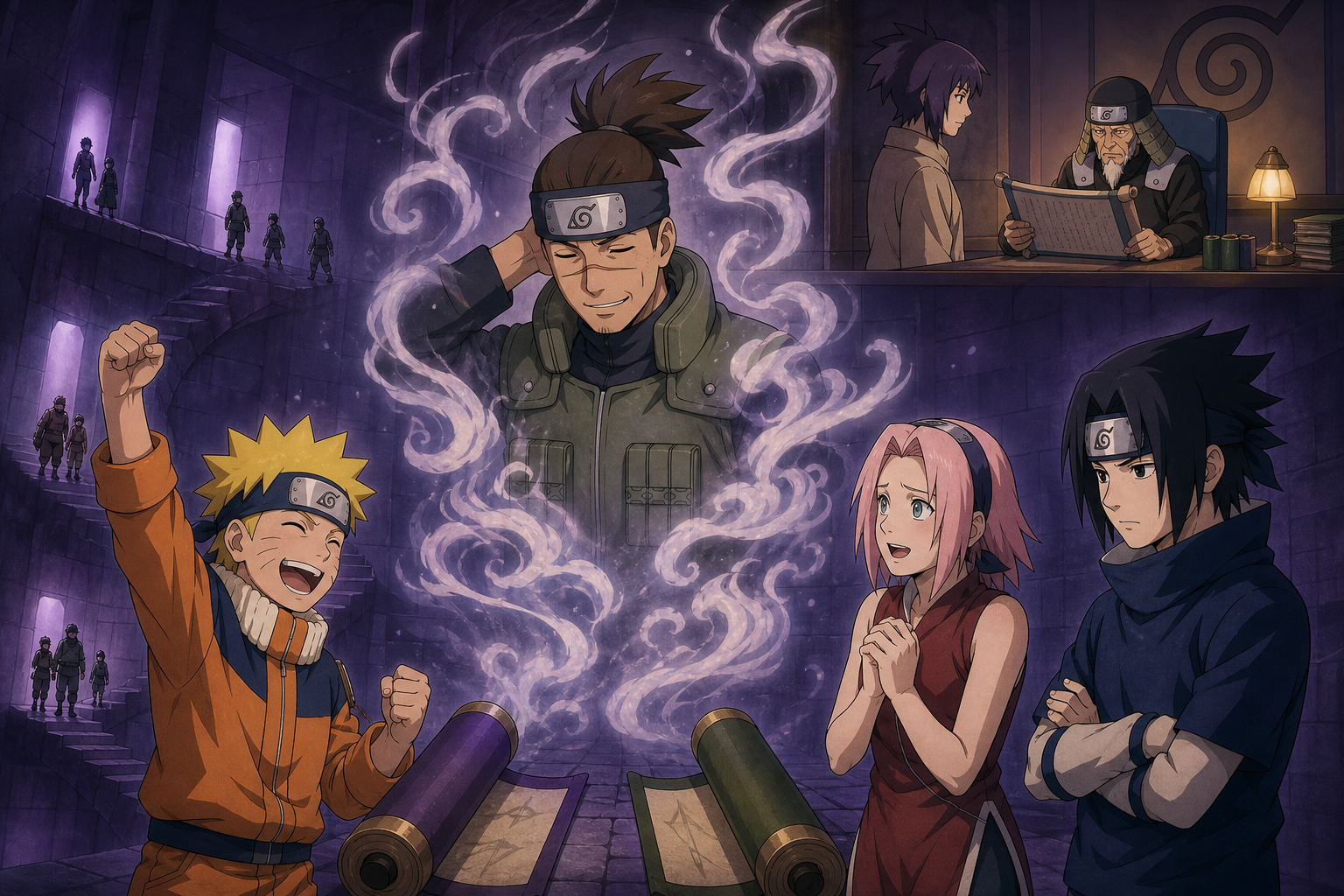
Team 7 reaches the tower, opens the paired scrolls and gets Iruka instead of treasure. Naruto celebrates survival. The adults quietly decide to keep the exam running after learning Orochimaru targeted Sasuke.
Episode 37 rewards Team 7 for surviving a test the village failed to secure, then asks Iruka to explain what a chūnin should protect. That lesson is sincere. So is the contradiction. Naruto, Sasuke and Sakura endured Orochimaru, the Sound trio, hidden penalties, hunger, injury and ambush while leadership knew the breach was bigger than ordinary exam danger.
Iruka’s pride is earned because he knows these children as people, not roster numbers. Hiruzen’s decision to continue the exam is harder to excuse. Twenty-one children survive the second stage, and the institution treats that as a scheduling problem before treating Sasuke’s targeting as a protection problem.
The paired scrolls finally reveal their job
Naruto, Sasuke and Sakura reach the tower with both Heaven and Earth Scrolls. When they open the pair in the authorized place, the embedded summoning technique brings Iruka Umino to them.
The same objects that could incapacitate a team when opened early now summon an instructor when handled correctly. The scrolls were never passive proof of possession. They carried the exam’s enforcement and completion mechanism.
That makes the tower a ritual threshold. Outside, opening means disobedience and removal. Inside, opening means recognition. Authority determines when the same act becomes wrong or correct.
Naruto celebrates because passing has always meant being seen
Naruto does not receive the news quietly. He has spent childhood chasing acknowledgment from adults who associated him with the Nine-Tails. Passing a stage under official rules gives him a visible receipt that cannot be dismissed as another prank.
The joy is not only rank ambition. Iruka is the adult whose recognition first reached Naruto without reducing him to the fox. Having that person appear at the finish line connects the boy who failed graduation repeatedly to the genin who carried a team through the Forest of Death.
That emotional payoff does not erase the cost. Naruto’s body survived dangers the exam did not disclose and threats the organizers did not contain. Recognition feels good because deprivation made it precious.
Iruka sees students where the system sees candidates
Iruka explains the mindset expected of a chūnin. Promotion means responsibility, judgment and protecting people under command, not simply producing the biggest technique.
His presence matters because he remembers their Academy selves. He can compare Naruto’s earlier irresponsibility, Sakura’s classroom strength and Sasuke’s isolation with the choices they made in the forest.
Iruka’s pride is a form of relational evaluation. He does not only know that Team 7 arrived with scrolls. He understands what growth means for these particular children. Institutions need that human memory, or assessment becomes a scoreboard without context.
The chūnin lesson exposes the exam’s own leadership failure
A chūnin must protect a squad, read danger and place mission responsibility above ego. The adults running the exam knew Orochimaru infiltrated the forest. Anko confronted him and reported the breach. Sasuke remained inside with a curse mark.
The institution therefore teaches standards it does not fully practice. Children are told leaders must protect subordinates while senior leadership leaves targeted genin inside an operation compromised by an S-rank missing-nin.
That hypocrisy does not make Iruka’s lesson fake. It makes the lesson a standard we can use against the adults too. Values matter most when they evaluate power upward, not only discipline downward.
Anko reports the breach with evidence and urgency
Anko Mitarashi tells the Third Hokage that Orochimaru entered the exam. She knows his methods, carries his curse mark and has directly confronted him. Her warning is not rumor from a frightened participant.
She also identifies that Sasuke is central to Orochimaru’s purpose. That raises the issue from general security failure to a targeted recruitment and bodily threat against one child.
Anko fulfills her institutional duty: investigate, confront, report. The decision about whether to stop the exam sits above her authority. This is where organizations often turn courage at the operational level into paperwork at the leadership level.
Hiruzen continues the exam knowing Sasuke is the target
Hiruzen Sarutobi decides the Chūnin Exams will continue. Political, diplomatic and security concerns surround an international event, and canceling may reveal weakness or disrupt relations. Those pressures explain the decision. They do not make the child-risk disappear.
Continuing also gives Konoha opportunities to observe Orochimaru’s plan and keep participants within a controlled venue. The forest has already proved the venue is not controlled enough. Any defense of the choice must admit that receipt.
Hiruzen’s leadership often carries warmth at the interpersonal level and dangerous compromise at the institutional level. He cares about village children and repeatedly asks them to absorb consequences produced by adult history. Episode 37 places that contradiction beside Iruka’s cleaner care.
Twenty-one survivors are too many for the next stage
The second exam ends with twenty-one qualifiers. That means seven three-person teams survive. The famous Rookie Nine are together again among them, alongside older and visiting competitors.
The number matters because the next stage cannot simply proceed as originally imagined. Too many successful bodies become an administrative issue, and the solution will be immediate individual preliminaries.
The institution designed a lethal filtering process and still dislikes the output count. That should tell us the exam is not merely measuring a fixed standard. It is managing scarcity in promotion slots.
The roster is also a military advertisement
Every surviving team represents a village, instructor and training system. Twenty-one qualifiers do not only create a bracket problem. They determine which villages can display depth, bloodlines and specialized techniques before clients and rivals.
Konoha’s Rookie Nine surviving together is therefore politically useful. The village can present a generation with clan inheritance, sensory skill, tactical intelligence and unusual power. The children experience reunion. Leadership can read the same bodies as institutional inventory.
This is why cancellation carries pressure beyond inconvenience. The exams are diplomatic theater and a market signal for military labor. Hiruzen’s choice protects that event economy while accepting greater risk around Sasuke. The political logic is real. So is the person paying for it.
Direction makes the tower feel safer before policy ruins it
The enclosed tower replaces the forest’s tangled space with stone, controlled light and official symbols. Team 7 can finally stop scanning every tree. Iruka’s arrival through clean summoning smoke turns the scroll mystery into a familiar face.
That relief creates room for the second half to sting. The episode moves from personal recognition to administrative discussion. Naruto receives praise downstairs while adults debate Orochimaru and continuation elsewhere. The edit lets viewers hold the emotional success beside the policy failure.
The contrast is not fake balance. One institution can contain a teacher who loves his students and leadership choices that endanger them. Warmth at the point of contact does not automatically repair decisions made above it.
The Rookie Nine reunion is relief with unresolved tension
The Konoha rookie teams reaching the tower creates a shared generational moment. Team 7, Team 8 and Team 10 carry different experiences from the forest, but all nine made it through.
Relief does not make them one uncomplicated friend group. Sasuke’s curse mark remains secret and dangerous. Sakura and Ino repaired part of their bond under attack. Kiba has seen Gaara kill. Shikamaru has been forced into responsibility. Lee’s condition sits nearby even though he belongs to the older Team Guy.
The reunion matters because the forest turned classmates into witnesses of one another’s limits. Future matches will look individual on the board while carrying those shared memories underneath.
Passing is not the same as healing
A test result can recognize completion without repairing what happened. Sasuke still carries Orochimaru’s mark. Sakura’s injuries and exhaustion do not vanish. Naruto’s chakra system was disrupted and forced back into service.
The village moves quickly from survival to the next assessment. That pace trains shinobi to treat recovery as private inconvenience rather than institutional responsibility.
Fans can celebrate Team 7 without pretending the exam was good for them. Growth under harmful conditions does not prove the harm was necessary. People build strength because they survive things, not always because those things deserved to happen.
Confucian duty gives Iruka’s lesson real weight
A Confucian lens values role ethics: a leader should act with responsibility toward people entrusted to them, while subordinates practice disciplined duty within the relationship. Iruka’s chūnin lesson fits that structure.
He also models the reciprocal side of authority. A teacher owes care, attention and moral example. Iruka does not merely demand growth from Naruto. He recognizes it and lets pride become part of the educational relationship.
Hiruzen’s decision creates the harder question. Proper hierarchy loses legitimacy when leaders protect institutional continuity more reliably than vulnerable people. Duty cannot flow only upward.
A Buddhist reading separates achievement from possession
Naruto wants promotion partly because rank promises identity and acknowledgment. The episode lets him enjoy passing while Iruka redirects attention toward what the role demands.
That movement loosens attachment to title as possession. A chūnin is not valuable because the vest proves superiority. The role matters when judgment reduces suffering and protects a group.
The exam itself remains attached to competition, prestige and village display. Individual candidates are asked to practice responsibility inside a system clinging to military status. That tension will become explicit when Hiruzen explains the political purpose next.
Japanese performance lets pride and warning share the room
Toshihiko Seki performs Iruka in the original Japanese anime. The scene needs warmth without becoming a graduation rerun. Iruka is proud, but he also speaks to candidates entering more serious responsibility.
Junko Takeuchi gives Naruto’s celebration the full force of a child receiving public confirmation. Noriaki Sugiyama keeps Sasuke guarded under the curse mark, while Chie Nakamura gives Sakura relief that still remembers what the team endured.
Takako Honda performs Anko with urgency shaped by personal history. Hidekatsu Shibata’s Hiruzen carries authority and deliberation. The contrast matters: Anko brings danger into the room; Hiruzen converts it into policy.
What changes after Episode 37
Team 7 officially completes the second exam. Iruka confirms their growth and defines chūnin responsibility. All twenty-one qualifiers assemble for the next stage.
Leadership now knows Orochimaru targeted Sasuke and chooses continuation. That decision makes every later consequence harder to call unforeseeable.
The story also shifts from team survival back toward institutional spectacle. Scrolls and forests give way to rosters and matchups. The children will be separated into individual contests while villages evaluate what their bodies can advertise.
RaeRae’s verdict
Iruka showing up inside the scroll is adorable because Naruto reaches the finish line and finds the first adult who truly saw him waiting there. I am keeping that feeling.
I am also keeping the side-eye. Anko reports that Orochimaru marked Sasuke, and the answer is to continue the youth military tournament. The village teaches chūnin to protect people while leadership protects the event.
Fandom misreadings I am rejecting
“Passing proves the Forest of Death was good training.” The team grew, and the exam contained preventable institutional failures. Both facts remain.
“Iruka only appears for nostalgia.” His teacher-student history gives the promotion lesson relational meaning and measures specific growth.
“Hiruzen had no choice but to continue.” He faced political constraints and made a choice. Constraints explain responsibility; they do not erase it.
“Twenty-one qualifiers mean the exam was too easy.” Participants survived lethal conditions and an outside breach. The number reflects outcomes, not an absence of cost.
“The Rookie Nine are already one united group.” They share history and survival, but relationships, rivalries and secrets remain uneven.
Receipts and official routes
Episode number, title and official synopsis: Naruto Official Site. Japanese broadcast title and synopsis: TV Tokyo. Streaming availability varies by region; use the official options linked from the episode directory.