
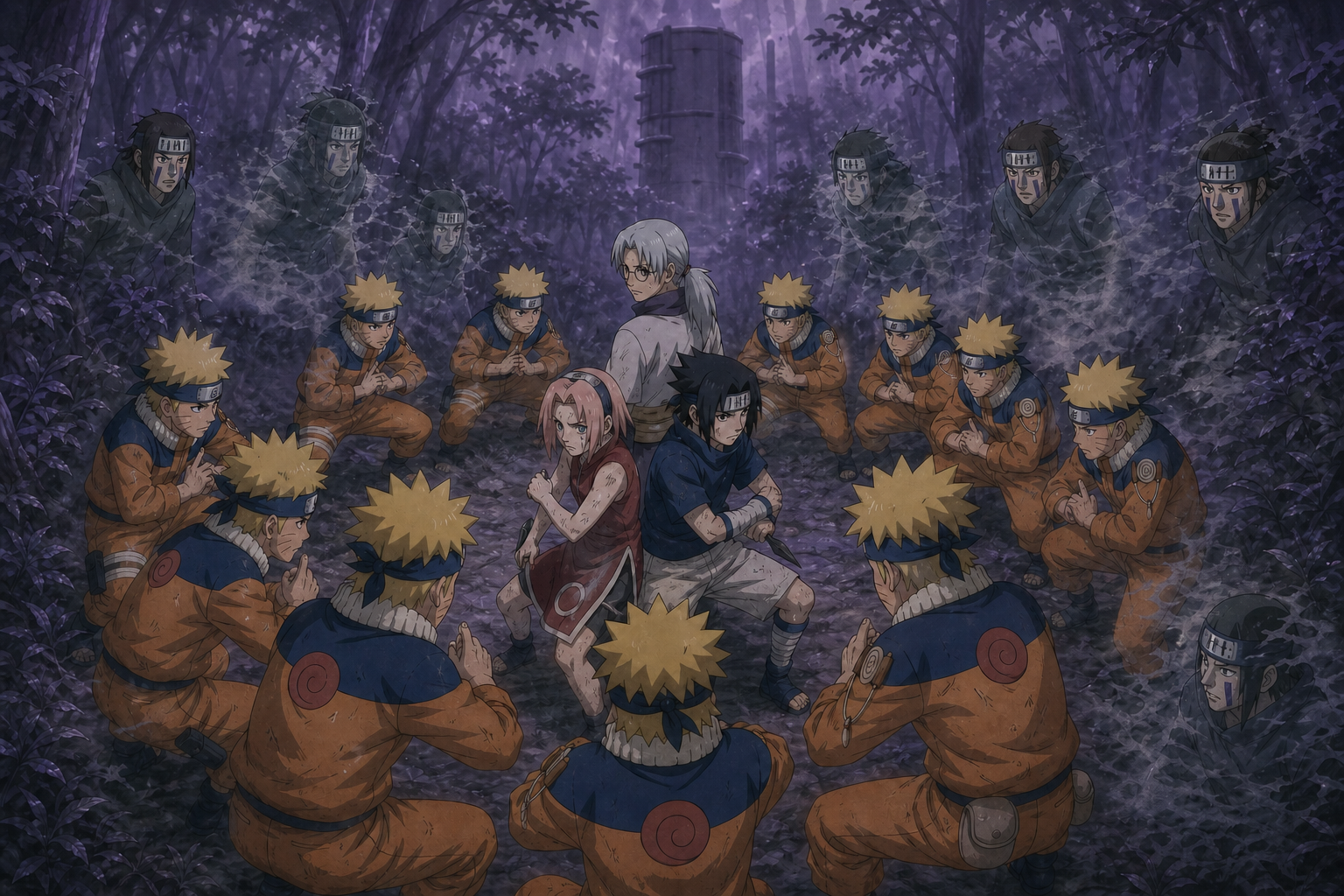
Clone vs. Clone: Mine Are Better Than Yours!
Rain genin trap Team 7 in a loop and weaponize fake bodies. Naruto answers with too many real ones, because subtlety has never been his favorite emergency service.
Episode 36 turns repetition into an ambush. Team 7 keeps walking the same ground, keeps striking bodies that do not matter and keeps spending energy while the real Rain genin remain hidden. Naruto’s answer is not refined. He floods the field with shadow clones until the enemy’s information advantage becomes harder to maintain.
The victory is not simply that his clones are “better.” Rain uses illusionary copies to waste labor. Naruto uses physical copies to create labor. One technique multiplies uncertainty. The other multiplies bodies willing to hit back.
Kabuto joins the road, and the road stops behaving
Naruto, Sasuke and Sakura travel toward the tower with Kabuto. They accepted his help because he prevented the scroll mistake and knows the exam terrain. That practical decision places a suspiciously informed stranger inside their formation.
The forest begins repeating. Familiar landmarks return. Distance stops producing progress. By the time the team recognizes the loop, the genjutsu has already extracted stamina.
That timing is the trap’s intelligence. A visible wall invites resistance. A repeated path lets targets spend their own bodies enforcing the prison. Team 7 is not held still. They are allowed to exhaust themselves through motion that feels productive.
Oboro’s team attacks the group’s confidence first
Hidden Rain genin led by Oboro use a genjutsu that fills the area with illusionary copies. The false bodies can be struck without reducing the threat. Every successful-looking attack teaches the team that effort produces no result.
That is psychological pressure as much as chakra technique. Fighters depend on feedback. A hit should change position, damage or numbers. When nothing changes, judgment starts to wobble.
The Rain team does not need each illusion to overpower Sasuke or Naruto. It needs the group to spend energy, expose habits and become frustrated enough to make a predictable mistake. Their advantage comes from controlling which information is real.
Illusion clones and shadow clones are not the same thing
The Rain copies are genjutsu images rather than independently physical fighters. Destroying one does not remove a body because there was no body there to begin with. Their value lies in misdirection, concealment and attrition.
Naruto’s Shadow Clone Technique divides chakra across physical copies that can act, strike, gather information and disappear when damaged. The clone returns experience to the original when it vanishes, though the early series has not yet built every later use around that fact.
This is why the title’s boast has a mechanical foundation. Naruto’s copies cost far more chakra, but they can occupy real space and perform real labor. Rain creates cheap uncertainty. Naruto spends an absurd reserve to create a workforce.
Sasuke’s Sharingan cannot solve a body that is already compromised
Sasuke tries to use the Sharingan to locate the real attackers. Normally, visual perception should help distinguish chakra use and movement. Orochimaru’s curse mark reacts and disrupts his control.
The failure matters because Sasuke has just been taught to rely on the eye as proof of superiority. Now an adult’s mark interferes with the very inheritance Orochimaru wants to exploit. The curse does not simply offer future power. It reduces present autonomy.
Sasuke’s frustration is therefore more than wounded pride. His body no longer obeys familiar technique rules. He cannot know whether using more chakra will solve the problem or feed the mark. Orochimaru has inserted uncertainty into his decision-making.
Naruto attacks the labor problem with labor
Naruto first strikes illusion after illusion and gets nowhere. The obvious lesson would be to stop wasting energy. His eventual answer is to create enough shadow clones to pressure the entire field at once.
That sounds like wasting even more energy, and for most genin it would be. Naruto’s abnormal reserves change the economics. He can sustain a number of physical copies that the Rain team did not budget for.
The strategy also shifts risk. Instead of three exhausted teammates guessing which target matters, clones can test space, absorb attacks and create simultaneous observations. Naruto turns his notorious excess into distributed reconnaissance.
Shadow clones solve this problem and create another bill
Physical multiplication does not create chakra from nowhere. Naruto divides his available chakra among the copies, then asks every body to move and fight. His reserve makes the scale possible, but exhaustion remains real.
That cost matters because the exam clock is still running. A solution that wins the clearing can leave the team too weak to finish the route. Naruto’s strategy is appropriate because continued looping is already draining them. He spends a large resource to stop a slower leak.
The episode therefore gives the power system an economic shape. Rain invests less chakra in deceptive forms and hopes the targets spend more answering them. Naruto accepts the high upfront cost of physical clones to collapse that advantage. Neither technique is “better” outside context. Cost, body, terrain and objective decide value.
Sakura’s field reading keeps the chaos connected
Sakura does not receive the loudest technique, but her attention to the trap and the team’s condition matters. She has already spent days caring for injured teammates. She knows their stamina is not theoretical.
Her role is not to clap while the boys solve things. She tracks what attacks fail to change and helps the group recognize the mismatch between visible targets and actual threat. In a genjutsu encounter, refusing false feedback is combat work.
The episode again exposes her curriculum gap. Sakura has excellent chakra control and academic knowledge, qualities that should support genjutsu literacy. The story has not yet given her a signature system equal to that potential. Her insight contributes while the power distribution remains uneven.
Kabuto is observing under the cover of assistance
Kabuto contributes information and stays close enough to study Team 7’s responses. He sees the curse mark limit Sasuke. He sees Naruto’s reserve produce a mass of shadow clones. He sees how Sakura organizes around both boys.
Nothing about that observation makes his immediate help imaginary. The useful ally and the intelligence collector occupy the same body. That is why he is dangerous.
Espionage rarely requires constant lying. Accurate information builds credibility. Shared danger produces intimacy faster than conversation. Kabuto can assist the team and still serve a purpose they have not consented to.
The Rain team represents a different survival economy
Amegakure’s genin enter from a smaller village shaped by larger powers fighting around and through its territory. This episode does not narrate the full Rain history, so we should not paste later politics into every movement. The institutional imbalance remains visible.
They use concealment, attrition and environmental control rather than meeting Konoha’s famous rookies in a clean strength contest. That is not cowardice. It is strategy shaped by limited comparative power.
Their methods become predatory when they use exhaustion to take the scrolls, but the exam created the scarcity driving the attack. Children from different villages are forced to convert one another into resources while the military institutions observe.
Walking in circles is a useful visual metaphor, but it earns the right
The team is literally moving without progress. That image also describes the exam’s promise of advancement. Children spend bodies, gather scrolls and chase rank while adults hide the political purpose behind ritual.
The metaphor works because it grows from the technique. The story does not stop to announce that life is a maze. Characters notice repeated terrain, lose strength and adjust. Meaning follows evidence.
Direction can make the familiar forest oppressive by repeating compositions and landmarks. The audience begins doubting movement with the characters. When clones fill the frame, quantity stops representing support and starts representing uncertainty.
Confucian teamwork needs role clarity, not identical power
A Confucian lens values ordered cooperation when roles serve collective welfare. Team 7’s members contribute different forms of judgment: Naruto supplies physical multiplication, Sasuke tests visual analysis, Sakura monitors pattern and Kabuto provides procedural experience.
The hierarchy remains unstable because Kabuto is not their assigned leader and his loyalties are unknown. Useful authority can emerge from expertise, but trust should remain accountable to relationship and conduct over time.
Naruto’s clones also complicate individuality. They share one identity and purpose, yet each copy performs separate labor. The technique literalizes collective effort without requiring Naruto to become socially disciplined first.
A Buddhist reading finds suffering inside false multiplication
The Rain illusions multiply forms without multiplying substance. Striking them repeatedly produces frustration because the fighters cling to visible bodies as if appearance guarantees reality.
Naruto’s shadow clones are physical, but they are also temporary. Their usefulness depends on accepting disappearance. The episode places two kinds of impermanence against each other: forms that were never materially present and forms created knowing they will vanish.
The practical lesson is not mystical. Observe effects. Release attachment to the first explanation. Stop spending the body on appearances that do not change the field.
Japanese performance makes repetition feel increasingly personal
Junko Takeuchi performs Naruto’s frustration as escalation rather than one repeated shout. Each failed attack adds insult until the shadow-clone answer feels emotionally inevitable.
Noriaki Sugiyama carries Sasuke’s anger inward as the curse mark interferes with the Sharingan. Chie Nakamura keeps Sakura alert to the team’s deterioration. Nobutoshi Canna lets Kabuto remain calm enough to sound helpful while everybody else loses patience.
Tadasuke Ōmizu performs Oboro in the original Japanese anime. The Rain team’s control works because their voices do not need to match Naruto’s volume. Hidden opponents benefit from letting the targets generate the noise.
What changes after Episode 36
Team 7 learns that the route to the tower can be weaponized through genjutsu and attrition. Naruto’s reserves become a tactical answer to mass deception. Sasuke receives another warning that the curse mark can deny access to his own abilities.
Kabuto deepens his position as a trusted guide while collecting direct evidence about the team. Sakura continues operating as the connective intelligence between dramatic powers.
The Rain team also proves that the exam’s strongest threat is not always the person with the largest attack. Control the route, feedback and target’s stamina, and a weaker squad can make famous rookies fight the air.
The larger consequence reaches beyond one scroll fight. Naruto is learning that his apparently ridiculous reserve can be organized into strategy. Sasuke is learning that outside control can interrupt inherited power. Sakura is learning how often she must stabilize a team whose strongest tools arrive with dangerous conditions. Kabuto is learning all of it too, and only one side knows the observation is part of another mission.
RaeRae’s verdict
Naruto wins the clone argument by bringing actual employees to a hologram convention. It is excessive, expensive and exactly tailored to the one advantage his body can afford.
The smarter point is that power depends on what problem it solves. Sasuke’s eye cannot stabilize under the curse. Sakura’s pattern recognition cannot strike every target. Naruto’s clones can turn uncertainty into enough simultaneous tests to force reality out of hiding.
Fandom misreadings I am rejecting
“Naruto wins by being too dumb to stop.” Persistence matters, but the physical clone mechanics and abnormal chakra reserve make the final strategy viable.
“Sasuke is useless without the Sharingan.” His body is being disrupted by an imposed curse mark. A compromised tool is not a complete measure of the user.
“Rain’s illusion tactic is cheap.” Attrition and concealment are legitimate strategy. The exam rewards taking scrolls, not entertaining spectators.
“Kabuto proves he is a trustworthy senior.” He provides real help. Trustworthiness requires knowing whom that help ultimately serves.
“More clones automatically means more power.” Physical copies divide chakra. Naruto can exploit the technique because his reserves make a normally ruinous cost possible.
Receipts and official routes
Episode number, title and official synopsis: Naruto Official Site. Japanese broadcast title and synopsis: TV Tokyo. Streaming availability varies by region; use the official options linked from the episode directory.