
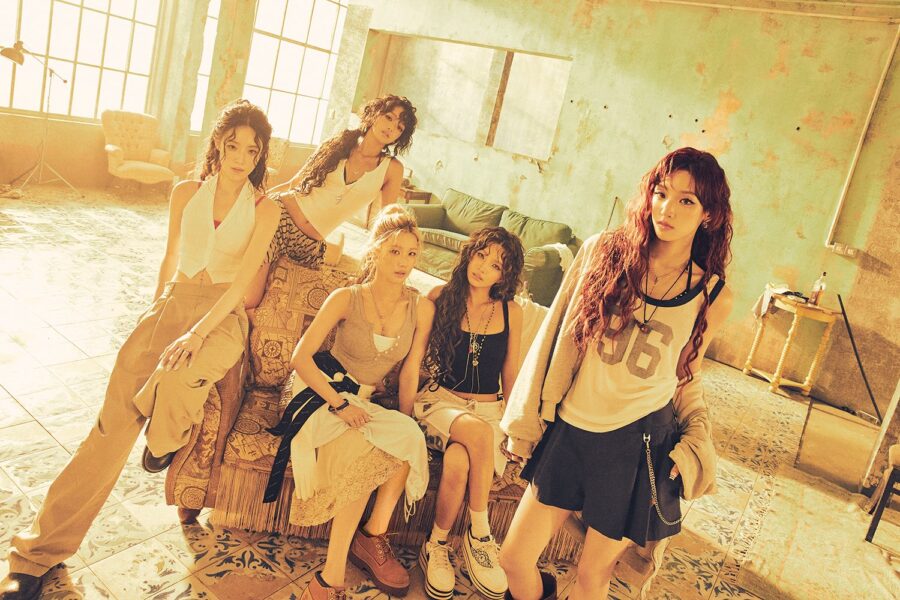
Mono
i-dle made a song about escaping binaries, trapped almost the entire video inside one, then let Miyeon turn the color back on.
Members: Miyeon, Minnie, Soyeon, Yuqi and Shuhua
Featured artist: skaiwater
Lyrics: icebluerabbit, Shannon Bae and skaiwater
Composition: icebluerabbit, Daily, Shannon Bae, Kameron Glasper and Likey
Arrangement: Daily and Likey
Performance video: February 1, 2026
What changed every time I replayed it
First play: This is incredibly calm for a song arguing with the entire concept of social boxes. The soft percussion and repeated “la la” phrases do not attack the listener. They invite the rules to sit down, then quietly explain why the rules are embarrassing.
Second play: Miyeon’s color change became the center. The song reaches the idea that people were born to love, and the screen suddenly remembers color exists. No giant production drop. No speech. Love itself changes the visual rule. Simple, effective and rude to my feelings.
Third play: skaiwater’s processed vocal still sounded like somebody opened another tab without muting the first one. The perspective belongs inside a song rejecting gender binaries. The sonic transition needed a better doorway. Friction can be meaningful without making me check whether Bluetooth disconnected.
Fourth play, performance version: Thirty dancers provided the missing punctuation. Symmetry became social order, rows became pressure, and loosened formations made freedom physical. The same repeated phrases that felt like padding on audio became cues for patterns spreading through the frame.
Fifth play: I stopped confusing a relaxed argument with a weak one. i-dle do not need to shout basic acceptance as if they discovered kindness yesterday. Still, confidence and musical development are separate jobs. The message is settled. The arrangement could have crossed one more line.
Where I landed: I like the song. I like the full audiovisual event more. “Mono” has an excellent premise and a pleasant groove; the choreography turns that premise into movement, hierarchy, disruption and release.
The argument travels from society to one person
At the macro level, “Mono” pushes against institutions that survive by sorting people into pairs: man or woman, normal or abnormal, family or outsider, respectable or dangerous. A binary makes administration easy. It also turns real lives into paperwork problems. K-pop operates inside that pressure because the industry sells carefully readable identities while its global audience brings many different ideas about gender, love and belonging.
At the interpersonal level, the song asks a smaller question: what happens when somebody you love needs you to stop treating your assumptions as facts? Acceptance is not a rainbow caption posted once a year. It is listening when a person tells you who they are, refusing to turn their life into debate practice, and noticing when your idea of harmony only keeps you comfortable.
A modern Confucian reading does not require frozen social roles. The tradition places enormous weight on relationship, responsibility and humane conduct. If a rule makes a person easier to categorize but harder to love with dignity, the rule has failed the relationship. Harmony without reciprocity is silence managed by the powerful.
A Buddhist lens also fits the title. “Mono” begins with one channel, one color and one accepted view. Buddhism warns against clinging to a permanent self because living things change through causes, conditions and relationships. The song does not ask us to replace one rigid label with a cooler rigid label. It asks why love needs the cage at all.
My RaeRae lens is less elegant: if your system needs five women, thirty dancers and a nonbinary artist to stand still so your boxes make sense, maybe your boxes are the ones having an identity crisis.
Freedom needs more than one pretty comeback
There is a reason this argument lands differently when five women in K-pop make it. Idol companies love a clear box because a clear box is easy to sell. The cute member, the elegant member, the tomboy, the foreign member, the rapper, the visual. Those labels help a new fan learn names, but they can also become job descriptions that follow a woman for years. A person changes. The marketing deck keeps wearing the same wig.
i-dle have spent much of their career fighting that kind of flattening in public. Soyeon writes with an eye on the whole group, Minnie and Yuqi bring musical colors shaped by lives outside Korea, Miyeon can move between polished grace and dry comedy, and Shuhua has become far more outspoken than the quiet role early promotions handed her. “Mono” works because the members already know what it costs to be reduced to one readable trait. The song is talking about gender and love, but the industry around them supplies another example every time a comeback assigns a personality along with the wardrobe.
The black-and-white frame also carries an East Asian social pressure that a generic “be yourself” caption cannot explain. Family duty and group harmony have real value. They teach people to notice how one choice affects everyone else. Trouble starts when harmony means the youngest person, the queer person, the woman, or the outsider must absorb every discomfort so the powerful people never have to feel awkward. That is not harmony. That is one side doing all the emotional labor while everybody else congratulates the room for staying quiet.
From an MRT lens, “Mono” is a systems problem dressed as a love song. A rule can look neutral on paper and still punish the same people over and over. If every approved path assumes one kind of family, one kind of body, or one kind of future, then “personal choice” is happening inside a hallway somebody else narrowed. The song’s best idea is that love exposes the bad architecture. The minute a real person does not fit, the box starts demanding that the person shrink.
That is also why Miyeon turning the color back on matters more than a pretty edit. She does not rescue the other members or announce that one enlightened idol fixed society. She changes what the audience is allowed to see. Color was present all along; the frame refused to show it. The visual lands because acceptance does not manufacture somebody’s identity. It stops treating that identity like a technical error.
I still wish the music took a similar risk. The lyrics and video question the room, while the instrumental keeps the furniture exactly where it was. A bridge that fractured the beat, stacked the members into competing lines, or let the final chorus bloom beyond the original groove could have made freedom audible. The performance crew eventually does that work with bodies. The record itself stays polite enough for the same boxes it is criticizing.
What “Mono” is saying
The title starts with one color, one channel, one accepted way of seeing. The lyrics push against that restriction. Right and left, correct and incorrect, masculine and feminine, acceptable and unacceptable. The song keeps naming the lines people are expected to stand on, then asks why love should obey any of them.
This is not coded so heavily that the meaning disappears into a graduate seminar. The language about sides, colors, and being born to love makes the queer reading very easy to find. That matters in a Korean pop context, where major acts often leave LGBTQ support inside vague universal-love language. “Mono” still uses metaphor, but the metaphor has taken off its sunglasses and is making eye contact.
The smart part is that the song does not perform rebellion by shouting. Its confidence is relaxed. i-dle sound as if the argument has already been settled and everybody else simply needs time to catch up.
The song: meaningful, smooth and almost too polite
The production is spare. A soft beat, open space, repeated melodic phrases, and vocals that glide rather than attack. It is easy to hear why some listeners called it charming and why others called it one-note. “Mono” establishes its atmosphere quickly and mostly stays there.
That steadiness fits the message. The song is refusing the idea that freedom must look like a riot. Still, message and momentum are different jobs. By the second half, I wanted one musical decision that felt as bold as the lyric. A more forceful bridge, a harmony pileup, a percussion change, anything that made the track step across its own line.
The members carry the calm well. Miyeon and Minnie give the melody warmth. Yuqi’s lower color keeps the softness from becoming weightless. Soyeon does not dominate the structure, which is surprising enough to become part of the texture. Shuhua’s cool delivery fits the detached confidence perfectly.
The skaiwater argument
skaiwater is the group’s first outside featured artist on an official single, and the collaboration is significant. The British rapper and producer is nonbinary, which makes the feature part of the song’s meaning rather than a random streaming calculation.
The verse is also the most divisive section. The heavy vocal processing snaps the listener out of i-dle’s smooth blend. Some fans liked the texture because it interrupts the polished K-pop surface. Others felt the flow became choppy or that the feature sounded imported from another song.
I am in the middle. The perspective belongs here. The sound is supposed to create friction. I simply wish the transition prepared the ear better. A feature can disturb the room without sounding as if it entered through the wrong door.
Why the performance video helps
The original music video already uses black and white as the central visual rule. The mega-crew performance takes that concept and gives it bodies. Rows of dancers become social order. Symmetry becomes expectation. When formations loosen, the message stops being an idea printed over pretty footage and becomes something physical.
i-dle are very good at using backup dancers as narrative material. The crew is not wallpaper. They build corridors, crowds, boundaries, and pressure. The members move through those shapes rather than standing in front of them waiting for a chorus.
Miyeon’s lifted “princess seat” moment is funny and visually satisfying, but it also breaks the horizontal sameness. She rises above the grid just before the performance opens outward. Reddit noticed the two men preparing the lift in the background because once you see the machinery, you wait for the payoff.
The choreography gives the repeated “la la” phrases a job. On audio alone, those repetitions can feel like padding. With the crew, they become cues for patterns spreading across the frame. The song finally gains visible escalation even when the instrumental remains steady.
Easter eggs and details worth noticing
- Color returns on the love lyric. The shift occurs with the idea that people are born to love. The video does not wait for a production drop. Love itself changes the visual rules.
- The crew begins as structure. Tight lines and repeated shapes make the dancers feel like the system the members are questioning.
- Miyeon’s lift breaks the flat frame. A song called “Mono” suddenly gives one body height, motion, and visual privilege.
- The five members retain different movement textures. They are dressed inside one palette without being flattened into one personality.
- skaiwater’s presence is conceptual. The featured artist embodies the song’s refusal of gender binaries, even for viewers who never read the press release.
- The performance became part of the comeback’s success. Korean coverage specifically pointed to the mega-crew video as a major response driver before the song finished its three-win music-show run.
The counterargument
A strong message does not require everybody to love the song. Fans worried that criticism of the track would be treated as criticism of its LGBTQ meaning. That would be unfair in both directions. People can support the message and still want a stronger chorus. They can dislike the feature’s processing without rejecting the featured artist.
My criticism is musical. “Mono” has an excellent premise and a pleasant groove. It does not fully develop that groove. The performance video supplies contrast, scale, and momentum that the recording leaves implied.
RaeRae verdict
I like “Mono.” I like what it says, and I like that i-dle delivered the idea without acting as if basic human acceptance required a motivational speech. The song could use more bite. The performance already found it.
Best part: the color transition and the mega-crew formations.
Biggest complaint: the audio stays in one emotional gear too long.
Replay danger: medium on headphones, high with the performance video.
Final rating: 8.0/10 for the song, 8.7/10 for the full audiovisual event.
Receipts
- Official i-dle release announcement
- YTN: collaboration and song message
- BizEnter: visual analysis and mega-crew response
- Edaily: three music-show wins and performance response
Keep digging: Visit i-dle, then read the “Gimme Dat Love” review and the “Crow” review.