
Memory, Sorrow, and Thorn · Canonical Character Profile
Maegwin
Hernystir’s too-tall princess becomes the last functioning authority of a broken royal house, finds an impossible city under the mountain, mistakes the Sithi for gods, and still makes one lucid final choice that helps save the world. Her tragedy is not that she feels too much. It is that grief, prophecy, leadership, and genuine supernatural contact become impossible to separate in time.
At a Glance
The woman beneath everybody else’s interpretation
- Title
- Princess of Hernystir; last surviving child of King Lluth
- Family
- Daughter of Lluth and Penemhwye; older half-sister of Gwythinn
- Primary role
- Exile leader, discoverer of Mezutu’a, visionary, military catalyst, and Graylands guide
- Defining love
- Count Eolair of Nad Mullach, her childhood friend and most trusted political companion
- Crucial objects
- Lluth’s wooden nightingale and Ys-fidri’s carved stone bearing her name
- End-of-series status
- Dead; gives her remaining life to Simon so he can return from the Graylands
The Visual Receipt
Tall, sorrel-haired, strong—and never the farm horse she sees in the mirror
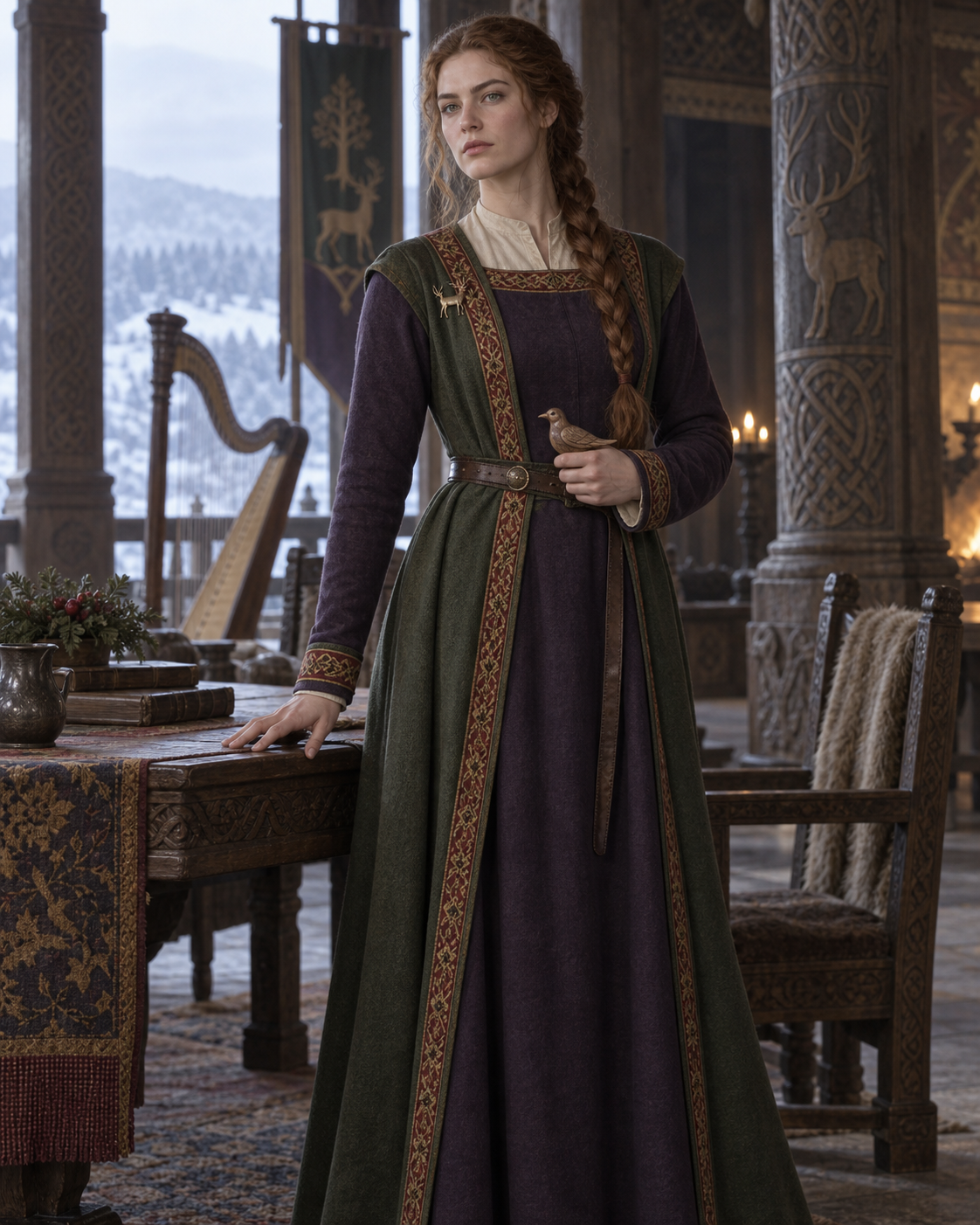
Maegwin is tall enough to match Gwythinn’s stride, long-legged, white-skinned, and sorrel-haired. She judges herself gawky, blunt, plain-faced, clumsy, and farmer-like, especially beside the courtly femininity she imagines men prefer. The text does not validate that verdict. Eolair notices her strength, warmth, scent, and the softness that appears when she is not armoring herself against pity. Her approved Taig portrait makes that gap visible: she is striking and desirable, while the guarded set of her face belongs to a woman who does not believe she is.
The portrait locks one adult identity: a very tall, strong young woman with fair skin, long sorrel-chestnut hair, and a watchful gray-green gaze. Her exact face, eye color, braid, purple-and-green dress, red-gold trim, stag brooch, carved nightingale, harp, hall, and winter light are editorial reconstruction built around the novel’s firmer physical anchors. Her visual chronology still matters. The composed Taig princess becomes ragged, stained, exhausted, and commanding in the Grianspog caves; then starving and frostbitten on Bradach Tor; then eerily calm inside her heaven-delusion. Those are milestones, not recastings. Her distress must never become grotesque beauty shorthand: light, clothing, health, and expression may change; her face and humanity may not.
The Complete Journey
The last daughter of a ruined house tries to make meaning arrive on time
Book 1 · The Dragonbone Chair
She understands the room before the men finish threatening one another
Maegwin enters as the person disciplining Gwythinn’s justified anger because he is expected to inherit Hernystir. She is five years older, unmarried, and already practicing a leadership the succession structure does not name. When Guthwulf calls her the Rose of Hernysadharc, she corrects him: that title belonged to Elias’s mother. The answer refuses a decorative compliment and restores the maternal debt Erkynland would prefer to forget.
Lluth cannot pay Elias’s demanded tithe without worsening starvation. Guthwulf mocks the refusal; Gwythinn puts a blade to the envoy’s throat; Maegwin picks up a fragment of the shattered harp and winds its string around her hand. The gesture is her Book 1 thesis. Men convert crisis into spectacle while she contains terror tightly enough to watch what the kingdom will require next.
After Skali’s invasion destroys Hernysadharc, Maegwin leads women in saving the Taig’s cattle and confronts the contempt that calls necessary labor men’s work. Lluth is mortally wounded, Gwythinn murdered, and the surviving Hernystiri driven into Grianspog. The princess who was not the heir becomes the last authority of her father’s house because everybody the law preferred is dead.
Book 2 · Stone of Farewell
She finds the past—and cannot make it answer the question she brought
Maegwin tends the cairns of Lluth and Gwythinn while singing the story of Drukhi and Nenais’u. The old song gives exile a shape, then threatens to become a mold she presses over every living person. She wants permission to join the dead; Eolair insists the displaced still need her. Maegwin responds with a real plan: move deeper into Grianspog, ration, hunt, raid, and survive beyond Skali’s reach.
She is not simply unraveling. She comforts mothers, settles disputes, listens, and discovers that her people value judgment more than delicacy. She also begins treating disagreement as betrayal. Grief, competence, and dangerous certainty develop together, which is precisely why nobody can solve her by announcing one clean diagnosis.
Following voices and dreams, Maegwin cuts through a massive sealed door. Eolair helps open it, and together they discover Mezutu’a, a city carved from living stone beneath the mountain. Its Shard carries the exhausted voice of First Grandmother. The supernatural contact is real; Maegwin’s interpretation is not therefore automatically correct. She uses the dwarrows’ maps strategically, sends Eolair to Josua with knowledge of Bright-Nail and hidden routes beneath Asu’a, and poisons the order with humiliation because admitting that she needs him feels unbearable.
Book 3 · To Green Angel Tower, Part I
A miracle arrives and makes the dangerous story feel proven
Fewer than a thousand Free Hernystiri remain. Maegwin governs them effectively, then dreams of beautiful inhuman lights commanding her to climb. Diawen’s wormglass finds an unknown language rather than confirmation, but the scryer encourages obedience. Maegwin ascends Bradach Tor without food and nearly steps into the abyss. Simon, Jiriki, and armored Sithi find her after three days. She sees Brynioch and the gods.
The mistake becomes public policy. Maegwin assembles her people, layers Mezutu’a, survival, and the mountain vision into proof, and argues that love for Hernystir is the greatest magic. She leads a few hundred elders, women, and children unarmed toward Skali, believing the gods will come if the people prove worthy. The march is courageous. It is also catastrophically irresponsible. The Sithi army arrives at the instant Skali’s prisoners despair, turning genuine rescue into apparent validation.
Back in her old room, Maegwin says she made the gods come. Attendants affirm her. She feeds seed corn to birds as flowers and treats Eolair as a fevered soul who cannot accept that they are dead in heaven. Kira’athu finds no bodily illness she can repair; Maegwin’s spirit hides like a mouse under an owl’s shadow. The healer gives Eolair one instruction: be kind.
Maegwin finally tells Eolair she has loved him since childhood—but asks how he died before doing it. Tenderness reaches her without reaching the shared world. She joins the march to Naglimund because she believes a dead woman cannot die twice. The battlefield’s actual dead fracture that sustaining cosmology. If gods die and Gwythinn is absent, what heaven has she entered?
Book 4 · To Green Angel Tower, Part II
Clarity returns where nobody can use it to save her body
Behind Naglimund’s keep, Maegwin touches the vast empty presence of the Fourth House: a four-cornered ring of flame around a white tree, every thought bent toward Green Angel Tower. She is found deathly cold and nearly breathless. Kira’athu can make her comfortable but cannot repair a soul wounded before the battle. Ys-fidri’s stone calms her because it carries her name when she feels most completely lost.
In the Graylands, Simon finds Maegwin as warm light. Their stories finally separate the Sithi from gods and supernatural manipulation from destiny. Simon does not erase her agency by declaring her powerless, and he does not confirm her fear that she single-handedly destroyed Hernystir. Maegwin sees the pride inside believing even gods waited upon her actions. The insight arrives without the cruel fantasy that perfect self-knowledge restores everything.
Simon wants to remain in the interval; Maegwin insists the living still need him. Afraid and lucid, she transfers her remaining life into him so he can return. Jiriki later touches her named stone and tells Eolair that her madness lifted and her last thoughts were clear. Eolair takes her home for burial and chooses the work she protected: rebuilding Hernystir instead of waiting for divine rescue.
The People Around Her
Love, inheritance, and the danger of being believed too quickly
Eolair
Friendship, fealty, childhood love, political partnership, and missed timing occupy the same relationship. He follows her into darkness, fails to name his love while she can receive it, then carries her home and rebuilds the country her last act helped preserve.
Lluth and Gwythinn
Father and brother structure both grief and authority. Their deaths leave her with a house she was not raised to inherit and a people whose need makes joining the dead impossible.
Diawen
Diawen offers compassion and then mistakes intensity for evidence. Her validation helps private delusion acquire public authority, making kindness without verification one of the story’s sharpest dangers.
The Sithi
They genuinely save Hernystir and genuinely are not the gods Maegwin believes them to be. Their arrival proves that events can be miraculous without proving the interpretation built around them.
Simon
He appears first as the divine messenger she imagines and later as the lost young man she can actually help. Their Graylands conversation gives both of them a truth the living world could not make audible.
Hernystir
Her deepest love is national without being abstract. It lives in songs, cattle, caves, hungry children, names, plains, and the unbearable conviction that she must personally force salvation to arrive.
Why She Works
The story refuses to make madness simple
Maegwin works because the narrative keeps three truths alive. She is traumatized and mentally unwell. She receives genuine supernatural signals. She makes consequential choices for which leadership requires accountability. Remove any one truth and the character becomes easier, flatter, and less humane.
Her worst decision grows from virtues already proven real: courage, cultural memory, willingness to share danger, and refusal to surrender Hernystir. The unarmed march does not become wise because the Sithi save it; it does not become meaningless because its premise is false. Belief creates collective courage and exposes children to an occupying army. Outcome cannot retroactively settle method.
Her final act is powerful because lucidity does not arrive as a prize for suffering. Maegwin cannot go back and choose differently. She can understand, refuse Simon’s attempt to remain with the dead, and give what remains of herself toward a future she will not see.
On the Record
Scope, spoilers, and one face across every threshold
This is Maegwin’s one canonical profile across all four owned Kindle volumes and their completed reading receipts. It is intentionally full-spoiler. Franchise and volume directories must filter this post by appearance and show status appropriate to their declared spoiler scope rather than create duplicate biographies.
Visual state: approved and identity-locked. The same Maegwin portrait now supplies this post’s featured image, visible hero, social image, and every referring directory card. Future Taig, Grianspog, Bradach Tor, Naglimund, death, or Graylands artwork must preserve this exact adult face, height, build, fair complexion, and sorrel hair. Costume, damage, weather, and emotional state may follow the chronology; the character may not be redesigned.