
Memory, Sorrow, and Thorn · Canonical Character Profile
Lluth ubh-Llythinn
King Lluth refuses Elias’s tithe because Hernystir is already watching crops fail and cattle die. He protects the envoy who threatens his children, rides to defend a kingdom he cannot save, and returns to Grianspog without speech. His bloodline leaves Maegwin authority; his death leaves her the impossible work of turning a broken household into a people.
At a Glance
The Stag King who refuses to tax a famine into obedience
- Title
- King of Hernystir
- Household
- Father of Maegwin and Gwythinn; husband successively to Penemhwye, Fiathna, and Inahwen
- Seat
- The Taig at Hernysadharc
- Conflict
- Rejects Elias’s tribute demand under drought, winter, and livestock sickness
- Final refuge
- Grianspog caverns after Hernystir’s defeat
- End status
- Dead; buried in a cairn tended by Maegwin
The Visual Receipt
A huge aging king with a broken nose—and later a body the war has nearly emptied
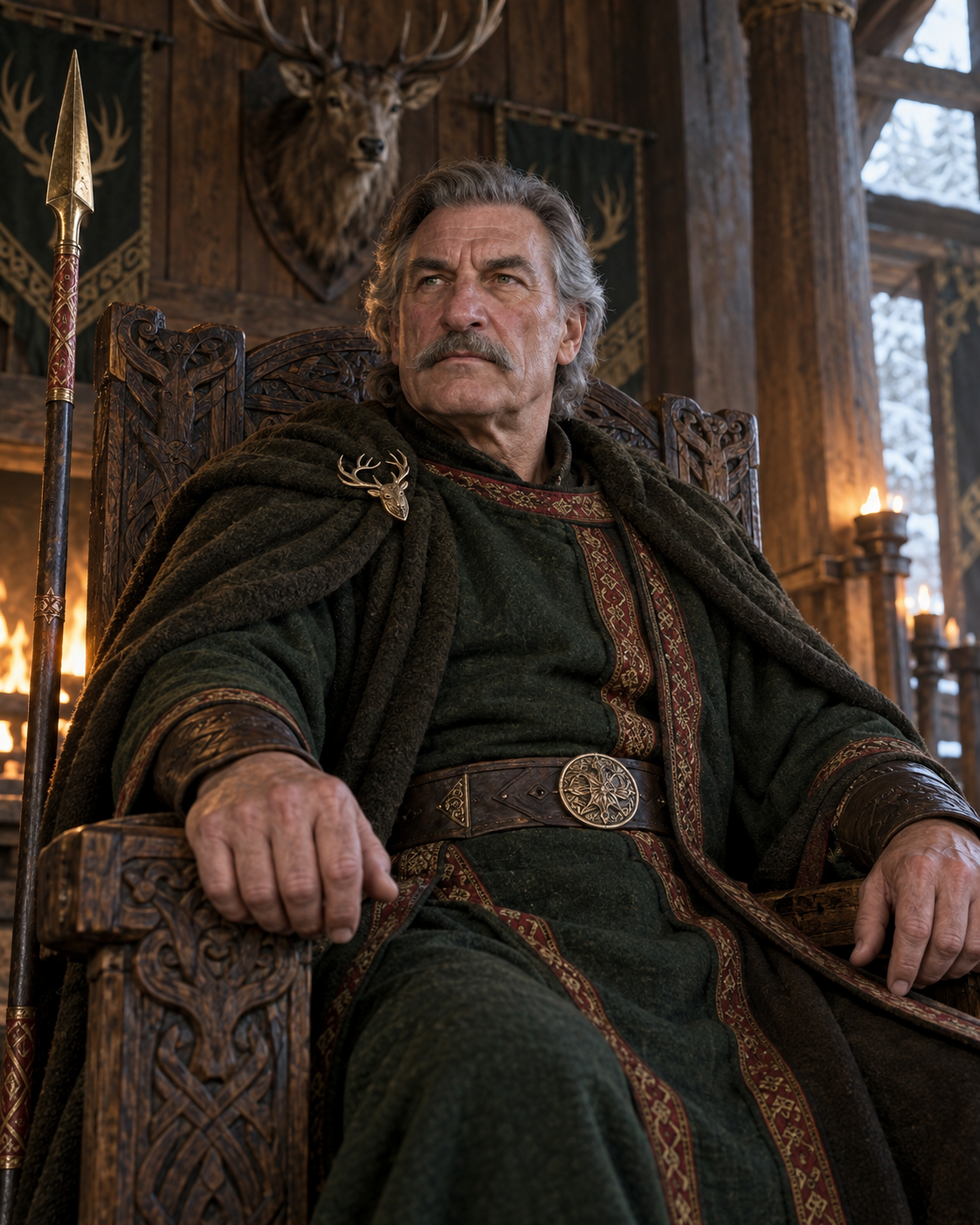
Lluth is a huge older ruler with a gray mustache, mobile clever features, and a thick crooked nose broken in boyhood. He sits beneath the Taig’s stag head in an oak chair fitted with real antlers. The throne makes Hernystiri authority material without turning him into a ceremonial prop.
After military defeat, the visual record changes brutally. Lluth returns gravely wounded, wax-pale and burning with fever, moving his lips without speech on a rough bed in Grianspog. The contrast must remain inside one canonical identity: ruling vitality and dying helplessness belong to the same man.
The approved Taig portrait makes mature power attractive while preserving age, size, gray mustache, broken nose, clever expression, and Hernystiri materials. Exact facial structure, eye color, hair, clothing, cloak, brooch, chair carvings, stag display, hall, and spear ornament are editorial reconstruction. Future wounded and deathbed milestones must keep this exact face and body rather than generating a different sick old man.
Book 1 · The Dragonbone Chair
“No greater tithe” is famine arithmetic before it becomes defiance
Hernystir’s relationship with the High Ward is already strained by seized grain ships, plague rumor, drought, and unnatural winter. Elias sends Guthwulf with twelve knights to demand full allegiance and overdue tribute, threaten destruction, and watch for Josua.
Lluth receives the envoy as a guest even while his household struggles to sustain hospitality. Crops have failed, cattle starve, and sickness reaches livestock such as the brood sow Aeghonwye. Tribute is not an abstract line in a royal ledger. Payment would worsen the death already moving through the kingdom.
Lluth acknowledges his house’s debt to Prester John but refuses Elias’s demand. No threatened penalty, he says, can exceed watching Hernystir die; he can pay no greater tithe. Guthwulf repeats the phrase with deliberate contempt.
Gwythinn draws his sword and nicks the envoy’s throat. Lluth orders his son to stand down because emissary law still applies. Guthwulf prevents his own men from retaliating, then leaves with a promise that when halls burn and children cry, Lluth should remember his words.
The exchange preserves a crucial distinction. Lluth’s refusal is not permission to abandon law whenever the other side is vicious. He protects an enemy envoy while naming coercion. The scene ends with the threat unresolved and violence explicitly foretold.
War Comes to the Taig
He leaves Maegwin authority because somebody must hold what cannot march
As Skali and Elias press Hernystir, reports arrive of ambushes, dead men, and the knife being placed at Lluth’s back. Before dawn, the king says farewell to Maegwin and makes her mistress of the Taig. She offers to ride beside him as the son she believes he needs; he assigns her the harder, less glamorous responsibility of remaining.
Lluth asks Maegwin to lend strength to Inahwen, the young stepmother she has never fully accepted. The request recognizes that household survival depends on women whose relationships are uncomfortable, unequal, and nevertheless real.
He rides to war and returns mortally wounded after defeat near the Inniscrich. Hernystir’s political center contracts into the Grianspog refuge while Maegwin and Inahwen keep vigil over a king who can no longer speak.
The House of Lluth
Three marriages, two surviving royal children, and a succession war already inside the family
Maegwin’s mother Penemhwye dies when the girl is four. Fiathna becomes Lluth’s second wife and bears Gwythinn. Inahwen, his third wife, is golden-haired, good-hearted, and one year younger than Maegwin. The chronology makes stepmother and stepdaughter near peers while rank asks both to behave as though the arrangement is ordinary.
Gwythinn is the expected future king: young, handsome, martial, impulsive, and enraged by Elias’s humiliation of his father. Maegwin is five years older, politically observant, and repeatedly corrects the discipline he must learn. Lluth’s household prepares the son for succession while the daughter already performs much of the watching.
War destroys the plan. Gwythinn is tortured and murdered; Lluth dies from his wounds. Maegwin survives as the remaining authority of his blood, leading remnants deeper into Grianspog. The kingdom’s legitimacy transfers not through a clean coronation but through disaster and labor.
Connections
The people through whom kingship becomes family, alliance, and obligation
Maegwin
Elder daughter, Taig caretaker, cave-refuge leader, and the child who turns his broken house into a final duty.
Gwythinn
Son and expected heir whose righteous anger lacks Lluth’s restraint and whose murder destroys the succession.
Inahwen
Young third wife and caregiver. Lluth asks Maegwin to support her when war removes him from the household.
Eolair
Count, diplomat, and long-serving liege whose loyalty to Lluth becomes responsibility toward Hernystir after the king’s death.
Guthwulf
Elias’s protected envoy. Lluth saves his life under emissary law while refusing the demand and receiving an explicit threat against Hernystiri children.
Elias
High King whose coercive tribute policy turns economic collapse into a loyalty test and pushes Hernystir toward open resistance.
Books 2–4 · The Cairns and the Kingdom After Him
Lluth’s death gives Maegwin authority but no instructions for surviving grief
Maegwin tends Lluth and Gwythinn’s cairns while singing “The Leavetaking Stone,” the Sithi-associated story of Drukhi and Nenais’u. The old song becomes personal. She wonders why she should not join her father and brother, then treats survival as the last duty of Lluth’s broken house.
She orders deeper Grianspog explored so the remaining Hernystiri can move beyond Skali’s reach before Eolair returns. The cave settlement becomes the largest surviving concentration of the nation. Lluth’s blood gives her recognized authority; it does not give food, certainty, or emotional safety.
Her later “heaven” story begins to fracture when she asks why Lluth, Gwythinn, and Penemhwye are absent if all dead heroes wait together. The missing family becomes evidence against the consolation she built.
Eolair continues serving the people Lluth ruled. The final movement toward rebuilding Hernystir honors the king best by choosing living communities over permanent attendance on loss.
Why He Matters
A king can be right about the tithe and still leave a damaged inheritance
Lluth’s refusal is morally and materially justified. Hernystir cannot feed Elias without deepening starvation. His protection of Guthwulf demonstrates law under provocation, and his military resistance answers a threat already made explicit.
Yet the profile should not turn him into a flawless national father. His household includes succession assumptions, a daughter who learned to discipline the heir, and a third wife nearly the daughter’s age. Maegwin inherits both love and structures that failed to recognize her fully until catastrophe.
That complexity makes his legacy useful. Hernystir’s resistance does not need a perfect king to be legitimate. It needs receipts showing what Elias demanded, what payment would cost, and how the threatened violence arrived.
Law at the Sword’s Edge
Saving Guthwulf does not soften the refusal—it proves Lluth knows what authority is for
Gwythinn’s blade makes retaliation emotionally satisfying for one second. Lluth stops him because an envoy’s protection cannot depend on whether the message is kind. If law disappears precisely when it becomes inconvenient, the king has copied the coercion he opposes.
Guthwulf exploits that protection and leaves with a threat. The scene does not reward Lluth immediately for restraint. It shows why restraint counts even when the protected enemy remains dangerous.
The Old Alliance
Hernystir’s debt to John was real; Elias’s claim that it has no limit is not
At Prester John’s funeral, Lluth’s realm contributes a tall Taig ashwood spear worked with red-gold inlay and a golden point. The gift makes Hernystir’s respect visible before the succession crisis turns every past obligation into a weapon.
Lluth does not deny that John bound the High Ward or that his house owes loyalty. He denies that inherited allegiance permits Elias to extract food from starving people and call refusal treason. The distinction protects gratitude from becoming a hereditary blank check.
On the Record
Scope, names, and evidence boundaries
This is the single canonical full-spoiler profile for Lluth ubh-Llythinn, displayed in directories as Lluth or King Lluth. His living action and death occur in Book 1; Books 2–4 carry his cairns, bloodline, Maegwin’s leadership, Eolair’s loyalty, Hernystir’s remnant, and explicit grief.
The visual record confirms a huge aging man with gray mustache, clever mobile features, thick crooked boyhood-broken nose, then wax-pale fevered decline. The approved living Taig portrait locks those receipts while identifying unspecified face, color, costume, throne, hall, stag, and spear details as editorial reconstruction.
Every future card, Taig scene, war image, deathbed, cairn, and legacy illustration must preserve this mature identity. Later book scope is marked as memory and aftermath rather than survival, and his physical collapse must be shown with dignity rather than decorative suffering.