
Memory, Sorrow, and Thorn · Canonical Character Profile
Leobardis
Duke Leobardis wraps Nabban’s imperial memory in seaside polish, mild blue eyes, and affable command. He resists Elias, sends help to Josua, and recognizes too late that the son whose obedience feels like reconciliation has designed his murder. His death collapses an alliance, crowns a traitor, and gives Camaris one final reason to return home.
At a Glance
The duke who chooses action after inaction becomes allegiance
- Title
- Duke of Nabban and head of the Kingfisher House
- Family
- Husband of Nessalanta; father of Benigaris, Varellan, and Antippa; brother of Camaris
- Political position
- Resists Elias and sends aid toward Josua
- Command
- Leads roughly two thousand Nabbanai north aboard Emettin’s Jewel
- Heraldry
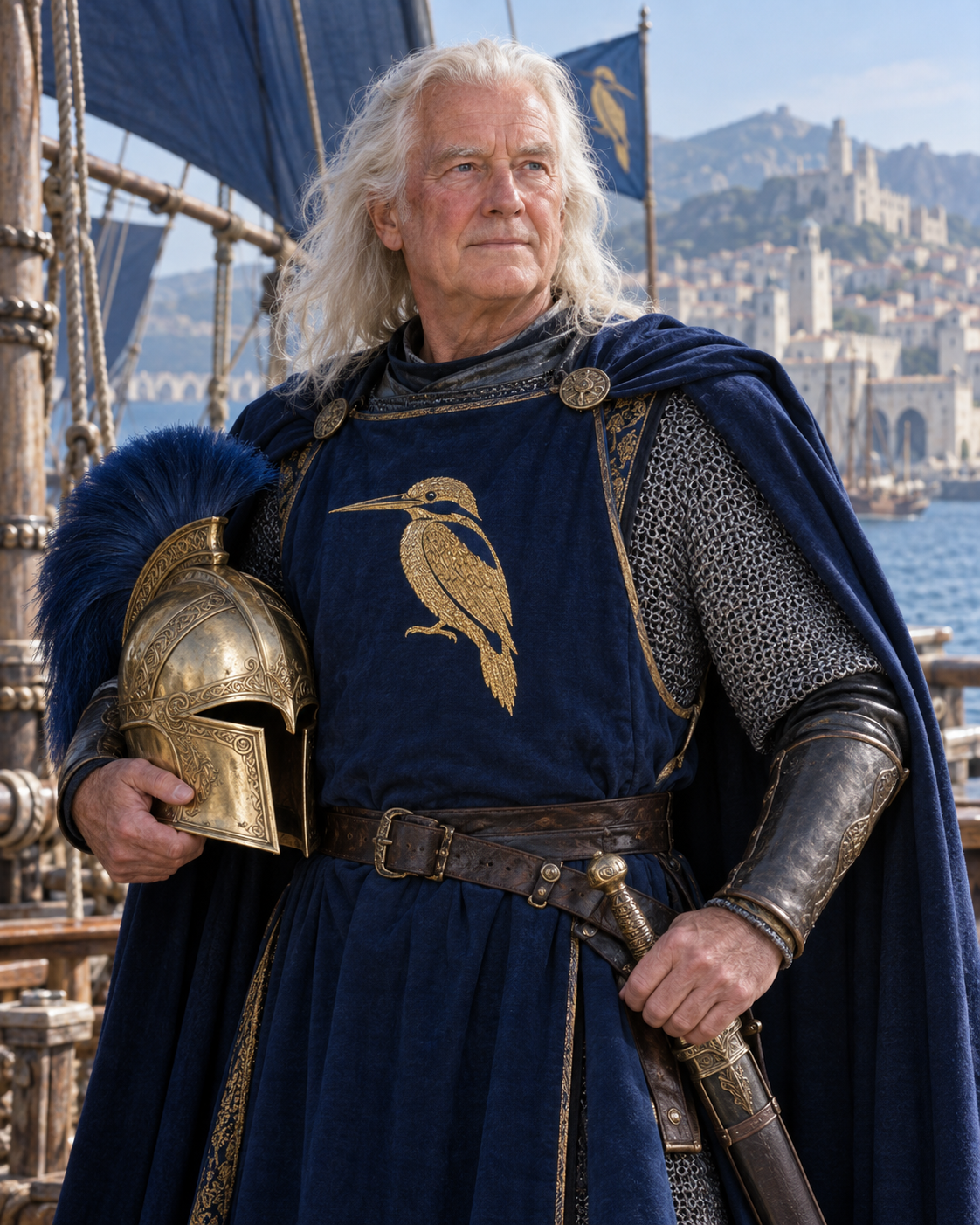
- Rich blue kingfisher surcoat and golden helm with blue horsehair crest
- End status
- Dead; stabbed from behind by Benigaris during the Bullback Hill trap
The Visual Receipt
Long white hair, pink cheeks, mild eyes—and command that does not need to shout
Leobardis is an elderly man with long white hair, pink cheeks, and mild blue eyes. The polished Nabbanai court suits his affable bearing, but battlefield gear reveals the ruler beneath the host: a rich blue surcoat marked by the golden kingfisher and a golden helm carrying a blue horsehair crest.
The approved flagship portrait makes mature authority attractive without erasing age. He is not Camaris with white hair pasted on, nor a fragile grandfather waiting to be replaced. His warmth, courtly ease, imperial inheritance, and decisiveness belong in the same face.
This identity must remain consistent across the Sancellan Mahistrevis, flagship, landing, parley, Bullback Hill murder, and memorial/legacy scenes. His exact facial structure, armor construction, harbor, ship details, kingfisher rendering, and helm ornament are editorial reconstruction where the novels leave space; his age, long white hair, pink cheeks, mild blue eyes, blue-and-gold heraldry, and crested helm are locked receipts.
Book 1 · The Dragonbone Chair
Nabban’s polish cannot soften the danger gathering beneath the diplomacy
Eolair meets Leobardis in the seaside court of the Sancellan Mahistrevis. Music, appearance, and refined hospitality surround a political crisis: Nabbanai ships have been seized, Elias presses for allegiance, Ranessin seeks mediation, and Sir Fluiren arrives as the High King’s emissary.
Leobardis’s eldest son Benigaris objects to Eolair hearing private business. The duke’s anger exposes strain beneath the charm. His household is not united, and the political question cannot be separated from succession inside the Kingfisher family.
Father Dinivan confirms that Leobardis has not yielded to Elias despite flattery and threats. Baron Devasalles carries a secret embassy toward Josua because the duke understands that Prester John’s surviving son is central to any continental settlement. Leobardis is already moving while other parties assume Nabban still deliberates.
He does not treat marching north as clean heroism. Elderly escritor Velligis warns that armies cultivate catastrophe. Leobardis answers that Elias has made inaction a political choice. Once a high king converts tribute, war, and fear into tests of submission, staying polished at home no longer qualifies as neutrality.
Family at Crannhyr
He can see how power shaped his younger son and still misses what it has made of the elder
Leobardis reaches Crannhyr aboard his flagship, Emettin’s Jewel, with Nabban’s army and fleet. Varellan supervises disembarkation in armor that seems too large for his uncertainty. The duke recognizes that he and Nessalanta helped smother or mock the boy’s interest in priesthood and pushed him into a soldier’s role.
That self-recognition makes the coming betrayal crueler. Leobardis can revise his understanding of one son, yet he reads Benigaris’s sudden strategic obedience as reconciliation. The older son’s competence and apparent submission supply exactly the emotional answer the father wants.
Nessalanta and Benigaris have resisted the Josua alliance. Camaris’s disappearance allowed Leobardis to inherit ducal power that would otherwise have belonged to his elder brother. The household therefore carries love, legitimacy, ambition, old absence, and imperial memory into every military decision.
Bullback Hill
The trap works because a father mistakes obedience for peace
Jarnauga’s distance sight detects the approaching Nabbanai and Guthwulf’s mounted Boars and Spears, but movement does not reveal motive. Benigaris proposes a plan to crush Guthwulf against Naglimund. Leobardis accepts.
The meeting becomes a prepared betrayal. Guthwulf holds the duke in place while Fengbald’s forces tighten the field. Amid the fighting, Benigaris drives a blade through the back of his father’s neck. Aspitis seizes the kingfisher banner, the army retreats toward the Inniscrich, and public grief covers the murder.
Deornoth witnesses the act. Later, the even wound and his sworn statement become the strongest evidence against Benigaris, though Brindalles refuses to condemn a ruler on one dead witness alone. The insistence on proof protects justice from becoming rumor even when the rumor is true.
Leobardis dies not because he lacks political intelligence but because family trust creates a point intelligence cannot fully armor. The betrayal weaponizes the relationship most likely to bypass suspicion.
Family and Political Kinship
The Kingfisher House before and after the knife
Benigaris
Eldest son, military heir, and murderer. He converts filial obedience into access, then performs grief while taking Nabban’s throne.
Nessalanta
Wife and formidable political partner. She becomes Benigaris’s strongest supporter despite likely suspecting the truth.
Varellan
Younger son whose priestly inclination Leobardis recognizes his parents helped suppress.
Antippa
Daughter used within Nabban’s marriage politics and pledged to Devasalles.
Camaris
Older brother and rightful senior Kingfisher claimant. Camaris later mourns Leobardis and vows to remove the patricide.
Miriamele
Niece through her Ingadarine mother and would-be diplomat whose mission depends on Leobardis’s alliance but arrives after his movement and death overtake the plan.
Books 2–4 · The Duke After Death
His murder rearranges every alliance that survives him
Miriamele learns that Leobardis marched north nearly a month earlier, then hears he died before Naglimund and Benigaris returned to rule with family support. She grieves personally and recognizes the strategic collapse: Josua’s best access to Nabban has vanished.
Dinivan knows the murder is whispered but unproven. Ranessin cannot act without proof, and Mother Church debates whether to legitimize the succession. Nessalanta’s backing turns family authority into political insulation.
At Sesuad’ra, Isgrimnur argues that Nabban’s ships and armies are essential. Camaris is the true senior Kingfisher claimant whose disappearance permitted Leobardis’s succession. Restoring him creates a route around Benigaris without pretending the dead duke can simply be put back.
Deornoth’s sworn account finally joins Camaris’s kinship claim. Camaris mourns his brother, condemns the patricide, and agrees to stand before Nabban’s army. His return is not triumph over Leobardis’s reign. It is an attempt to rescue the house from the crime that ended it.
The eventual restoration offers captured soldiers a choice rather than humiliating them. Leobardis’s legitimacy survives through truth, kinship, and political repair—not through mass punishment performed in his name.
Why He Matters
He is the alliance the heroes lose before they understand they had it
Leobardis proves that politics continues offscreen. By the time Miriamele sets out to persuade him, he has already chosen and marched. Her courage remains real, but the map has moved. The world does not wait for the protagonist’s mission structure.
His murder also shows how private family damage becomes continental consequence. One son’s ambition collapses a relief effort, alters Nabban’s succession, isolates Josua, and forces Camaris back into public life. The knife enters one neck and exits through armies, churches, ports, and dynastic trust.
Affability Is Not Passivity
The mild eyes belong to a ruler willing to move an army
Leobardis’s warmth can be misread because fantasy often treats volume as strength. He listens, hosts, negotiates, grows angry when required, and makes a military choice after weighing mediation. His affability is style, not absence of will.
That same openness becomes vulnerable inside the family. The profile should hold both truths: trust is not stupidity, and a leader remains responsible for the ambitions cultivated in his own house.
The Mission That Arrives Too Late
Miriamele’s diplomacy is brave, necessary, and already overtaken by the world
Josua sends Miriamele toward Nabban because her Ingadarine blood and family connection to Leobardis give her a plausible route into the alliance. The mission is not ceremonial. Nabban’s ships, soldiers, money, and continental authority could change the balance against Elias.
Yet Miriamele moves on an obsolete political map. By the time she reaches Stréawe, Leobardis has been marching north for nearly a month. News of his death follows, then news of Naglimund’s fall. Her assignment fails without proving her judgment or courage worthless. Events simply move faster than the message.
That timing makes Leobardis more than a destination-shaped uncle. He has already evaluated the danger and acted through Devasalles, Dinivan’s network, his fleet, and his own command. The heroes do not activate him by arriving.
Truth After Patricide
Everybody suspects the son; rebuilding legitimacy still requires more than suspicion
Benigaris returns to Nabban with the throne, the army, a public performance of grief, and Nessalanta’s support. Dinivan believes the whispered account of treachery, but Ranessin cannot reorganize a duchy because a trusted secretary has a protected source.
Deornoth’s sworn testimony later gives the accusation a named witness. The shape of Leobardis’s wound supports betrayal from behind. Camaris supplies the senior Kingfisher claim. Each piece answers a different problem: what happened, whether the account is physically plausible, and who can lawfully challenge the successor.
The caution is frustrating because the murderer is guilty. It is also the difference between repair and another faction declaring truth by force. Leobardis’s aftermath asks the survivors to oppose treachery without copying its method.
On the Record
Scope, status, and evidence boundaries
This is Leobardis’s one canonical full-spoiler profile across all four published volumes. His living action and murder occur in Book 1; Books 2–4 carry direct news, political consequences, evidence, Camaris’s claim, and the restoration of Nabban.
The visual record confirms long white hair, pink cheeks, mild blue eyes, elderly age, rich blue kingfisher surcoat, and golden helm with blue horsehair crest. The approved flagship identity preserves every one of those anchors while marking unspecified facial, armor, ship, harbor, emblem, and helm details as editorial reconstruction.
Every future card, court scene, flagship image, battlefield portrait, murder scene, and memorial must use this approved identity. Later volume membership is marked as aftermath rather than false survival, and his murder must never become decorative gore.