
Leleth
The adults keep calling her a messenger. The books keep showing the bill: a wounded child, a body left sleeping, a spirit stretched across the Road of Dreams, and one final act of love in her own voice.
A little girl becomes the clearest route through a war built by adults
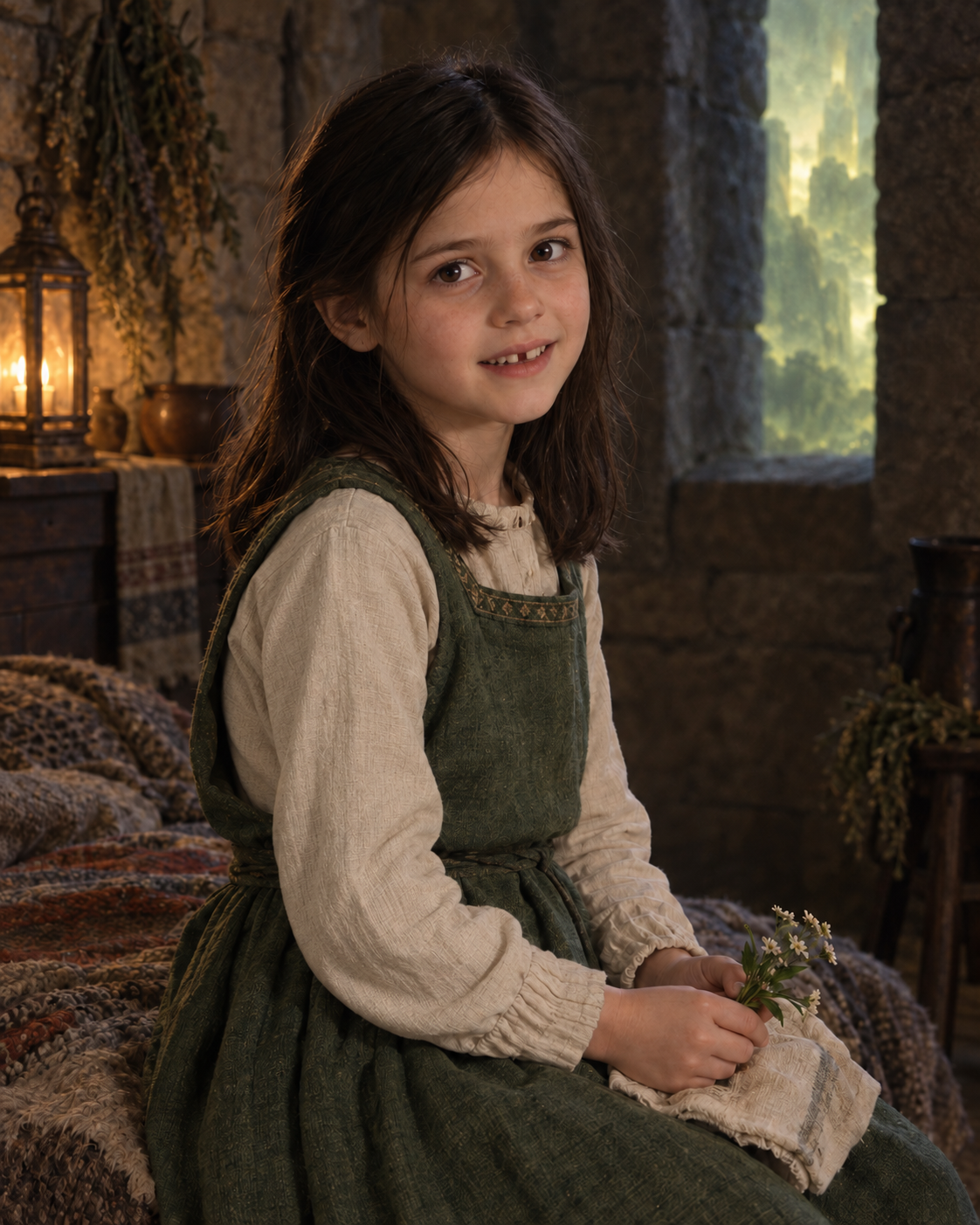
Leleth is Miriamele’s young handmaid and one of the princess’s only childhood companions. She is the youngest child of a large baronial family, a dark-haired girl around eight or nine when she enters the road, with dark brown eyes and both front teeth missing. After escaping the Hayholt beside Miriamele, she is mauled by Stormspike hounds, left badly scarred, and drawn into the Road of Dreams through abilities nobody around her fully understands.
Her page count is smaller than the political leaders around her. Her consequence is not. Geloë uses Leleth’s gift like a burning glass to reach Simon across the world. Leleth carries warnings, recognizes danger before adults do, helps search for Miriamele, speaks through Aditu near the twins, and finally meets Simon as the Green Angel to show him buried truth before she dies.
The profile has to resist the exact flattening the story criticizes. Leleth is not “the psychic child” as a job description. She is loyal enough to follow Miriamele when told to stay behind, frightened and wounded, close to Jeremias, trusting of Geloë and Aditu, capable of love, and denied the ordinary childhood every prophecy machine quietly assumes someone else will pay for.
From handmaid to angel without skipping what happened to the child between
Book 1: she follows Miriamele into the hunt
Miriamele plans her escape carefully: cropped and dyed hair, boy’s clothing, a wig Leleth helps provide, and the traveling identity Malachias. Leleth is not supposed to join. The frightened child follows anyway. That decision reveals affection and agency while making the cost immediate. Ingen Jegger’s white hounds pursue them through Aldheorte and tear Leleth badly.
Simon and Binabik first see Miriamele carrying the unconscious girl while still believing “Malachias” is an older brother. The travelers hide above the hunting pack, then carry Leleth for hours to Geloë’s lake. Her body is bruised nearly black; a ragged wound runs from beneath one arm toward her hip and leg; bites carry unclean flesh. Geloë and Binabik treat her without promising survival.
Miriamele finally admits Leleth is her handmaid, not her sister, and must leave her behind to continue toward Naglimund. The correction does not make the sister claim emotionally false. Court life deprived Miriamele of ordinary peers; Leleth became almost her only young companion. Their improvised sibling language exposes intimacy the official hierarchy cannot name.
Book 2: the silent child becomes the warning system
Leleth survives, scarred and changed. At the Qanuc hearing, her face becomes Geloë’s channel. Geloë explains that the girl focuses her will like a burning glass, allowing communication across impossible distance. Through Leleth, the coalition learns Naglimund has fallen, Josua lives, Miriamele cannot be found, and the Stone of Farewell may offer temporary safety.
When Geloë arrives with her, Leleth’s eyes often stare without fixing. Vorzheva cannot coax her back, but the child remains responsive to danger and trusted people. Her first cry is a warning toward the northern storm. Josua believes her quickly enough to move the refugees before the black weather reaches them.
At Sesuad’ra she enters dream work with Geloë, Simon, Binabik, and Strangyeard. She helps reach Tiamak’s book-built dream city and carries Simon’s call toward Miriamele aboard the Eadne Cloud. The hostile storm prevents contact. The episode makes her ability powerful without turning it into a clean communications device. Every crossing exposes her to forces much older and crueler than the people asking for help.
Book 3: the attack takes Geloë and leaves Leleth stranded
Leleth permits Aditu physical closeness she grants almost nobody else. That trust matters after the Talons enter camp under kei-vishaa. Geloë is stabbed repeatedly and chooses to return to the forest as a wounded owl. Leleth remains unreachable on the Road of Dreams.
Geloë uses the child’s mouth one last time to warn that the Norns are playing a double game and Simon must remember the false messenger. She promises to try to send Leleth back. After Geloë is gone, the sleeping body grows dangerously thin and accepts only small draughts. Aditu understands the coalition has lost the person most likely to retrieve her.
Jeremias gives the human relationship underneath the mystery. Having once thought quick death sounded merciful during imprisonment, he now says he must live because Leleth needs a friend. The line is funny, scared, and tender. It refuses to let her become merely a supernatural problem.
Book 4: Leleth finally speaks as herself
Her presence continues through unstable boundaries. Aditu holds Vorzheva’s newborn twins and involuntarily speaks futures in a voice she suspects belongs to Leleth. Prophecy enters a safe birth without invitation, reminding us that this gift is not under ordinary control.
Simon later encounters the Green Angel. She has little time, says she is being called onward, and leads him deeper than the myths and lies surrounding the swords. She shows him the Pool of Three Depths, Eahlstan’s history, and fragments needed to understand the present. The truth cannot simply be told because manipulation has colonized the available story.
At the moment she leaves, Simon recognizes Leleth. She tells him she loves him, tried to save him, and knows people she loves still need him. Her final act is not a riddle assigned by Geloë or a prophecy routed through Aditu. It is a child using the freedom available at death to push someone she loves back toward life. Simon calls her name and feels her smiling—free and flying.
Princess and handmaid is the title; childhood companionship is the relationship
After Hylissa’s death, Elias restricts Miriamele’s contact with children her age and replaces companionship with tutors and royal ritual. Leleth, from a large family full of stories, becomes the closest thing she has to ordinary girlhood. Miriamele envies those family stories because rank has given her privilege and isolation together.
Leleth’s decision to follow the escape is not proof a child should have been placed in danger. It is evidence that attachment exceeded instruction. Miriamele carries her, lies about their relationship to protect identities, and is devastated when Geloë insists travel will kill the girl. Later, the dream-changed Leleth is almost unrecognizable to her. The reunion she wants never arrives in an ordinary form.
Care comes before use, and that order is the whole moral difference
Geloë first cleans wounds, fights infection, provides shelter, and refuses dangerous travel. Only then does the scope of Leleth’s ability emerge. Their bond permits extraordinary contact because it is grounded in touch and trust, not because the wise woman found a convenient magical child.
That does not make the relationship cost-free. Leleth’s body remains behind while her spirit travels. The war needs information, and the person paying is too young to negotiate the strategic value. Geloë’s final promise to send her back acknowledges the debt. Her own death turns that promise into tragedy rather than a completed rescue.
She focuses connection, recognizes danger, and moves through meanings adults have buried
Leleth can carry or focus another person’s will across the Road of Dreams, appear inside Simon’s dreams, participate in long-distance contact, detect approaching supernatural danger, and communicate through or alongside Aditu. As the Green Angel, she guides Simon through historical visions that direct him toward interpretation rather than handing him a polished answer.
The limits are severe. Her body weakens while she is absent. Communication can be blocked or invaded. Voices may pass through her without being fully hers. She does not control the timing of every prophecy. The adult coalition benefits from her gift while lacking a reliable way to protect or retrieve her.
The adults build the myths; a child pays the interpretive bill
The saga is full of kings, scholars, immortal elders, priests, and secret leagues. They preserve records, bury records, mistranslate records, weaponize records, and organize wars around records. At the crisis point, Simon can only reach the buried truth because Leleth spends the last of herself guiding him.
Her arc makes “innocent messenger” an indictment. Children are often used in fantasy to symbolize hope while adults keep the interesting agency. Leleth has agency, but the books also show what that agency costs when institutions fail. Loyalty sends her onto the road. Violence scars her. Strategy needs her. Prophecy moves through her. Love is the last thing she claims for herself.
Recognizing her as the Green Angel does not erase the injured handmaid. It gathers the identities together: the girl who followed Miriamele, the silent warning, Geloë’s burning glass, Jeremias’s friend, Aditu’s trusted child, and the person who tells Simon to live.
Scope, death, and a non-negotiable child-art boundary
This profile covers all four owned Kindle volumes and their reference material. Leleth’s final status is deceased within the original sequence: the Green Angel says she is called onward, Simon recognizes her as she departs, and the survivors grieve her. The profile distinguishes Geloë speaking through Leleth from Leleth’s own final voice.
Canonical art must portray an age-accurate child around eight or nine: dark hair, dark brown eyes, pale face, missing front teeth, and later scars consistent with the verified hound injuries. No adultification, romantic framing, makeup, sexualized styling, or “tiny fantasy woman” proportions are permitted. Milestones may include pre-escape court life, injured recovery, silent Sesuad’ra period, and Green Angel form, all using the same recognizable child.
The approved Sesuad’ra portrait now controls the hero, featured image, directory cards, social image, and every later scene appearance. Its exact face, hair arrangement, forest-green dress, flower sprig, refuge chamber, and green-gold dream light are editorial reconstruction; her age, dark hair, dark brown eyes, pale face, missing front teeth, and child proportions are the canonical lock. Future scar and Green Angel milestones must preserve this same child and keep injury non-graphic.