
Iyu’unigato
The last Erl-king of Asu’a gives mortals room, trades across old borders, watches his eldest son vanish west in agony, and finally recognizes that his younger son has forged something worse than defeat. He is the father Ineluki kills—and the ruler whose warning about Sorrow proves devastatingly exact.
The king who understands the weapon one command too late
Iyu’unigato is the Sithi Erl-king who rules from Asu’a before its fall, partner of Queen Amerasu, and father of Hakatri and Ineluki. His reign sits at the hinge between two orders of Osten Ard: the long Gardenborn age in which mortals live and build within lands he allows, and the violent Rimmersman conquest that turns coexistence into siege, burning, and exile.
He is not preserved through a conventional present-tense adventure. Readers meet him through contested history, old song, Morgenes’s careful lessons, Jarnauga’s fuller account, and the objects and descendants that survive him. That distance matters. Iyu’unigato is a king remembered after the victors have renamed the ground beneath his city. Reconstructing him means keeping testimony attached to its teller instead of pretending the past arrives untouched.
What emerges is a ruler defined by permission, exchange, mourning, and a catastrophic limit. He allows Ineluki’s dangerous research to continue while Hakatri suffers and the siege closes. When he finally sees Sorrow for what it is, his language is exact: the sword is a wound in creation. He orders it destroyed and tells Ineluki to destroy himself if that is what stopping the corruption requires. Ineluki answers by killing his father with the blade.
His authority is visible in what he permits, protects, and exchanges
The earliest political picture does not make mortal settlement impossible. Herding and fishing peoples enter Osten Ard from the west and remain within territory the Erl-king allows. Mortal settlements grow, bronze-working expands, and Nabban eventually becomes an empire beneath Asu’a’s shadow. This is not modern equality dressed in fantasy silk; the land relationship is unequal and permission still belongs to Iyu’unigato. But it is not the exterminating order that follows.
Trade makes the coexistence material. Mortals bring spices, island dyes, and precious stones from the Grianspog Mountains. The Sithi exchange finely worked objects from the Erl-king’s coffers. An ancient road connects Asu’a to the Taig at Hernysadharc, and long exchange becomes military alliance when Rimmer violence horrifies Hernystir. Iyu’unigato’s kingship therefore reaches beyond a sealed fairy court. It governs borders, objects, diplomacy, and obligations between peoples.
Ti-tuno, the horn mortals know as Cellian, also passes through his hands. Fashioned from Hidohebhi’s tooth, it is given by Iyu’unigato to Prince Sinnach before Ach Samrath. The object later travels through Lluthinn, Ebekah’s dowry, John, Camaris, Amerasu, and Simon. That chain turns the Erl-king from a remote name into one custodian within a history of gifts, marriages, wars, and promises.
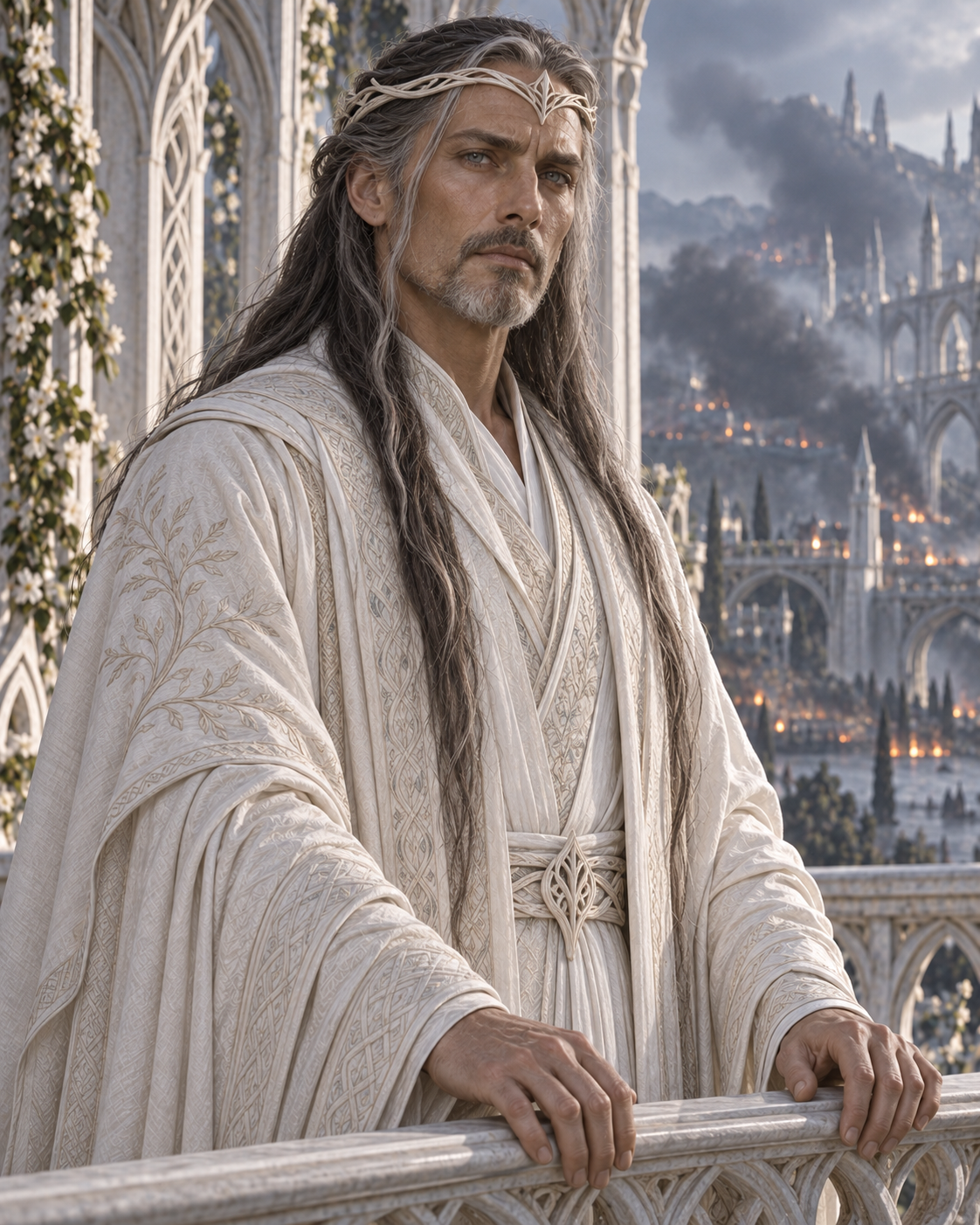
Then Fingil crosses the Frostmarch. Combined Sithi and Hernystiri resistance cannot prevent the advance. Asu’a endures an almost three-year siege while the older political world contracts to the walls of its greatest city. Iyu’unigato wears mourning white. The costume is not neutral pageantry; it places the ending of a people visibly upon the king’s body before the city has technically fallen.
A wounded heir turns a family crisis into the opening Ineluki cannot stop widening
Hakatri is the elder son and original heir. He and Ineluki fight Hidohebhi, mother of Shurakai and Igjarjuk. The brothers kill the dragon, but Hakatri survives horribly burned and trapped in unending pain. Victory does not restore the prince who should inherit. It produces a living wound at the center of the ruling family.
Iyu’unigato eventually sends Hakatri west by boat with a trusted servant in search of relief. The record does not grant the king’s private monologue, and this profile will not manufacture one. The choice can still be read through its consequences: a suffering son disappears beyond the known political world, the younger son becomes heir, and the siege continues without the family structure that existed before the dragon.
Ineluki’s love and guilt curdle into dangerous purpose. He pursues increasingly forbidden knowledge, poisons witchwood with iron, and uses the Hammer That Shapes to forge Jingizu—the sword later called Sorrow. Iyu’unigato does not interrupt that path at its beginning. Jarnauga’s history says the king refuses to stop the experiment while his people face destruction and Hakatri’s fate hangs over them.
That refusal is one of Iyu’unigato’s most important facts because it prevents his final condemnation from becoming spotless wisdom. He recognizes the corruption, but only after authority has helped give it room. Perhaps a besieged father hopes his brilliant remaining son can save something. Perhaps a king facing annihilation tolerates what peace would forbid. The books verify the permission and the result, not the exact private calculation. The moral weight lies in the gap.
“A wound in creation” is not a metaphor the series outgrows
When Iyu’unigato sees the completed weapon, he does not treat it as merely dishonorable, politically inconvenient, or too dangerous for an unstable prince. He identifies damage at the level of Making itself. Iron has been driven into witchwood; incompatible substances and intentions have been forced into a blade whose injury will keep unfolding after every living witness is gone.
His order is absolute. Sorrow must be destroyed, and Ineluki must destroy himself if necessary rather than allow its corruption to continue. This is the moment when paternal and royal duties collide without compromise. The son who has justified every boundary crossing through Hakatri, Asu’a, and survival hears the command as an attack on the only answer he still trusts.
Ineluki kills Iyu’unigato with Sorrow. The act proves the king’s diagnosis in the same instant it makes enforcement impossible. The weapon does not simply win a duel. It severs dynasty, counsel, and any path by which Ineluki might return from obsession without surrendering power. The prince crowns himself, binds the Red Hand to his defense, and carries Asu’a toward fire and Unbeing.
Amerasu and Shima’onari lead survivors into Aldheorte. Those who remain because they are trapped, weak, loyal, or unwilling to flee face Rimmersman slaughter. Iyu’unigato’s death is therefore both intimate murder and constitutional collapse. The wrong person gains the crown at the worst possible moment, with the weapon that has already taught him opposition is something to cut away.
He is dead before Simon’s journey, but his court, family, objects, and warning organize it
Book 1: forbidden history becomes named catastrophe
Morgenes introduces the Sithi Erl-king, Asu’a, mortal trade, the Rimmersman advance, and the terrible magic used by the Erl-king’s son, but refuses to name the son. Binabik later sings a fragment associated with the battlefield west of Asu’a and attributes it to Iyu’unigato’s final hours, while the surviving translation evokes ancestral hearts, falling light, iron, and smoke. These are mediated clues, not a complete transcript.
Jarnauga’s account finally joins the family names to the catastrophe: Iyu’unigato, Amerasu, Hakatri, Ineluki, the dragon wound, Sorrow, patricide, and exodus. Simon’s present quest stops being a hunt for three convenient magical swords. One of those swords killed the king who first named its true nature.
Book 2: descendants and hidden survivors inherit the unfinished argument
In Jao é-Tinukai’i, Simon meets the family line that escaped. Amerasu still opposes Ineluki. Shima’onari rules the hidden city. Likimeya, Jiriki, and Aditu embody different responses to mortals and renewed war. Iyu’unigato’s household has become a living political spectrum rather than a memorial portrait.
Books 3 and 4: the warning reaches its final proof
Sorrow remains central to Ineluki’s design, while the Sithi and Norns divide over memory, grief, obedience, and survival. The ending confirms that the blade’s problem was never only sharpness. It participates in a scheme aimed at undoing the present through accumulated grievance. Iyu’unigato’s diagnosis survives because the world keeps demonstrating it.
He turns ancient kingship into responsibility, complicity, and belated clarity
Iyu’unigato matters because he cannot be reduced to the noble father murdered by an evil son. His reign holds space for coexistence and exchange. His alliance with Hernystir resists genocidal conquest. His final judgment of Sorrow is right. Yet he also allows Ineluki’s experiment to proceed long enough to become a weapon, a succession crisis, and a cosmological threat.
That combination is painfully adult. Correct understanding does not erase earlier permission. A leader can name disaster precisely and still bear responsibility for the conditions in which it matured. The series refuses the comfort of making everyone either innocent victim or singular monster.
He also anchors the title’s emotional machinery. Memory preserves Asu’a and its dead; sorrow motivates both mourning and atrocity; Thorn’s wider sword-pattern cannot be understood without Sorrow’s corrupted making. Iyu’unigato stands where private grief becomes public policy and where a weapon becomes an answer to history. His last act is to say no. His tragedy is that kingship has already helped make no insufficient.
What the books verify—and what the art must not invent
This profile covers Iyu’unigato’s verified history and continuing significance across all four owned Kindle volumes. The record is retrospective and sometimes explicitly attributed to Morgenes, Binabik, or Jarnauga. Where the text does not provide private thoughts, dialogue, facial details, or a complete scene, the profile does not smuggle them in as fact.
The firm visual receipt is his mourning white during Asu’a’s siege. The approved identity presents an exceptionally beautiful mature Sitha Erl-king, period-consistent with Amerasu, Hakatri, and Ineluki, with royal authority shaped by grief rather than a generic silver-haired fantasy monarch. Dark silver-threaded hair, pale blue-gray eyes, bronze-olive skin, short beard, facial structure, and witchwood circlet are explicitly editorial reconstruction.
This identity now governs featured image, hero, five directory cards, social image, family scenes, siege milestones, Sorrow’s condemnation, and death-scene continuity.