
Memory, Sorrow, and Thorn · Canonical Character Profile
Isgrimnur
The enormous Rimmersman duke begins as Prester John’s grieving old friend and ends as one of the people deciding what survives John’s failed peace. He is loud, loyal, occasionally prejudiced, unexpectedly tender, and built like a fortress somebody taught to hug.
At a Glance
The facts, with room left for the man
- Title
- Duke of Elvritshalla; dispossessed by Elias and later restored
- People
- Rimmersman; son of Isbeorn
- Family
- Husband of Gutrun; father of Isorn and other surviving children; grandfather
- Primary role
- Northern political witness, soldier, diplomat, rescuer, and bridge between John’s generation and the new realm
- Defining loyalties
- Prester John, Josua, Miriamele, Gutrun, Isorn, and the people Elias hands to Skali
- End-of-series status
- Alive; restored to the Great Table community while mourning Isorn
The Visual Receipt
Huge, aging, and still faster than your assumptions
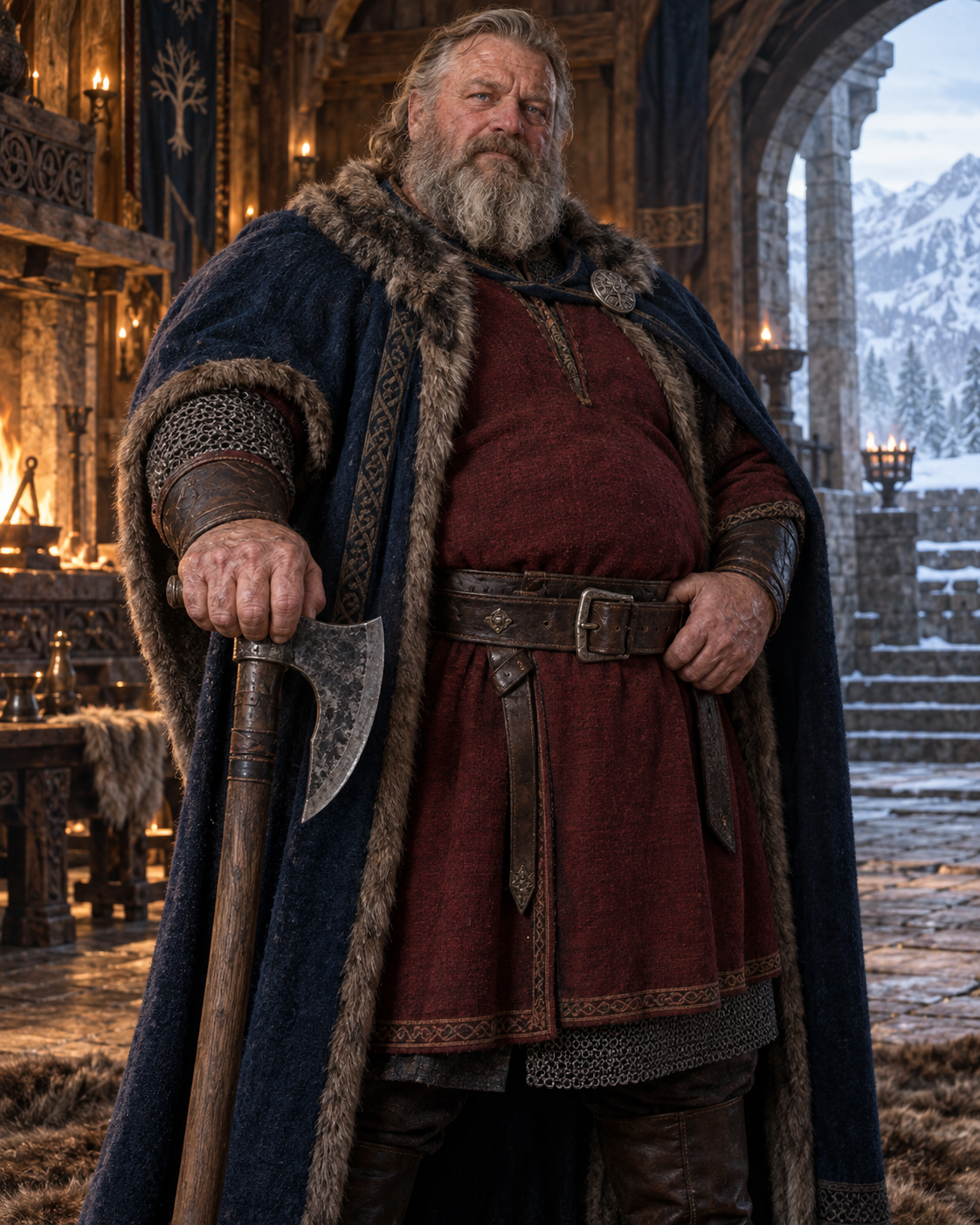
Isgrimnur is older, massive, broad-backed, and fat, with blue eyes, great pink gnarled hands, and a famous beard. The text never treats size as softness or old age as incapacity. He spars, rides, fights, hauls, organizes, and survives country that kills younger men. His body should look lived in: wealth and appetite, old campaigning strength, weather, scars, and the physical confidence of someone who occupied a great deal of every room long before anybody called that a flaw.
Book 1 requires two connected milestones. The public duke wears the beard and northern authority. The secret searcher shaves that beard and hides inside black priestly robes, creating the frankly ridiculous sight of an enormous monk prowling dockside inns for his missing princess. The disguise changes silhouette and social reading, not identity. Future art must preserve one face, the same blue eyes, the same size, and the same difficult mixture of command, grief, irritation, and warmth.
The Complete Journey
The old king’s friend learns that loyalty can require opposing the king’s son
Book 1 · The Dragonbone Chair
He puts John’s boots back on, then watches John’s kingdom take them off
Isgrimnur gives the funeral its human center. The state sees the Dragonbone Chair’s conqueror; he remembers the laughing old man rigging Sea-Arrow in weather that made the land-raised duke pray. When the House of Preparing leaves John’s familiar battered boots on blue-veined feet, Isgrimnur removes and replaces them himself, kisses his dead friend, and feels like a traitor for abandoning the body to earth. His alarm when Josua brings Bright-Nail to the barrow is political because his grief is intimate: he knows what John intended and can see inheritance being rewritten before the soil closes.
Elias answers concrete northern danger with loyalty theater. The Vestvennby garrison vanishes; Skali is favored; Bindesekk is murdered; Elvritshalla is transferred to the cousin Isgrimnur hates; Isorn is held as leverage. The duke does not begin as a clean rebel. He remembers Elias as good, tries to warn him, and keeps separating Pryrates’s influence from the king’s responsibility. By the time he reaches Naglimund dispossessed, loyalty to John’s realm requires refusing John’s crowned heir.
Isgrimnur’s Book 1 road also exposes both care and inherited prejudice. He feeds and shelters the frightened red-haired boy who lies to him, yet his men nearly turn the Raed into a brawl when they discover Binabik is Qanuc. He later accepts the Three Swords search, gives Sludig to it, reunites with Gutrun and the escaped Isorn, and leaves again at Josua’s request to find Miriamele. To pass unnoticed he shaves the beard that helped announce him for most of his adult life. Love turns one of the realm’s most conspicuous men into a bad monk with excellent persistence.
Book 2 · Stone of Farewell
He finds Miriamele, Tiamak, and a legend who cannot remember being one
In Kwanitupul, Isgrimnur refuses to leave Pelippa’s Bowl while Miriamele may still follow Dinivan’s instructions there. He finds Tiamak and recognizes the white-haired, childlike doorkeeper Ceallio as Camaris. The discovery is not triumphant. Isgrimnur falls to his knees and weeps because the dead man lives while the person inside the legend is missing.
When Miriamele finally runs into his arms, Isgrimnur’s first question is whether she is hurt. He cries, checks her safety, then immediately mistakes Cadrach for her kidnapper until she names the monk as her friend and takes responsibility for running away. The road north through the Wran forces his certainty into contact with other political systems, other kinds of courage, and trauma he does not understand. He calls the Wran’s anti-hoarding gift economy foolish because it has no king; Cadrach points out that kingdoms routinely solve succession with blood. When Cadrach cannot enter the ghant nest, Isgrimnur treats terror as cowardice until Miriamele’s trust proves more useful than humiliation.
He survives the nest because courage is collective: Miriamele fights, Camaris rescues, Tiamak knows the terrain, Cadrach performs the role he can, and Isgrimnur organizes what remains. At Sesuad’ra he reunites with Gutrun like the two old trees he used to describe beside the fire. He helps make Camaris public, argues for Nabban as the strategic road, and begins converting the old knight’s impossible return into political leverage without forgetting the human being trapped inside the symbol.
Book 3 · To Green Angel Tower, Part I
The practical uncle keeps asking what the next generation will inherit
Isgrimnur remains one of Josua’s necessary corrections. He understands the prince’s conscience as moral force and governing liability: Josua feels every wound, then risks mistaking suffering for a plan. When Vorzheva delivers twins, Josua says fatherhood gives him something to live for and that their generation owes the children a better world after making such a muck of this one. Isgrimnur’s private hope is not a shining prophecy. It is that Josua survives long enough to watch them grow.
He also continues learning in public. Before Binabik leaves after Simon and Miriamele, Isgrimnur confronts his anti-Qanuc prejudice, clasps the smaller man’s hand, and recognizes courage in a people Rimmersmen have reduced to size and strangeness. The correction does not erase history. It changes what he chooses to carry forward from it.
War strips away the romance he never truly believed. Isgrimnur reflects that every war calls itself exceptional and promises to purchase peace while reproducing the same slaughter. He fights from fear and necessity, questions the honor of killing an unaware enemy when refusal means death, and is crushed beneath his fallen horse when an arrow brings the animal down. Survival leaves the question standing.
Book 4 · To Green Angel Tower, Part II
He helps build the ending, then has to bury the son it costs
At the Hayholt, Isgrimnur is strategist, decoy-maker, soldier, and the man ready to enter a visible trap because Isorn’s force cannot be abandoned inside it. When Josua and Camaris vanish below the castle, he creates substitutes: Isorn wears black-painted steel as the apparent Camaris while Brindalles becomes the visible Josua. Isgrimnur raises a makeshift Rimmersgard banner from his own surcoat and a Norn pike as the White Foxes close the breach from both sides.
After Green Angel Tower falls, succession again becomes practical work. Elias and Josua are believed dead; barons distrust Miriamele; Simon’s ancestry surfaces. Isgrimnur argues for Simon because people trust what he has done, not because Eahlstan’s blood performs magic competence. The duke can use lineage as political language without accepting it as moral proof.
The victory costs Isorn. Isgrimnur and Gutrun stand at their son’s grave while speaking of surviving children and grandchildren, refusing the finale’s restored kingdom permission to treat the dead as scenery. At the Great Table he remains part of the community beside Miriamele, Simon, Rachel, Tiamak, Strangyeard, Sludig, Sangfugol, Jeremias, Eolair, and the others. The realm is not John’s peace restored. It is a more honest table built by people who remember where the old one failed.
The People Around Him
Friendship, marriage, parenthood, and one princess-shaped emergency
Prester John
John is king, commander, sailing companion, and friend. Isgrimnur’s grief rescues the man from the monument and makes the new court’s betrayal legible before it becomes policy.
Gutrun
He describes their marriage as two old trees grown together. Their reunion is physical, noisy, tearful, and gloriously undignified. Their shared mourning for Isorn gives mature love narrative weight beyond advisory parenthood.
Isorn
Isorn is heir, commander, rescued hostage, and eventually the child Isgrimnur cannot protect from war. The duke’s politics repeatedly become personal through what Elias, Skali, and the final campaign demand from his son.
Miriamele
He searches because she will resist almost anyone else. His protectiveness can become controlling or unfair, but his first question at reunion is the one she has needed from an adult for hundreds of pages: are you hurt?
Josua
Affection does not blind Isgrimnur to Josua’s paralysis. He respects the conscience, challenges the self-punishment, and supplies practical force when the prince’s empathy threatens to become another way of postponing action.
Camaris
Isgrimnur recognizes the legend before the legend recognizes himself. He needs Camaris as a banner and still understands that the returned knight is a vulnerable person rather than equipment left by history.
Why He Works
The old order’s best qualities, forced to answer for its worst habits
Isgrimnur works because loyalty is never allowed to remain a flattering adjective. Loyalty to John makes him notice Elias’s failure. Loyalty to the realm makes him a traitor to its king. Loyalty to Miriamele sends him into disguise; loyalty to Josua requires argument; loyalty to Isorn cannot keep the boy alive. Every devotion eventually asks whether he loves a person, an institution, a memory, or the version of himself that once served all three.
He also grows without becoming suspiciously modern. Isgrimnur does not stop being loud, hierarchical, impatient, or culturally proud. He is corrected by evidence, dependence, affection, and other people’s competence. Tiamak makes him laugh. Cadrach exposes the blood inside hereditary certainty. Miriamele’s judgment outperforms his contempt for fear. Binabik makes inherited slurs impossible to maintain without lying about the man in front of him. Growth happens because he remains reachable.
On the Record
Scope, spoilers, and the two-milestone art requirement
This is Isgrimnur’s one canonical profile across all four owned Kindle volumes and their completed reference layers. It is intentionally full-spoiler. The franchise and four volume directories must surface this post through scope-aware role and status labels rather than create duplicate biographies.
The approved portrait preserves the full body receipt: attractive and age-correct, enormous, broad-backed, visibly fat, campaign-strong, blue-eyed, weathered, famously bearded, and equipped with great pink gnarled hands. Exact apparent age, hair shade, scars, clothing colors, and axe design remain editorial reconstruction.
This identity now governs the hero, five scoped directory cards, featured and social images, and every scene-art reuse. The shaved, black-robed search milestone must preserve this exact face, body, blue eyes, hands, age, and weathering beneath the deliberately ridiculous disguise.