
Ineluki
The Storm King was once a dazzling Sithi prince who loved his brother and his people. Five hundred years later, that love has been hollowed into a machine that can only preserve pain by making everybody else live inside it.
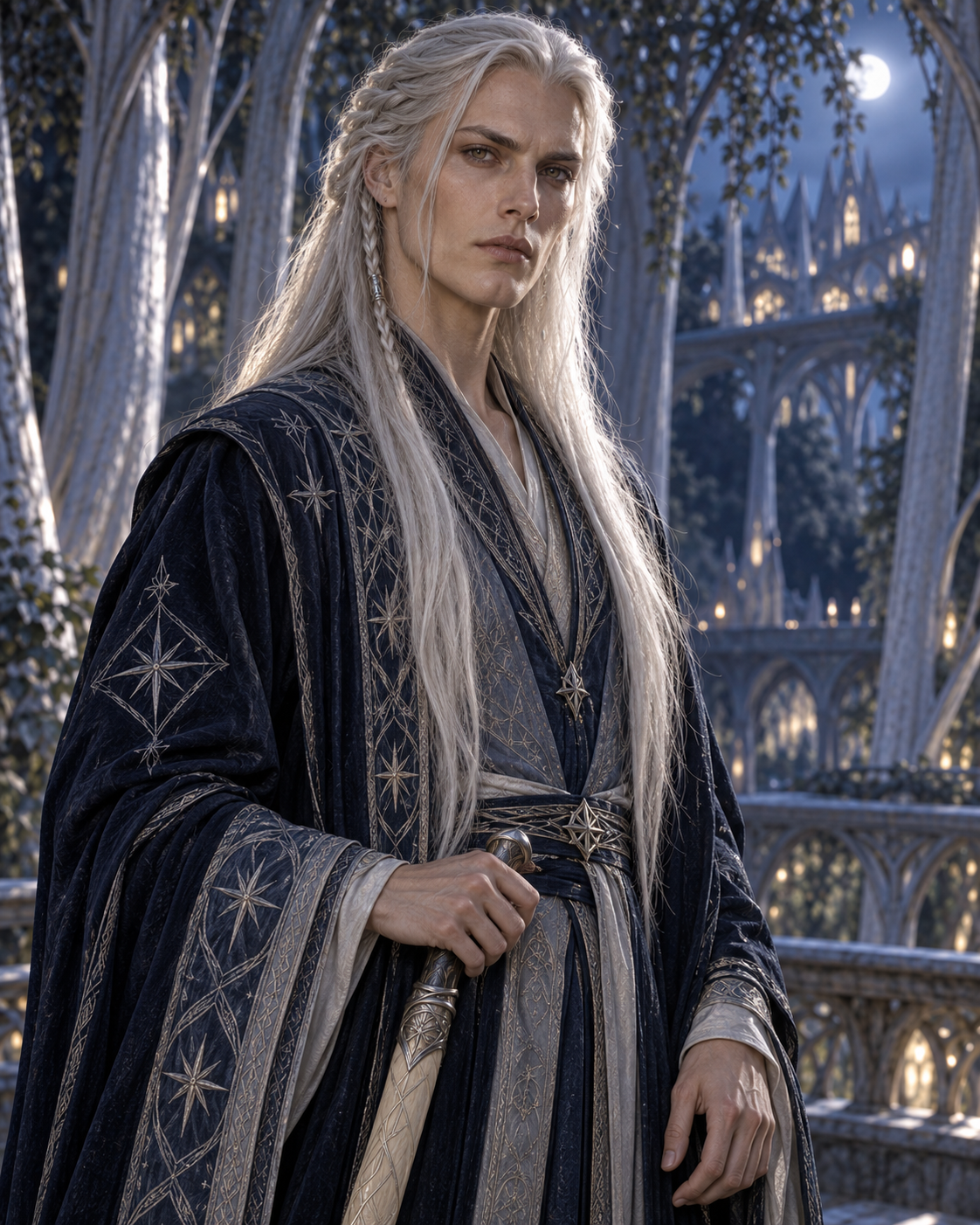
The villain is not secretly right. His pain is simply real.
Ineluki is the younger son of Erl-king Iyu’unigato and Amerasu, brother of Hakatri, prince and last self-crowned king of Asu’a, maker of Jingizu—Sorrow—and the dead power remembered as the Storm King. In life he was so beautiful and brilliant that memory compares him to the silent music of Asu’a. Near the city’s fall, grief, guilt, forbidden study, iron-poisoning, war, and the sword reduce him to someone haggard, sick, and almost unrecognizable. After bodily death, hatred becomes the structure holding him together.
That history matters because the series refuses two convenient lies. Ineluki is not an abstract demon who arrived from outside suffering. He was dispossessed, besieged, grieving, manipulated, and desperate to answer his brother’s agony. He is also not excused by any of it. His answer murders his father, consumes followers, exploits living Norns, possesses Elias, engineers continental terror, and attempts to rewrite Time through thousands of harvested fears.
The emotional precision is brutal: love can be part of an atrocity’s origin without remaining love in its final form. Ineluki keeps calling the result loyalty to his people. Amerasu recognizes that the living fire of her son is no longer the hatred sustaining him.
Hakatri’s wound becomes the excuse for a wound in creation
Ineluki fights beside his elder brother Hakatri against the black dragon Hidohebhi. The dragon dies, but Hakatri is burned beyond healing and left in unending pain. Iyu’unigato eventually sends the heir west by boat with a trusted companion, seeking relief that Osten Ard cannot provide. Ineluki remains with grief sharpened by survivor’s guilt and succession he never expected to inherit.
As Fingil’s Rimmersmen tighten the siege around Asu’a, Ineluki pursues dangerous knowledge. He tends sacred witchwood groves and introduces black iron into selected trees. Almost all sicken and die. One survives because he binds it with protections, then harvests the poisoned wood and enters the forge alone. Using the Hammer That Shapes—an instrument normally reserved for the High Smith—he creates a living gray blade whose forging cracks the air with heat.
Iyu’unigato calls the sword a wound in creation. He commands its destruction and orders Ineluki to destroy himself if necessary rather than let the corruption spread. Entangled with the weapon and convinced his father has chosen passivity over salvation, Ineluki kills him with it. He names the blade Jingizu, Sorrow, takes the white witchwood crown, and declares himself king.
The act does not occur in a vacuum. Fingil’s forces are invading and will burn the city. Ineluki’s defenders hold tens of thousands outside Asu’a for nearly a year. Still, resistance has become inseparable from domination. Amerasu and Shima’onari lead those willing to leave after the king’s murder; Ineluki keeps the Red Hand and people too loyal, weak, or trapped to flee.
At the tallest tower he performs a final working. Rimmersmen inside the city burn. The sky goes white and then impossibly dark. Ineluki and five followers leave six piles of ash while a vast red hand writhes above the tower. The spell denies him ordinary death and creates the prison he will later call survival.
Four published volumes of making other people deliver the pieces
Book 1: the name behind the weather
Ineluki first reaches the narrative through dreams, old names, terror, and servants. Simon sees red eyes beneath the Hayholt and hears Jingizu before he understands either. At Thisterborg, Pryrates cuts Breyugar’s throat over a black coffin, reveals Sorrow, and makes Elias kneel to the Storm King. One Red Hand entity takes shape while Simon’s buried vision of Asu’a erupts.
The influence travels outward through unnatural cold, Nornhounds, Bukken, disturbed sleep, the Red Hand at Naglimund, and the dread attached to speaking his title. Jarnauga finally gives the coalition the historical sequence: Hakatri, the poisoned witchwood, Iyu’unigato’s death, Asu’a’s burning, Eahlstan’s later discovery, and the League created to watch for return. Crucially, Jarnauga refuses to claim he knows the Storm King’s entire mind. Revenge is inference, not a complete plan.
Book 2: ideology spreads farther than embodiment
Ineluki cannot simply walk into the Hayholt. Mortal rulers layered prayers and protections over rebuilt Asu’a. He therefore acts through living servants: Pryrates, Elias, Skodi, Fire Dancers, Norns, and people drawn to the promise that disaster will reveal the strong. His ideology reaches Kwanitupul youths who have never seen Stormspike. The villain becomes political before he becomes bodily present.
Amerasu reads Simon’s memory and understands the design is subtler than restoration of Asu’a. Utuk’ku has given her descendant’s surviving hatred a home. Ingen Jegger murders Amerasu before she can fully explain. The assassination proves knowledge, not merely armies, threatens the plan.
Book 3: war becomes the magician’s misdirection
The continent focuses on Elias against Josua, Sithi against Norns, and siege after siege. Ineluki withdraws beyond dream and death to gather strength under the Conqueror Star. Sorrow’s bond allows visions to pass through him into Elias. The Red Hand consumes immense power to maintain even one physical presence at Naglimund.
Tiamak and Strangyeard slowly recognize that contradictory sword records and visible wars may be part of the strategy. Pryrates already knows Bright-Nail is Minneyar and wants all three blades delivered to the Hayholt. The prophecy’s first stanzas recount history accurately; the final promise never says the swords will defeat Ineluki. Hope inserts that conclusion.
Book 4: the quest succeeds, and that is the disaster
The Five Houses harvest synchronized fear while the three sword-bearers reach Green Angel Tower. Pryrates uses Words of Unmaking to reverse Time toward Ineluki’s banishment and provide Elias as a living vessel. He intends to bargain with or control the power he served. Ineluki emerges and destroys him first.
Inside the sword circuit, Simon sees the suffering that kept the Storm King coherent. He refuses the expected heroic hatred and says Ineluki should not have suffered so. Camaris adds forgiveness without pretending the crimes were harmless. The mechanism weakens because vengeance cannot find its mirror.
Elias surfaces long enough to recognize Miriamele and expel Ineluki at the cost of his own life. The displaced cold claws for Simon, who rejects it as something that does not belong. The swords dissolve and the tower falls. The Storm King does not lose because pain is disproved. He loses because living people refuse to keep performing the identities his pain assigned them.
Every intimate bond becomes material for the machine
Hakatri is the loved brother and original wound. Ineluki’s guilt begins as a desire to heal or restore him, then becomes permission to violate every boundary. Hakatri’s suffering is real; turning it into universal captivity does not honor him.
Amerasu remembers her son as living fire and recognizes what hatred made of him. Her willingness to indict both Gardenborn withdrawal and Ineluki’s annihilation makes her dangerous enough to assassinate.
Utuk’ku gives his shade shelter and strategic direction while pursuing her own ancient grievance. Their alliance is not simple obedience. The eldest living Gardenborn needs a dead descendant’s force; he needs her Norns, Witnesses, and preserved hatred.
Elias offers grief, kingship, and a body. Sorrow amplifies the king’s existing wounds and choices. Ineluki treats him as a vessel, yet Elias’s final paternal decision proves a vessel remains a person capable of refusal.
Pryrates believes contact with power makes him partner rather than tool. He learns otherwise at the exact moment his immortality scheme appears complete.
Simon is the mortal echo the design cannot fully absorb: marked, lonely, angry, tempted by heroic certainty, and still capable of seeing suffering without becoming its servant.
The swords are access keys with appetites of their own
Ineluki cannot simply summon the blades. Forces and Words of Making give them a kind of life; they hunger to join and must choose bearers. The plan therefore manipulates stories, lineages, wars, and hopes until people voluntarily transport what the ritual needs.
Sorrow carries Ineluki’s making and bond through Elias. Thorn carries Sithi craft, Amerasu’s blood, Camaris’s history, and Simon’s quest. Minneyar, hidden as Bright-Nail, carries Eahlstan’s line and the most familiar human inheritance. Their joining does not heal fragmentation. It opens Unbeing.
That reversal is the elegant obscenity at the center of the trilogy. The heroes are not foolish for wanting hope. They are vulnerable because the enemy understands exactly what shape hope must take to move them.
He is memory without revision, sorrow without community, and the thorn turned inward forever
The title’s three nouns are not personality labels, yet Ineluki concentrates their danger. He remembers an injustice until no present person can be encountered outside it. He treats sorrow as proof of authority. He preserves pain by building an identity that cannot survive relief.
Williams refuses the shallow “villain had a sad childhood” maneuver. Backstory does not purchase absolution. It establishes the political stakes of interpretation. If we deny Ineluki’s people were invaded, his grievance becomes cartoon evil. If we treat invasion as permission for extermination, we reproduce his logic.
Simon’s final compassion is powerful because it does neither. He recognizes pain, rejects hatred, and leaves responsibility intact. The Storm King cannot inhabit that answer. His entire afterlife depends on a world where understanding and vengeance are the same act.
Scope, names, status, and visual continuity
This profile covers all four owned Kindle volumes and their reference sections. The sword is Jingizu in the canonical Sithi form used by the owned edition and Sorrow in translation. “Storm King,” “Lord Red Eyes,” and ritual titles remain aliases, not separate profiles.
Ineluki requires visually distinct but continuous milestones: this extraordinarily beautiful living prince, his haggard iron-poisoned late-Asu’a self, and the destructive red-eyed Storm King presence whose form must never collapse into a handsome man merely because fandom prefers cheekbones. Family resemblance to Amerasu and Hakatri persists beneath the living face without duplicating either identity.
The approved living portrait now governs the profile hero, directory cards, featured and social image, and every later transformation. Pearl-silver hair and amber-gray eyes are labeled editorial reconstruction; the corrupted and supernatural forms must retain the underlying facial map while becoming genuinely ruined and inhuman.