
Memory, Sorrow, and Thorn · Canonical Creature Profile
Igjarjuk
Igjarjuk is the white ice dragon beneath Urmsheim: pale-furred, black-blooded, older than Simon’s heroic vocabulary, and extremely inconvenient for the tidy nickname “Dragon Killer.” Simon strikes one eye with Thorn, falls through the dragon’s ancient life, wakes scarred and white-haired—and spends the rest of the series refusing to pretend that means he knows whether Igjarjuk died.
At a Glance
The dragon whose blood makes a boy larger—and sends him home to his own name
- Kind
- White ice dragon
- Lineage
- Child of Hidohebhi; sibling of Shurakai; descendant of Khaerukama’o the Golden
- Lair
- The frozen heights and abyss of Urmsheim
- Key encounter
- Attacks the Thorn expedition and Utuk’ku’s Huntsmen
- Mark on Simon
- Facial scar, white hair, dragon-blood vision, and the name Snowlock
- End status
- Falls into the abyss and disappears; death never confirmed
The Visual Receipt
White scales, pale fur, black blood, and enough mass to tear open a frozen valley
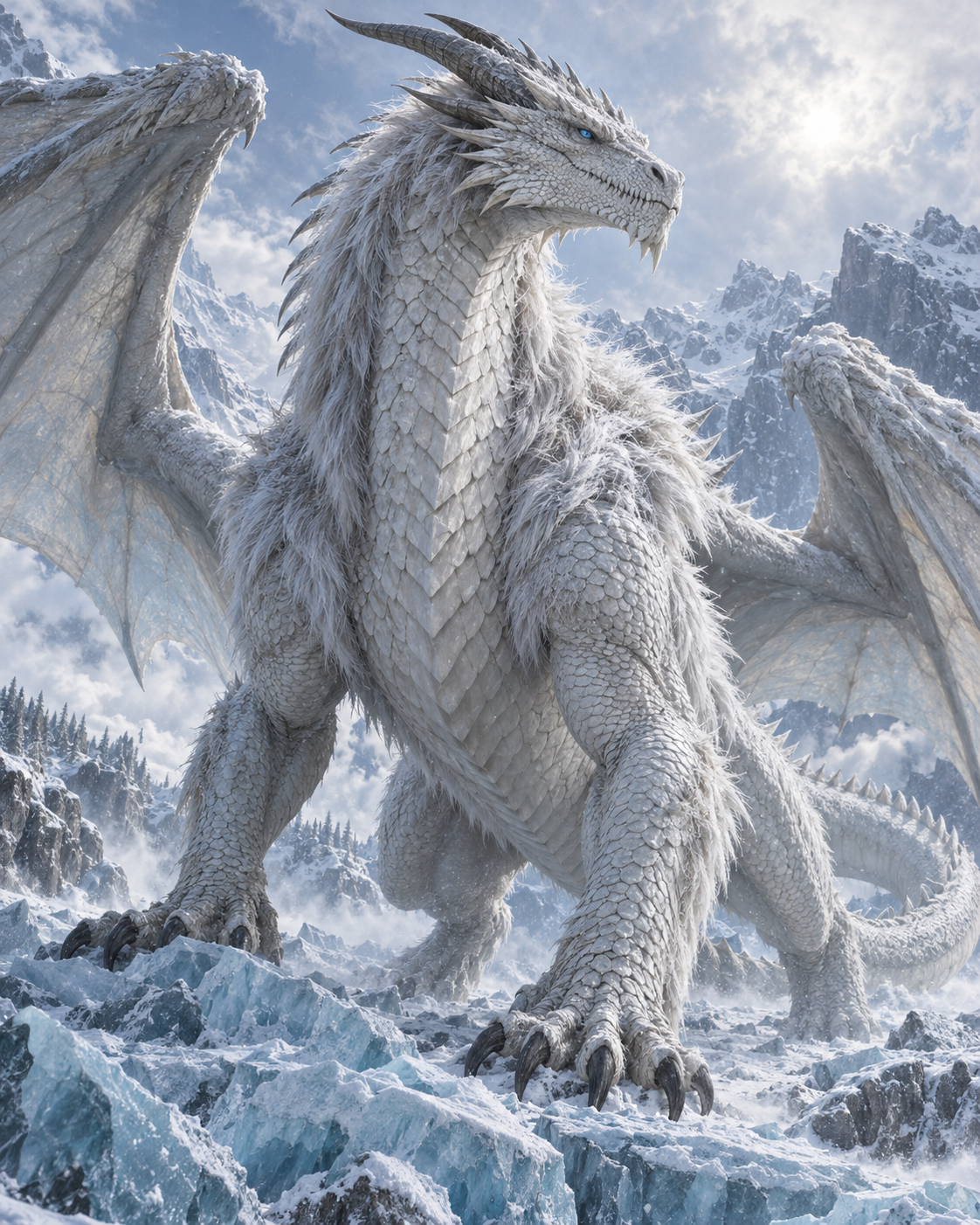
Igjarjuk emerges as an immense white-scaled dragon covered in pale fur, an anatomy suited to the impossible cold of Urmsheim without becoming a soft fantasy snow-pet. The body erupts through valley ice, hurls An’nai an extraordinary distance, kills Huntsmen, and drives Jiriki toward the precipice.
The blood is black. When Simon’s strike opens the eye region, it burns across him like fire and ice. The visual contrast—white hide, black blood, black sword—should remain central to every reconstruction of the encounter.
The approved creature model fixes the long skull, swept crown horns, cheek spines, frost-matted mane and shoulder fur, ivory scale map, four-limbed body, two wing roots, black claws, and ice-blue eyes. Later Urmsheim art must add Simon’s eye wound and black blood to this exact anatomy. Shurakai and Hidohebhi should share lineage cues without becoming palette-swapped copies.
Dragon Lineage
A diminished descendant is still a mountain with teeth
Igjarjuk and Shurakai descend from Hidohebhi the Black, the more powerful mother-worm slain by Hakatri and Ineluki. The line reaches farther back to Khaerukama’o the Golden. Jiriki explains that dragons diminish by generation.
“Diminish” is relative. Igjarjuk remains powerful enough to rupture ice, scatter armed companies, and overwhelm a human mind through blood. The genealogy recalibrates the world: the creature Simon barely survives is a lesser descendant of beings whose death-battles helped deform Sithi history.
Hidohebhi’s burning of Hakatri drives Ineluki toward forbidden knowledge. Shurakai’s bones become John’s throne. Igjarjuk’s blood marks Simon. Each dragon survives defeat by entering somebody else’s identity, politics, or body.
Before the Eruption
Thorn is found at the exact moment too many powers arrive to claim it
Simon’s party follows Colmund’s ledger trail and Uduntree wordplay to the black sword Thorn. The weapon is longer than a man’s outstretched arms, nearly black from point through pommel, and so heavy Haestan and Sludig together can barely move it. Simon touches it and the weight changes; life pulses beneath the cold surface.
At the same time, Utuk’ku bargains through the Master Witness, Ingen Jegger’s mortal Huntsmen close around the party, and Jiriki refuses to abandon mortals under Sithi protection. Igjarjuk’s awakening is therefore not a random boss fight waiting beside a treasure chest. Sword recovery, Norn politics, mortal pursuit, Sithi obligation, and buried dragon territory collapse into one event.
Urmsheim
The ice opens, and every plan becomes “do not be the nearest moving thing”
Igjarjuk erupts from the valley ice during the fight with Ingen Jegger’s hunters. The dragon kills several Huntsmen, throws An’nai from its back, and turns on the survivors. Allegiance means nothing to a creature awakened beneath the battle; Utuk’ku’s disposable mortal proxies die alongside the people they came to kill.
Jiriki remains near fallen An’nai as Igjarjuk pursues him toward the edge. Simon grips Miriamele’s scarf, raises Thorn, and remembers Jiriki’s lesson about mortal being. With the jaws descending, the boy answers the question of what he should cry at the end: “Here I am! I am Simon!”
He strikes at the dragon’s eye. Thorn is light and singing in his hands. Black blood floods the moment, something white crashes through him, and both boy and dragon go into darkness.
Blood and the Spinning World
Igjarjuk’s dying life does not give Simon superpowers; it destroys the scale of his old imagination
The black blood overwhelms Simon with the dragon’s ancient life. His bones, skin, heart, and perception become dragonlike. The earth feels like body. Living beings appear as small, vital sparks while Simon’s mortal identity begins to dissolve.
He sees Rachel alone in the Hayholt, Josua above burning Naglimund, Isgrimnur at a pier, Miriamele aboard ship, Maegwin at two cairns, Elias holding Sorrow, and other images whose exact mixture of far-sight, symbolism, and future hook remains deliberately uncertain. Morgenes appears crowned in flame and warns him to beware the false messenger.
Simon begins to understand connection rather than dominance. Every life is a mote in an incomprehensibly large world, but a mote can guide a mariner or comfort someone awake in darkness. Even the Storm King is small beneath the stars; Binabik later reminds him that a mountain remains lethal to the person underneath it.
The Name That Brings Him Back
Dragon-life expands Simon until remembering the gawky child becomes an act of survival
As the vision pulls him toward stranger places, Simon refuses to go before he remembers who he was. The answer is not Seoman Snowlock, heir, knight, chosen bearer, or Dragon Killer. It is Simon—the awkward scullion child.
Jiriki calls him back as Seoman. Simon wakes days later in a Qanuc cave on Mintahoq. A scar runs from his jaw across his cheek and past his left eye. A long swath of red hair has turned white. The dragon has become a public story written on his face before he understands what happened.
The blood does not install a clean magical skill tree. It changes his relation to other lives and to his own smallness. That is more disruptive than a convenient power.
Did Igjarjuk Die?
The book refuses the clean trophy Simon’s admirers want
Igjarjuk falls into the abyss after Simon’s strike and disappears. Jiriki cannot confirm death. Simon himself rejects the public “Dragon Killer” story. He knows Thorn’s power, not personal strength, drove the encounter, and he does not believe the dragon is proven dead.
The heroic simplification angers him because it removes everything true: terror, the dragon’s gaze, the sword’s agency, black blood, dead companions, and uncertainty. “Dragon Killer” turns a harrowing encounter into a flattering noun.
That resistance is part of Simon’s growth. John’s Shurakai victory taught him how cultures polish dragon stories. Having lived one, he recognizes the cost of polishing his own.
Connections
The dragon encounter binds the sword party together—and takes two of them away
Simon
Strikes Igjarjuk with Thorn, enters the dragon’s ancient life, returns scarred and white-haired, and rejects the killer myth.
Jiriki
Explains dragon lineage, protects the mortals, faces the precipice, and calls Simon back from dissolution.
An’nai
Sitha companion thrown by the awakening dragon and later buried with Grimmric beneath the Uduntree.
Thorn
Black sword whose impossible change in weight and apparent intention make Simon’s strike more than personal prowess.
Ingen Jegger
Queen’s Huntsman whose mortal force helps trigger the clash and loses several followers to the awakened dragon.
Shurakai
Red dragon sibling whose polished slaying story teaches Simon why his own encounter must keep its uncertainty.
Why Igjarjuk Matters
The dragon is not a checkpoint between Simon and Thorn
Igjarjuk transforms the end of Book 1 into a collision of identity, historiography, and scale. Simon finds the sword but cannot claim uncomplicated mastery over it. He strikes the dragon but cannot claim a verified kill. He gains perception but nearly loses the self capable of using it.
The encounter also exposes how quickly communities manufacture heroes. The Qanuc and survivors see the white hair, scar, sword, and absence of the dragon and produce Snowlock and Dragon Killer. Simon remembers the blood from inside and knows the public version is cleaner than truth.
Later volumes carry Igjarjuk through his body and interpretation rather than repeated physical attacks. The white streak and scar remain; the widened sense of connection shapes how he understands power, prophecy, and the supposedly tiny lives beneath great kings.
On the Record
Scope, status, and visual boundaries
This is Igjarjuk’s one canonical full-spoiler creature profile. Direct action centers on the Book 1 Urmsheim climax. Books 2–4 retain scope through Simon’s Snowlock identity, scar, white hair, memory, dragon-blood insight, public legend, and the continuing correction that death was never confirmed.
The evidence confirms white scales, pale fur, black blood, descent from Hidohebhi, relationship to Shurakai, emergence from valley ice, violence against Huntsmen and the expedition, Simon’s eye strike, and the fall into the abyss. “Dead” is not supported; status remains missing or unconfirmed after the fall.
The approved pre-wound portrait is the canonical creature identity for hero, directory, and social images. Every lineage, ice eruption, pursuit, eye strike, blood vision, abyss, and later-memory scene must preserve its horn, spine, scale, fur, limb, wing, and tail map—and preserve Simon’s already approved identity whenever he appears. Visual continuity is story evidence here, not decoration.