
Memory, Sorrow, and Thorn · Canonical Character Profile
Haestan
Haestan never mistakes weapons training for destiny. He gives Simon rusty tools, bruises, honest limits, and the moral discipline to reject suicidal heroics. Then, on a mountain far from the wife he hopes to see again, the burly guardsman moves Simon out of a giant’s blow and turns ordinary courage into one of the saga’s longest shadows.
At a Glance
The weapons tutor whose best lesson is knowing when not to fight
- Home
- North Erkynland; wife living in Hewenshire
- Role
- Naglimund guardsman, Simon’s weapons tutor, Thorn expedition companion
- Build
- Broad, burly, and bearlike, with a curly brown beard
- Core ethic
- Each person must do their best even when the wrong cannot be made right
- Death
- Killed by a Hunën’s club after pushing Simon clear
- Memorial
- A mountain cairn, Qanuc wind-song, Aedonite prayer, and stone Simon carries onward
The Visual Receipt
Built like a bear, equipped like a garrison that has already spent everything
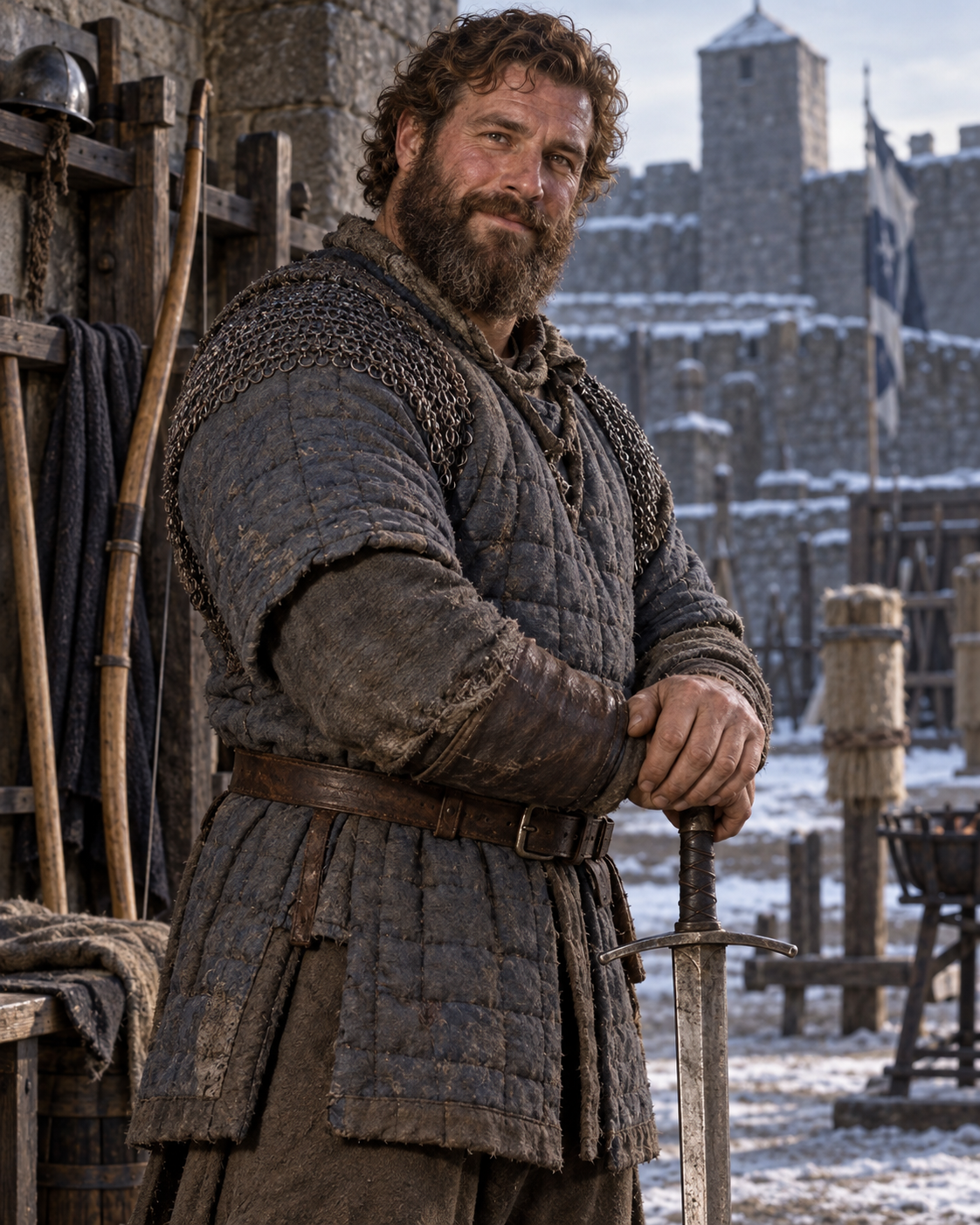
Haestan is broad and burly enough to be described as bearlike. His curly beard is brown, his hand reads as a great paw, and his speech carries a rustic northern cadence. The record emphasizes physical solidity without turning him into a polished tournament knight. He belongs to a strained defensive force whose armory can offer Simon a rusty but serviceable slender sword, an unstrung Thrithings longbow, six arrows, and padded practice poles.
The approved portrait makes that practical competence attractive: an adult soldier with weight, weather, humor, and working strength rather than a bodybuilder costume. His clothes and gear fit North Erkynland and Naglimund, then must change credibly for winter travel and Mintahoq. The same face carries instructor patience, exhausted mountain care, moral firmness, and the fatal Hunën encounter.
The curly brown beard and bearlike build are fixed by the text. Eye color, exact age, facial structure, scar placement, and precise gear are editorial reconstruction. The locked image now supplies hero, featured image, directory cards, and social metadata.
Book 1 · The Dragonbone Chair
Simon asks for glory; Haestan hands him repetition
A harried Naglimund captain assigns Simon to Haestan when the castle prepares for war. Haestan assesses depleted stores and the boy in front of him without flattering either. He selects a narrow sword that can still function despite rust, an unstrung longbow, a few arrows, and practice staves. He recommends spears for actual battlefield usefulness. The choice punctures the fantasy that one heroic blade is all a scullion needs.
Training is pain, posture, and endurance. Haestan works Simon until the boy is bruised, exhausted, and scarcely able to lift the staff. The next morning Simon returns and uses repetitive effort to quiet emotional hurt. Improvement arrives, but expertise does not. Haestan builds capacity without inventing a montage that lets desire skip labor.
He then joins Binabik’s expedition carrying Thorn north, alongside Simon, Sludig, Ethelbearn, Grimmric, and others. The road strips away companions. Ethelbearn dies in pursuit; Grimmric later falls. Haestan survives violence, weather, and Urmsheim long enough to reach Mintahoq with a fevered Simon. By the end of the first physical volume, the weapons tutor has become guard, nurse, witness, and one of the few stable lowlander presences beside the boy.
Book 2 · Stone of Farewell
He steadies a dragon survivor, argues against martyr theater, and dies doing the useful thing
Simon wakes in a Yiqanuc cave after five days of fever with Jiriki and Haestan watching him. Recovery is humiliatingly physical: he must relearn walking while Haestan supports him. When Simon appears before the Qanuc court, he is simultaneously the legendary dragon survivor people want to see and a sick adolescent who cannot stand without a guardsman’s arm.
Haestan contributes more than muscle. He proposes that he and Simon be recognized as speaking witnesses before the Herder and Huntress. Later, after Binabik and Sludig receive a death judgment, Simon wants action but has no plan that can solve guards, rope, mountain, Thorn, and survival at once. Haestan refuses to confuse courage with making more bodies. Ethelbearn and Grimmric died helping bring Thorn north; a doomed attack that loses sword and bearers would empty their sacrifices of purpose.
His principle is not passive surrender: every person must do the best they can even when the situation cannot be made right. That idea challenges Simon’s all-or-nothing heroism while leaving room for Sisqi to supply the solution neither man possesses. She arrives with a rope and a decision. When Simon reaches toward Thorn, both he and Sisqi maintain the boundary that the sword will not be used to murder Qanuc guards. Fever has left Simon too weak to carry it, so Haestan takes the physical burden.
In the rescued archive, Haestan first considers saving discarded skins madness. Once Binabik explains that knowledge unnecessary tonight may matter to someone later, the guardsman helps return the records to protected niches. He can revise a judgment when given a reason. That modest flexibility tells us more about intelligence than a scholar’s speech would.
Before leaving, the Qanuc give him a decorated liquor vessel. The gift recognizes a guest who has argued firmly, worked, listened, and accepted their law even while fighting for his friends. On the descent and road ahead, he continues caring for Simon. When the boy asks to be buried somewhere warm if he dies because he is tired of cold, Haestan nearly breaks before reassuring him.
The Hunën Attack
His final movement is not toward greatness; it is toward the person in danger
Haestan has a wife in Hewenshire whom he sent away from threatened Naglimund. Their first baby died, and they had no other children. He has not seen her since before winter. The disclosure refuses to let him remain “the nice soldier” whose family exists only as sentimental garnish. He is already carrying grief and an unfinished homecoming.
When five Hunën attack, Thorn behaves unpredictably—light as though eager to travel at one moment, impossibly heavy when Simon desperately needs it. In the chaos, a giant’s club comes for the boy. Haestan pushes Simon out of its path and takes the blow to the head. Simon later finds him facedown with Thorn still attached to his pack and learns that he died immediately.
The company kills all five giants but loses Haestan and nine of the twenty-four Qanuc companions; six more are badly wounded. Ten cairns rise on the mountain, nine smaller Qanuc graves and Haestan’s larger one. Binabik sings the Sedda, Lingit, and Yana wind-song in Westerling. Sludig adds an Aedonite prayer and leaves his wooden Tree. The rites coexist without one being treated as decorative folklore or the other as the only death that counts.
Haestan dies as he lived: identifying the useful act and performing it before anybody can turn it into a speech. The simplicity is exactly why it hurts.
Books 3 and 4 · The Memory Carried Forward
The cairn stays behind; the lesson keeps moving
Simon descends the mountain furious that rabbits, birds, moss, and sunset continue while Haestan, An’nai, Grimmric, and Morgenes do not. He cannot initially cry. When Sludig assures him Haestan is in heaven, Simon challenges a faith that either permits good people to die pointlessly or cannot prevent it. The argument is grief demanding an answer, not adolescent contrarian theater.
Sludig begins teaching Simon sword and spear in Haestan’s memory. The lessons preserve the same refusal of shortcuts: balance, keeping the weapon up after a fall, footwork, repeated smacks, no glorious victories. Simon renames his spotted mare Homefinder after forgetting the name Haestan chose, another small failure of memory that makes remembrance active rather than automatic.
Simon also carries a stone from Haestan’s cairn among his few treasures. Later, when Binabik finds Jiriki’s White Arrow tangled in a shirt, the cairn-stone helps prove that Simon did not intentionally discard the Sithi gift. Haestan’s memorial becomes evidence about the kind of person Simon is: someone who keeps the ordinary dead close even while prophecy and enchanted swords demand attention.
That is why Haestan remains relevant in the later volume scopes after his death. He does not receive invented posthumous scenes. His teaching, cairn, family, and the questions raised by his death continue shaping Simon’s conduct and the series’ argument about importance.
Connections
The people who turn a garrison instructor into a remembered moral center
Simon
Student, patient, companion, and the boy Haestan saves. Simon carries his stone and continues training in his memory.
Haestan’s wife
She lives in Hewenshire after he sends her away from Naglimund. Their dead first child and interrupted reunion give his mountain death a private cost.
Binabik
Leader, cultural interpreter, and mourner. Haestan listens when Binabik explains archive ethics; Binabik later gives him the Qanuc wind-song.
Sludig
Fellow soldier and companion. Sludig leaves an Aedonite Tree at the cairn and carries Haestan’s instruction forward through Simon’s training.
Sisqinanamook
She provides the lawful rescue plan after Haestan stops Simon’s suicidal one. Their cooperation makes survival collective rather than heroic property.
Ethelbearn and Grimmric
The fallen expedition companions become part of his argument that grief must guide useful action, not justify wasting the mission they died to protect.
Why He Matters
Importance is not the same thing as greatness
Haestan is not royal, prophetic, magical, or secretly descended from anybody. He has a job, a wife, a dead baby, a broad hand, and enough experience to know that a spear may keep a frightened recruit alive better than a romantic sword. The saga makes those facts sufficient for consequence.
His strongest instruction is ethical rather than technical. Doing something is not automatically better than restraint; sacrifice must not become an excuse for another useless sacrifice; impossible situations still permit better and worse choices. Simon’s later leadership grows partly from learning that courage must answer to other lives.
Even his death resists grandiosity. He does not defeat the Hunën alone, pronounce a final lesson, or discover destiny. He moves Simon. The gesture costs everything and requires no prophecy to matter.
Training Without a Montage
The body learns slower than the imagination, which is precisely the point
Simon arrives wanting the visible symbols of adulthood. Haestan makes him repeat movements until glamour falls away. The sore arms and failed blocks do not prove the boy lacks potential; they prove that potential is not skill.
After Haestan dies, Sludig continues the same method. Instruction becomes a line of care rather than one master’s proprietary magic. The techniques matter, but the deeper inheritance is patience with being bad at something long enough to become less bad.
Two Rites, One Mountain
His funeral lets cultural difference share grief without forcing a winner
The ten cairns distinguish bodies without ranking their humanity. Binabik’s wind-song names Qanuc tradition in a language the lowlanders can understand. Sludig’s prayer and wooden Tree place Haestan within Aedonite hope. Neither act cancels the other.
The scene answers the journey’s broader argument about law and belief. Respect does not require every people to imagine death identically. It requires allowing the dead and mourners to remain specific while sharing the work of burial.
On the Record
Scope, status, and evidence boundaries
This is Haestan’s one canonical full-spoiler profile across the four published volumes. He lives through Book 1, dies during Book 2, and remains relevant to Books 3 and 4 through Simon’s grief, continued training, cairn-stone, and explicit memorial associations.
The physical record confirms a broad, bearlike North Erkynlandish guardsman with a curly brown beard and rustic speech. It does not confirm eye color, precise age, or facial structure. Until an owner-approved identity is generated, this draft carries no featured, hero, or social image.
Every directory card and later scene image must point back to this canonical post and preserve the same approved identity. Post-death scope is labeled as memory or legacy; it does not imply that Haestan survives the Hunën attack.