
Memory, Sorrow, and Thorn · Canonical Character Profile
Guthwulf
Elias’s hardest friend spends half the story enforcing a poisoned kingdom and the other half learning, blind and starving beneath it, that need is not weakness. Guthwulf does not receive a clean redemption. He receives a cat, an old woman’s food, one boy to free—and enough time to choose fellowship before he dies.
At a Glance
The man behind the Hand
- Title
- Earl of Utanyeat; King’s Hand to Elias
- Primary role
- Royal enforcer, military commander, compromised loyalist, underground exile, and Simon’s rescuer
- Defining creed
- Need is weakness and weakness is not manhood—a belief the Hayholt dismantles piece by piece
- Turning point
- Grapples Pryrates to save Rachel and is burned blind
- Final companion
- A small gray cat that turns hunger into trust and brings him food
- End-of-series status
- Dead beneath the Hayholt after freeing Simon and carrying Bright-Nail toward Green Angel Tower
The Visual Receipt
A warrior’s body, then the ruin left when power stops protecting it
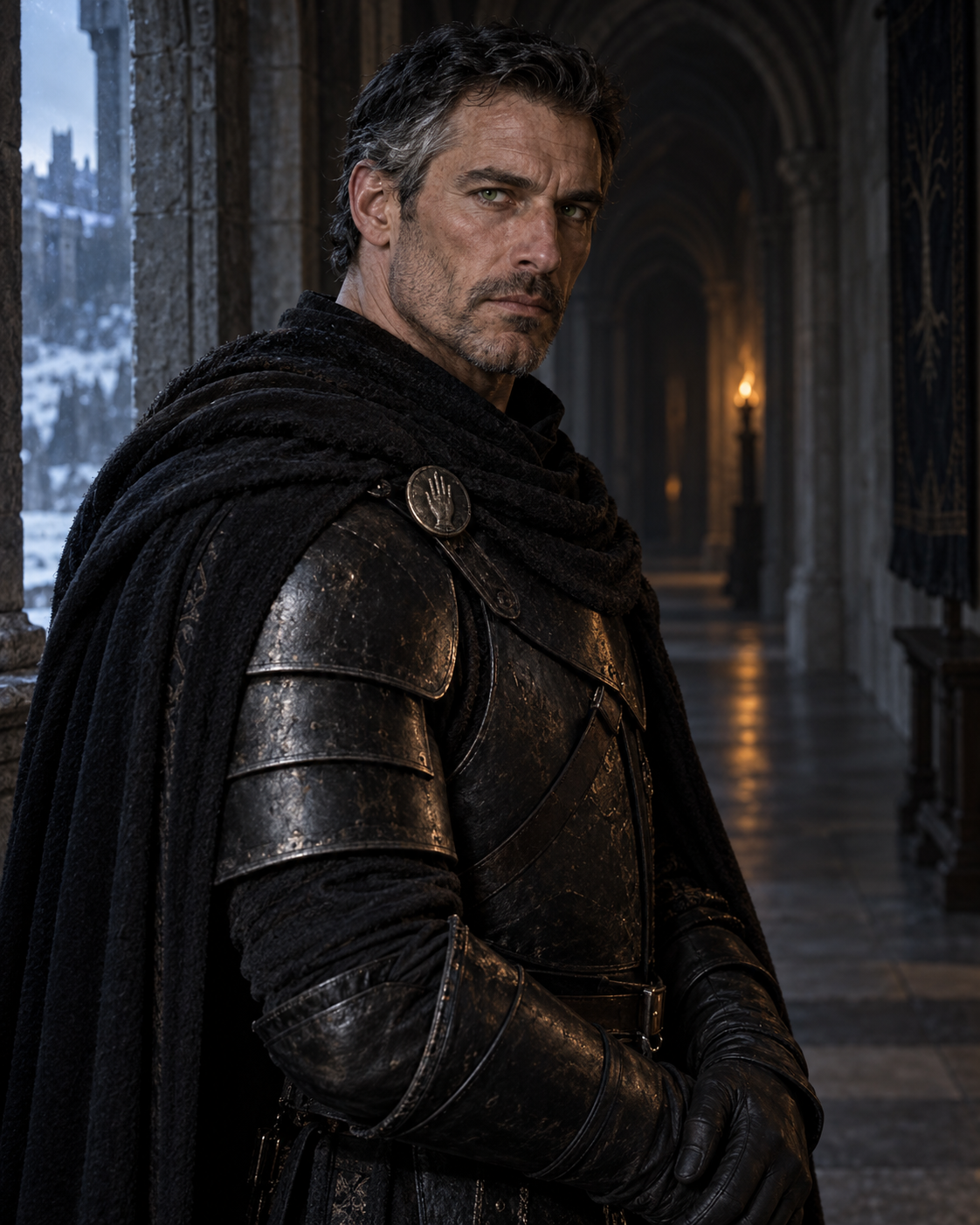
Guthwulf begins with a long jaw, strong arms, green eyes carrying an unsubtle fire, and the physical confidence of a noble soldier accustomed to being obeyed. His dark hair grays as the kingdom contracts around him; after Naglimund he shears it close and feels himself shrinking inside armor that has become too loose. The visual is not decorative deterioration. Elias’s regime is consuming its strongest servant before the supernatural sword finishes the work.
Pryrates burns his face and destroys his sight. Beneath the Hayholt, Guthwulf grows long-bearded, filthy, scarred, and skeletal while retaining enough buried strength to survive passages that no longer obey ordinary space. His canonical identity therefore needs two extreme milestones: the formidable, attractive King’s Hand and the blind underworld survivor. The later face must show damage, starvation, and terror without becoming a different man or reducing disability to horror makeup.
The Complete Journey
The king’s fist learns how to open a hand
Book 1 · The Dragonbone Chair
Power looks uncomplicated when somebody else is sealed inside the house
Guthwulf belongs to Elias’s favored table before the crown is officially his. He and Fengbald turn knives into drinking-game theater while the prince laughs, and Guthwulf draws steel when Towser’s “Old King Juniper” makes treason audible inside entertainment. The reaction establishes his governing instinct: threat first, interpretation later.
As newly made King’s Hand, he carries that instinct into Meremund’s plague. His men board infected families inside their homes; stories describe screams and whole streets sealed. Containment may be the stated purpose, but the policy makes vulnerable bodies disappear behind state carpentry. The series does not give Guthwulf the luxury of being remembered only for what he later suffers.
Elias sends him to Hernysadharc with twelve knights to demand tribute from a starving kingdom. Guthwulf calls Maegwin the Rose of Hernysadharc, ignoring that the title belonged to Elias’s mother. When Lluth says no tithe can exceed watching his people suffer, Guthwulf answers with contempt. Gwythinn puts a sword to his throat; diplomatic protection saves him. He leaves promising fire and crying children. The mission is not negotiation gone wrong. It is coercion delivered by a man still confident that loyalty converts cruelty into duty.
Book 2 · Stone of Farewell
He sees the rot clearly and keeps serving it anyway
After Naglimund, Guthwulf rides through celebration that cannot hide shuttered windows or Elias’s sickness. Sorrow hangs at the king’s side like a wrongness the room has learned to orbit. Elias sweats in impossible cold, rages at imagined betrayal, then asks his old friend to save him. Guthwulf considers killing Pryrates but fears the priest may be the only person controlling Elias—or the person guiding him into catastrophe. Doubt becomes another reason to postpone action.
The Hayholt begins showing him the conquered city beneath it. Corridors shift; the chapel court becomes white-walled Asu’a for a breath; a high inhuman voice speaks with Elias and Pryrates behind a closed door. Guthwulf confronts what he hears and receives a perfectly calm lie. The powerful earl has evidence his culture cannot classify and authority that cannot force truth from the people above him.
Elias makes him touch Sorrow. The gray sword consumes the song of his soul and reaches toward its brothers across the world. Guthwulf now knows corruption physically, yet still accepts command because leaving for the Thrithings offers ordinary soldiers and breathable air. His decisive turn comes when Rachel drives a knife into Pryrates. Guthwulf, already intending to desert and give his force to Josua, grapples the priest to save her. Pryrates burns his face and eyes. Elias leaves his oldest friend blind on the balcony, soothing him like a discarded dog.
Book 3 · To Green Angel Tower, Part I
The blind man becomes the Hayholt’s most accurate witness
Guthwulf’s escape route betrays him one landmark at a time. Blindness sharpens touch and hearing while the castle overlays incompatible histories: winter, hot wind, mud, polished floors, remembered fire. Sorrow beats through stone like a living gray heart. Guthwulf tumbles into the underworld and wanders for an unknowable stretch, living on worms and beetles while whispering shades and changing passages teach him what rank once concealed.
He believes the maze is damnation for lying and killing. More painfully, he recognizes the poverty inside his creed. If need is weakness and weakness disqualifies manhood, companionship becomes impossible precisely when he needs it most. A cat tests the doctrine without making a speech. Guthwulf nearly kills it for food; its trusting purr breaks him into tears. The animal returns with a rat, and he divides the meal equally. His first honest fellowship is tiny, hungry, and completely outside the heroic language he once respected.
Rachel finds him by the furnace and leaves food without demanding conversation. He cannot trust the gift for long. Sorrow calls him deeper, and the blind man who once administered a kingdom becomes the body through which the castle’s hidden architecture, foundry, voices, and sword-network are made legible. He is no longer politically powerful, but he is finally paying attention without assuming attention grants ownership.
Book 4 · To Green Angel Tower, Part II
One boy, one sword, one last answer to the voices
Rachel’s untouched food turns Guthwulf into a missing person nobody else will search for. The irony is beautiful and cruel: Simon later eats the provisions, and Rachel mistakes the empty plate for proof Guthwulf has returned. Her care reaches both men even when neither understands the entire route.
Guthwulf finds Simon tortured on Inch’s water wheel. He gives him water, says he once had a name in another place, and finally remembers it aloud. At first he cannot offer more; the voices tell him that helping will cost everything. He returns anyway. Guthwulf saws through Simon’s bonds while the wheel is raised, helps him escape, and retrieves Bright-Nail by touch. When Simon names the sword, Guthwulf calls it his—not as a crowned claim but because the blade has been singing him through the dark.
Simon feeds the feverish earl before himself. Beside the Pool, the cat curls against Guthwulf and calms him. By morning he is cold, Bright-Nail locked in his fingers. Simon wraps him in the best rags available, says the Prayer for the Dead, thanks him, and apologizes for taking the sword. No title is restored. No crowd learns the story. Guthwulf’s final public legacy remains compromised power; his final human act is freeing the boy who will carry the needed sword upstairs.
The People Around Him
Loyalty, abandonment, and care from people he once would not have noticed
Elias
Old friendship becomes the leash Guthwulf mistakes for honor. He sees Elias’s fear and genuine suffering, then lets compassion for the friend delay resistance to the king. Elias ultimately discards him without surrendering the language of affection.
Pryrates
Guthwulf correctly recognizes the priest as architect or accelerator of disaster but waits for certainty power will never provide. His attempt to save Rachel converts suspicion into action and costs him his eyes.
Rachel
The old Mistress of Chambering attacks where the King’s Hand hesitates. Later she offers food with no demand for trust. Their connection turns domestic care into resistance and lets each save the other without receiving a tidy reunion.
Simon
Simon knows Guthwulf first as an enemy’s name and finally as the man holding water to his mouth. Their brief companionship strips rank away until kingship and redemption both mean feeding the wounded person first.
The gray cat
The cat is not a cute accessory pasted onto tragedy. It makes trust physical, shares food, supplies warmth, refuses Guthwulf’s self-exile, and tries to wake him after death.
Sorrow and Bright-Nail
Sorrow violates him and calls him into the deep; Bright-Nail gives that compulsion a final route toward Simon. The swords recognize Guthwulf before he has learned how to recognize himself outside service.
Why He Works
Redemption small enough to remain honest
Guthwulf works because the narrative never confuses suffering with moral balance. Blindness does not compensate Meremund. Starvation does not unsay the threat against Hernystiri children. Saving Rachel and Simon matters because those are real choices, not because they settle an invisible account.
His arc also understands that domination is lonely long before punishment arrives. Guthwulf’s creed makes need shameful, so friendship with Elias becomes obedience: he can protect, command, threaten, and kill, but cannot admit uncertainty without feeling unmanned. Beneath the Hayholt, every prop disappears. The cat needs him and feeds him. Rachel offers care without control. Simon is helpless and still feeds Guthwulf first. Dependence becomes reciprocal rather than humiliating.
On the Record
Scope, spoilers, and a two-stage visual identity
This is Guthwulf’s one canonical profile across all four owned Kindle volumes and their completed reading receipts. It is intentionally full-spoiler. Franchise and volume directories must surface this post through explicit appearance metadata and scope-aware status—not duplicate biographies.
His locked pre-injury identity preserves one attractive, long-jawed, green-eyed, graying dark-haired face across the strong King’s Hand milestone and the scarred, blind, long-bearded, skeletal underworld milestone. Later damage must remain recognizably this man and must never reduce blindness to horror makeup.