
Profile trail: HUNTR/X and KPop Demon Hunters
Free
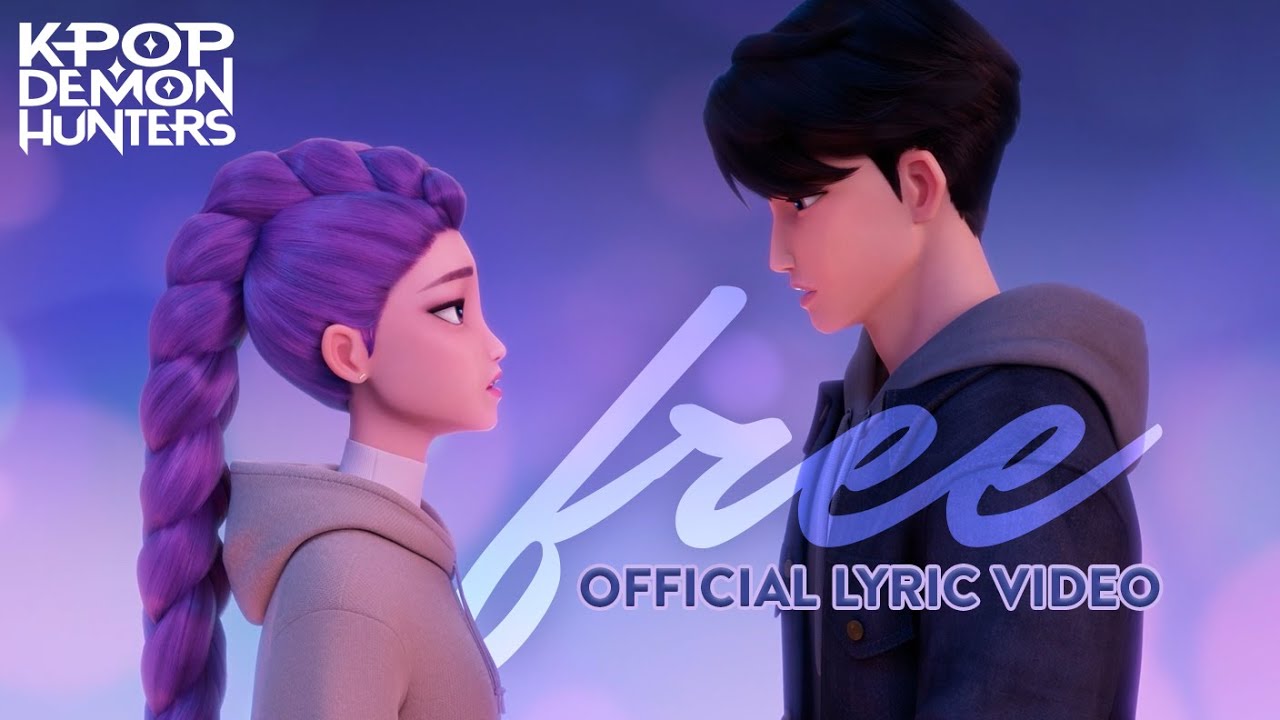
Release file
Released: June 26, 2025
Runtime: 03:12
Label / channel trail: Sony Pictures Animation
Sound: Rumi and Jinu floated over Seoul, confessed the ugliest things they believed about themselves, and almost convinced me this doomed demon romance had a future. Almost.
Sources: Exact official playlist uploadDaily+156.3KTotal views222.3M.
Rumi and Jinu floated over Seoul, confessed the ugliest things they believed about themselves, and almost convinced me this doomed demon romance had a future. Almost.
“Free” is the quietest major song in KPop Demon Hunters, which is exactly why it hurts. The movie stops selling an arena and lets two people imagine what life might feel like without shame deciding every move.
Performed by: EJAE as Rumi and Andrew Choi as Jinu, with the KPop Demon Hunters cast
Soundtrack release: June 20, 2025
Official lyric video: Sony Pictures Animation
Written by: Jenna Andrews, Stephen Kirk, and Mark Sonnenblick
Produced by: Jenna Andrews, Stephen Kirk, and Ian Eisendrath
Vocal arrangement: EJAE and Ian Eisendrath
Related: Full movie review · “What It Sounds Like” deep dive
What changed every time I replayed it
First thought: These two are emotionally undressing on a rooftop and the movie expects me to act normal.
Sound check: A restrained pop ballad with strings, breathing room, and two voices that sound careful because hope has punished both of them before.
The moment I leaned in: Jinu admits that hope hurts, so he taught himself to forget it. That one line explains centuries of bad decisions.
The side-eye: The open hand, the floating lights, the almost-kiss energy, and then betrayal. Sir, this is why trust issues have a retirement plan.
Current status: Still shipping it. Still mad. Still aware the tragedy is why the song works.
A love song for two people who do not believe they deserve one
“Free” is not about a relationship that already exists. It is about possibility. Rumi and Jinu recognize the same prison from opposite sides. She performs purity while hiding demon marks. He performs charming evil while hiding the human guilt Gwi-Ma has used to control him for centuries.
Neither person begins by saying “I love you.” They say, in different ways, “I can breathe near you.” That is more intimate.
Rumi opens with the damage already reaching her voice. She has tried to hide, smile, and keep singing until her body refuses. The broken note is not a technical problem. It is the cost of performing a self that excludes the truth.
Jinu’s answer is darker. Time has not healed him. It has destroyed perspective. Hope became painful, so forgetting looked safer. Andrew Choi sings the line with exhaustion instead of villainous drama. Jinu does not sound proud of what he became. He sounds practiced.
The duet works because the voices do not blend too quickly
EJAE and Andrew Choi have different vocal textures. EJAE’s Rumi sounds clear but strained by everything she is withholding. Choi’s Jinu sounds warmer, lower, and older in spirit. Their lines begin separately, then the arrangement lets them overlap as trust becomes imaginable.
A weaker musical would force perfect harmony immediately to announce chemistry. “Free” makes them approach it. They trade observations. They test whether confession will be punished. The shared chorus arrives only after both have named the thing they run from.
The word “free” is stretched into open space rather than hammered like a slogan. Strings support the lift, but the production does not bury the singers under a heroic wall. Jenna Andrews, Stephen Kirk, and Ian Eisendrath understand that the fantasy depends on fragility. If the song sounded too certain, Jinu’s later betrayal would feel like a cheap twist instead of fear winning one more round.
The vocal arrangement by EJAE and Eisendrath keeps breaths and transitions emotionally useful. Rumi sounds like she is learning to let a sentence leave her body. Jinu sounds like he has not spoken honestly in so long that honesty has become a foreign language.
Lyrics and meaning: “We can’t fix it if we never face it” is the entire movie
The central lyric is simple enough to sound obvious. The characters have organized their entire lives around avoiding it.
Celine believes demon heritage must be hidden and ultimately erased. Rumi believes the golden Honmoon will cure the part of her that frightens everyone. Jinu believes his human past proves he is beyond repair. Gwi-Ma survives by making shame feel private and permanent.
Facing the past threatens every system keeping them functional. Rumi could lose her group. Jinu could lose the numbness that lets him obey. “Free” is powerful because it does not promise facing pain will be pleasant. It asks whether avoiding it has worked. Clearly, no.
The line about letting the past become weightless also needs care. The song is not saying consequences vanish. Jinu harmed people. Rumi lied to her friends. The past becomes lighter when it stops secretly choosing the future, not when everybody agrees it never mattered.
The visual sequence turns emotional honesty into flight
In the film, the duet lifts Rumi and Jinu above the city. They move through air and light as if confession has temporarily changed gravity. It is romantic, but the image also literalizes relief. Both characters have spent the story carrying identities built by other people. For one song, the weight loosens.
Jinu’s footsteps lighting the rooftop and contributing to the Honmoon is a tiny detail with enormous implications. A demon can create protective energy through honest connection. That quietly disproves the ideology Rumi inherited before the finale states it openly.
The city beneath them matters too. They are not escaping into an abstract cloud kingdom. Seoul remains visible. Freedom is imagined inside the world that produced their roles, careers, wounds, and obligations. They want another way to live here.
Rumi reaching out an open hand gives the sequence its emotional center. She is not offering purification. She is asking him to choose change beside her. Jinu wants to take the hand. That want is real even when he later fails it.
Yes, there was almost more romance
Early visual-development material reportedly included an aquarium-date concept and a kiss. I understand why fans mourn it. The song already feels like a confession under romantic lighting. An aquarium would have looked gorgeous, and I am not immune to pretty people almost touching beside glowing fish.
I also think cutting the kiss was correct.
Rumi and Jinu have reached recognition, not safety. A kiss would have made their connection feel more resolved than the story can support. Jinu has not told her the full truth. He remains tied to Gwi-Ma. Rumi is imagining a joint escape with incomplete information.
The restraint protects the tragedy. They could have loved each other. That possibility hurts more than a brief romance followed by predictable breakup mechanics.
Jinu’s betrayal does not make the song fake
This is the argument I had with myself immediately after watching. If Jinu uses Rumi’s vulnerability against her, was the rooftop honesty manipulation?
No. Not entirely.
Jinu’s feelings during “Free” can be sincere while his later choice remains terrible. People do not need to be lying every moment to betray someone. Sometimes they mean the promise and then choose fear when the cost arrives.
Gwi-Ma controls Jinu through shame, memory, and the belief that his past is unforgivable. The duet gives him hope. Hope also gives him something new to lose. When pressure returns, centuries of survival behavior beat one night of honesty.
That does not excuse him. Rumi trusted him with the secret most likely to destroy her relationships and public identity. He helped turn that secret into a weapon. Her anger afterward is deserved.
The tragedy is that “Free” identifies the correct path. Jinu simply cannot stay on it yet. His final sacrifice becomes meaningful because he eventually chooses the truth the duet offered, but too late for the life they imagined.
Rumi is not trying to save a bad boy with love
I need this distinction because romance often asks women to become rehabilitation centers with good hair.
Rumi does not promise to fix Jinu for him. She asks whether they can face their prisons together. He has agency. He must fight what he runs from. The language remains “we,” but responsibility does not disappear.
She also needs the relationship. Jinu sees her demon side without treating it as evidence of corruption. He gives her a perspective Mira and Zoey cannot offer yet because they do not know the secret. Their connection is reciprocal, not charity.
Unfortunately, shared wounds do not guarantee shared courage. That is the adult part hiding inside the animated romance.
Details that hurt more after the ending
- The open hand: Rumi offers choice, not a cure.
- The lit footsteps: Jinu can strengthen the Honmoon, proving identity is not moral destiny.
- The breathing language: Safety is described physically because concealment has become suffocation.
- The word “dangerous”: Both fear their damage will hurt anyone who comes close. Jinu eventually proves the fear partly justified, which makes it crueler.
- The missing kiss: Possibility stays suspended instead of becoming a promise the plot immediately breaks.
- The return to the opening image: Rumi tried to hide and could not sing. By the end of the film, singing truth becomes her weapon.
- The wish to make the past weightless: Jinu reaches that freedom only when he chooses sacrifice over obedience.
Why some viewers rank it lower
“Free” is less immediately catchy than “Golden,” “Soda Pop,” or “Your Idol.” It does not have a dance challenge waiting inside it. The chorus uses repetition and emotional lift rather than a sharp pop hook. Listeners who come to the soundtrack for K-pop spectacle may hear it as the required movie ballad.
Fair. I do not play it when I need gym music.
But removing “Free” would weaken the entire film. Rumi needs someone who understands the hidden half before she can build the final truth with Mira and Zoey. Jinu needs one genuine vision of another life before his final decision can be more than last-minute guilt.
The song is narrative architecture. It is also beautiful on its own, especially when EJAE and Andrew Choi let uncertainty remain in the performance.
RaeRae verdict
“Free” is the romantic heart of KPop Demon Hunters, but it is not a reward. It is a glimpse of what honesty could make possible and a warning that recognition alone does not erase fear.
Rumi and Jinu see each other clearly enough to imagine freedom. They do not have enough time, trust, or courage to live there together.
That is why the song makes people cry. We are not mourning a finished love story. We are mourning the life they almost chose.
Receipts and places to keep digging
Sony Pictures Animation: official lyric video · Shazam: complete song credits · Netflix Tudum: soundtrack guide · Netflix Tudum: Rumi, Arden Cho, and EJAE · Fan discussion: emotional scenes · Fan debate: Jinu’s betrayal · Rewatch details, including Jinu’s lit footsteps · Deleted aquarium-date and kiss concept
Bottom line
“Free” hurts because the duet discovers a truthful future before either character has learned how to survive the truth in public. The harmony is possibility, not a promise the story can safely keep.
What changed every time I replayed it
- First replay: listen to how EJAE and Andrew Choi move from alternating confession toward shared phrasing.
- Second replay: watch the distance between Rumi and Jinu change before either one states what the closeness means.
- Third replay: follow the visual interruptions that remind the duet its sanctuary is temporary.
- Fourth replay: return after “What It Sounds Like” and hear which parts of Rumi’s honesty survive the loss.
Canonical character, artist and group trail
- HUNTR/X group profile
- Rumi profile
- Mira profile
- Zoey profile
- EJAE artist profile
- Exact official videoDaily+156.3KTotal views222.3M
- Jinu profile
Sources and receipts
- Exact official Sony Animation videoDaily+156.3KTotal views222.3M
- Netflix Tudum — soundtrack credits
- Sony Pictures Animation — official film page
SAJA Boys relationship
Verdict
Rumi and Jinu floated over Seoul, confessed the ugliest things they believed about themselves, and almost convinced me this doomed demon romance had a future. Almost.