
Deornoth
Josua’s plain-sword knight witnesses a murder hidden beneath a kingfisher banner, loves his prince enough to contradict him, and dies after making a refugee army believe bare stone can become home.
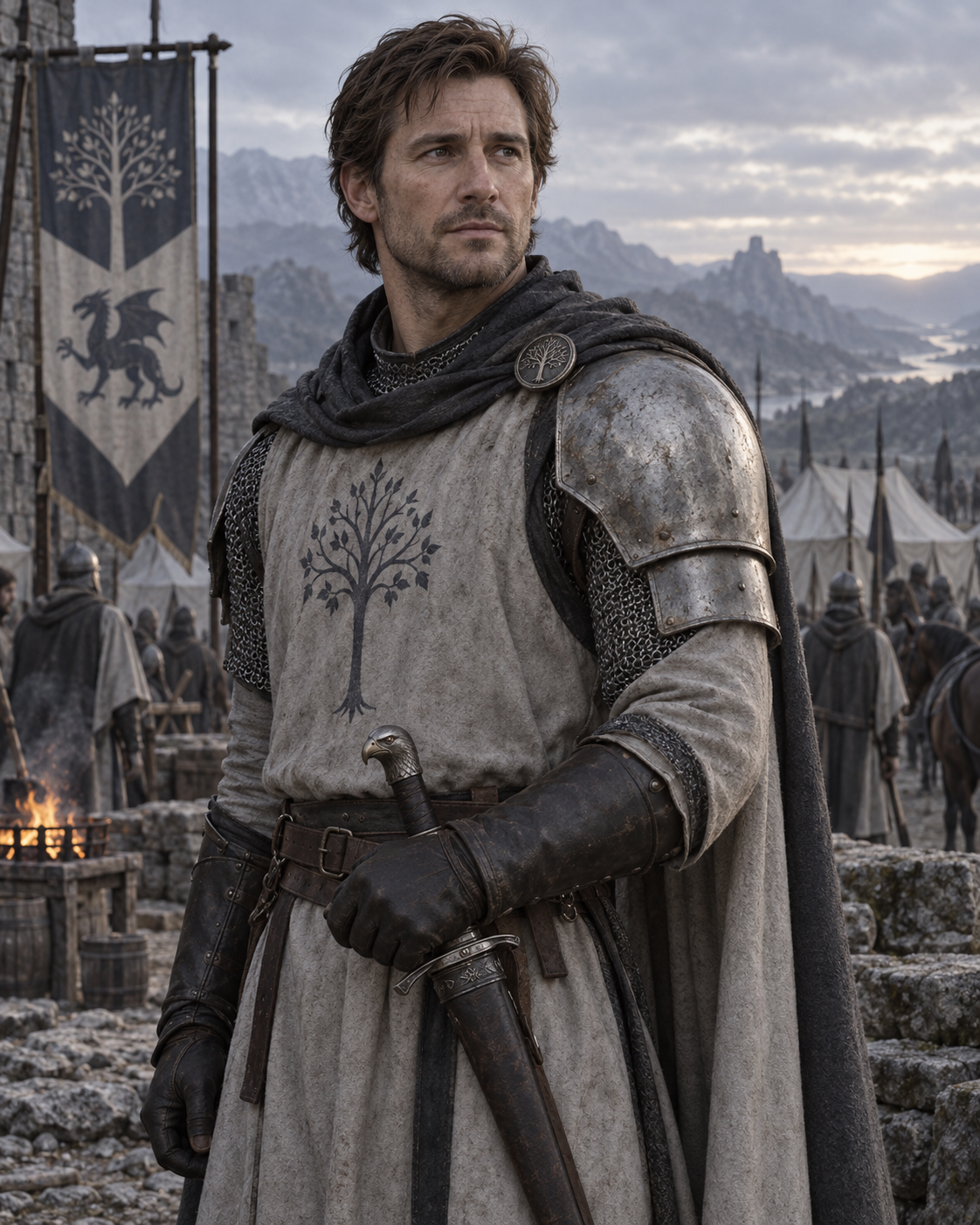
The right hand is strongest when it can tell the prince he is wrong
Sir Deornoth is Josua Lackhand’s closest knight, commander, intelligence gatherer, battlefield leader, chosen family, and eventually the witness whose account threatens Nabban’s stolen succession. He does not carry a named sword. His plain blade has a hawk pommel, gathers notches, and keeps doing the work. Deornoth recognizes himself in it: useful, uncelebrated, and privately pleased that his prince depends on him.
That self-description understates him. Deornoth repeatedly performs the kind of loyalty authoritarian men cannot understand. He obeys, advises, protects, investigates, and fights—but he also refuses to let Josua’s despair disguise itself as moral truth. Loving a lord does not require applauding the lord’s cruelty toward himself.
His death at Sesuad’ra is not memorable because a faithful subordinate gets a noble exit. It is memorable because the coalition loses a person who made duty feel like relationship rather than hierarchy.
Two living volumes and two books of consequences
Book 1: court service turns into survival and witness
Deornoth first arrives in Saint Tunath festival costume to announce Prester John’s death. The image is almost comic—white robe, blue sandals, long false beard—until the news empties the room. From the beginning, ceremony and political rupture occupy the same doorway.
At Naglimund he reports armies, alliances, Hernystir’s retreat, and the tightening routes around Josua. He prevents frightened guards from shooting Isorn’s returning company. His intelligence is rarely glamorous; it is the accumulation of distances, troop counts, damaged messengers, and knowing when a silhouette at the gate deserves one more heartbeat.
Bullback Hill makes him indispensable and powerless at once. Benigaris drives a sword through Leobardis’s neck from behind, then sounds retreat while Aspitis carries the Kingfisher banner. Deornoth alone sees clearly. He reaches Josua, names the betrayal, and escapes the trap—but one witness cannot instantly outrun an army repeating the official story.
Book 2: the prince’s friend becomes a people’s commander
After Naglimund, Deornoth watches Josua collapse inward while survivors die around him. He pulls the prince back toward leadership by asking the practical question despair has ignored: why are the Norns herding them instead of killing them?
He also offers Strangyeard a future small enough to believe in, promising to read aloud if they survive. The archivist fears blindness because it would end his access to books; Deornoth answers apocalypse with companionship and literacy.
When Josua calls himself a lodestar for disaster, Deornoth finally refuses the speech. He says Josua is his own worst enemy and will not hear a fine man slandered, even by that man. Josua later thanks him for the act of a friend. Their loyalty becomes adult because disagreement does not threaten it.
At Sesuad’ra, Deornoth leads untrained refugee riders through a mounted feint, adapts when Fengbald’s forces defeat the first ice plan, and returns bloodied with his plain sword newly notched. On the second day—the Lake of Glass—his farmer-soldiers fight as near-equals because the stone has become their home. He kills Lezhdraka, is gravely wounded, and dies soon afterward beneath the Tree and Drake banner in Leavetaking House.
Books 3 and 4: testimony outlives the witness
Strangyeard’s sworn account preserves what Deornoth saw at Bullback Hill. Josua can place it before Nabbanese witnesses, and Camaris can turn suppressed knowledge into a legitimate challenge to Benigaris. The dead knight’s evidence becomes political force because someone recorded it before grief could turn the memory into rumor.
His absence also changes leadership. Josua loses the friend who could rebuke him without calculation. Simon carries Deornoth’s recognition that careful reporting and restraint may matter more than performance. Later characters invoke him as part of the coalition’s moral memory rather than allowing him to become only another name in a heroic casualty list.
Chosen family is not obedience with warmer lighting
Deornoth’s devotion to Josua is complete enough to include resistance. He protects the prince physically, serves as commander and emissary, and accepts responsibility for Vorzheva and the unborn child as family. Yet he will not reinforce Josua’s belief that everyone near him is doomed because of him.
That correction is not insubordination sneaking through an emotional loophole. It is the mature form of fealty. A prince surrounded only by people who convert his pain into wisdom becomes dangerous. Deornoth makes love accountable to truth.
Josua’s request that Deornoth stand beside him as friend and protect his new family rebuilds a political household before the rebels possess walls. The bond is public duty and private belonging at once. Deornoth’s death therefore removes both a commander and part of the structure by which Josua understands home.
He sees the murder. The banner still reaches the crowd first.
The Bullback Hill sequence is one of the trilogy’s cleanest demonstrations that truth and public knowledge are not synonyms. Deornoth sees Benigaris kill Leobardis. Aspitis takes the banner. Benigaris blows the retreat and cries that the duke has fallen. Thousands experience only the command, symbol, and announced grief.
Deornoth cannot win by remembering harder. He must survive, reach Josua, speak, and later have the account preserved through Strangyeard. Even then, Nabban requires corroboration, claimant, audience, and political opportunity before the truth can move.
His role connects the human conspiracy to the trilogy’s larger memory argument. False history does not always need ancient sorcery. Sometimes it needs one dead man, one isolated witness, and a person holding the right flag.
Plain usefulness becomes charisma when everyone else is freezing
Deornoth’s authority grows from attention. He hears reports, counts forces, evaluates uncertain intelligence, restrains frightened defenders, leads people who were farmers yesterday, and tries to produce order inside fog and panic.
He is not infallible. He favors using Helfgrim’s intelligence despite Geloë’s warning that the messenger’s mind hides from itself. His religious certainty can turn incomprehensible enemies into proof of the Day of Weighing-Out. Fear, faith, pride, and judgment remain mixed.
The mounted feint shows the cost of this leadership. His riders are not polished cavalry; they are displaced people learning under immediate threat. His hornman falls, his helmet dents, fog breaks formation, and he must hammer sword against shield to make retreat audible. Command is not a clean view above the battle. It is damaged hearing, missing signals, frightened horses, and responsibility for whoever fails to come back.
His choice of Vildalix, “Wild-shine,” after Josua’s Thrithings wager is another quiet receipt. Even the horse enters through responsibility: selection must honor the bargain without stripping Fikolmij’s people into poverty. Deornoth’s world is full of victories whose ethical meaning depends on what the winner refuses to take.
What distinguishes him is the willingness to revise and act without pretending uncertainty has vanished. His soldiers fight for the stone because leadership has helped convert refuge into mutual obligation. That does not cleanse the battlefield. It explains why people follow him onto it.
The series gives fidelity a spine
Deornoth dismantles the fantasy that loyalty means surrendering judgment upward. He can love Josua, serve Josua, disagree with Josua, and defend Josua from Josua. The bond becomes stronger when obedience stops being its only grammar.
His plain sword also answers the Great Swords. Thorn, Sorrow, and Bright-Nail carry names, prophecy, history, and catastrophe. Deornoth’s blade carries notches and daily use. One set of weapons rearranges the world; the other keeps a frightened line from breaking.
Finally, his posthumous evidence shows memory becoming ethical only through stewardship. A witnessed murder, honestly told and carefully recorded, can outlive the banner meant to bury it. Deornoth does not survive to see the lie fail. He still helps make failure possible.
Scope, status, and identity-art lock
This profile follows Deornoth through all four owned Kindle volumes and reference back matter. Books 3 and 4 include posthumous mentions, sworn testimony, and political consequences; those appearances belong in the filtered directories without pretending he is physically alive.
One canonical profile serves all scopes. The per-volume status timeline prevents an early shelf from silently displaying his later death while preserving full spoilers inside this page.
His locked identity preserves one exceptionally attractive adult Erkynlander knight with practical campaign strength, gray-liveried service to Josua, a plain hawk-pommel sword, and a face capable of warmth, worry, religious conviction, and battlefield command. Saint Tunath costume, Naglimund, Bullback Hill, Thrithings flight, Sesuad’ra command, and final wounded milestones must remain this same man.