
Camaris
The greatest knight in Osten Ard returns without his name, finds that everybody wants the legend, and spends the final war teaching them how much discipline it takes not to love violence.
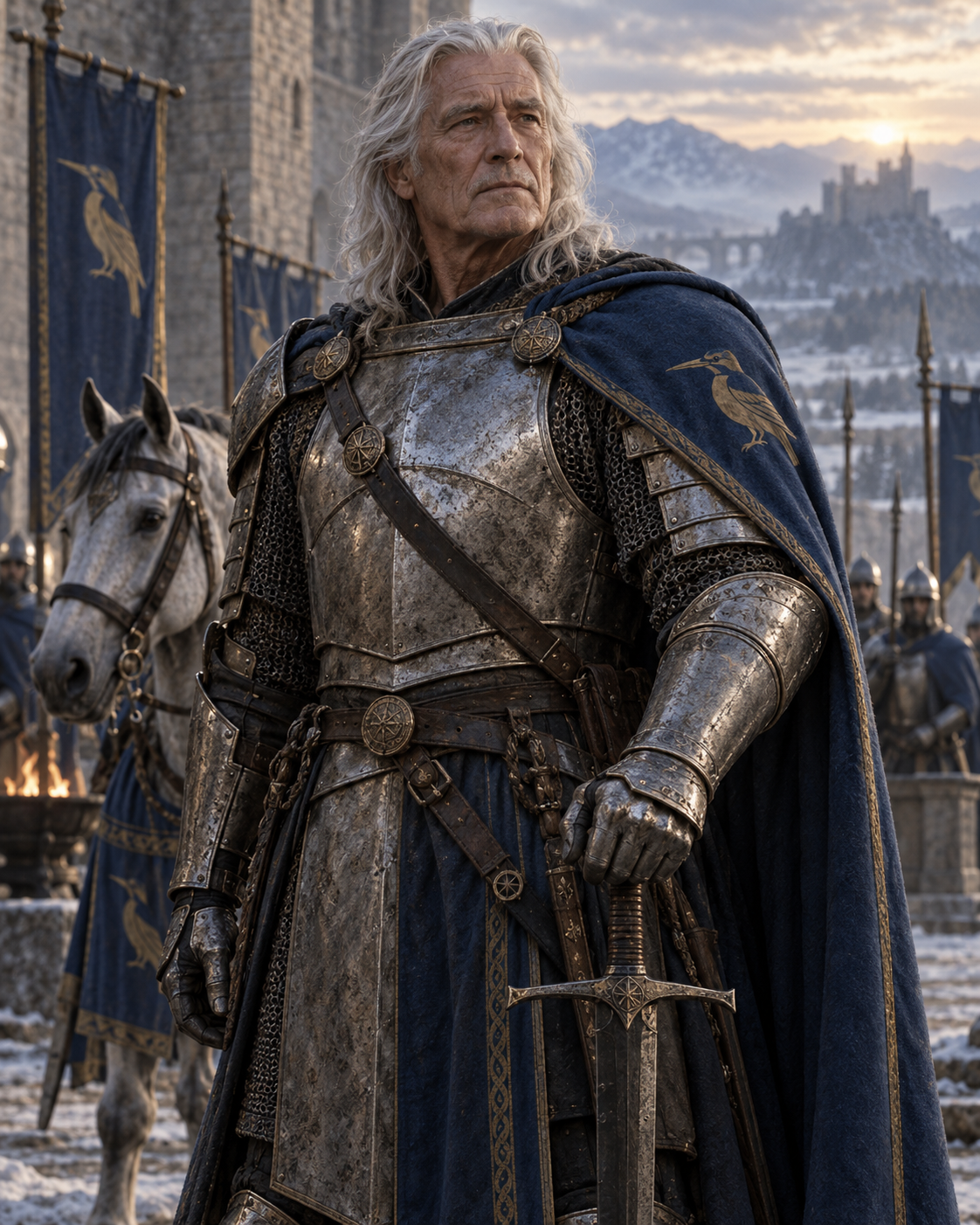
The legend is real. The legend is also the least interesting version of him.
Camaris Benidrivis—Camaris-sá-Vinitta, Prince Camaris, the greatest knight of Aedondom—is the kind of figure fantasy usually leaves safely in a song. He fought Prester John at Nearulagh, carried Thorn, became the High King’s most celebrated companion, vanished at sea, and grew taller every decade he stayed missing.
Then Tad Williams brings him back as Ceallio: an immensely strong, childlike old man with almost no accessible memory, living in Pelippa’s Bowl under the care of people who do not know they are feeding a geopolitical earthquake. The choice is ruthless and generous. We meet the vulnerable person before the world gets its weapon back.
When Camaris’s identity and memory return, his skill is every bit as frightening as the stories promised. What separates him from the usual invincible warrior is not humility pasted over greatness. It is his conviction that killing is a burden, knighthood is labor, and a person’s value cannot be reduced to how efficiently everyone else can aim him.
From fifteen-year-old prince to returned knight
Book 1: Morgenes dismantles the clean song
Book 1 introduces Camaris as history under argument. At Nearulagh, Emperor Ardrivis underestimates Prester John and dies. Young Camaris—roughly fifteen, son of Bendrivis and now Nabban’s senior prince—takes up Thorn and meets John after the armies have nearly destroyed each other.
The duel becomes a lesson nobody involved gets to keep clean. John helps Camaris free his fallen horse and returns his weapon. Camaris later holds Thorn at John’s throat but offers mercy in exchange for Nabban’s safety. John exploits the pause, knocks him down, and argues that personal honor becomes vanity when it outranks duty to family, king, and people. Camaris follows him afterward.
Morgenes’s account contrasts the two men. John is brilliant, fearless, impulsive, and cheerful in violence. Camaris may be the deadliest warrior alive, yet takes no pleasure in battle and kills without hatred only when forced. Popular song turns both men back into uncomplicated fireworks. The book lets the receipt and the fandom coexist, then asks which one Simon is actually learning from.
Book 2: Ceallio enters before Camaris does
Nearly forty years after Camaris vanished at sea, Isgrimnur finds an old man called Ceallio in Kwanitupul. His memory is absent and his behavior childlike, but his body remembers. When Fire Dancers attack Tiamak, Ceallio kills with effortless precision. The scene confirms the legend while making the confirmation horrifying: technique survives where identity does not.
Isgrimnur refuses to treat him as abandoned military equipment. He recognizes both the political hope Camaris represents and the human being who requires food, shelter, patience, and protection. That order matters. Care comes before restoration.
Book 3: the banner wakes up and asks what the march is for
Camaris returns to Josua’s company, survives a Norn assassination attempt, and recovers enough identity to alter the balance of the war. His name opens doors that armies cannot. Eneppa, who knew him as Fuiri—“flower”—recognizes the man before the heraldry finishes proving the prince. Her personal memory returns something the songs discarded: he once belonged to ordinary rooms and other people’s affection.
He claims his Benidrivine place and vows to answer Leobardis’s murder. On campaign he is decisive to the point of terror, breaking cavalry beside Hotvig, cutting through armored opposition with Thorn, and sending prisoners back with repeated offers to stop. Josua explains the apparent contradiction: Camaris hates unnecessary war so deeply that once forced into it, he ends each encounter rather than indulge a second round of killing.
As Simon’s teacher, Camaris makes knighthood gloriously uncinematic. He corrects hands and feet, insists on study, teaches horse care, and rejects the idea that a sword tap transforms character. Knighthood is discipline repeated until responsibility becomes habit. Simon wants to grow up; Camaris gives him chores.
Book 4: the sword reaches its destination and discovers the prophecy was bait
Camaris marches into the final campaign carrying the authority of the old world and the weapon everyone believes must oppose Sorrow. The revelation beneath Asu’a overturns that faith. The Three Swords are not a heroic lock waiting for the correct noble hands. They complete the enemy’s mechanism.
His death belongs to the same argument as his life. Camaris is neither exposed as a fraud nor rewarded with invulnerable legendhood. He is a magnificent, compromised, aging person placed inside a design that has been manipulating inherited stories for generations. His greatness remains real. It simply cannot make a false prophecy true.
He makes virtue procedural
Camaris’s ethic is not “be good while being extremely good with a sword.” He treats skill as morally dangerous unless governed by mercy, study, obedience, judgment, and responsibility toward people without weapons. His battlefield power attracts attention; his refusal to romanticize its use is the actual inheritance Simon needs.
That does not make him gentle in every situation. Camaris can end a fight with appalling efficiency. The distinction is appetite. He does not make killing proof of masculinity, divine approval, or personal worth. He refuses the emotional sugar that lets warriors call devastation glory because they looked impressive inside it.
His teaching also exposes the distance between title and formation. Simon’s field accolade recognizes service; it does not download maturity. Caring for tack, learning precedence, studying the Canon, controlling the body, and thinking about whom power serves all belong to the work. Camaris makes the glamorous identity answer to maintenance.
The people who remember a man instead of a military asset
Prester John defeats, recruits, and defines Camaris’s public life. Their Nearulagh encounter becomes foundational myth, but Morgenes preserves the manipulation and moral friction inside it.
Josua gains a commander, dynastic witness, and living challenge to Benigaris. He also inherits responsibility for a vulnerable elder whom his cause desperately wants to display. Their relationship keeps leadership and exploitation uncomfortably close.
Isgrimnur and Tiamak protect Camaris before restoration makes gratitude politically useful. Tiamak’s defense during the Norn attack and his humane solution to Camaris’s sealed confession treat privacy as part of personhood, not an obstacle to strategy.
Simon receives the unromantic education the boy’s adventure fantasies never included. Camaris does not merely teach him to win. He teaches him why winning is not a complete moral sentence.
Eneppa recognizes Fuiri. In a story drowning in lineage documents, swords, prophecies, and official histories, an elderly cook’s memory verifies him with devastating intimacy.
Jao é-Tinukai’i, Ti-tuno, and Josua’s bloodline
Camaris’s missing decades are not one blank. They contain journeys, identities, a secret visit to Jao é-Tinukai’i, his knowledge of an intimate song Amerasu loved, and a confession so painful Strangyeard refuses to repeat it after determining that it does not bear on the present war.
The series also ties Camaris to Josua’s hidden parentage and the Kingfisher House. The reveal changes the dynastic map without turning biology into moral proof. Blood can explain claims and danger. It cannot manufacture worth.
Cellian—Ti-tuno, the tooth of Hidohebhi—links Camaris to the dragon history surrounding Hakatri, Ineluki, and the Great Swords. Like Camaris himself, the object carries a past larger than its immediate battlefield use.
The restoration fantasy has to return a person
Fantasy loves a lost sword, lost king, lost heir, and lost champion because recovery promises that the broken present can borrow competence from a better past. Camaris arrives carrying all four temptations. The trilogy then asks whether anybody can recover a legend without consuming the human being trapped inside it.
His story refuses two easy answers. He is not secretly useless, and the old songs are not wholly lies. His ability really can change a war. But usefulness does not cancel bodily vulnerability, traumatic absence, private shame, or the right not to be converted into public property.
Camaris matters because the series lets excellence survive its own deconstruction. He can be the greatest knight and still need care. He can be a symbol and hate being used as one. He can teach a younger hero while remaining full of locked rooms. The legend becomes better when the person is allowed back inside it.
Scope, names, spoilers, and identity-art status
This profile follows Camaris across all four owned Kindle volumes and their reference back matter. The canonical appendix form is Camaris Benidrivis; Camaris-sá-Vinitta, Ceallio, Fuiri, and Prince Camaris remain searchable aliases.
Volume-filtered character directories all point here. They do not create four different Camarises, and later-book cards must present status appropriate to their scope rather than silently dropping the final outcome onto an early shelf.
His locked restored-elder identity preserves the book’s towering, aged, immensely strong knight—beautiful enough for this fandom and visibly weathered enough to have lived his life. Younger Nearulagh, childlike Ceallio, commander, teacher, and final-battle milestones must all remain recognizably this same man.