
Memory, Sorrow, and Thorn · Canonical Character Profile
Brother Hengfisk
Brother Hengfisk begins as a terrified, prejudiced survivor whom the heroes help anyway. He ends as a body occupied by something patient enough to imitate service and cruel enough to leave its victim awake for flashes of his own captivity. His story is not a heel turn. It is an invasion.
At a Glance
The survivor whose body becomes enemy territory
- Calling
- Rimmersman monk associated with Saint Hoderund’s
- First role
- Survivor and rescuer after the abbey massacre
- Core flaw
- Religious and cultural certainty sharpened into prejudice
- Later condition
- Captured at Naglimund, physically altered, and controlled by the Storm King’s forces
- Final clarity
- Briefly identifies that “they” filled him before control returns
- End-of-series status
- Dead; Binabik kills the possessed body while defending himself
The Visual Receipt
The face must change because the violation changes it
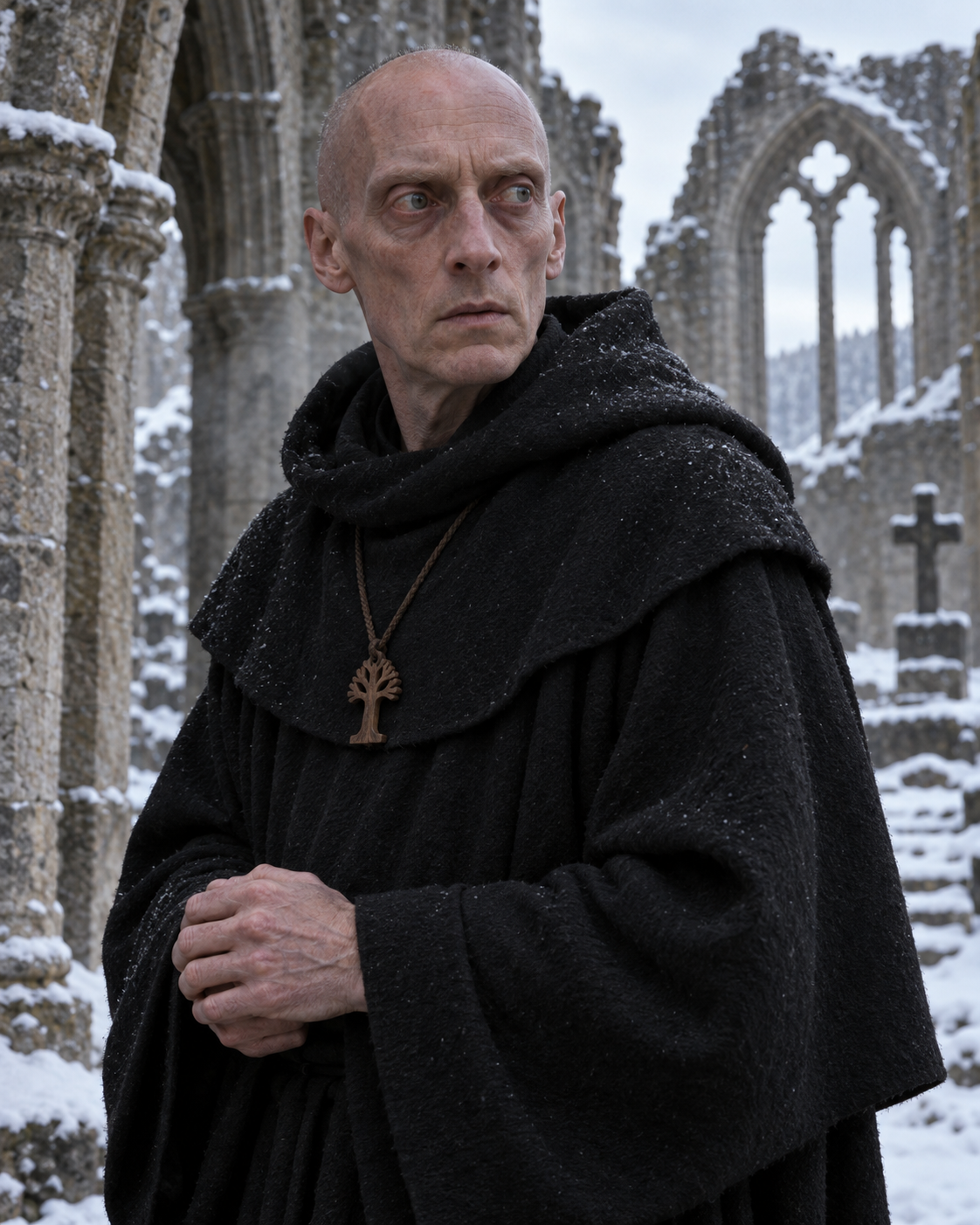
In Book 1, Hengfisk is an angular Rimmersman monk with a bald or pink skull, bulging eyes, bony arms, and a black robe. Shock makes him tremble and turns him sick-pale. He looks frightened because he is frightened. That first milestone cannot be retroactively painted as obvious supernatural evil. His prejudice is human, and so are the cloak he gives Langrian, the work he does beside Binabik, and the tears he sheds for Dochais.
After Naglimund, the same face becomes peeled, withered, and profoundly wrong. His eyes can look empty; his grin remains fixed; his skin carries unnatural heat and the smell of hot metal and decay. He fails to react when hot liquid burns his hands. The horror depends on continuity. Future art must preserve one identifiable adult man across trauma, capture, wasting, compulsion, and the final instant of lucidity. Making the possessed version into a glamorous unrelated villain would erase the crime committed against him.
The Complete Journey
He survives one massacre and walks directly into the machinery behind it
Book 1 · The Dragonbone Chair
A prejudiced man can still be terrified, grieving, and worth saving
Qantaqa finds Hengfisk after the attack on Saint Hoderund’s. He is the only mobile survivor Simon and Binabik encounter, protecting himself with the Tree and initially assuming the Qanuc man and his wolf caused the slaughter. Binabik recognizes the accusation as part of a long history in which Qanuc communities wake to Rimmersman axes and fire. Simon sees hatred moving in both directions without pretending the histories are equal.
Hengfisk leads them to Brother Langrian, badly wounded, and Brother Dochais, fevered or mentally altered. He says he had been away on vigil and returned to devastation. The monks’ evidence is incomplete but crucial: pale-eyed attackers, a violent confrontation, impossible cold, and Dochais’s warning about White Foxes whose master freezes hearts and carries souls away.
The chapter refuses to flatten Hengfisk into his ugliest first words. He gives Langrian his cloak. He works beside people he distrusts. When Dochais dies after whispering “Storm King,” Hengfisk openly weeps. He demands that every corpse receive burial. Binabik agrees to bury Dochais but refuses to spend days endangering the living for bodies Hengfisk believes are already spiritually safe. Their argument contains grief, ritual obligation, practical danger, and cultural injury. Nobody gets a painless moral monopoly.
Hengfisk leaves Book 1 alive. The survivor has real evidence, a great deal of certainty, and no understanding of how close the larger danger already is.
Book 2 · Stone of Farewell
He mistakes beauty for salvation one beat before it takes him
During impossible summer winter, Hengfisk crosses toward Naglimund. His damaged lungs, peeled skin, and punishing internal commentary reveal a man who has turned survival into proof of his own rigor. He imagines Bishop Anodis admiring him and anticipates correcting the supposedly lax people waiting at the castle. The fantasy is self-important, but it is also painfully ordinary: he needs the catastrophe to make sense and wants endurance to mean he was right.
Naglimund is buried, breached, and silent. Pale-haired, cold-faced figures emerge beneath blue-lit towers. Hengfisk first reads their beauty through the only category grand enough for it and decides they are angels. Then he sees the fell light in their black eyes. Recognition arrives too late. The Norns capture him and carry him inside while his screams rise briefly over the wind.
This is the hinge his later appearances require. Hengfisk does not volunteer for Pryrates, discover a taste for cruelty, or become corrupted by ambition. He is taken. Whatever comes back wearing him begins here.
Book 3 · To Green Angel Tower, Part I
The king’s cupbearer looks like service after choice has been removed
At the Hayholt, Hengfisk appears as Elias’s cupbearer. The familiar monk is visibly transformed: raw, peeled-looking skin, a lunatic fixed smile, empty attention, and no normal response when hot drink burns his hands. His body performs obedience while every material sign says that obedience is not consent.
Rachel encounters him with unnatural heat and the smell of hot metal and decay. She prays to Elysia. The prayer appears to interrupt the control—not with a triumphant exorcism, but with a few terrible seconds of personhood. Hengfisk looks bewildered by his own body and begins an untranslated plea or question. Then the occupying force wins again and he flees.
That flicker changes how the cupbearer scenes must be read. His silence is not proof that nothing remains. Elias strikes him for watching. Pryrates uses him inside a system that drugs, isolates, frightens, and controls the king as well. Master and servant are both being consumed at different speeds, and Hengfisk’s body shows the more complete theft.
Book 4 · To Green Angel Tower, Part II
Lucidity returns only long enough to name the prison
Hengfisk remains near Elias and the tower while the final design closes. He serves the sleepless king who clings to Sorrow and senses that somebody has altered the music of the dark. The monk’s presence makes royal degradation domestic: cups carried, footsteps heard, blows absorbed, a human being reduced to one more mechanism in Pryrates’s controlled rooms.
During the descent into the Hayholt, the apparently dead monk reappears on the stair and attacks. Binabik recognizes that something has entered him. The struggle is tangled with Miriamele’s abduction; unseen hands seize and hood her while Hengfisk keeps the others occupied.
A bite or wound produces one final lucid interval. Hengfisk explains that “they” filled him and tries to communicate the scale of the falsehood: something beyond belief, cunning as time. He is not delivering a villain’s confession. He is reporting from inside an occupied body before the occupier retakes it. When the attack resumes, Binabik kills him in self-defense.
The death ends the threat but cannot restore the man. Hengfisk’s tragedy is that survival carried him farther into danger, and the story allows only fragments of his own voice after capture. Those fragments are enough to establish the truth: the monster was done to him.
The People Around Him
Care, prejudice, control, and the few people who notice the difference
Binabik
Hengfisk greets him with slurs; Binabik helps the wounded anyway. Later Binabik is the person who recognizes possession and must kill the body when the trapped man can no longer control it.
Brother Dochais
Hengfisk rescues, restrains, mourns, and buries him. Their scenes prove that an abrasive survivor’s grief can still be sincere.
Brother Langrian
He gives the younger monk his cloak and helps keep him alive. Care exists beside prejudice, making Hengfisk human rather than morally tidy.
Rachel
Her imperfect prayer briefly reaches the person beneath the compulsion. She does not cure him; she witnesses him.
Elias
The controlled king strikes the controlled servant. Their proximity shows how domination reproduces itself downward even among victims.
Pryrates and the Norns
They turn capture into utility. Hengfisk’s body becomes transport, surveillance, service, and violence after his agency has been stripped away.
Why He Works
The books let an unpleasant victim remain a victim
Hengfisk works because the narrative does not require innocence to prove violation. He is prejudiced, vain, punitive, frightened, dutiful, grieving, and capable of care. None of those facts grants anyone ownership of his body. None of his human failures make possession karmic justice.
His arc also turns obedience into a visual warning. Before capture, Hengfisk argues, accuses, demands, cries, and makes choices other people dislike. After capture, he serves perfectly. The “better behaved” version is the horrifying one because friction was evidence of a self.
On the Record
Scope, spoilers, and identity continuity
This is Brother Hengfisk’s one canonical full-spoiler profile across all four published volumes. It is grounded in the completed owned-edition ledger and corrects his omission from the earlier Book-1-centered registry. The four volume directories must filter this post and show status as of their own scope rather than clone his biography.
His locked pre-possession identity preserves the angular, bald, prominent-eyed adult monk from Saint Hoderund’s through his winter journey, physical wasting, compelled cupbearer state, and final lucid attack. Later art may be frightening, but it must remain recognizably this same violated person; the horror is the theft of a human face, not its replacement.