
Benigaris
Nabban’s impatient heir gets the crown by putting a sword through his father’s neck, then discovers that a stolen banner can command an army more easily than it can make a ruler.
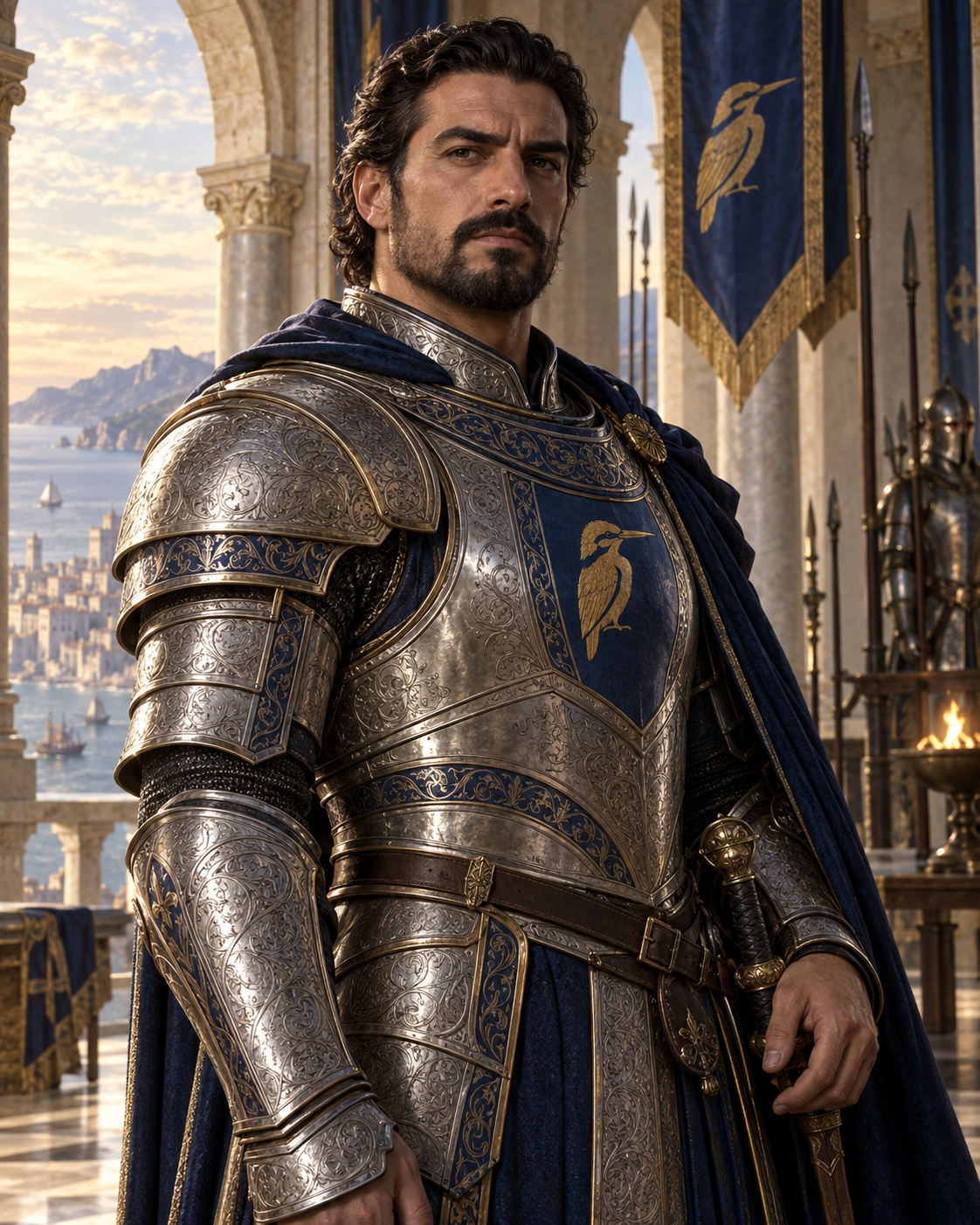
He does not inherit Nabban. He edits the witnesses.
Benigaris is the eldest son of Duke Leobardis and Duchess Nessalanta, brother of Varellan and Antippa, nephew of Camaris, and heir to Nabban’s Kingfisher House. He is also the man who murders his father from behind at Bullback Hill, sounds retreat, announces the duke has fallen, and lets thousands of people carry the lie home for him.
That sequence is Benigaris in miniature. His decisive talent is not swordsmanship. It is controlling what everybody else thinks just happened. He understands banners, timing, household soldiers, closed rooms, prepared explanations, useful allies, and the speed with which a public story can bury one inconvenient witness.
He wants authority without the moral inconvenience that made Leobardis hesitate. Once he has it, governance becomes a running complaint that ordinary people are refusing to behave like supplies. The crown does not enlarge him. It gives his impatience a larger room.
Four books of turning inheritance into acquisition
Book 1: the son under the uncle’s shadow
Benigaris arrives at Prester John’s funeral leading more than one hundred mail-clad Nabbanai aboard warships bearing the golden kingfisher. The crowd immediately compares him with vanished Camaris. Benigaris is tall and broad, but the public treats his thickening body as proof he is a lesser cutting from Leobardis’s tree rather than Camaris’s legend. That judgment is crowd prejudice, not moral diagnosis. His later choices convict him without needing a waist measurement.
In Nabban he resists Eolair’s access to Leobardis’s private diplomacy and favors alignment with Elias. He is impatient with his father’s affable caution and with anyone who complicates the clean transfer of power. The household tension becomes part of the larger war before the family admits it.
At Bullback Hill Benigaris proposes a maneuver that appears strategically sound: pin Guthwulf against Naglimund while allied forces close. The message to Josua never arrives. Fengbald’s soldiers emerge, the field becomes a prepared trap, and Benigaris drives his sword into Leobardis’s neck from behind. Aspitis takes the kingfisher banner while Benigaris calls retreat and performs grief. Only Deornoth sees the murder clearly.
Book 2: a duke protected by other people’s bodies
Benigaris consolidates Nabban while Pryrates eliminates opposition inside Mother Church. Roughly twenty of Benigaris’s armed household men are positioned in the Sancellan before the confrontation that ends with Dinivan and Lector Ranessin murdered. The manufactured story—Fire Dancer killers inside God’s house—begins before the bodies can contradict it.
Aspitis continues confidential work for him, carrying money, routes, and a hidden Fire Dancer robe aboard the Eadne Cloud. Benigaris’s political order therefore connects court, soldiers, religious terror, shipping, and private captivity. None of those abuses remain isolated accidents once the same names keep paying the bills.
Book 3: Camaris returns and the stolen house develops a memory
Benigaris complains about levies, abandoned fields, Thrithings raids, Fire Dancers, and Wran laborers who resist forced agricultural work. His language treats a country under supernatural winter and political collapse as defective inventory. People exist as the workforce that failed to make his reign comfortable.
Then Camaris returns. The vanished senior prince is not just a heroic morale boost; he is the Kingfisher House’s living counterclaim. Camaris vows to answer Leobardis’s murder, and old officers, cooks, barons, and provincial memories begin doing what Benigaris’s controlled story cannot tolerate: recognizing the past out loud.
Book 4: the lie loses territory
By the final volume Benigaris’s control is fracturing. Aspitis Preves, once his accomplice, defeats his forces and takes Eadne. Camaris’s return has become credible political fact rather than rebel theater. Nessalanta’s strategy and maternal control crack under pressure.
Benigaris survives the central catastrophe at last confirmation, but survival is not victory. He ends as the ruler who obtained a country through a perfectly managed battlefield lie and then proved unable to command the loyalties, harvests, labor, faith, and history that a functioning country actually contains.
Patricide is the climax, not the beginning, of the household failure
Leobardis wants alliance, continuity, and reconciliation badly enough to read Benigaris’s sudden strategic cooperation as the return of a son. The trap exploits paternal hope before it exploits battlefield geometry. Trust is not Leobardis’s moral failure; failing to investigate the convenient reversal is his fatal political one.
Nessalanta favors Elias and helps position the household against Leobardis’s direction. Her ambition does not make her the author of Benigaris’s sword stroke. It does reveal a family culture where marriage, children, and allegiance are pieces to be arranged around dynastic survival.
Varellan is the anxious younger brother pushed toward soldiering despite earlier religious interest. His uncertainty throws Benigaris’s aggressive certainty into relief without making either son’s path inevitable.
Camaris is the uncle whose absence made Leobardis duke and Benigaris heir. His return turns genealogy into an army. Benigaris cannot dismiss him as merely legendary once living witnesses recognize Fuiri and the old knight begins leading troops.
The banner works until people start comparing receipts
Benigaris understands concentrated force and message control. Household guards inside holy space, an allied noble carrying the right standard, an astrologer framing collapse as cosmic renewal, and a false retreat can all make seizure look like necessity.
His government fails at reciprocity. Levies, fields, Wran workers, ships, provincial estates, and noble marriages are things from which obedience should flow. When people resist, he reads the resistance as malfunction rather than political evidence.
The series gives his opposition a different intelligence system: Deornoth’s sworn account, Strangyeard’s record, Eneppa’s recognition, Camaris’s embodied claim, provincial barons’ choices, and the behavior of former allies. One witness can be buried. A network of memory is harder to kill.
Every useful ally eventually becomes another claimant
Aspitis Preves helps sell the Bullback Hill lie and conducts later business for Benigaris. Their alliance is transactional enough that Aspitis eventually takes Eadne from him.
Pryrates and Elias offer the external force Benigaris believes will secure his rule. His admission that he trusted Pryrates lands less as innocence than as the political version of hiring a fire because it promised to warm only your room.
Deornoth is the witness who survives. His account cannot restore Leobardis, but it keeps the murder from becoming whatever Benigaris called it into the horn.
Stréawe brings intelligence into Nabban while pursuing his own design. Benigaris attempts to convert hospitality into velvet captivity, proving he recognizes coercion readily when he is the one holding the door.
Power is partly the ability to make your sentence arrive before the witness
Benigaris embodies the trilogy’s obsession with contested memory at a human scale. The Storm King manipulates history across centuries; Benigaris does it between a sword stroke and a retreat call. Both understand that violence becomes more durable when the victim’s account cannot circulate.
His story also punctures bloodline fantasy. Benigaris has legitimate birth, excellent armor, military command, Nabban’s richest symbols, and the correct palace. None of those facts make him a worthy duke. Camaris’s blood claim can dislodge him politically, but the moral case was already settled by conduct.
He also demonstrates why administrative failure belongs inside the moral portrait of a ruler. Abandoned fields, angry laborers, unstable levies, provincial losses, and frightened allies are not boring weather happening around his dramatic crime. They are the long form of that crime: a government built to extract obedience while refusing to cultivate trust.
The Kingfisher banner is therefore more than heraldry. Under Leobardis it gathers alliance. In Aspitis’s hands it hides murder. Behind Camaris it restores suppressed memory. The cloth does not carry virtue. People keep deciding what it means.
Scope, status, and identity-art lock
This profile follows Benigaris through all four owned Kindle volumes and their reference back matter. It distinguishes direct action, other characters’ political inference, and later reported outcomes.
All four volume directories and the franchise directory point to this one canonical profile. His end-of-series status remains alive at last confirmation rather than invented death or redemption.
His locked identity keeps the same tall, broad-shouldered Nabbanai man across funeral envoy, armored conspirator, duke, and losing ruler: late thirties, intent dark eyes, thick black brows, a substantial body, engraved silver armor with costly ilenite work, and Kingfisher authority that looks expensive before it looks trustworthy.