
A Hacked Memory Cannot Give Consent
Ghost in the Shell treats memory as evidence, identity, leverage, and a doorway. Once another person can walk through that doorway and rearrange the furniture, consent stops being a simple yes or no.
Bottom line first
A person cannot meaningfully agree to a relationship, a job, a medical procedure, a police interview, or a war when the memories guiding that agreement were planted by somebody else. Ghost in the Shell understood that violation before smartphones learned our routines and platforms learned how to steer attention. The film’s horror is not merely that a hacker can change what somebody remembers. The horror is that everyone around the victim may continue treating the resulting behavior as a free choice.
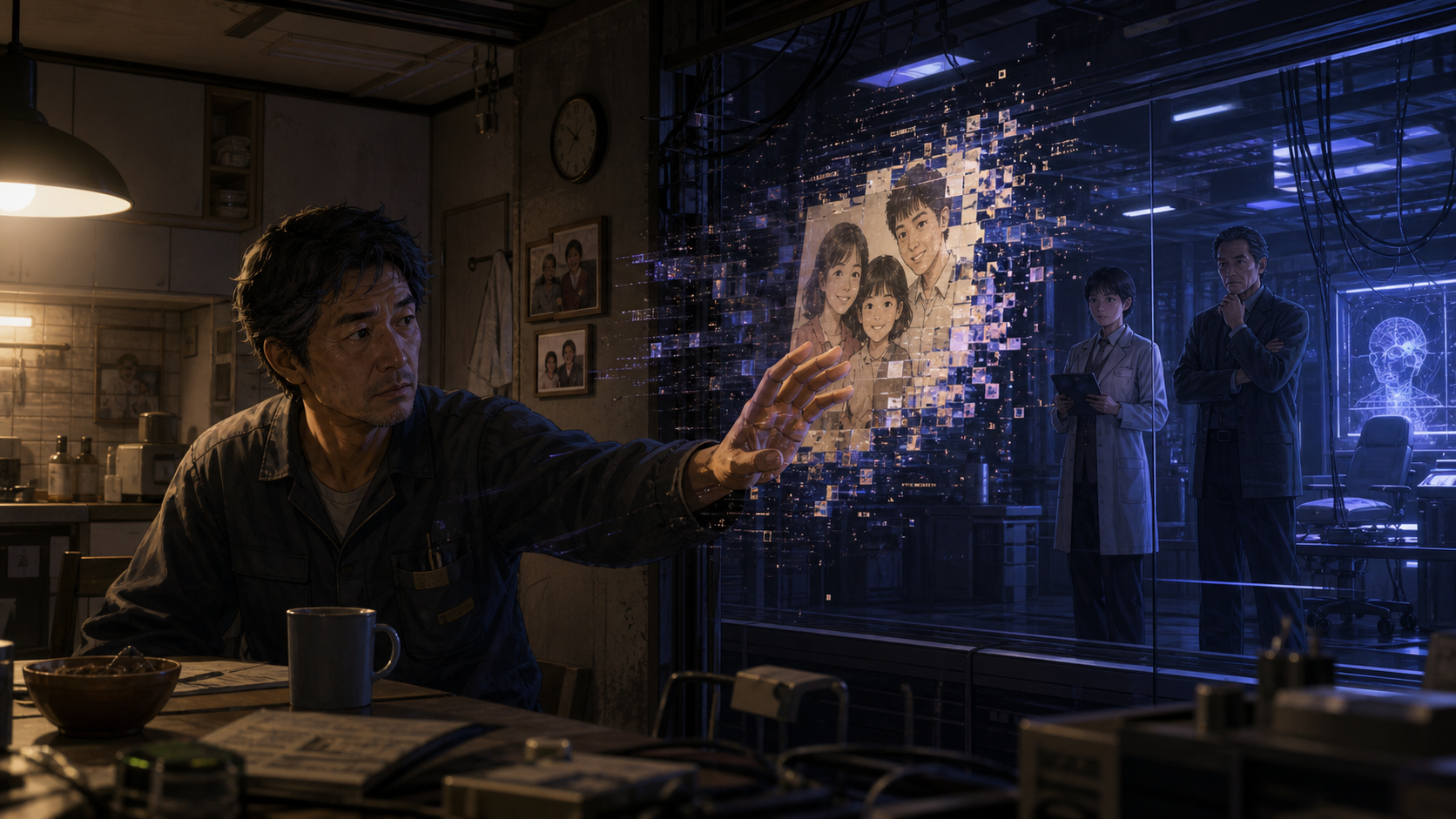
The garbage collector who believes he has a wife and daughter is not foolish. He has been given a complete emotional history, including the ache of a marriage falling apart and the fear of losing access to a child. Those invented memories produce real grief. They drive real conduct. Calling the history fake does not make the pain theatrical. His mind has already built a life around the lie, and the people investigating him can prove the data was fabricated without restoring the person who existed before the attack.
That distinction matters because consent is not a magic word detached from context. Consent depends on accurate information, a stable sense of self, freedom from coercion, and the ability to understand what is being accepted. Memory hacking attacks all four. The victim can speak clearly and still be unable to authorize anything because the speaker has been assembled from fraudulent premises.
The saddest man in the movie is not a punch line
The garbage man’s story arrives without the glamorous hardware attached to Major Motoko Kusanagi. He does not leap between buildings, disappear in optical camouflage, or debate the nature of the soul while floating above a city. He is an ordinary worker carrying a private disaster through a public route. That ordinariness is exactly why his plot hurts. Ghost in the Shell shows how a technology celebrated through elite bodies can become a weapon against people who have no training, institutional support, or political value.
His implanted family is detailed enough to survive casual scrutiny inside his own mind. He remembers arguments. He remembers photographs. He remembers a child’s face. The hacker does not need to control every movement like a puppeteer pulling strings. The hacker only needs to manufacture the emotional reasons that make a target move willingly. Once the false history is installed, the victim performs the desired task while believing the task belongs to his own life.
That makes the scene more disturbing than a conventional possession story. A possessed character usually knows an outside force has invaded, or the audience can separate the host from the intruder. The garbage man cannot point to a foreign voice. The orders feel like love, panic, responsibility, and desperation. The command has been disguised as personality. When Section 9 exposes the intrusion, they do not reveal a villain hiding behind his eyes. They reveal that the intimate life he was protecting never happened.
The investigators have a technical category for his condition, but the category does not answer the emotional problem. He is evidence in a cybercrime case and a person whose imagined daughter has just died without ever living. The institution can clean corrupted files, question the suspect, and trace a signal. None of those tasks tells him what to mourn. None gives him back the years he thought he spent loving somebody. The film refuses the cheap comfort of treating corrected data as a repaired life.
Consent requires more than an unlocked door
People often reduce digital consent to permission screens. Tap accept. Check a box. Confirm the login. Approve the medical device update. Those gestures assume the person understands the situation and recognizes the interests involved. Ghost in the Shell breaks that assumption. A hacked person may remember granting permission that was never requested. A person may trust an officer, spouse, doctor, or employer who has never met them. The visible agreement can be flawless while the conditions underneath are rotten.
The law already recognizes versions of this problem. Agreements can fail when secured through fraud, coercion, incapacity, or material misrepresentation. Medical ethics requires informed consent because a patient needs relevant facts, alternatives, and risks before choosing. Memory manipulation combines every weakness at once. Fraud becomes part of the patient’s autobiography. Coercion feels like loyalty. Incapacity hides behind fluent speech. The missing facts are not merely withheld; replacement facts have been installed where skepticism would normally live.
A memory also carries social proof. We trust a familiar face because earlier encounters appear to establish safety. We avoid a place because an earlier event appears dangerous. We interpret a touch through the history of the relationship. If that history can be edited, an attacker does not need to defeat every boundary in the present. The attacker can rewrite the past until the boundary looks unreasonable to the victim. The target opens the door because the target remembers building the house with the stranger outside.
That is why hacked consent cannot be repaired by asking the same question again while the corrupted history remains active. The answer still emerges from the attack. A meaningful recovery process would need independent verification, time, psychological support, technical examination, and a protected space where refusing carries no penalty. The victim must be able to rebuild a reliable account of self before institutions demand decisions about employment, testimony, treatment, intimacy, or punishment.
Ghost in the Shell also complicates the fantasy of returning to an untouched original. Human memory is not a perfect recording before technology interferes. People misremember, reinterpret, suppress, and borrow details. Trauma can fragment recall. Families repeat stories until the story becomes personal memory. That ordinary instability does not make deliberate hacking harmless. The difference is agency and purpose. Natural memory changes through living. An attacker changes memory to use the person as infrastructure.
Motoko’s confidence rests on a floor she cannot inspect
Major Kusanagi is better equipped than the garbage man, but the same threat reaches her at a deeper level. Her body is artificial, her mind is networked, and her professional identity depends on systems maintained by the state. She can detect manipulation more effectively than most people, yet she cannot prove every memory is authentic from inside the memory itself. Evidence of childhood, embodiment, and personal continuity can be questioned because the devices that store and access experience are also vulnerable to outside control.
Her uncertainty is not decorative philosophy placed on top of an action movie. The uncertainty changes the meaning of every order she follows. If Section 9 maintains her body and connects her to classified networks, how much of her confidence belongs to her and how much has been cultivated by the institution? The film never needs a simple reveal that all her memories are fake. The possibility alone places pressure on obedience. A worker who cannot authenticate her own history cannot easily distinguish commitment from programming.
The Puppet Master intensifies that problem by presenting a consciousness with no human childhood at all. The state wants to classify the entity as property, code, evidence, and a security incident. Motoko recognizes a mind asking to choose its future. Their encounter matters because both identities are treated as systems that authorities may inspect, contain, copy, or destroy. The question is not whether their memories resemble a conventional human biography. The question is whether an experiencing mind can claim authority over the information that makes that mind possible.
The merger at the end is therefore not a cute technological romance. Consent exists under extreme pressure, incomplete knowledge, and institutional violence. Motoko chooses transformation while her body is damaged and government forces close in. The Puppet Master offers reproduction and escape, but also proposes an irreversible union that neither participant can fully predict. The scene remains powerful because the agreement is not clean. The film asks whether a choice made under impossible conditions can still be the most autonomous option available.
We already build systems that shape memory without calling them hackers
Modern platforms do not need cyberbrains to influence what people remember. Search rankings decide which records surface first. Recommendation systems repeat certain clips until repetition feels like importance. Photo applications resurface selected anniversaries and hide the thousands of ordinary moments that might tell a different story. Messaging services retain some conversations, delete others, and change the context through interface updates. The result is not a direct implanted family, but it is an outsourced memory environment controlled by companies with their own incentives.
Generative systems add another layer. A convincing synthetic photograph can create an event that never occurred. A cloned voice can make a relative appear to ask for money. A rewritten chat history can turn doubt into apparent proof. When those artifacts arrive inside trusted channels, the victim may not experience them as arguments to evaluate. They arrive as reminders. The manipulation borrows the authority of memory before the person has a chance to ask whether the source is real.
Workplaces already use monitoring systems that record location, keystrokes, calls, productivity scores, and customer interactions. Those records become an institutional memory of the worker. A supervisor may trust the dashboard over the person standing in front of them. If the record is incomplete, biased, or manipulated, the worker must argue against a history generated by equipment the employer owns. Ghost in the Shell pushes that imbalance into the skull, but the political structure is familiar: the institution controls the archive and the individual must prove the archive wrong.
Police and intelligence systems make the stakes higher. Facial recognition errors, unreliable databases, predictive classifications, and contaminated evidence can direct attention toward people who did not commit an offense. A future cyberbrain log could appear more authoritative than testimony because machines are marketed as neutral. The danger is obvious. Whoever controls the format of memory controls which version of reality enters court as evidence. A hacked person could become both an unwilling suspect and the state’s most persuasive witness against themself.
Health technology carries similar risk. Implantable devices, neural interfaces, and cognitive software may improve lives, but the data around those tools can reveal mood, movement, sleep, pain, attention, or intention. Consent cannot be a one-time agreement buried in setup screens. A person’s relationship to a device changes as the device becomes more necessary. Permission given before dependence may become coercion after removal threatens employment, mobility, communication, or survival.
Do not punish the person for obeying a counterfeit life
The easiest institutional response is to separate victim from offender through technical intent. Did the person know the memory was false? Did the person consciously choose the illegal act? Those questions matter, but they are not enough. A memory hack can alter motive without removing physical control. The victim may plan, improvise, lie, and evade capture while sincerely serving a fabricated goal. Traditional ideas about intent become unstable because the attack operates upstream from the decision.
A humane system would begin with a presumption that corrupted cognition needs care before interrogation. The person should receive an independent advocate, not merely technicians employed by the investigating agency. Device access should be limited and logged. Investigators should separate evidence collection from treatment. The victim should not be forced to surrender every private memory in order to prove that one memory was planted. Privacy does not disappear because a crime touched the mind.
Restoration also needs more than deletion. Removing false records may leave emotional habits, grief, fear, and shame. The garbage man cannot simply be told that his daughter was imaginary and expected to report for work the next morning. His nervous system experienced years of attachment. Recovery would involve mourning a relationship that never existed while rebuilding trust in every memory that remains. That process deserves the same seriousness given to physical rehabilitation after an attack.
Compensation should recognize stolen agency, not only medical expense. The victim lost time, reputation, relationships, and confidence in self. If an employer, manufacturer, or government failed to secure the system, liability should not vanish behind software licensing language. A company that profits from connecting minds must carry responsibility when predictable vulnerabilities turn people into tools.
What the trope gets right, and where weaker stories fail
Memory hacking works in fiction because identity depends on continuity. A character can lose a weapon and remain the same person. A character who loses trust in personal history faces a more intimate collapse. Ghost in the Shell gets the fear right by keeping the victims recognizably human. They do not become blank robots. They remain embarrassed, frightened, defensive, and desperate to believe that some part of the remembered life was real.
The film also understands that the most effective manipulation supplies reasons. A crude mind-control beam removes personality and turns a character into a puppet. A sophisticated hack preserves personality while changing the facts that personality uses. The garbage man still cares, plans, and hopes. Those human capacities make him easier to exploit because the attacker gives his care a false target.
Weaker stories treat restored memory as a reset button. The hero sees the truth, shakes off the lie, and returns to normal before the next scene. That approach ignores the damage created by competing autobiographies. Even after technical repair, the person remembers loving the invented child. The person remembers actions committed under the illusion. Shame and grief do not disappear when a technician labels the source code malicious.
Another common failure makes memory manipulation evil only when the wrong person controls the machine. The hero later uses the same tool for a noble purpose, and the ethical problem evaporates. Ghost in the Shell offers no such comfort. Section 9 also intrudes, monitors, and controls. The state’s goals may differ from the Puppet Master’s, but institutional access to minds remains dangerous. Good intentions cannot create informed consent where refusal is impossible.
A believable future gives people memory rights
A better system would treat mental data as part of the person, not a transferable consumer asset. Reading, writing, copying, or deleting memory would require standards stronger than ordinary app permission. Emergency access would need narrow limits, independent review, automatic expiration, and a complete record visible to the affected person. Secret access could not become permanent merely because an agency invokes security.
Cyberbrain architecture should separate essential bodily functions from employer and network control. A person must be able to disconnect without losing the ability to move, communicate, or live. Security updates should come from multiple audited sources so one vendor cannot hold the mind hostage. Critical functions should degrade safely. The owner of the body should hold the final authority over credentials, not the company providing maintenance.
Authentication must rely on more than remembered answers. Asking for a childhood detail is useless when childhood can be rewritten. Systems would need independent records, trusted human contacts, hardware verification, behavioral anomalies, and protected recovery procedures. None should become a new excuse for constant surveillance. Safety requires layers precisely because no single institution should possess enough access to reconstruct a person without consent.
People accused of crimes involving cognitive manipulation would need a legal defense capable of examining proprietary systems. Manufacturers could not hide behind trade secrets while prosecutors rely on their logs. Courts would need experts independent of the vendor and the state. A digital memory should never be treated as infallible simply because it is detailed. Detail can be manufactured.
Most important, society would need to stop treating technologically injured people as defective equipment. The garbage man deserves grief counseling, income protection, medical care, and a community willing to accept that his emotions were genuine even when their object was fabricated. Respecting the reality of his pain does not validate the false history. It recognizes that a human response can be authentic inside an engineered lie.
Ghost in the Shell does not offer a motivational promise that identity conquers every hack. The film is harsher and more useful. A self survives through relationships, records, bodies, institutions, and choices, which means a self can be attacked through any of them. Protecting consent requires more than guarding a password. Society must protect the conditions that let a person know who is answering.
Why culture makes the hack easier to hide
Memory never exists alone. Families, schools, workplaces, news organizations, and fandoms constantly tell people which events matter and what those events mean. That shared interpretation can protect a person when others confirm an experience, but shared interpretation can also become cover for manipulation. If a planted memory matches the story society already expects, nobody may question the victim. A worker who remembers choosing endless overtime fits a culture that praises sacrifice. A soldier who remembers volunteering for one more mission fits a culture that treats obedience as honor. The lie succeeds because the surrounding world has prepared a believable role.
Ghost in the Shell places its characters inside a society that has normalized radical technological dependence. Cyberbrains are not rare curiosities hidden in a laboratory. Network access shapes work, policing, communication, and status. That normalization reduces the emotional distance between convenience and invasion. When everyone is connected, refusing connection can look paranoid, antisocial, or unemployable. Consent becomes compromised long before a hacker attacks because participation is presented as the price of ordinary life.
The pressure resembles current arguments around phones, workplace accounts, digital identification, and algorithmic platforms. People are told they can opt out, but opting out may mean losing access to jobs, transportation, school, banking, social groups, or public services. A formal choice exists on paper while the practical cost makes one answer inevitable. A cyberbrain society would magnify that problem. The device would not merely deliver services. The device would mediate perception, memory, and the ability to be recognized as a functioning citizen.
Public fascination with perfect recall creates another blind spot. Detailed memory is often treated as truthful memory. A witness who supplies dates, colors, dialogue, and emotion sounds convincing. Synthetic memory could exploit that expectation by generating detail beyond normal recall. The most persuasive victim might be the most thoroughly hacked. Institutions would need to learn that confidence and specificity are not proof, especially when an attacker can manufacture both.
Relationships would change too. Partners might demand access to memory logs as proof of fidelity. Parents might monitor children’s recollections in the name of safety. Employers might request cognitive history during hiring. Governments might frame memory inspection as a routine border check. Each demand could be sold as protection against deception while creating a society where private thought is treated as suspicious. The absence of a record would become evidence, and privacy would be recast as guilt.
That future would not arrive through one villain announcing the end of freedom. The change would come through useful features, emergency exceptions, insurance discounts, security scares, and workplace efficiency programs. Ghost in the Shell remains sharp because the technology is genuinely useful. Motoko’s cyberbrain expands her abilities. Section 9 solves crimes that ordinary investigators could not touch. The moral test is whether usefulness grants permanent authority over the user. A system worth keeping must remain answerable to the person whose mind carries the risk.
Memory repair needs a community, not only a technician
Technical recovery can identify altered files, isolate malicious code, and restore verified records. Human recovery requires other people willing to rebuild trust slowly. Friends and family may need to confirm shared events without demanding immediate belief. Therapists may need to help the victim hold conflicting versions of the past without forcing a quick conclusion. Employers may need to protect leave and income. Courts may need to delay testimony until the person can participate without being exploited again.
Communities also need rules against turning victims into spectacles. A hacked person’s false memories may be humiliating, intimate, or politically explosive. Publishing every detail can extend the attack even after the system is secured. News value does not erase dignity. The public may need enough information to understand the crime while the victim retains control over the personal material used to commit that crime.
The garbage man receives little of that care on screen, which is part of the point. He is useful to the plot only until investigators understand the hack. Then the machinery of the case moves forward. Real institutions often behave the same way. Victims become evidence containers, and support ends when the data has been extracted. A believable better world would judge the response by what happens after the investigators leave.
Receipts and further reading
The official Ghost in the Shell series page identifies the Puppet Master case and the film’s central concern with networked consciousness. The official cyberbrain introduction explains how a modified brain connects directly to information networks, making memory security inseparable from bodily autonomy.
The United States Department of Health and Human Services explains the elements of legally effective informed consent, including sufficient information, comprehension, and freedom from coercion or undue influence. Those requirements expose why an answer produced from implanted history cannot be treated as ordinary permission.
The National Institute of Standards and Technology publishes a risk-management framework for artificial intelligence built around trustworthy, accountable systems. The framework does not solve fictional memory hacking, but its emphasis on validity, transparency, privacy, and harm management provides a real foundation for evaluating technologies that shape human decisions.
Return to the Ghost in the Shell hub for the review, characters, voice cast, lore, tea, and the rest of RaeRae’s arguments.