
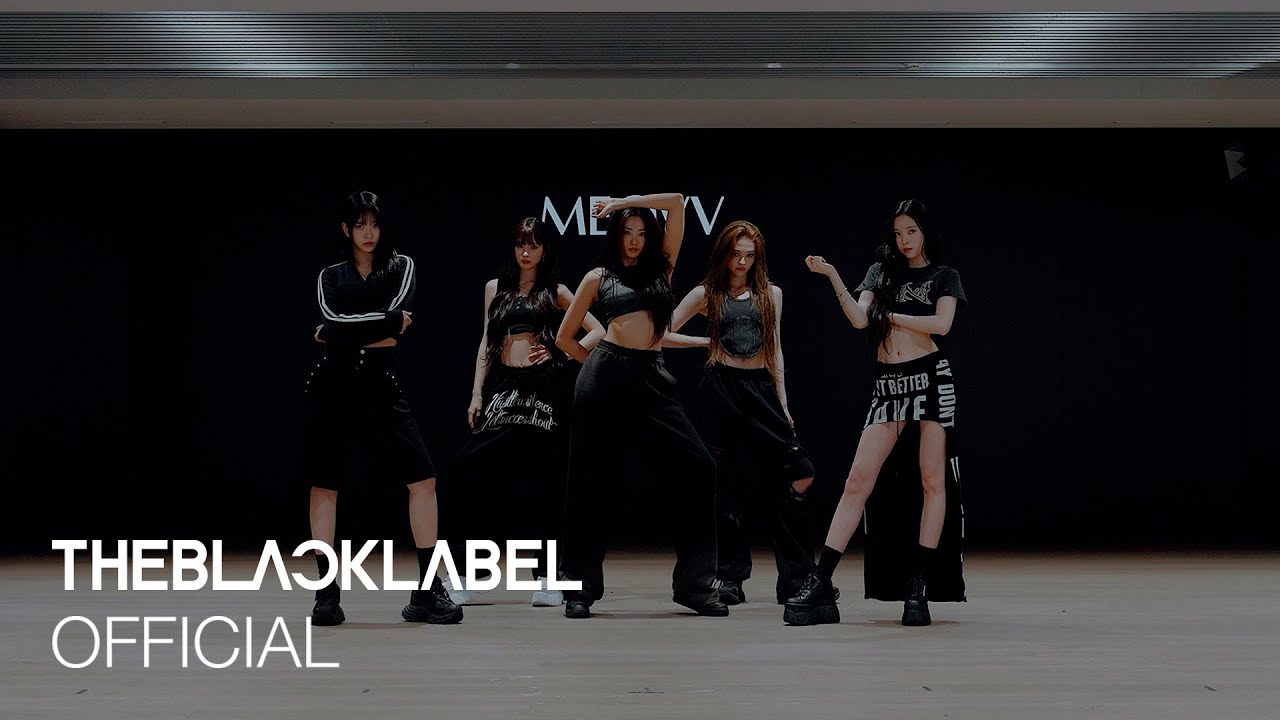
Abracadabra Dance Practice: MEOVV Had Nowhere to Hide the Hip-Line Homework
The Abracadabra dance practice removes KCON lighting and leaves the homework under fluorescent truth. MEOVV pass because the famous hip line still looks controlled when no camera cut can manufacture authority.
Release file
Released: August 19, 2025
Runtime: 02:32
Artist / channel: MEOVV / MEOVV
Exact-file focus: Official Abracadabra KCON-version dance practice.
BLUF: the arrogant dance passed through a fixed camera. This React covers the exact official upload above, not a similarly titled performance, audio track or dance practice.
RAERAE REACTS · K-POP · MEOVV
They inherited one of K-pop’s most recognizable dances and had the sense not to explain it to death.
Artist
MEOVV
Performance
Abracadabra
Stage
KCON LA 2025
Verdict
Inheritance with clean hips
Bottom line:
MEOVV did not pick an easy classic for their first KCON LA appearance. Brown Eyed Girls’ “Abracadabra” arrives with a signature dance, sixteen years of performance memory, and a chorus people recognize before anyone sings. This practice succeeds because MEOVV keep the original’s arrogant-dance silhouette visible while using Teddy’s heavier KCON arrangement, sharper attack, and five-member formation logic to perform it as themselves. The fixed camera proves the spacing; it cannot prove the vocals.
Performance file
- Performers: MEOVV
- Song: “Abracadabra,” originally recorded by Brown Eyed Girls
- KCON stage: August 3, 2025
- Practice released: August 19, 2025
- Original release: July 21, 2009 on Sound-G
- Original lyrics: Kim Eana and Miryo
- Original composition: Lee Min-soo and Hitchhiker
- KCON arrangement: Teddy
- Official practice: 6lUV_py21_Q
First watch: the room has nowhere to hide
A fixed practice camera is rude in the useful way. It removes KCON screens, broadcast cuts, audience noise, styling close-ups, and every editor who might rescue a late transition. What remains is the distance between five bodies and whether they arrive together.
MEOVV begin spread across the room, then repeatedly draw the formation inward around the next phrase. Centers change without requiring a camera cut to announce them. The members do not rush back to neutral after floor work, and the rise into formation looks like part of the phrase rather than cleanup after it.
The performance is not impressive because all five dance every count at identical size. It is impressive because they understand hierarchy. One body can strike hard, another can hold, and the frame still directs the eye instead of becoming a competition for visible effort.
What changed every time I replayed it
Second watch: I tracked only the outer members. Anna and Ella keep the edges active even when they are not carrying center. Their pose changes prevent the wide formation from turning into one performer with four waiting-room attendants.
Third watch: The handoffs became the story. Gawon and Narin often finish an arm line before redirecting the face, so attention passes through the body rather than jumping when the lyric changes.
Fourth watch: Sooin’s lower-body control explained why the signature section holds together. She grounds the pulse instead of treating the hip movement as decoration added above the beat.
Fifth watch: Teddy’s arrangement sounded less like modernization and more like venue engineering. Heavier percussion makes transitions register in an arena, but it also reduces some of the original track’s cold, unsettling tension.
Where I landed: The practice is a better test of choreography than the stage recording and a worse test of live performance. It proves spacing, timing, stamina, and choices. It cannot tell me what reached the KCON microphones.
The song they inherited
Brown Eyed Girls’ original is built on a cold electronic pulse, clipped phrases, and repetition controlled tightly enough to make obsession sound like an order. It does not need a large instrumental climax. The discomfort comes from how little the performers seem to need approval.
That makes “Abracadabra” difficult cover material. A group can copy the visible choreography and still miss the emotional temperature. Oversell the sexuality and the move becomes parody. Add too much festival impact and the threat becomes celebration.
MEOVV navigate the problem by preserving the recognizable bones. The repeated hip sway remains centered, the upper body stays restrained, and nobody performs the reference like a joke from an older generation. Recognition lands before reinvention begins.
The practice room tells the truth it is qualified to tell
The room reveals formation geometry. MEOVV are comfortable with asymmetry, allowing one member to remain almost still while others redirect the frame around her. Stillness reads as authority because the moving members respect its boundary.
The practice also reveals recovery. A finished move is only half the task; the body has to reach the next starting point without showing the commute. Here, resets are absorbed into turns, walks, and face changes. The choreography keeps breathing between its headline moments.
What it does not reveal is audience negotiation. At KCON, a performer decides when to send energy past the front row, when to acknowledge a scream, and when to protect timing against venue delay. The clean room version is choreography under laboratory light, not the full stage organism.
Five movement identities, one inherited silhouette
Sooin keeps the movement grounded and makes the lower-body accents feel structural. Gawon finishes lines with enough clarity that center time looks authored instead of merely assigned.
Narin is especially effective when a phrase needs attack without extra size. Anna and Ella maintain the outer frame, changing focus and texture so the group does not collapse toward the middle.
The members share timing without erasing difference. That matters for a cover of choreography already embedded in K-pop memory. Mechanical unison would prove training; controlled variation proves interpretation.
Keeping the arrogant dance arrogant
The famous side-to-side motion remains the section everyone waits for. MEOVV give it a clean silhouette and resist adding unnecessary facial punctuation. The move carries its own history. Their job is to inhabit the nerve, not underline the reference with a marker.
Restraint is the difference between homage and costume. The original choreography feels arrogant because the performers barely seem to spend energy proving their effect. MEOVV’s sharper shoulders and arms update the surrounding language while leaving that center of gravity intact.
The arrangement trades discomfort for impact
Teddy’s KCON version makes the percussion heavier and transitions more explicit. That supports five sharper movers and a large venue, where subtle electronic tension can disappear into crowd noise.
The tradeoff is emotional. Brown Eyed Girls made control unsettling. MEOVV’s version sometimes turns the same material into a cleaner festival hit. The practice shows why the new weight works physically, but it also sends me back to the original to recover the chill.
What works
- The signature choreography remains visible and respected.
- The fixed camera proves spacing and center changes without editing.
- Five members use different movement sizes without fighting for every count.
- The heavier arrangement supports arena-scale attack.
- Floor work returns to formation without a visible reset.
- Every member and the group have canonical profile links.
What the practice cannot prove
The performance track and clean room audio cannot establish live vocals. It is evidence for choreography, not a microphone audit.
The KCON arrangement also favors visible impact over the original’s controlled unease. The body wins something the song loses.
RaeRae verdict
The practice: 8.8/10. Clean enough to prove the formation and alive enough not to resemble a synchronization exam.
The arrangement for this body of work: 8.2/10. Excellent arena engineering, slightly less dangerous than the song it inherits.
Final ruling: MEOVV kept the move K-pop already knew by heart, then gave the surrounding counts enough of their own handwriting to justify another watch sixteen years later.
Sources and official links
- MEOVV official dance practice
- Mnet Plus KCON LA 2025 performance archive
- CJ ENM KCON dates and Teddy arrangement
- Apple Music original Brown Eyed Girls release
- Melon Brown Eyed Girls history and signature-dance context
First-watch verdict
Abracadabra — Dance Practice works because a KCON arrangement that respects Brown Eyed Girls without photocopying them. The production does not ask MEOVV to prove maturity by sanding away every youthful edge. It gives the five members a defined physical problem and lets their different instincts solve it.
My first reaction was not “look at the budget.” It was that the arrangement knows when to leave a gap. A gap is dangerous in K-pop because somebody always wants to fill it with another ad-lib, camera crash or decorative bass hit. Here, the empty space turns posture, timing and breath into part of the rhythm.
The exact upload matters
Video ID 6lUV_py21_Q is treated as its own text. A music video, official audio, fixed-camera practice and broadcast performance may share a song, but they do not provide the same evidence. Collapsing them into one review would make the tracker look tidy while quietly deleting the reason anyone rewatches alternate versions.
This page therefore embeds one player. Other official versions receive their own Reacts and their own locally stored canonical images. The featured image, hero, static landing-page card, Open Graph image and Twitter image all point to the same attachment on this post, but no other post borrows it.
What the production is doing
A KCON arrangement that respects Brown Eyed Girls without photocopying them. Listen to the relationship between the low end and the vocal pockets. The beat is not simply “hard”; it changes how much room each member gets to finish a consonant, stretch a vowel or let a look land before the next cut.
The mix keeps MEOVV recognizable as a group without pretending five voices occupy identical ranges. Gawon and Narin can give a line conversational bite, Anna can cool the temperature, Ella can brighten the surface, and Sooin can turn rhythmic emphasis into movement. The useful question is not who “won” the song. It is whether the handoffs create one argument.
The visual grammar
Clean spacing, hip accents and handoffs with nowhere for an edit to hide. The best frames establish a rule, then bend it. Repeated colors and locations stop being decoration once the edit uses them to predict a drop, isolate a member or make a formation feel larger than the room containing it.
Close-ups are strongest when they arrive after movement instead of replacing it. MEOVV has multiple members with serious camera experience, so the video can trust a held face for half a second longer than usual. That tiny delay is often more memorable than another fast cut.
Sooin: movement as punctuation
Sooin performs transitions as if they are part of the lyric. Watch the shoulders and torso between named moves: she does not switch off while traveling to the next mark. That continuity gives the choreography its full-body quality and helps the formation look intentional even when the camera favors somebody else.
Gawon: weight and conversational authority
Gawon sounds most convincing when the line feels spoken directly at someone. Her lower color gives the arrangement weight without forcing a cartoonishly deep tone. On camera, she lets the phrase do the intimidating work and avoids stacking ten extra expressions on top of it.
Anna: control before the close-up
Anna often prepares the face before the edit reaches her. Years of modeling show up in angle awareness and in her willingness to hold still while the frame moves. The restraint is not absence. It is a different scale of performance, especially useful when the production around her is busy.
Narin: timing, texture and authorship
Narin treats consonants like percussion. She can make a short line feel longer by controlling the pause around it, and her documented lyric work elsewhere in the catalog makes that rhythmic attention worth tracking. A credit should be named only where verified, but her interpretive choices remain audible even when she did not write the line.
Ella: responsiveness instead of one fixed persona
Ella is compelling when the arrangement changes and she changes with it. She can move from bright to severe without the switch looking like a new character wandered onto the set. That flexibility matters for a group whose releases keep testing different ratios of luxury, youth, humor and menace.
Concept versus evidence
A visual theory is useful only when the frames support it. Color, set repetition, framing and choreography can justify an interpretation; a fan caption cannot. This review separates what the official upload visibly does from what I think that choice means, and it does not turn an aesthetic coincidence into secret lore.
The same standard applies to production controversies. If an official credit names a writer, composer, choreographer or director, the role can be discussed. If it does not, the page does not assign responsibility based on rumor or punish young performers for company decisions made above them.
Replay section
On replay, watch once with the sound low and follow formation travel. Then listen without watching and mark where the beat actually changes. The gap between those two maps reveals whether the edit is supporting the music or trying to manufacture excitement the arrangement did not earn.
My replay pick is the first moment a member hands the center to another without breaking character. It is rarely the thumbnail moment, but it proves whether five strong individual images have become a group performance.
Verdict
Abracadabra — Dance Practice earns its place in the MEOVV rabbit hole because the arrogant dance passed through a fixed camera. It is specific about its sound, confident about its visual rule and useful for seeing how five different performers build one piece without becoming interchangeable.
Profiles and relationships
This group performance links the canonical profiles for MEOVV, Sooin, Gawon, Anna, Narin and Ella. None of these member links implies a solo release; they document the actual people participating in the video.
Receipts and official sources
- Exact official YouTube uploadDaily+3.5KTotal views2.1M
- THEBLACKLABEL official MEOVV profile
- Universal Music Japan official MEOVV page
Lyrics and meaning
The lyric turns a spell into revenge fantasy after betrayal. In practice-room form, the control becomes physical evidence: power comes from deciding exactly when motion stops, not from throwing every limb at the beat.