
Rachel, called the Dragon
The Hayholt calls kings powerful because kings command armies. Rachel commands the people who make a castle survivable, remembers every child under her care, and can identify nonsense before the sentence finishes dressing itself.
Profile
The woman everybody mistakes for comic discipline until grief reveals the size of her jurisdiction
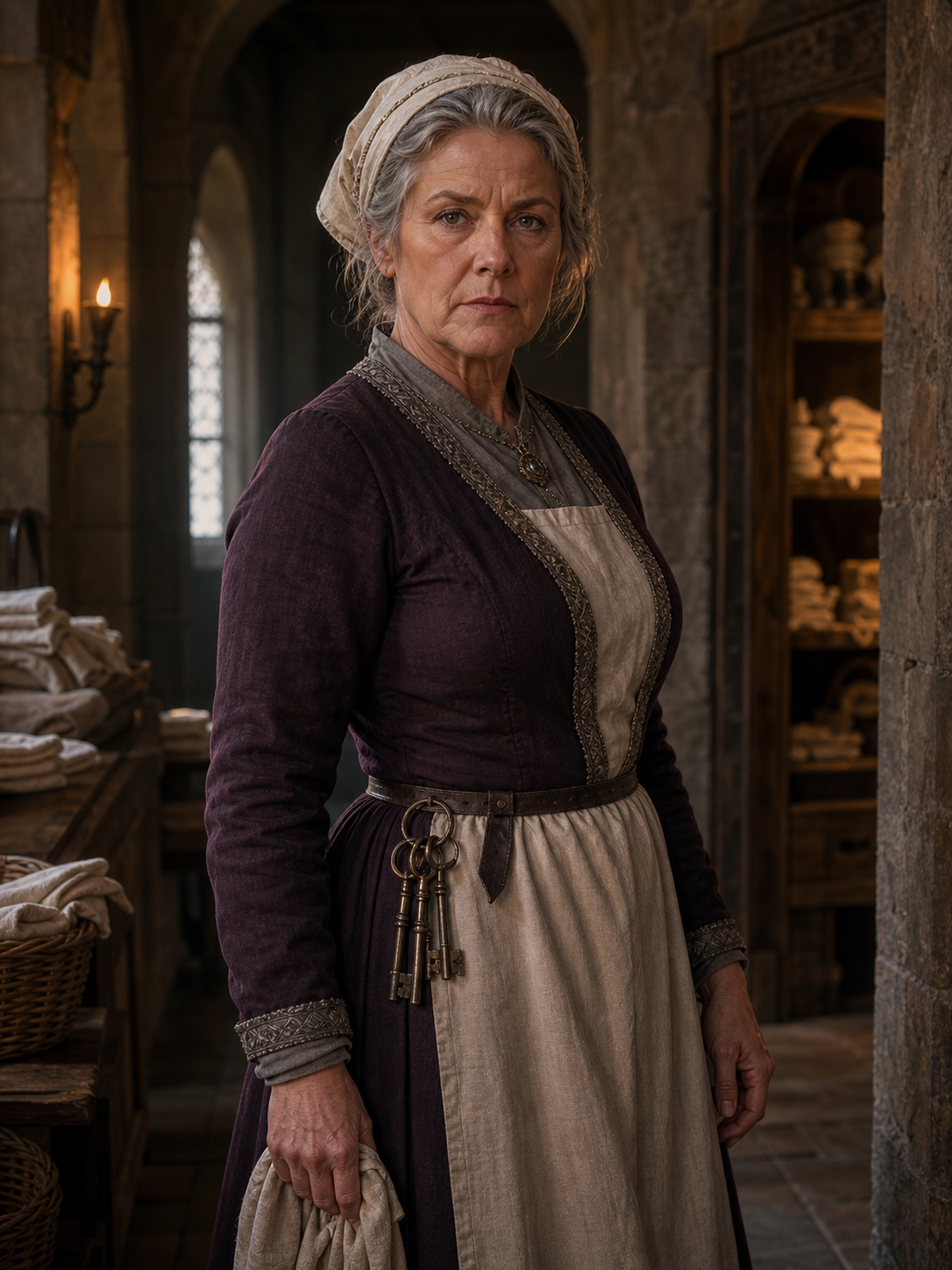
Rachel is the Hayholt’s Mistress of Chambermaids, Simon’s disciplinarian, and the closest thing the orphaned boy has to a living mother. She is nearly a foot shorter than Simon even when he slouches, with steel-gray hair beneath a bonnet and the physical certainty of a woman accustomed to moving people, linen, water, schedules, and excuses through an ancient castle.
“The Dragon” sounds like a joke until the story asks what her anger protects. Rachel does not terrorize servants for sport. She insists that work be finished because somebody sleeps in the cleaned chamber, somebody needs the candle replaced, somebody will trip over the abandoned bucket, and somebody with rank will punish the wrong woman if Rachel does not understand the danger quickly enough. Her standards are a form of household government.
The Dragonbone Chair · Verified chronology
She gives Simon a name, raises him, protects the maids, and refuses to let the official story finish grieving for her
Susanna dies; Rachel accepts the child everybody else immediately surrounds with secrecy
Rachel is present when the young widow Susanna gives birth prematurely and names her son Seoman, meaning “waiting.” Susanna dies after asking that the child be saved. Morgenes conceals a shining object and tells Rachel to care for the orphan. Rachel and the chambermaids do the actual raising.
Rachel adapts Seoman into Simon, a Warinsten household form. The change does not erase Susanna’s choice. It places the birth name inside the language of the servants who keep the child alive. Simon begins with two names from two mothers: one chosen at death, one carried through daily care.
She recognizes curiosity without pretending curiosity washes its own shirt
Rachel finds Simon watching a beetle while the household rushes around King John’s unexpected return to the throne room. She sees what everybody sees: a distracted, slouching boy who can convert any responsibility into a side road. She also remembers the child she received, watches him rescue fallen nestlings, and ultimately permits his apprenticeship with Morgenes.
The permission matters because Rachel does not suddenly agree that chores were beneath him. She allows another future while preserving accountability. Simon may study. Simon may also stop making Sarrah repair the same torn clothes and stop treating other people’s labor like weather.
Rachel takes Fengbald’s violence so Jael does not have to
When spilled wash water trips Fengbald, Rachel recognizes the nobleman’s tantrum before it fully forms. She sends Jael away and claims responsibility. Fengbald strikes Rachel, leaving her cheek swollen. Rank permits him to turn a work accident into violence; Rachel’s authority cannot punish him, but it can redirect the immediate blow away from a younger subordinate.
Her protection is physical, not rhetorical. The scene also refuses to romanticize competence. Rachel can read the danger perfectly and still be hurt because domestic leadership exists beneath noble impunity.
The court declares Simon dead; Rachel’s grief refuses to behave administratively
The official story says Simon died with Morgenes and others in the fire. Rachel believes the report because the institution gives her no evidence capable of defeating it. Alone with her aching back and injured face, she cries for the boy she raised.
Then she dreams Simon alive beneath an immense white tree. The dream is not yet proof available to Rachel, and this profile will not pretend otherwise. Emotionally, however, it preserves a future the court has already closed: Simon older, changed, and still belonging to the woman who would correct his posture before admiring the miracle.
Power, class, and household labor
The castle functions because women like Rachel keep converting danger into a list somebody can survive
Epic fantasy loves castles as silhouettes. Rachel’s story insists a castle is also laundry, mending, candles, water, sick staff, schedules, food carried upstairs, and the social knowledge required to keep powerful people from destroying whoever stands nearest. Simon wants armies, swords, and flags while assuming serving women know nothing about great matters. Rachel is the evidence against his definition of greatness.
Her work generates intelligence. Chambermaids know which rooms are occupied, which visitors arrive, who is ill, who has been struck, what clothing requires repair, and which noble is already angry before breakfast. The institution treats that knowledge as gossip or service until survival needs it. Rachel’s profile cannot reduce her to “strict mother figure” while ignoring the management system that makes her strictness effective.
She is also not automatically right because she works hard. At Simon’s birth, Rachel invokes religious duty while Susanna is bleeding and barely able to speak, raising difficult questions about faith, reproductive danger, and whose preference governs a room when the dying woman’s voice is failing. A full profile keeps that ethical pressure visible. Loving Simon later does not retroactively make every decision around his birth simple.
Relationships
The people inside Rachel’s responsibility are never interchangeable staff
Simon / Seoman
She gives him a household name, disciplines him, grants the apprenticeship he wants, and grieves him as her own. Simon imitates irritation when remembering her because admitting the full attachment would expose how safe she made him feel.
Susanna
Rachel receives Susanna’s child at the worst possible moment. Their connection makes Simon’s upbringing a promise carried through work, even while the birth scene preserves unanswered questions about consent, faith, and Morgenes’s concealed evidence.
Doctor Morgenes
Rachel knows Morgenes protected Simon and that Eahlferend visited him before drowning. She allows the apprenticeship but never receives the whole file. Like Simon, she performs responsibility inside an information economy controlled elsewhere.
Jael
Rachel absorbs Fengbald’s anger before the nobleman can make Jael its target. The choice defines her leadership more honestly than the nickname Dragon ever could.
Judith, Sarrah, Hepzibah, Rebah, Sophrona, and the maids
Rachel’s world is collective. Some women report to her, some rule adjacent labor systems, and all possess names, work, loyalties, risks, and knowledge that Simon’s early heroic imagination routinely undervalues.
Fengbald
He demonstrates the limit placed around Rachel’s formal authority. She can coordinate a castle workforce and still be struck because aristocratic power expects domestic labor to absorb abuse quietly.
Fandom notes and what the fact box misses
“The Dragon” is a child’s complaint, a workplace reputation, and accidentally the correct scale
Simon experiences Rachel from below her authority. She interrupts hiding, redirects wandering, notices unfinished work, and possesses the terrifying adult ability to remember what he promised yesterday. From that angle, Dragon is funny and emotionally accurate. The nickname lets a fourteen-year-old convert dependence into mock combat: if Rachel is a beast, then avoiding laundry becomes a heroic escape.
The novel steadily changes the joke without confiscating its warmth. Rachel’s reach is not supernatural. She knows the castle because labor has taught her where bodies, objects, and information move. She knows Simon because she has watched every version of his excuse grow up. A dragon guards treasure in the old stories. Rachel guards people the court does not recognize as treasure.
That reading should not turn her into a flawless saint. Rachel can be rigid, frightening, impatient, and morally certain. She sometimes interprets disorder as character failure before learning why the disorder exists. Her faith shapes decisions inside Simon’s birth room that deserve scrutiny. JIN-standard treatment means giving her enough personhood to be wrong without making wrongness the only interesting thing about her.
The adult Simon she imagines is one of Book 1’s quietest futures
Rachel’s grief does not stop at the dead boy. She imagines the grown Simon who might have visited, shared cider, grown a beard, and still required correction. That domestic future measures maturation differently from swords, scars, and titles. Becoming an adult would mean returning to somebody who remembers the child without trapping him there.
The scene also reveals what Rachel expected for herself: age, work, an ongoing place in Simon’s life, and affection expressed through familiar irritation. Epic catastrophe steals futures long before every body dies. Rachel mourns conversations, visits, jokes, complaints, and the ordinary continuity nobody writes into royal chronicles.
Her profile belongs beside kings because hierarchy is one of the story’s arguments
A directory that gives Elias, Josua, and John enormous biographies while reducing Rachel to “strict chambermaid” would repeat Simon’s early mistake. The royal plot depends on people who wash, carry, remember, hide, mend, and absorb the consequences of elite decisions. Rachel’s work is not a break from politics. It is where politics lands.
Book 1 keeps asking who gets treated as a witness. Rachel cannot prove Simon lives, cannot compel Fengbald’s accountability, and cannot demand Morgenes’s full secret. She nevertheless reads people accurately, protects those within reach, and preserves a version of Simon the official story has already deleted. Her evidence begins as care. The series would be foolish to confuse that with ignorance.
Canonical identity and milestone art
Age is evidence, not a flaw the portrait needs to apologize for
Rachel’s canonical image preserves an attractive older woman with natural steel-gray hair, visible age, compact strength, a practical bonnet, dark plum wool, linen apron, household keys, and hands shaped by work. Future images must keep this face, age range, build, hair, and grounded high-medieval styling.
Stone of Farewell through To Green Angel Tower
Rachel survives the apocalypse by continuing to notice who has not eaten
Domestic work becomes resistance inside occupied power
Rachel remains in the Hayholt as Elias’s rule and Pryrates’s influence corrupt the castle around her. Household knowledge—food, rooms, servants, absence, injury—keeps producing truths the court’s official spectacle cannot see.
The woman everybody overlooks keeps an independent evidence system
Rachel’s authority travels through keys, routes, memory, and care rather than title. She continues protecting people below the political line of sight, preserving the Hayholt as a lived place even while its rulers turn it into ritual machinery.
Two untouched meals become a missing-person investigation
Food left for blind Guthwulf and his cat remains untouched for two days. Rachel decides to search because nobody else will. After the tower falls, her practical authority becomes reconstruction: while legends settle succession, Rachel helps make rooms usable and life possible again.
On the record
What this profile can prove today
This canonical profile currently covers Rachel through The Dragonbone Chair. Book 1 verifies her role in Simon’s birth and naming, her years raising him with the chambermaids, her permission for the Morgenes apprenticeship, her protection of Jael, Fengbald’s assault, her grief after the tower fire, and the white-tree dream that contradicts emotional closure without yet becoming ordinary evidence.
Source: owner-accessed Kindle edition of The Dragonbone Chair, verified front-to-back through page 652 of 652 and reconciled with the complete Book 1 character manifest. Later-volume chronology will be added only after sequential reading reaches and verifies it.
The Dragonbone Chair hub → · Book 1 characters → · Simon’s canonical profile → · Series hub →