
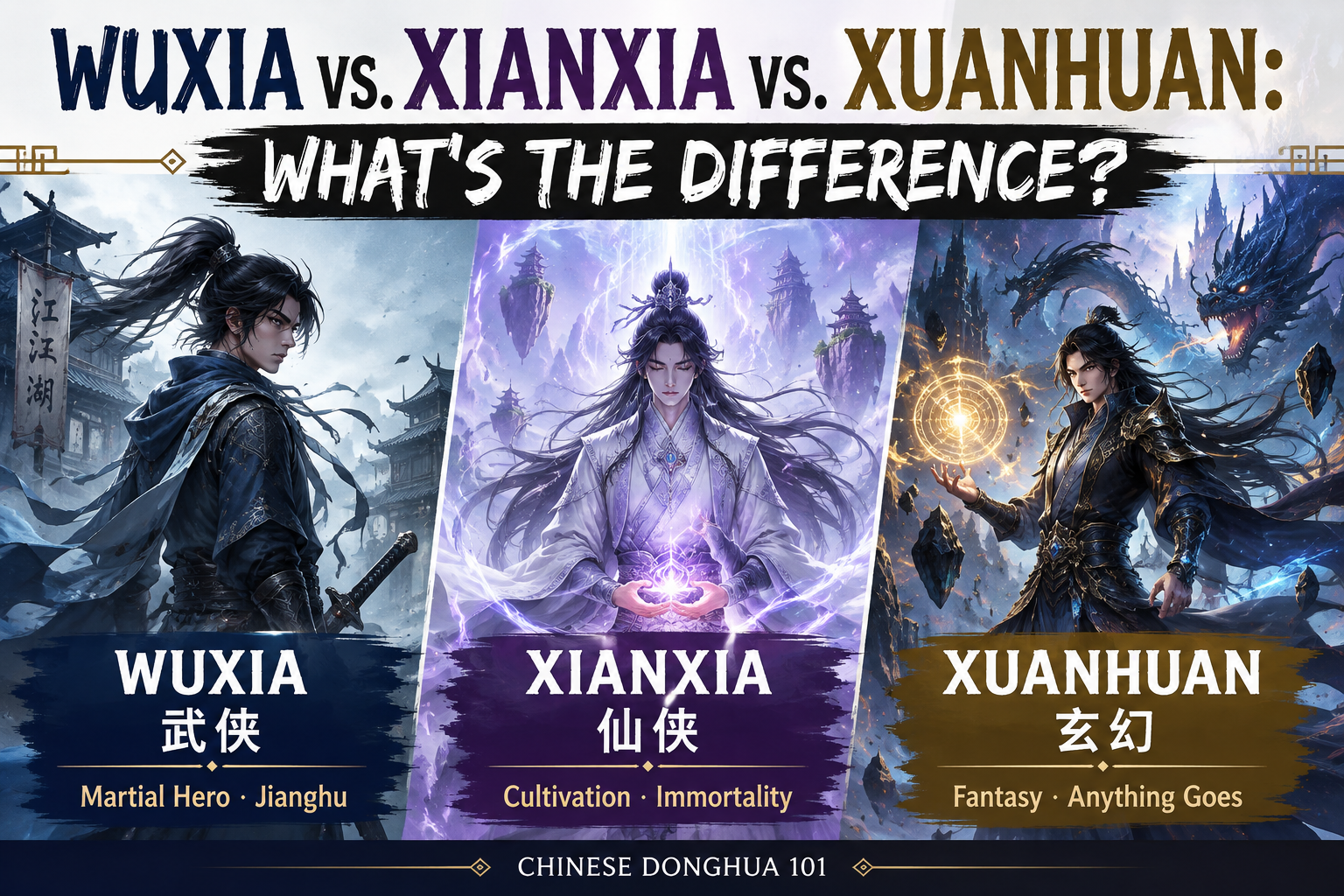
Wuxia vs. Xianxia vs. Xuanhuan: What’s the Difference?
You start watching Chinese fantasy and everything seems reasonably manageable. There are swords. There are sects. People leap across rooftops. Somebody mentions qi. Fine. Then one character begins cultivating toward immortality, another survives a heavenly tribulation, somebody else opens a portal to another realm, and the internet informs you that the story might be wuxia, xianxia, or xuanhuan. Wonderful. Three words, overlapping ingredients, and apparently no one thought to hand us the orientation packet.
The easiest beginner distinction is this: wuxia (武侠) centers martial heroes and the world of martial society; xianxia (仙侠) pushes martial and spiritual traditions toward cultivation, transcendence, immortality, and supernatural cosmology; and xuanhuan (玄幻) is broader fantasy territory where authors can build more freely invented worlds and power systems, often mixing Chinese ideas with elements that do not need to follow traditional wuxia or xianxia logic.
That is the useful shortcut. It is not an iron wall. These traditions overlap, borrow from one another, evolve over time, and get labeled inconsistently by publishers, platforms, translators, fandoms, and even creators. A story can begin with a wuxia-like Jianghu and later explode into xianxia-scale cultivation. Xuanhuan can borrow cultivation systems from xianxia. A wuxia hero can perform feats that look impossible without becoming an immortal cultivator. The goal here is therefore not to build three cages. It is to understand the centers of gravity.
- What do the three words mean?
- What is wuxia?
- Why Jianghu matters to wuxia
- How powerful can wuxia heroes be?
- What is xianxia?
- Why cultivation matters to xianxia
- Does xianxia always mean immortality?
- What is xuanhuan?
- Why xuanhuan can feel less traditionally Chinese
- Wuxia vs. xianxia vs. xuanhuan
- Do flying swords automatically mean xianxia?
- Do all three have sects?
- Why the boundaries overlap
- How the terms work in donghua
- Common myths
- Why fans should care
If you remember only three things, remember these
These categories become much easier when you stop identifying them by individual props. A sword does not define wuxia. Cultivation vocabulary does not automatically settle every xianxia versus xuanhuan argument. Ancient Chinese-looking clothing does not guarantee any particular genre. Look at the world, power system, scale, themes, and goals of the characters.
What do wuxia, xianxia and xuanhuan actually mean?
The words themselves already point us toward different centers. In wuxia (武侠), wu (武) relates to martial or military ideas, while xia (侠 / 俠) refers to the chivalrous or martial hero. Translating xia as simply “knight” is tempting but incomplete because the Chinese literary tradition carries its own ideas about personal codes, justice, loyalty, reputation, wandering heroes, and relationships with formal authority.
Xianxia (仙侠) keeps that xia but replaces the martial wu with xian (仙), associated with immortals or transcendent beings. That change is enormous. We have moved from martial heroes toward a fantasy tradition where cultivation can transform the body, lifespan, spiritual power, and eventually the character’s relationship with mortality itself.
Xuanhuan (玄幻) is more slippery in English because translating it as simply “fantasy” hides why the term is useful. Xuan (玄) can carry associations with the mysterious, profound, or abstruse, while huan (幻) relates to fantasy, illusion, or the fantastical. In modern genre usage, xuanhuan provides a broad home for imaginative fantasy that can borrow heavily from Chinese traditions without being constrained to the cosmology or expectations commonly associated with xianxia.
These are literary and media categories, not scientific classifications. Stories evolve. Authors hybridize. Marketing labels simplify. Translation shifts meaning. If two knowledgeable fans disagree about a borderline work, it does not necessarily mean one of them forgot how genres work. The story may genuinely be sitting near the border.
What is wuxia?
Wuxia is a Chinese storytelling tradition centered on martial heroes and the social world surrounding them. The setting is generally recognizably human, even when the martial abilities are highly exaggerated. Characters train, master techniques, join or leave schools and sects, form rivalries, repay debts, seek revenge, protect reputations, challenge corrupt authorities, defend companions, wander between communities, and make decisions according to personal codes that do not always align neatly with official law.
That last part matters. Wuxia is not merely “people doing martial arts.” Fighting is the visible machinery, but the genre has long been interested in what a powerful individual owes to other people. What happens when law is unjust? When loyalty to a teacher conflicts with personal morality? When revenge becomes an obligation? When a person’s reputation in the martial world matters more than their relationship with the government?
Wuxia heroes can be extraordinary. They may leap impossible distances, move with supernatural-looking speed, use internal energy, strike pressure points, survive injuries that would end the career of an ordinary human, or perform martial techniques so heightened that a new viewer reasonably asks whether everyone has secretly become magical.
The key is that these abilities generally exist inside the logic of martial mastery. Training, internal strength, technique, experience, inherited manuals, teachers, schools, and personal discipline matter. The hero is usually becoming a greater martial artist rather than progressing through a cosmic cultivation ladder whose eventual destination is immortality or transcendence beyond the human condition.
Why Jianghu matters so much to understanding wuxia
One of the easiest ways to misunderstand wuxia is to treat Jianghu (江湖) as though it were simply another name for a fantasy world. Literally, the characters mean “rivers and lakes,” but the cultural and literary idea is far larger. Jianghu can describe a social world operating partly outside ordinary official structures: wandering martial artists, sects, schools, healers, merchants, performers, criminals, escorts, assassins, beggars, information networks, rival factions, sworn relationships, and people whose reputations travel ahead of them.
Jianghu creates an alternative social order. A government official may have legal authority, but a famous martial master can possess enormous influence within Jianghu. A sect can enforce rules on its disciples. A debt of honor can matter more than a written contract. Reputation becomes a kind of currency. Insults, favors, betrayals, mentorships, alliances, and old grudges can create obligations that outsiders barely understand.
This is why wuxia conflicts can feel intensely personal even when many factions are involved. The hero is moving through overlapping networks of loyalty and reputation. Saving one person can create a lifelong debt. Killing another can create enemies across an entire school. Possessing a legendary manual can make half the martial world suddenly interested in your travel plans.
Jianghu can appear in xianxia too, especially when a story begins close to the mortal martial world before expanding into cultivation realms. That does not make Jianghu itself synonymous with xianxia. It is a social and literary concept that can travel across related Chinese storytelling traditions.
How powerful can a wuxia hero become before it stops being wuxia?
This is where beginners understandably get annoyed. If wuxia is the more human-centered category, why are people flying through bamboo forests, balancing on impossible surfaces, launching opponents across courtyards, and apparently treating the laws of physics as optional reading?
Because “human-centered” does not mean “realistic martial-arts documentary.” Wuxia has long used heightened physical ability, internal strength, qinggong or lightness skills, extraordinary technique, secret manuals, legendary weapons, and martial feats that exceed ordinary human possibility. The genre’s world can be romanticized and fantastical without reorganizing itself around immortal cultivation.
A useful distinction is to look at the purpose of advancement. A wuxia fighter trains to become more skilled, faster, stronger, more disciplined, or more formidable within the martial world. A xianxia cultivator may be refining the body and spirit in order to break through fundamentally different stages of existence, extend lifespan, survive heavenly tribulations, enter higher realms, or pursue immortality.
The visual difference can become tiny while the conceptual difference remains large. Two characters can both stand on swords. One may be using an extraordinary martial technique inside a wuxia-like story. The other may be controlling a spiritual artifact through cultivation while traveling between immortal sects. Props alone do not classify the story.
What is xianxia?
Xianxia takes us into a much more openly supernatural world. The genre draws on Chinese mythology, Daoist-influenced ideas, religious and philosophical vocabulary, immortality traditions, folklore, martial storytelling, and generations of modern fantasy invention. Its characters may begin as ordinary humans, but remaining ordinary is frequently not the plan.
Cultivation becomes one of the genre’s most recognizable engines. Characters refine qi or spiritual energy, strengthen their bodies and souls, learn techniques, acquire artifacts, study under masters, join cultivation sects, break through realms, face bottlenecks, consume pills or elixirs, survive tribulations, and pursue increasingly distant stages of power or transcendence.
The scale can expand dramatically. A wuxia dispute may concern rival schools, a corrupt official, a stolen manual, or revenge between families. Xianxia can begin with those same ingredients and eventually involve immortal realms, reincarnation, heavenly law, ancient gods, demons, spiritual beasts, cosmic cycles, karmic consequences, and conflicts capable of making the original village look extremely far away.
This does not mean every xianxia story begins at cosmic scale. Many of the
most satisfying cultivation narratives begin small precisely so the audience
can feel the expansion. The protagonist starts weak, enters a sect, learns
how little they understand, discovers that the local masters are insignificant
compared with the next region, and eventually learns that the supposedly
terrifying next region is also basically the tutorial.
Cultivation is one of the ideas that makes modern xianxia immediately
recognizable, but it is also one of the easiest concepts to oversimplify.
At the broadest level, cultivation involves deliberate self-refinement.
Characters train the body, mind, spirit, qi, or some combination of them in
order to move beyond their current limitations. Modern fantasy turns that
idea into elaborate progression systems where spiritual development can
become measurable, hierarchical, dangerous, and extremely competitive.
A story may divide cultivation into named realms or stages. Characters
gather and refine spiritual energy, strengthen meridians, establish
foundations, form cores, temper bodies, develop souls, understand laws,
master techniques, acquire artifacts, consume pills or elixirs, and attempt
breakthroughs into higher states of existence. Those stages are not
universal. Different authors create different ladders, rename familiar
concepts, combine systems, or invent entirely new progression structures.
This means learning the cultivation hierarchy in one donghua does not give
you a permanent passport to every other xianxia universe. One story may use
familiar stages such as Qi Condensation, Foundation Establishment, Core
Formation, and Nascent Soul. Another may build its progression around
completely different terminology. A third may borrow recognizable names but
change what those stages actually allow a cultivator to do.
Cultivation also gives serialized stories a powerful structural engine. A
protagonist can begin at the bottom of one hierarchy, struggle upward,
finally reach what everyone claimed was the pinnacle, and discover that the
entire hierarchy was basically the children’s menu compared with the next
realm. New stages create new enemies, resources, sects, teachers, mysteries,
political systems, and geographical spaces. The world expands because the
character becomes capable of entering parts of it that were previously
inaccessible.
The strongest cultivation stories usually connect advancement to something
larger than combat statistics. A breakthrough can require discipline,
insight, sacrifice, emotional control, obsession, enlightenment, or a deeper
understanding of the character’s Dao. A person may become physically
stronger while becoming morally weaker. Someone else may discover that the
attachments they were taught to abandon are exactly what keeps them human.
Longevity creates its own problems. If a cultivator can live for centuries,
what happens to relationships with ordinary mortals? What does revenge mean
when somebody can carry it for three hundred years? What does family mean
when generations pass while one person remains? Xianxia can use fantastic
power progression to ask very human questions about ambition, mortality,
attachment, loneliness, and what anyone actually wants from a longer life.
Immortality and transcendence are deeply associated with xianxia, but not
every protagonist begins the story announcing a five-thousand-year plan to
escape death. A character may cultivate because strength is necessary for
survival. Another may want revenge, freedom, knowledge, protection for a
family, the power to revive someone, or enough status to stop stronger people
from deciding their future.
What matters is that the world accepts a path beyond ordinary human
limitation. Cultivation may extend lifespan, transform the body, strengthen
the soul, open access to higher realms, or eventually turn a mortal into a
being ordinary humans would interpret as immortal or divine. Death itself
can become more complicated when reincarnation, soul survival, possession,
resurrection, karmic cycles, and rebirth enter the cosmology.
This changes the scale of the genre. Wuxia frequently asks what kind of
person a powerful martial hero should be while living among other humans.
Xianxia can eventually ask what remains of that person’s humanity when they
have lived long enough, traveled far enough, and become powerful enough to
leave ordinary human society behind.
Xuanhuan is where classification becomes wonderfully inconvenient. It is a
broad fantasy category that can draw heavily from Chinese cultivation,
martial arts, mythology, qi, sects, artifacts, bloodlines, spiritual beasts,
and familiar progression systems while allowing the fictional world to
operate under much more freely invented rules.
A xuanhuan story may contain cultivation realms that look immediately
familiar to a xianxia reader, then place them inside an invented continent
with magical species, game-like systems, foreign-inspired fantasy elements,
unusual technology, elemental powers, dungeons, academies, bloodline
abilities, or a cosmology that does not particularly care whether it matches
traditional immortal-fantasy expectations.
This flexibility is why xuanhuan can sometimes feel easier for international
fantasy readers to recognize while being harder to define precisely. One
story may look almost like xianxia until the world begins introducing
mechanics that push it elsewhere. Another may resemble a giant
secondary-world fantasy while still using cultivation, Chinese names,
martial techniques, and storytelling structures familiar from Chinese web
fiction.
Xuanhuan does not mean “Western fantasy written by a Chinese author,” either.
Foreign-inspired elements can appear, but they are not required. The
category is useful because it gives fantasy more room to invent. The author
can borrow Chinese ideas without promising to organize the entire universe
around the cosmology commonly associated with xianxia.
Costume is one of the least reliable ways to classify Chinese fantasy. If
everyone wears flowing robes and lives among misty mountains, international
viewers often assume xianxia. If the world contains heavy armor, enormous
fantasy cities, unusual races, strange creatures, or visual influences that
feel less historically Chinese, people sometimes assume it cannot belong to
a Chinese fantasy tradition at all.
Xuanhuan demonstrates why that approach fails. A Chinese author can build a
completely invented secondary world while still drawing from Chinese
storytelling habits, progression systems, philosophical vocabulary, martial
ideas, naming traditions, family structures, and genre conventions. Cultural
origin and fictional geography are not the same thing.
This becomes especially obvious in long web novels where the scale can grow
almost without restraint. The protagonist may travel between continents,
dimensions, planets, realms, or universes. Different regions can have
different species, cultures, technologies, and power systems. What began as
recognizable cultivation fantasy can eventually resemble science fiction,
cosmic fantasy, game progression, mythology, and martial storytelling all
sharing one very crowded apartment.
That freedom is part of xuanhuan’s appeal. The story can preserve the
satisfying progression of cultivation while refusing to make immortality,
Daoist-influenced cosmology, or traditional Chinese mythic structures the
central organizing logic of everything that exists.
The distinctions become clearer when we compare what each category tends to
emphasize rather than looking for one magical identifying object. Wuxia
centers martial heroes inside a martial social world. Xianxia opens a path
toward spiritual transformation and existence beyond ordinary mortality.
Xuanhuan gives fantasy permission to combine those ingredients with much more
freely invented systems and settings.
None of the rows below should be treated as a legal requirement. A wuxia
story can contain supernatural elements. A xianxia story can spend enormous
amounts of time on mortal politics. Xuanhuan can look deeply Chinese.
Categories work through patterns, structures, and emphasis rather than a
single prop that settles the argument forever.
No. This is one of the best examples of why identifying Chinese fantasy by
visual props alone becomes unreliable. Swords appear everywhere. Impossible
movement appears everywhere. Characters can jump, glide, fly, manipulate
weapons, or move at ridiculous speeds for completely different reasons
depending on the rules of the story.
In wuxia, extraordinary movement can come from fictionalized martial skill
such as lightness techniques. A hero may leap impossible distances, skim
across water, land on narrow surfaces, or move with speed that ordinary
humans could never achieve. The world still understands the feat as martial
mastery rather than evidence that the hero has ascended into an immortal
cultivation realm.
In xianxia, a sword may become a spiritual artifact controlled through
cultivation. A character can fly on it, summon it remotely, bind it,
spiritually refine it, store it inside a magical space, or control multiple
weapons through spiritual power. The sword is participating in the
cultivation system rather than merely functioning as an excellent sword.
Xuanhuan can do either of those things or invent an entirely different
explanation. The sword may be powered by magic, technology, a bloodline,
a contracted spirit, an ancient system, or a rule unique to that universe.
The useful question is therefore not, “Is that sword flying?” It is,
“Why can that sword fly here?”
They can, which is another reason the categories blur for new viewers. In
wuxia, a sect or martial school can function as a community built around
lineage, techniques, teachers, disciples, reputation, rules, rivalries, and
relationships with other martial groups. Joining one can define a
character’s identity and obligations within Jianghu.
Xianxia expands that structure into cultivation. A sect may control
mountains, spiritual veins, secret realms, cultivation manuals, alchemy,
artifacts, training grounds, mines, medicinal resources, and entire
hierarchies of outer disciples, inner disciples, core disciples, elders,
masters, ancestors, and terrifying senior figures who have apparently been
meditating since before everyone else’s family tree started.
Xuanhuan can use the same sect structure because it is extremely useful for
progression fantasy, but it can also replace or combine sects with academies,
guilds, kingdoms, magical organizations, clans, military orders, churches,
corporations, game factions, or whatever institution fits the world.
So “there is a sect” tells us very little by itself. What the organization
teaches, how its power works, what its members are trying to become, and how
the organization fits into the larger world are much better clues.
These traditions did not develop in sealed boxes. They share literary
ancestry, imagery, vocabulary, martial traditions, philosophical ideas,
mythology, folklore, and generations of creators who have borrowed from,
expanded, challenged, and remixed the stories that came before them. That
shared history is why the border between wuxia and xianxia can feel gradual
rather than dramatic, and why the border between xianxia and xuanhuan can
become even messier.
Wuxia contributes a great deal of the martial DNA that later Chinese fantasy
continues to use. Martial schools, sect rivalries, secret techniques,
master-disciple relationships, legendary weapons, internal power, revenge,
honor, reputation, loyalty, wandering heroes, and Jianghu politics do not
disappear simply because supernatural fantasy enters the story. Xianxia can
inherit those structures and then push them into a universe where martial
development becomes spiritual cultivation and the limits of human life are
no longer the limits of the story.
This is why the beginning of a xianxia story can sometimes feel remarkably
close to wuxia. The protagonist may still be living among mortals. Local
martial experts seem terrifying. Entering a respected sect feels like the
greatest opportunity imaginable. Rival families, stolen manuals, teachers,
human politics, personal grudges, and martial reputation dominate the
immediate conflict. If you only watched the opening episodes, you could
reasonably think the story belonged much closer to wuxia.
Then the scale starts moving. The protagonist discovers that the strongest
mortal expert is barely relevant to a true cultivator. The local sect turns
out to be one tiny organization inside a much larger cultivation world.
Spiritual beasts, artifacts, secret realms, soul techniques, heavenly
tribulations, reincarnation, ancient inheritances, immortal beings, and
higher planes begin appearing. The martial foundations are still there, but
the story’s center of gravity has moved toward xianxia.
Xuanhuan frequently borrows the progression machinery that modern readers
strongly associate with xianxia. There may still be cultivation realms,
spiritual energy, sects, pills, artifacts, breakthroughs, ancient
inheritances, masters, disciples, powerful bloodlines, magical beasts, and
characters spending suspicious amounts of time sitting in caves while
becoming exponentially more dangerous.
Looking only at those ingredients is therefore not always enough. The larger
cosmology usually tells us more. In xianxia, cultivation and transcendence
tend to sit near the heart of how the universe works. Dao, spiritual
refinement, heavenly order, immortality, reincarnation, souls, tribulations,
supernatural realms, karma, fate, or related immortal-fantasy ideas may form
the architecture underneath the progression system.
Xuanhuan has more freedom to treat cultivation as one fantasy mechanic among
many. A character might cultivate qi while another relies on an inherited
bloodline. Another culture may use a completely different magical system.
The world can contain unusual species, technological civilizations, game-like
interfaces, elemental magic, alternate planets, dungeons, academies,
dimensions, or powers that have no need to fit neatly inside the logic of
immortal cultivation.
That does not mean xianxia must be culturally pure and xuanhuan must look
foreign. That would create another false rule. Xianxia authors invent
constantly, and xuanhuan can be deeply rooted in Chinese aesthetics and
ideas. The distinction is more useful when we look at what organizes the
fantasy. Is cultivation toward transcendence the fundamental structure of
existence, or is cultivation one flexible piece inside a larger invented
fantasy system?
Genre labels are descriptive tools, not natural laws. A story may borrow so
heavily from two traditions that different readers classify it differently.
Marketing can use the broader label because it is easier to sell. A
translation platform may call everything “fantasy.” A fandom database may
choose xianxia because cultivation is prominent, while readers familiar with
the original Chinese publishing context consider the work xuanhuan.
That disagreement does not automatically mean somebody is wrong. Sometimes
the work itself is hybrid. Sometimes the genre changed over the course of a
long publishing history. Sometimes English terminology simply lacks the
precision of the original market. The useful goal is to understand what each
label tells us about the story rather than turning classification into a
courtroom trial.
Donghua did not create any of these categories. Wuxia, xianxia, and
xuanhuan belong to much larger Chinese storytelling traditions that extend
across novels, web fiction, manhua, film, television drama, games, audio
drama, and other media. Donghua is simply one place where international
audiences now encounter them, and animation has a funny way of making the
differences both easier and harder to recognize.
Animation makes them easier because concepts that prose has to describe can
become immediately visible. A martial artist can channel internal power and
move with impossible speed. A cultivator’s spiritual energy can surround the
body. Meridians can appear as glowing internal pathways. Formations can rise
from the ground. A breakthrough can change the sky. A heavenly tribulation
can arrive with enough lightning to inform everyone within several mountain
ranges that somebody has just become inconveniently powerful.
Xianxia particularly benefits from animation’s ability to visualize scale.
Flying swords, spiritual beasts, immortal palaces, secret realms, enormous
magical formations, soul techniques, heavenly armies, ancient ruins, and
cosmic landscapes can move from abstract descriptions into spectacle. One
visual transition can communicate that the protagonist has entered a higher
realm without requiring several pages explaining why everything is suddenly
operating under new rules.
Wuxia can become equally striking without needing immortal cosmology.
Choreography, camera movement, timing, sound, environmental interaction, and
stylized movement can make martial skill feel almost supernatural. A
beautifully animated wuxia duel may contain less raw fantasy machinery than
a xianxia battle while still looking astonishingly impossible to anyone who
has personally attempted to climb stairs while carrying groceries.
Xuanhuan can become the most visually unpredictable of the three because the
fictional world is allowed to combine so many systems. Cultivation can exist
beside giant beasts, unusual species, invented magic, bloodline powers,
strange technology, game mechanics, floating cities, alternate dimensions,
cosmic empires, or whatever else the source material decided belonged in the
same universe.
Once everything is animated, the surface-level similarities become louder.
A wuxia martial artist moving through the air can look supernatural. A
xianxia cultivator and a xuanhuan warrior may both fire glowing attacks
across a mountain range. All three can contain sects, swords, ancient ruins,
legendary masters, secret techniques, powerful clans, magical-looking
landscapes, dramatic robes, and people who stand on cliffs long enough that
somebody really should install railings.
This is why one screenshot rarely tells you enough. A glowing sword is a
visual. Genre lives underneath the visual. Ask how the story explains the
sword. Is the wielder using extraordinary martial skill? Is it a spiritual
artifact controlled through cultivation? Is it powered by an invented magic
system, bloodline, technology, or another rule unique to the world?
The same applies to flight. A wuxia hero may use highly exaggerated
lightness skills. A xianxia cultivator may literally fly because cultivation
has moved them beyond ordinary human limitations. A xuanhuan character might
have wings, a magical mount, a flying artifact, a system ability, or a power
that the author invented three chapters ago because walking had apparently
become inefficient.
This becomes particularly confusing when a series adapts a very long web
novel. The early story may take place in a mortal region where local martial
schools, clan disputes, human politics, basic techniques, and ordinary
survival dominate the plot. The visual scale can feel close enough to wuxia
that new viewers assume that is what they are watching.
Several seasons later, the same protagonist may be traveling through
cultivation realms, confronting immortal ancestors, surviving heavenly
tribulations, manipulating souls, crossing dimensions, dealing with
reincarnation, and fighting enemies who would regard the terrifying masters
from Episode 3 as mildly athletic civilians. The story may not have changed
genres halfway through. Its larger xianxia architecture may simply have taken
time to reveal itself.
Xuanhuan can expand even more dramatically. What begins as recognizable
Chinese cultivation fantasy may eventually reveal entirely new continents,
species, civilizations, planets, technologies, magical systems, or cosmic
structures. The early episodes may contain only a tiny portion of the world,
which makes classification by the opening arc especially dangerous.
Stop looking for one magic clue. Instead, look at several parts of the story
together. No single question perfectly classifies every work, but the
pattern usually becomes much clearer once you ask about the world, the power
system, the social structure, the character’s goals, and the ultimate ceiling
of progression.
This method also helps when a story is clearly hybrid. Maybe the social world
feels strongly wuxia while the progression system is unmistakably xianxia.
Maybe the story uses a xianxia-style cultivation ladder inside a xuanhuan
secondary world. Instead of panicking because two labels seem applicable,
you can describe what each tradition is contributing.
That is more useful than trying to force every work into one perfect box.
Genres help us communicate patterns. A detailed description of those patterns
is often more informative than winning the argument over which single label
gets to sit in the database field.
These genres overlap enough that fandom shorthand can become useful and
misleading at the same time. A visual clue may point you in the right
direction, but it rarely tells the whole story. The most common mistakes
happen when one recurring feature gets promoted into a universal rule.
English-language platforms often simplify Chinese genre terminology for
audiences who may never have encountered the original words. Wuxia may become
“martial arts.” Xianxia may become “fantasy,” “cultivation,” or “immortal
fantasy.” Xuanhuan may simply become “fantasy.” Those translations are
understandable from a marketing perspective, but they flatten distinctions
that become useful once viewers start exploring Chinese storytelling more
deeply.
“Fantasy” is especially broad in English. It can describe nearly everything
from a grounded martial story with slightly impossible techniques to a
universe containing immortal emperors, reincarnated gods, spiritual beasts,
magical artifacts, alternate dimensions, and a protagonist who has not seen
the village from Chapter 1 in eight hundred episodes. The English word tells
us something fantastical is happening. It does not tell us which Chinese
storytelling tradition is organizing the world.
Fan translation creates another layer because communities develop practical
vocabulary around what they actually read and watch. Some readers use
“cultivation story” as a broad label regardless of whether a work is more
precisely xianxia or xuanhuan. Others use xianxia loosely for almost any
Chinese fantasy involving qi, sects, breakthroughs, and spiritual
progression.
That kind of shorthand can be useful for recommendation. If somebody says,
“Give me a cultivation donghua,” they are communicating the experience they
want, even if the individual works later turn out to belong to several
different Chinese genre categories.
The problem begins when shorthand gets mistaken for exact classification.
That is why seeing the Chinese terms themselves can help. 武侠,
仙侠, and 玄幻 preserve distinctions that can disappear when an
international streaming menu reduces all three to “Fantasy.”
Imagine three protagonists who all begin with swords. The first lives inside
a martial world where schools compete for reputation and political influence.
He trains techniques inherited from his master, becomes famous throughout
Jianghu, and must decide whether revenge is worth violating his personal
code. His abilities may be spectacular, but his story remains centered on
martial society and human relationships. That is strongly wuxia-shaped.
The second protagonist begins in a similar mortal world, but martial training
is only the first layer. She discovers cultivation, learns to refine
spiritual energy, enters a sect, breaks through realms, survives heavenly
tribulations, extends her lifespan, and eventually travels beyond the mortal
domain. The story’s architecture revolves around spiritual advancement and
transcendence. That is xianxia territory.
The third protagonist also cultivates, but the world contains several
unrelated power systems. One civilization uses spiritual energy. Another
develops magical bloodlines. A third uses technology. There are strange
species, game-like rankings, alternate planets, dimensional gates, and an
ancient inheritance that has absolutely no obligation to resemble Daoist
cosmology. That broader secondary-world flexibility pushes the story toward
xuanhuan.
All three characters can carry swords. All three can belong to sects. All
three can use qi. All three can eventually perform attacks that remove
mountains from the local property records. The differences become visible
when you look at why those things exist and how they structure the
story.
The first benefit is expectation. If you enter a wuxia story expecting
immortal cultivation, you may spend the entire thing waiting for a power
system that was never supposed to arrive. If you enter xianxia expecting the
relatively contained social world of wuxia, the eventual appearance of
higher realms, reincarnation, heavenly tribulations, ancient beings, and
people living for thousands of years can feel like the story escaped its
enclosure.
Genre gives you a rough map. Wuxia tells you to pay attention to Jianghu,
reputation, martial lineage, personal codes, loyalty, revenge, justice, and
the relationship between individual morality and formal authority. Xianxia
tells you that cultivation, transcendence, spiritual hierarchy, mortality,
and cosmology may eventually matter as much as the immediate conflict.
Xuanhuan tells you to learn the rules of this particular fictional universe
rather than assuming another story’s cultivation manual applies here.
The second benefit is cultural context. Wuxia has a deep relationship with
Chinese ideas about the xia hero and Jianghu. Xianxia draws from
Chinese immortal traditions, mythology, religious and philosophical
vocabulary, martial storytelling, and generations of modern fantasy
invention. Xuanhuan demonstrates how contemporary Chinese creators can take
parts of those traditions and remix them inside enormous secondary worlds.
The third benefit is recommendation. “I like Chinese fantasy” is useful but
enormous. “I like Jianghu stories with strong martial rivalries” points much
more clearly toward wuxia. “I want cultivation, sect politics,
breakthroughs, spiritual beasts, and immortal realms” points toward xianxia.
“Give me cultivation progression, but also give me bizarre races, invented
worlds, game systems, bloodlines, cosmic weirdness, and whatever else the
author found behind the couch” starts pushing us toward xuanhuan.
And finally, understanding the categories makes genre arguments less
exhausting. Instead of trying to prove that one glowing sword has legally
transformed a story into xianxia, we can look at the larger structure and
ask what traditions the story is actually using.
This was confusing to me because the visual evidence is basically useless
when you first start. Everybody has beautiful hair. Everybody has a sword.
Everybody can jump farther than my car. Somebody is always standing on a
mountain looking emotionally unavailable. Then the subtitles throw
“sect,” “qi,” “master,” “cultivation,” and “realm” into the same episode and
apparently expect me to identify the genre from vibes.
The distinction finally clicked when I stopped looking at what everybody was
wearing and started looking at what the world thinks power is
for. In wuxia, becoming an extraordinary martial artist matters
inside the human social world. Reputation matters. Jianghu matters. Your
teacher, school, enemies, debts, promises, and personal code matter. You can
be ridiculously powerful without trying to evolve into another category of
existence.
Xianxia changes the question. Cultivation can literally transform what you
are. Lifespan changes. Your relationship with the body and soul changes.
Realms change. The heavens themselves can become part of the progression
system. You are no longer only becoming better at fighting people. You may
eventually become the sort of being the people from Episode 1 would build a
temple for.
And xuanhuan is where I stop trying to predict what the author is allowed to
do. Cultivation? Sure. Dragons? Fine. Ancient bloodline? Naturally. Magical
academy? Why not. Another planet? Apparently. Game system? Throw it in.
Cosmic ancestor sleeping inside a ring who knows the protagonist’s secret
destiny? At this point I would be more surprised if nobody had one.
The categories are much more useful once I treat them as directions rather
than cages. They tell me what traditions and rules are probably organizing
the story. They do not tell me every story has to behave exactly the same
way.
Wuxia asks how to live as a martial hero. Xianxia asks how far cultivation
can take someone beyond ordinary humanity. Xuanhuan asks what happens when
fantasy decides it wants the entire toolbox.
Why cultivation matters so much to xianxia
Cultivation is more interesting when power changes the person
Does xianxia always mean somebody is trying to become immortal?
What is xuanhuan?
Why xuanhuan worlds can look very different from wuxia and xianxia
Wuxia vs. xianxia vs. xuanhuan
Aspect
Wuxia 武侠
Xianxia 仙侠
Xuanhuan 玄幻
Core focus
Martial heroes, skill, justice, loyalty, reputation, rivalry,
personal codes, and Jianghu.
Cultivation, spiritual transformation, transcendence, immortality,
supernatural cosmology, and heavenly systems.
Broad fantasy worldbuilding with flexible rules, influences, and
invented power systems.
Typical world
A heightened but largely human martial society.
Mortal worlds, cultivation sects, spiritual domains, immortal
realms, heavens, and supernatural spaces.
Almost any invented world, continent, realm structure, planet,
dimension, or cosmology.
Power source
Training, martial technique, internal strength, weapons, experience,
secret manuals, and mastery.
Qi or spiritual energy, cultivation, techniques, artifacts, Dao,
heavenly resources, and breakthroughs.
Cultivation, magic, bloodlines, systems, artifacts, technology,
inherited powers, or whatever combination the world establishes.
Progression
Becoming a greater martial artist.
Breaking through cultivation stages and transforming beyond ordinary
mortality.
Ranks, levels, realms, evolution, cultivation, classes, bloodlines,
or another invented progression system.
Common organizations
Martial schools, sects, clans, alliances, escort agencies, gangs,
and Jianghu networks.
Cultivation sects, immortal clans, master-disciple lineages,
heavenly organizations, and supernatural factions.
Sects, kingdoms, empires, academies, guilds, races, military orders,
churches, corporations, or invented institutions.
Typical scale
Personal, local, regional, or national.
Can expand from mortal communities to realms, heavens, and cosmic
conflict.
Can remain intimate or expand into multiverse-sized chaos if the
author wakes up ambitious.
Relationship with mortality
Characters are generally extraordinary humans.
Transcending ordinary lifespan or mortality can be fundamental to
the system.
Depends entirely on the rules of the fictional world.
Best beginner question
Is martial society and the hero’s conduct within it central?
Does cultivation and transcendence structure the world?
Is the fantasy freely combining systems beyond traditional xianxia
expectations?
Do flying swords automatically mean xianxia?
Do wuxia, xianxia and xuanhuan all have sects?
Why wuxia, xianxia and xuanhuan overlap so much
Xianxia and xuanhuan can be even harder to separate
A story can genuinely sit between categories
How wuxia, xianxia and xuanhuan show up in donghua
The problem is that spectacle can flatten the differences
Long-running donghua can make the genre appear to change
How do I tell which one I am watching?
Xianxia: cultivation as a path beyond ordinary humanity.
Xuanhuan: broader fantasy where the author can remix the
entire toolbox.
Common wuxia, xianxia and xuanhuan myths
Why English labels can make the differences harder to see
What a genre difference can actually look like in practice
Why knowing the difference actually makes Chinese fantasy more fun
The flying was never the problem. My filing system was.