
NOVEL WORLD 101 · ANIME 101 · STORY WORLD 101
Jianghu (江湖): The World Between Rivers, Laws, and Other People’s Grudges
Not merely a martial underworld. Jianghu is a social world, a moral geography, a literary inheritance, and sometimes the uncomfortable truth that people create their own order when official order fails them.
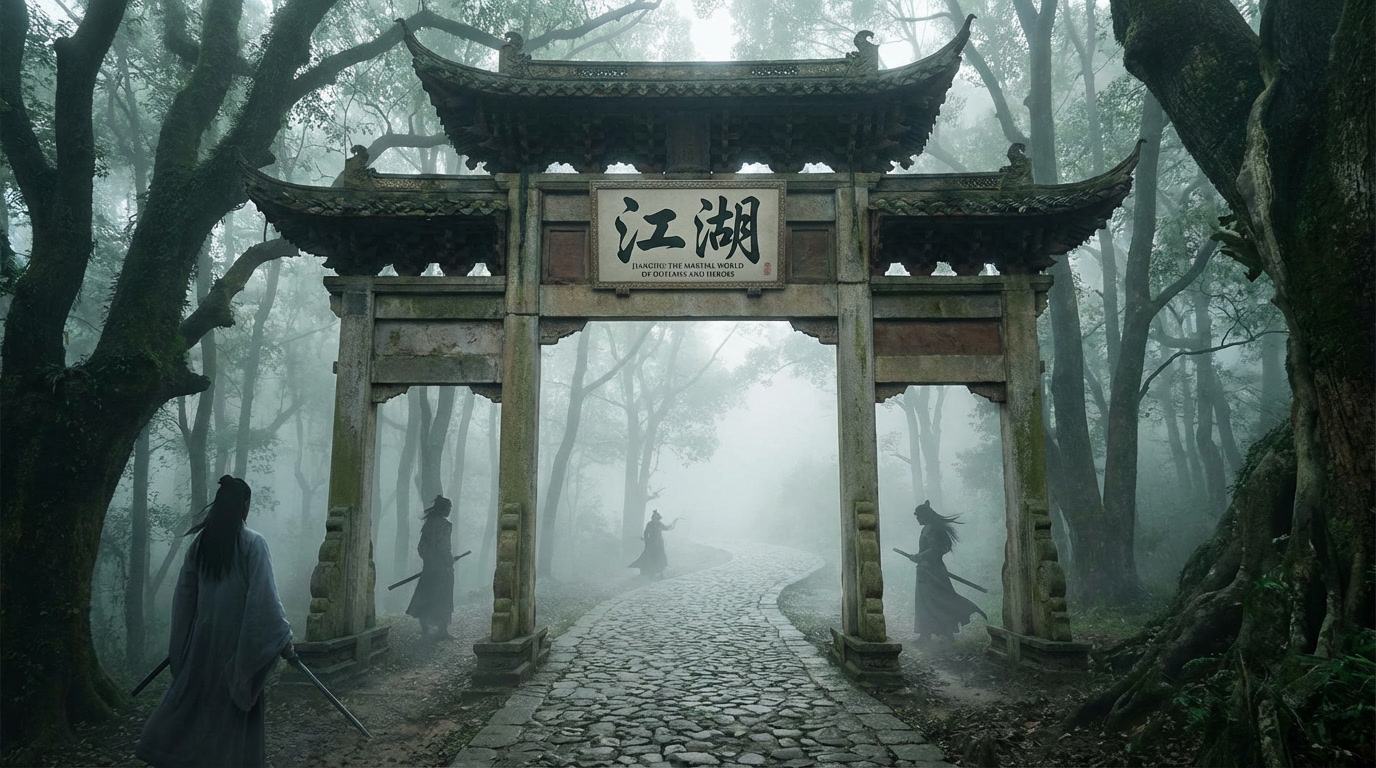
“Rivers and lakes” is the beginning, not the definition
Jiānghú is written 江湖. The characters literally mean “river” and “lake,” but the phrase has carried layered figurative meanings for more than two thousand years. Depending on period and context, jianghu can suggest the wider world, life away from court, wandering existence, unofficial society, reclusion, itinerant trades, criminal networks, artistic communities, or the imagined realm of martial heroes.
This is why “martial underworld” is useful and still insufficient. It catches danger, secrecy, and unofficial power, but loses freedom, exile, community, longing, self-invention, cultural memory, and resistance. Jianghu is not necessarily underground. It may be a road, an inn, a mountain school, a marketplace, a borderland, a rumor network, or the relationships among people who recognize each other as belonging to the same difficult world.
The concept existed before the sword fights
An early and famous use appears in the Zhuangzi, where stranded fish would be better off forgetting one another in the rivers and lakes than struggling together on dry land. Later writing expanded jianghu beyond literal waterways. It could evoke distance from official life, the freedom of wandering, reclusion, the wider country, or a social position outside the center of power.
Hsiu-ju Stacy Lo’s historical study traces how the idea moved through hermit imagery, literati culture, social margins, storytelling, and modern artistic communities. The point is not that one ancient passage secretly contained every later wuxia convention. The point is that jianghu remained flexible enough to absorb changing desires: escape, independence, fellowship, danger, and life beyond official categories.
The familiar contrast with miàotáng (庙堂), the court or official political sphere, matters here. Jianghu and court are often positioned as alternatives, but they are not sealed universes. Officials enter the jianghu. Martial figures become entangled in dynastic politics. Outlaws enforce rules as rigid as bureaucrats. The border leaks because people leak.
Wuxia turned jianghu into a mass-cultural world
Modern wuxia novels and cinema made jianghu internationally recognizable. Scholar Helena Yuen Wai argues that jianghu and wuxia define each other: jianghu provides the social and imaginative space in which martial heroes move, while wuxia continually rebuilds that space for new readers and viewers.
Jin Yong, Liang Yusheng, Gu Long, and many other writers did not produce one standardized martial universe. Their jianghu worlds differ in historical density, politics, humor, violence, romance, loneliness, and moral optimism. Screen directors transformed the concept again through landscape, architecture, movement, sound, and the visual opposition between wilderness and court.
A desert inn can become jianghu because enemies, officials, wanderers, and hidden identities collide there. A mountain can become jianghu because a sect’s authority matters more on its paths than an emperor’s decree. A city alley can become jianghu because the people inside it recognize debts and reputations invisible to the police.
Who belongs to the jianghu?
Sects, schools, masters, disciples, clans, rivals, expelled students, and one elder who has been “in seclusion” since the budget meeting.
Traveling heroes, swordspeople, escorts, fugitives, vigilantes, and people whose conscience has made ordinary employment impossible.
Healers, poison experts, weapon makers, diviners, performers, storytellers, information brokers, and traders in knowledge.
Bandits, assassins, criminal organizations, corrupt leaders, frauds, and respectable institutions doing criminal work in nicer robes.
Membership is contextual. A farmer does not automatically become jianghu because a swordsman buys noodles from her. Yet an innkeeper who maintains networks, hides fugitives, and trades information may be central to the story’s jianghu without throwing one punch. The world is built through participation and recognition, not a character-class menu.
The jianghu has rules, but no single rulebook
Wuxia repeatedly returns to enyuan, debts of gratitude and resentment. Favors demand repayment. Insults survive witnesses. Reputation travels ahead of the body. Sworn kinship can compete with blood family. A master’s name may shelter a disciple or trap them inside an inherited feud.
These are social conventions, not universal commandments. One sect honors a promise another calls foolish. One hero sees loyalty as sacred; another refuses loyalty without justice. “The rules of jianghu” often means the expectations powerful participants can enforce. That is exactly why the genre keeps asking whether honor is genuinely ethical or merely violence wearing ceremonial language.
Face, rumor, hospitality, seniority, oaths, reciprocity, and martial reputation create an unofficial institution. The state is not absent. It is one force among others. A corrupt court can drive heroes into resistance, while a stable court may still fail people at the margins. Jianghu fills gaps, but it can reproduce cruelty, patriarchy, hierarchy, and exclusion with breathtaking efficiency.
Jianghu did not stay inside period fiction
The word continues to appear in modern speech, cinema, crime stories, artistic communities, business metaphors, online culture, and descriptions of any social field with its own loyalties, rivalries, reputations, and survival knowledge. Contemporary films can invoke jianghu without swords by focusing on gangsters, migrants, performers, or people navigating unofficial networks.
That does not make every fandom, workplace, or group chat “a jianghu” in the full literary sense. The metaphor works when it reveals a social world beside formal institutions, especially one governed by lived relationships and unwritten consequences. It stops working when it becomes decorative Mandarin for “drama happened.”
How to read jianghu without flattening it
- Ask what official order cannot reach. The answer explains why an unofficial world exists.
- Map relationships before geography. A jianghu can move with its people.
- Track debts and witnesses. Reputation is a form of currency, and somebody always kept the receipt.
- Do not romanticize automatically. Freedom from the court can also mean freedom from protection.
- Watch the adaptation. Novels build networks through names and history. Film may build them through landscapes, entrances, costumes, and who bows first.
- Separate wuxia from xianxia. Xianxia may contain sects and unofficial martial society, but cosmic cultivation does not define the historical concept of jianghu.