
Meridians (经络)
The body map that translators call “energy channels,” cultivation novels turn into upgradeable plumbing, and medicine treats as part of a much larger diagnostic system.
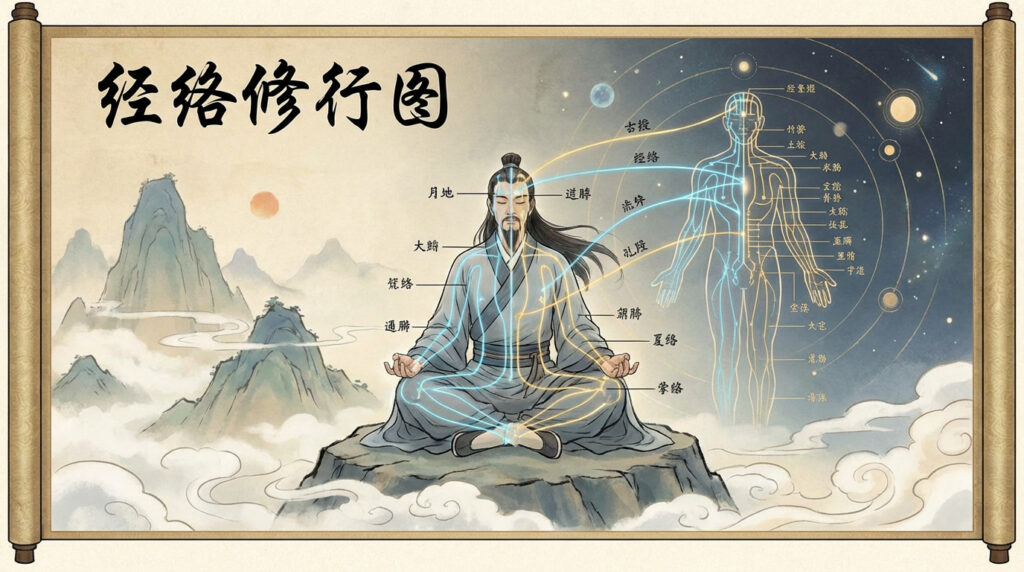
“Meridian” is useful English, but it hides half the idea
The Chinese term is jīngluò (经络 / 經絡). Jing refers to the main channels. Luo refers to the connecting network or collaterals. “Meridian” makes readers picture one neat line. The original model is closer to routes plus branches: main paths, smaller connections, relationships among organs, limbs, surface, and interior.
That is why a character can injure a “meridian” in one translation and a “channel” in another without the novel necessarily changing its rules. The translator may be choosing between familiar English and a more literal description.
What the traditional medical model actually says
Meridian theory is a core part of traditional Chinese medicine and acupuncture. The Chinese Medicine Hospital of Hong Kong describes the system as jing mai, the main meridians, plus luo mai, the collaterals. Within that framework, the network helps explain how qi and blood relate to different parts of the body.
Modern international nomenclature commonly organizes the practical map around twelve regular meridians and two midline vessels, the Governor and Conception vessels. The World Health Organization’s standard acupuncture nomenclature lists fourteen main meridians and separately names eight extraordinary vessels. It also standardized 361 classical acupuncture points so practitioners and researchers could use the same labels.
That standardization does not prove that meridians are literal anatomical tubes. Researchers continue to debate what, if anything, corresponds to them in biomedicine. A 2021 review from Chinese medical universities called the “essence” of meridians elusive and proposed studying their functional, historical, cultural, and material dimensions instead of pretending one easy answer has won.
The map readers keep encountering
| Term | Traditional framework | What fiction usually does with it |
|---|---|---|
| Twelve regular meridians | Named in relation to organ systems and arranged as connected routes. | Basic channels every cultivator is expected to possess. |
| Eight extraordinary vessels 奇经八脉 | Special pathways including Du, Ren, Chong, Dai, Yin Qiao, Yang Qiao, Yin Wei, and Yang Wei. | Secret reservoirs, high-capacity routes, or late-stage breakthrough channels. |
| Collaterals 络脉 | Smaller connecting branches within the larger network. | Fine channels that must be cleared after the “main” ones. |
| Acupoints 穴位 | Specific named points used in acupuncture practice. | Combat switches. Hit one and a limb freezes, qi reverses, or the villain starts coughing blood on schedule. |
Only the Governor and Conception vessels have their own standardized acupuncture points in the same way as the twelve regular channels. The other extraordinary vessels intersect with points assigned to those regular routes. Novels rarely stop for that level of bookkeeping because the hero is busy surviving lightning.
What cultivation fiction changed
Webnovels turn a relational medical map into a measurable power system. Channels now have width, durability, purity, capacity, and sometimes elemental compatibility. A protagonist can be born with blocked meridians, have them shattered, rebuild them, discover hidden ones, or possess an impossible configuration that makes every elder choke on tea.
Opening the meridians
In fiction, “opening” or “unblocking” meridians usually means making the body capable of circulating cultivated qi. The scene often combines pain, medicine, breath control, and a mentor yelling instructions after waiting until the dangerous part to explain anything.
Damaged meridians
This is one of the genre’s favorite disability and comeback devices. Damage may prevent cultivation, destabilize techniques, or cause backlash. Sometimes the story treats healing as rehabilitation. Sometimes it produces a miracle pill and moves on before consequences can file a complaint.
Hidden or spiritual meridians
These are generally fictional additions, not standard traditional medical categories. They give the author room for rare constitutions and surprise upgrades. If a page treats “hidden meridian” as ancient medical fact without showing a source, side-eye it.
Combat use
Wuxia often focuses on acupoint striking, internal injury, breath disruption, and the flow of neili or internal strength. Xianxia scales the same vocabulary into supernatural circulation routes that carry spiritual qi, support spells, and survive realm breakthroughs. The borrowed terms overlap, but the power ceiling does not.
Five translation traps worth knowing
- Meridian and channel may be the same word. Check the Chinese term before assuming the author introduced two systems.
- Acupoint is not a whole meridian. A point belongs to or intersects with a route.
- Neili is not automatically qi. Internal strength is usually trained power. Qi is the broader substance or process the story says is being worked with.
- Spirit veins may describe geography. Lingmai can refer to spiritual veins in mountains or land, not veins inside a person.
- Medical vocabulary does not make the magic medically factual. The novel is remixing a cultural framework.
Research trail
- Chinese Medicine Hospital of Hong Kong: Meridian Theory
- World Health Organization: A Standard International Acupuncture Nomenclature
- PubMed: A “4D” Systemic View on Meridian Essence
- PMC: Electrical Impedance Along Connective Tissue Planes Associated With Acupuncture Meridians
Keep wandering: Qi · Neigong · Wuxia vs Xianxia · Novel World 101