
STORY WORLD 101 · NOVEL WORLD 101
Jianghu vs Xianxia: One Is a Social World. One Is a Fantasy Genre.
The fastest bad explanation says Jianghu is “the human realm” and Xianxia is “the immortal realm.” That sounds tidy. It is also why people keep using the words as if they were parallel settings. They are not.
The answer before the boba ice melts
A wuxia novel can be set in the Jianghu. A crime film can invoke Jianghu without a single sword sect. A Xianxia story can contain a martial community that feels like Jianghu, but the cultivation cosmos is not “Jianghu upgraded.” One term describes a social world. The other describes a genre.
Jianghu is bigger than the martial-arts clubhouse
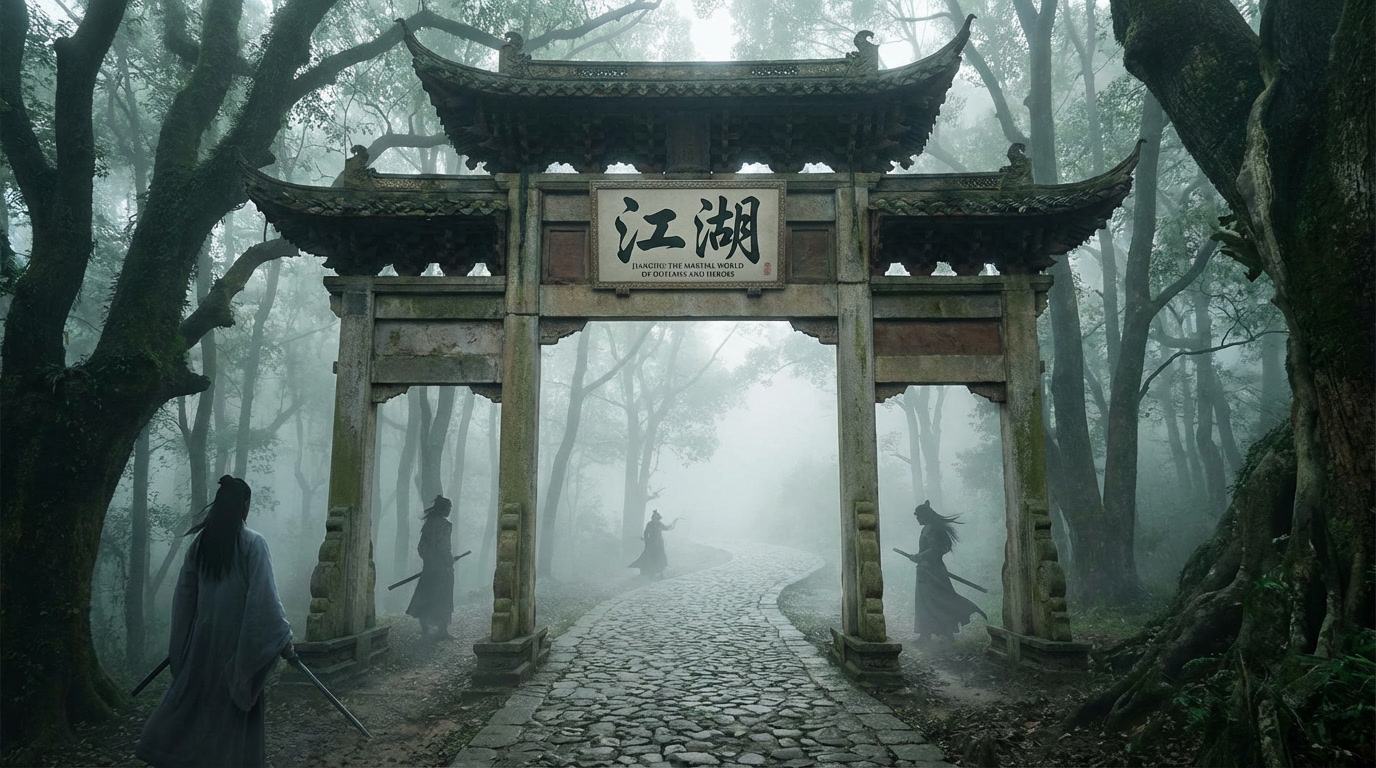
The characters 江湖 literally point to rivers and lakes, but the cultural life of the term is much wider than the dictionary gloss. In classical writing, Jianghu could suggest physical distance from court, exile, withdrawal, wandering, or a life beyond official politics. Modern scholarship still describes it as a space at society’s margins, occupied by people who negotiate an alternative order.
Wuxia popularized a version many international viewers recognize immediately: martial artists, escorts, healers, beggars, outlaws, monks, assassins, sects, inns, and sworn allies operating through reputation and unwritten obligation. Government exists, but it does not fully organize this world. A promise, insult, favor, murder, stolen manual, or disputed leadership succession may matter more than a magistrate’s paperwork.
It is not simply “the underworld”
Organized crime can belong to Jianghu, but translating the whole concept as “criminal underworld” crushes the poetry and flexibility out of it. Jianghu can include honorable wanderers, political exiles, performers, merchants, rebels, hermits, and people who simply live outside respectable structures. Its moral order is unstable. That is the point. Characters must decide whose rules deserve loyalty.
And yes, Jianghu stories can fly
The old page claimed Jianghu meant no magic and no flying. Nope. Jianghu is not a power ceiling. Wuxia routinely uses heightened martial abilities, qinggong movement, internal force, impossible leaps, secret techniques, and bodies that behave with magnificent disrespect toward normal physics. The better question is not “Did someone leave the ground?” It is “What kind of story-world logic explains the feat?”
Xianxia builds a cultivation cosmos

Xianxia is usually translated as “immortal heroes” or “immortal chivalry.” The genre draws from Chinese mythology and from ideas associated with Daoism, Buddhism, Confucian ethics, folk religion, medicine, martial arts, alchemy, gods, ghosts, demons, and immortals. Modern novels and dramas remix those materials aggressively. A fictional cultivation manual is not a documentary about Daoist practice, and a heavenly bureaucracy is not a clean transcript of one historical belief system.
Many contemporary Xianxia narratives center cultivation: refining body, mind, spirit, or qi; advancing through named stages; acquiring techniques; surviving tribulations; seeking longevity or immortality; and confronting the rules that govern a layered cosmos. But the genre is broader than one webnovel leveling template. Romance, sacrifice, karmic debt, divine office, reincarnation, sect politics, demons, artifacts, and mortal-immortal conflict can carry as much weight as power progression.
Xianxia is not “anything with a glowing sword”
A drama can use wirework, magical-looking cinematography, or spiritual language without belonging neatly to Xianxia. Marketing labels travel loosely across platforms and translations. Xuanhuan also borrows cultivation structures while permitting a more hybrid fantasy vocabulary. Shenmo fiction foregrounds gods and demons differently. Genre borders blur, but blur is not permission to throw every Chinese fantasy into one lavender basket.
Side by side without pretending the categories match
| Question | Jianghu | Xianxia |
|---|---|---|
| What is it? | A social and literary space, plus a cultural metaphor | A Chinese fantasy genre |
| Core tension | How people live outside or beside official order | How beings pursue, resist, or survive cosmic power and transcendence |
| Typical structures | Sects, clans, inns, escort agencies, sworn bonds, favors, rivalries, reputation | Cultivation sects, realms, divine courts, reincarnation, tribulations, artifacts, demons, immortal lineages |
| Power scale | Not fixed. It can range from social realism to heightened martial fantasy | Usually openly supernatural and cosmological |
| Relationship to wuxia | Often the social world wuxia characters inhabit | Historically and aesthetically related, but developed as its own genre |
| Can it appear outside costume fantasy? | Yes. Modern crime, gangster, migration, and marginal-community stories can invoke Jianghu | Usually remains tied to fantasy, mythic, cultivation, or immortal-hero storytelling |
Where they overlap, because authors enjoy making charts suffer
A Xianxia sect may have grudges, alliances, wandering healers, reputational law, forbidden manuals, and networks outside state authority. That social layer can feel deeply Jianghu. Meanwhile, a wuxia tale may include legends of immortals, strange medicines, uncanny techniques, or religious imagery without turning into full Xianxia.
The overlap makes sense because the traditions share cultural materials and literary ancestry. The mistake is imagining a mandatory elevator ride: mortal Jianghu on floor one, Xianxia immortals on floor ninety-nine. Some stories escalate that way. The vocabulary itself does not require it.
Mostly Jianghu logic
A disgraced swordswoman enters a network of escort houses, sect leaders, wandering doctors, and assassins. Her problem is not how to ascend. It is whether any oath survives money, revenge, and political pressure.
Mostly Xianxia logic
A mortal disciple cultivates through a sect, faces heavenly tribulation, carries karmic debt from a prior life, and discovers that the divine order is run by people with excellent robes and terrible governance.
A better reader test
Do not diagnose the genre by asking whether someone flies. Ask what organizes the story.
- Is the central world a network beside official society? You are probably reading Jianghu as a social concept.
- Does reputation, obligation, sect affiliation, or personal justice govern survival? Strong Jianghu logic.
- Does the plot require cultivation, immortality, divine or demonic beings, reincarnation, heavenly law, or a layered cosmos? Strong Xianxia logic.
- Does it use both? Congratulations. The author also rejected your demand for one clean shelf.
That last answer is normal. Genre language helps us notice patterns. It should not punish stories for being interesting.
RaeRae takeaway
Jianghu asks, “What happens when people create their own order outside the respectable one?” Xianxia asks much larger questions about power, transcendence, fate, immortality, and what a person becomes while trying to outrun death. One can sit inside the other, brush against it, or walk away entirely.
If a glossary turns Jianghu into “humans who cannot fly,” please confiscate its tea until it apologizes.
Receipts and further reading
- Mario Wenning, “Jianghu: Los niños de los ríos y lagos, y la modernidad china”, on Jianghu as a marginal countercommunity with its own norms.
- Zhu Gang, “A World Derived from Taoyuan: Jianghu in the Su Brothers’ Writings”, on earlier literary meanings of Jianghu.
- Helena Yuen Wai Wu, “A Journey Across Rivers and Lakes”, on the difficulty of translating Jianghu across culture and literature.
- Morgan Yu Hao, “Cultivation games and cosmotechnics”, on cultivation narratives, qi, and immortality.
- Liu Wei, “Construction of New Ancient Style Discourse in Online Novels of the Xianxia and Fantasy Genre”, on modern Xianxia and fantasy language.
CVM Sekai cross-reference: Read the full Jianghu guide, the Xianxia guide, and the corrected Wuxia vs Xianxia comparison.