
Qi (气 / 氣)
The word translators turn into “energy,” “breath,” “vital force,” “aura,” or whatever fits inside the subtitle box. Qi is older, messier, and much more interesting than a glowing blue mana bar.
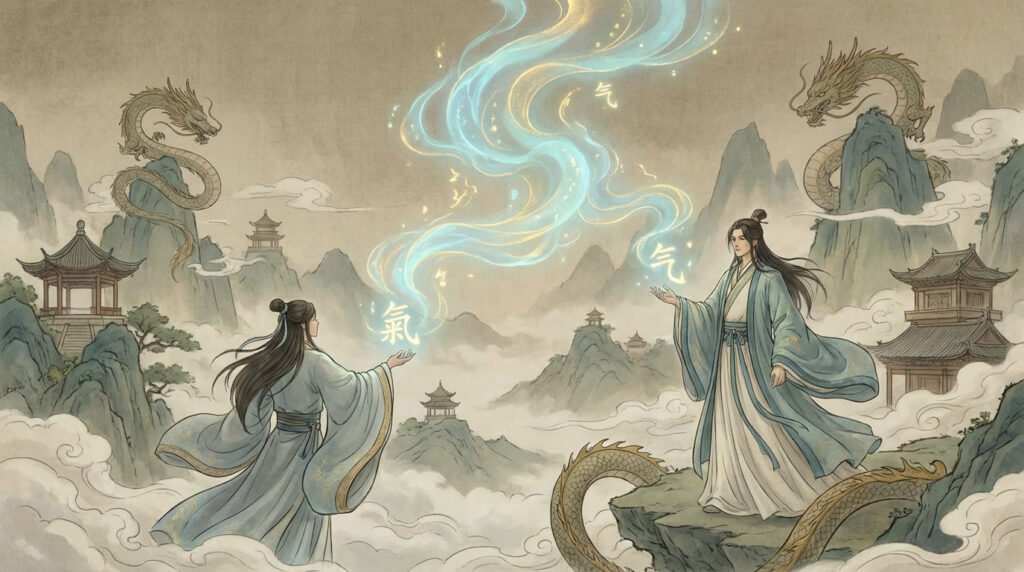
First, “life energy” is not completely wrong. It is just painfully small.
The modern character 氣 can refer to air, breath, vapor, weather, smell, temperament, manner, and the vital processes described in Chinese philosophy and medicine. The simplified form is 气. Even everyday words keep that range alive: tiānqì (天气) means weather, kèqi (客气) describes courtesy, and shēngqì (生气) can mean becoming angry. One character is already doing more work than the English word “energy” volunteered for.
In historical philosophy, qi is often described less like a supernatural battery and more like the dynamic stuff, breath, or psychophysical force through which things take form and change. Different thinkers did not all use it identically. That matters. “Chinese philosophy says qi is X” is usually the beginning of an argument, not the ending.
Qi existed before cultivation novels gave it attack stats
Early Chinese texts use qi in discussions of breath, vapor, climate, the body, and the processes linking human life with the larger world. Later Confucian, Daoist, medical, and cosmological traditions developed the concept in different directions. In Song and Qing thought, philosophers debated how qi related to li (理), often translated as pattern or principle. Some thinkers treated qi as the concrete, changing material through which pattern becomes the world we actually experience.
That history is why “qi is magic” feels wrong. Qi belonged to serious arguments about matter, life, morality, perception, health, and change long before webnovel heroes inhaled an entire mountain’s spiritual atmosphere and exploded a measuring stone.
It is also why “qi is scientifically proven energy” is too confident. A historical philosophical or medical concept does not become a measurable modern physical substance because an English translation uses the word energy. Culture deserves better than fake science wearing a lab coat.
Qi in Chinese medicine is a framework, not one glowing fluid
Traditional Chinese medicine discusses multiple functional forms and relationships of qi. Terms may distinguish inherited and acquired aspects, defensive functions, nourishing functions, organ systems, breath, food, blood, fluids, and pathogenic influences. The vocabulary describes patterns inside that medical tradition. It is not a single object that a scanner can photograph moving through a meridian.
Modern medical authorities make an important distinction: traditional theories can be studied as cultural and medical history, while claims that specific treatments work require clinical evidence. You can respect the intellectual history without turning a fantasy explainer into medical advice. CVM Sekai is here to explain the story language, not prescribe herbs because your protagonist coughed artistically.
| Context | What qi may be doing | What not to assume |
|---|---|---|
| Classical philosophy | Explaining change, formation, material force, breath, or the relation between body and world | That every thinker meant one identical substance |
| Chinese medicine | Describing functional patterns within a traditional diagnostic system | That a novel’s glowing meridians are literal medical anatomy |
| Martial arts fiction | Supporting breath control, internal force, endurance, pressure, and technique | That historical martial practice included rooftop flight and palm lasers |
| Xianxia and xuanhuan | Fueling realms, talismans, formations, weapons, alchemy, spiritual senses, and lifespan | That the power ladder is ancient doctrine instead of author-built mechanics |
What webnovels changed
Wuxia often keeps qi closer to breath, internal cultivation, and martial force. A fighter trains the body, circulation, focus, and technique until the result looks impossible but still belongs to the martial world. Xianxia pushes farther. Qi becomes harvestable, storable, compressible, elementally aligned, commercially valuable, and occasionally available in suspiciously convenient pills.
Modern cultivation stories may divide it into spiritual qi, demonic qi, yin qi, yang qi, immortal qi, sword qi, death qi, or a private flavor invented for one sect with excellent branding. Some terms draw on older vocabulary. The system connecting them is usually modern fantasy design.
This is where the old page got itself into trouble. It treated CVM Sekai’s own “higher-density qi variants” as if they belonged inside the cultural definition. They do not. That material belongs in the Worldbuilding Lab, clearly labeled as an invented system. The 101 page explains the inherited language. The lab explains what RaeRae built with it.
Translation traps that make three different ideas look identical
Qi (气 / 氣)
The broad word. Depending on context: breath, air, vital process, force, atmosphere, temperament, or a fictional energy system.
Zhenqi (真气 / 真氣)
Literally “true qi.” In martial and cultivation fiction, translators may render it as true energy, genuine qi, or internal energy. The exact mechanics belong to the story.
Neili (内力 / 內力)
Internal power or internal strength, especially common in wuxia. It overlaps with qi training in fiction, but it is not automatically a synonym for every use of qi.
Jing (精)
Essence. In traditional thought and medicine it participates in a larger body of ideas sometimes grouped with qi and shen (spirit). Translating it as simple “stamina” flattens the term.
Lingqi (灵气 / 靈氣)
Spiritual qi or numinous vitality. In modern fantasy it often becomes the ambient resource cultivators absorb. Authors disagree wildly about density, purity, elements, and who can sense it. Read the local rulebook before starting an argument in the comments.
So what should the reader picture?
Picture a concept with several historical lives. It can be breath moving through a body, the vigor of a person, the dynamic material force of a philosophical universe, a category inside Chinese medicine, or the gasoline of a fictional immortality economy. Context chooses the meaning.
When a drama uses qi quietly, it may be talking about health, breath, or internal condition. When a cultivator splits a mountain with it, the author has already left the cultural dictionary and entered worldbuilding. Both uses matter. They just should not be smushed together and presented as one ancient rulebook.
That distinction makes the stories better. You can see which ideas were inherited, which were transformed, and which were invented because an author wanted the villain’s aura to kill three decorative trees before he entered the room.
Research trail
- Chinese Text Project dictionary entry for 氣, showing the word’s range beyond “life energy.”
- Stanford Encyclopedia of Philosophy: Qing Philosophy, including qi as material or psychophysical force in late imperial thought.
- U.S. National Library of Medicine MeSH entry for Qi, useful for the historical “life-breath” vocabulary used in medical indexing.
- National Center for Complementary and Integrative Health: Traditional Chinese Medicine, which separates traditional theory from evidence questions.
- Historical development of the deqi concept, tracing medical uses through classical Chinese sources.
Keep reading: Meridians · Neigong · Wuxia vs Xianxia · Worldbuilding Lab