
Naruto character dossier
Boruto Uzumaki
He begins as the Hokage’s angry son, cheats for attention, inherits an alien death sentence and ends up protecting a village whose memories identify him as its enemy.
The boy after the happy ending
Boruto is the son of Naruto Uzumaki, the Seventh Hokage, and Hinata Hyūga. He grows up with a home, parents, a sister and a village at peace. Those advantages are real. So is the loneliness created when Hokage labor pulls Naruto out of the house.
His early resentment can sound spoiled because Naruto’s childhood was catastrophically worse. Children do not grade absence on a historical curve. Boruto knows his father is alive, loving and celebrated. That makes the repeated empty chair feel chosen even when the real cause is an office consuming Naruto’s time.
Boruto is talented before he earns discipline. He learns quickly, uses multiple chakra natures young and understands combat patterns with little repetition. Natural ability lets him avoid the long failure cycle that taught Naruto humility. The Chūnin Exams force that missing lesson to arrive in public.
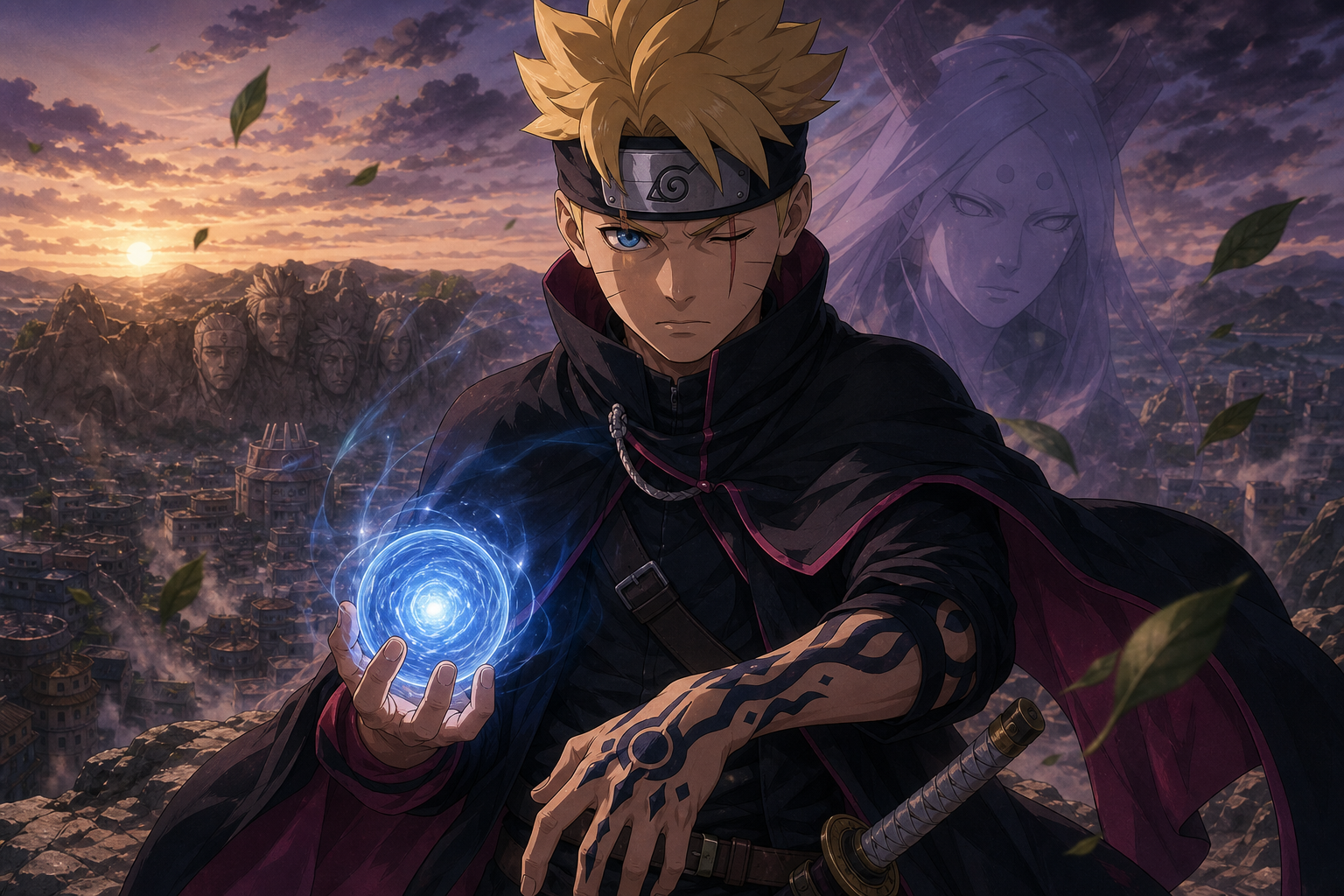
His design begins with blond hair, blue eyes, whisker marks and black clothing accented in bright pink. Those cues connect him to Naruto without copying the orange silhouette. Two Blue Vortex adds a scarred right eye, cloak, sword and heavier accessories. The older design records three years of exile through weight and asymmetry.
The manga and anime do not provide one identical childhood shelf. The manga enters his story near the Chūnin Exams. The anime develops Academy friendships, the Nue incident, school missions and the mysterious eye commonly called the Jōgan. That eye is central to anime material but has not received the same clear confirmation and mechanics in the manga. A complete profile labels the difference.
Naruto gives the village what Boruto wants at home
Naruto becomes Hokage because he wants every villager recognized. The job expands until symbolic fatherhood to Konoha competes with actual presence for Boruto and Himawari. Boruto does not hate the village. He hates that the village receives the version of Naruto he wants.
The birthday disaster makes the conflict visible. A shadow clone attends Himawari’s celebration and disappears when the exhausted original loses focus, dropping the cake. The broken plate becomes more important than any villain speech. Naruto uses a technique associated with multiplying care, yet administrative overload turns the clone into proof that attention cannot be infinitely copied.
Hinata carries the household continuity without being reduced to a silent solution. She understands Naruto’s duty and Boruto’s anger. The story sometimes leans too heavily on her patience while the father-son conflict receives the dramatic center.
Himawari gives Boruto a protective role that is not political. He can be sarcastic about Naruto and still take his sister’s feelings seriously. Later events make that bond painful because Omnipotence rewrites Boruto’s place inside his own family story.
Boruto eventually asks Naruto to tell him about his past rather than simply lecture him. That request is growth on both sides. Boruto wants history. Naruto needs to practice fatherhood as relationship rather than instruction.
The scientific ninja tool scandal is about attention, not laziness
New Team 7 joins Boruto, Sarada Uchiha and Mitsuki under Konohamaru Sarutobi. Boruto performs well through the early exam stages, then uses a forbidden scientific ninja tool to win individual matches.
The tool stores techniques and lets a user deploy them without earning the chakra control or practice normally required. Scientific tools are not inherently corrupt. The exam prohibits this one because the test is supposed to evaluate the shinobi, not a hidden catalog of someone else’s work.
Boruto cheats because he wants Naruto to see and approve of him. That motive explains the choice without excusing it. Naruto disqualifies him publicly and removes the forehead protector. The father acts correctly as Hokage while the son experiences the judgment as another public version of a private absence.
Momoshiki and Kinshiki attack before the family can resolve the shame. Naruto protects the stadium and is taken because the invaders want Kurama‘s chakra. Boruto finally sees Hokage work as bodily risk rather than paperwork stealing his father.
Sasuke Uchiha lends Boruto his forehead protector and joins the rescue with the Kage. Boruto’s Vanishing Rasengan catches Momoshiki off guard, while Naruto helps him form the enormous final Rasengan. The victory combines Boruto’s innovation with inherited effort. He cannot pretend he did it alone.
Momoshiki turns victory into occupation
After defeat, Momoshiki freezes Boruto’s perception of time, warns that his blue eyes will take everything and places Karma on his palm. The mark stores Ōtsutsuki data that gradually rewrites Boruto’s body.
Karma grants absorption, physical enhancement, space-time movement and access to Momoshiki’s combat experience. Every advantage advances an occupation. Boruto’s body becomes a backup file for the person he killed.
During the Boro battle, Momoshiki takes control after Boruto loses consciousness and destroys the enemy. The rescue works, but Boruto wakes without ownership of the action. Power and violation arrive together.
Against Isshiki, Boruto uses Karma to move himself, Naruto and Sasuke into another dimension. After Isshiki falls, Momoshiki takes control again and destroys Sasuke’s Rinnegan. Boruto eventually regains himself by forcing the body into conditions that disrupt the possession.
Amado’s medication slows Karma progression temporarily. Medical intervention provides time, not a clean cure. Boruto must make decisions while knowing sleep, exhaustion or chakra depletion may open the door for Momoshiki.
Brotherhood grows inside matching brands
Team 7 finds Kawaki after a Kara transport crash. His Karma resonates with Boruto’s. The matching marks create immediate suspicion and the possibility of shared understanding.
Kawaki moves into the Uzumaki home under Naruto’s protection. Boruto resents the intrusion, while Kawaki expects every kindness to hide control. Daily life, training and Himawari’s broken vase create a family bond slowly enough to matter.
Kawaki protects Himawari from Delta and loses an arm. Boruto begins treating him as a brother rather than a dangerous guest. Both boys want to remove Karma, but the marks carry different histories. Momoshiki chooses Boruto after defeat. Isshiki and Jigen engineer Kawaki through prolonged abuse.
Their bond becomes a death pact. Boruto asks Kawaki to kill him if Momoshiki takes permanent control. Kawaki accepts because he believes Naruto’s safety outranks Boruto’s life and because Boruto shares that fear.
Brotherhood does not stop the conflict because both boys turn love into unilateral sacrifice. Boruto offers his body. Kawaki makes himself executioner. Neither plan gives the family a vote.
Kawaki kills him, and Momoshiki rebuilds the vessel
During the fight involving Code, Momoshiki takes Boruto’s body again. Boruto regains control long enough to carry out the agreement. Kawaki strikes through his chest and kills him.
Momoshiki uses the remaining compressed Karma data to reconstruct Boruto’s damaged body. The process revives Boruto but completes his biological conversion into an Ōtsutsuki. Momoshiki loses the ability to resurrect through him in the original planned way, yet his consciousness remains present.
Boruto survives because the invader needs the vessel alive. Resurrection is therefore rescue and deeper entanglement. His body is now fully Ōtsutsuki even though his identity and loyalty remain Boruto’s.
The event also exposes the moral pressure placed on children. Adults build scientific tools, village policy and anti-Ōtsutsuki strategy around Boruto. The two boys make the final lethal agreement themselves because no adult solution arrives in time.
Omnipotence steals his citizenship, family and biography
Kawaki seals Naruto and Hinata in a dimension where time does not move because he believes killing Boruto is necessary to eliminate Momoshiki. Eida’s Omnipotence then responds to Kawaki’s desire and rewrites nearly all human memory.
The world remembers Kawaki as Naruto’s son and Boruto as the outsider who killed the Seventh Hokage. Photographs, records and logical contradictions do not reliably defeat the effect. Memory supplies emotional certainty strong enough to explain away evidence.
Sarada and Sumire remain unaffected. Sarada awakens the Mangekyō Sharingan while begging Sasuke to protect Boruto. Sasuke’s memory tells him Boruto is the enemy. His trust in Sarada makes him act against that memory.
Boruto loses home, public identity and the presumption of innocence in a single event. Momoshiki expects despair to break him. Boruto instead declares that he will prove who he is again and still refers to Kawaki as his brother.
That resolve is admirable and dangerous. Forgiveness cannot become permission for Kawaki’s choices. Boruto can reject revenge while still requiring accountability, truth and the return of Naruto and Hinata.
Two Blue Vortex turns the prodigy into a hunted veteran
Roughly three years later, Boruto returns to Konoha during Code’s Claw Grime attack. His movement, swordsmanship and composure show training far beyond his younger self. He protects Sarada while most of the village identifies him as a murderer.
Rasengan Uzuhiko uses the planet’s rotation, orbit and related forces. The energy is not Sage Mode nature energy. Contact destroys the target’s balance, and the effect continues because planetary movement continues. Boruto uses it on Code as a disabling threat rather than immediate execution.
His version of Flying Raijin is explicitly more restricted than Minato’s. Boruto can mark metal objects above a certain mass, needs at least a minute to set the mark, and uses recognizable shaped ornaments for long-distance visualization. The official database calls the technique a “copycat Flying Raijin.” Kashin Koji’s Prescience lets Boruto learn in two years what would otherwise take roughly six.
Prescience shows possible futures rather than one guaranteed timeline. Koji uses that information to teach techniques and avoid catastrophic branches. Knowledge changes behavior, and behavior changes the future. Boruto trains from possibilities he has not personally lived.
Code’s Claw Grimes evolve into self-aware Divine Trees after consuming people. Sasuke becomes trapped through that process, turning Boruto’s mentor into both a rescue objective and a source for a new enemy identity. Current Two Blue Vortex chapters continue developing that conflict. Any final outcome, confirmed romance or complete explanation of every new ability remains unwritten.
Abilities, mechanics and honest limits
Rasengan
Boruto learns the Rasengan from Konohamaru and creates variants through instinct and later training. His compact form, Vanishing Rasengan and Uzuhiko serve different mechanics rather than simple size upgrades.
Vanishing Rasengan
Lightning nature causes the thrown Rasengan to disappear from sight before impact. The surprise works best when an opponent assumes the attack has failed.
Rasengan Uzuhiko
Uzuhiko uses planetary rotation and orbit, damages balance and can persist. Contact and grounding conditions matter. The technique is powerful but not proof that Boruto controls an infinite planet-sized chakra reserve.
Copycat Flying Raijin
Boruto marks qualifying metal objects slowly and teleports through them with distance-specific visualization rules. His version is brilliant and materially less flexible than Minato’s.
Karma
Karma enhances physical ability, absorbs many chakra-based attacks and enables space-time movement. Use risks Momoshiki influence, information leakage and loss of bodily control.
Elemental ninjutsu
Boruto uses Lightning, Wind and Water Release across his record. Adaptations add techniques and combinations that should not be silently treated as manga appearances.
Shadow clones
He uses fewer clones than Naruto and relies more on tactical placement. Dividing chakra and maintaining attention remain limits.
Kenjutsu
Older Boruto fights with a sword after training under Sasuke. The blade supports teleportation, feints and close-range control. He should not be relabeled a generic samurai.
Relationship atlas
Naruto Uzumaki
Boruto begins by demanding Naruto’s attention and matures into protecting Naruto’s work without copying his career. Their reconciliation comes through history, shared battle and a smaller request for time.
Hinata and Himawari
Hinata gives Boruto household stability. Himawari gives him an ordinary sibling bond worth protecting. Omnipotence steals the public story of both relationships while leaving Boruto’s memory intact.
Sasuke Uchiha
Sasuke becomes Boruto’s model for supporting the Hokage from outside the office. After Omnipotence, he chooses Sarada’s trust over his own altered memory and trains Boruto in exile.
Sarada Uchiha
Sarada is teammate, moral witness and the person who wants the Hokage path Boruto rejects. She remembers him through Omnipotence and fights the village’s false certainty. Current canon supports deep trust. A final romance remains unconfirmed.
Mitsuki
Mitsuki initially defines Boruto as his sun. Omnipotence redirects that attachment toward Kawaki, turning love into a weapon against its original person. Their later confrontation forces Mitsuki to examine desire beyond implanted memory.
Kawaki
Kawaki is brother, fellow vessel, killer and identity usurper. Boruto’s refusal to hate him prevents another revenge cycle. Reconciliation still requires truth and the release of Naruto and Hinata.
Momoshiki Ōtsutsuki
Momoshiki is invader, involuntary life-support system, source of power and internal antagonist. Shared existence creates information exchange without creating consent or friendship.
Konohamaru Sarutobi
Konohamaru gives Boruto formal team leadership and the Rasengan foundation. Boruto later grows beyond his teacher’s power level without making the original instruction irrelevant.
Boruto asks whether identity can survive corrupted memory
Naruto builds identity through recognition. Boruto loses recognition through a shinjutsu that rewrites collective memory. The sequel tests whether a self remains meaningful when society’s agreement about that self collapses.
A Confucian lens highlights family roles and their disruption. Son, brother, student and citizen are relational identities. Omnipotence changes who others believe occupies each role. Boruto maintains his duties even when reciprocal recognition disappears.
A Buddhist reading centers the instability of reputation. Praise after defeating Momoshiki, shame after cheating and hatred after Omnipotence all change quickly. Boruto learns that public identity cannot be the only ground for action. The lesson is not emotional detachment from people. That choice becomes commitment without guaranteed reward.
The technology theme also matures. Young Boruto cheats with a scientific tool because he wants results without process. Older Boruto uses Karma, Koji’s future knowledge, teleportation markers and inherited techniques while understanding that every shortcut has conditions and cost.
Industry context matters because Boruto carries a franchise as well as a surname. Audiences compare him with Naruto before allowing his story to establish a different premise. The strongest writing accepts the comparison, then asks what peace does to the children born after a war epic.
Yūko Sanpei and the original Japanese performance
Yūko Sanpei is Boruto’s original Japanese voice across the anime’s central portrayal. The role moves from prankish confidence and family anger into fear, possession, guilt and hard-earned composure while keeping the character recognizably young. This profile names the verified performer and the narrative demands of the role. I will not invent claims about pitch, line timing or breath without a lawful scene-by-scene audio comparison.
The anime gives Boruto a much larger childhood and mission record than the manga. Academy arcs, the Jōgan material, friendships and anime-original travel expand his world. Those episodes can be meaningful without being used as unlabeled proof for manga-only mechanics.
Fandom arguments that need a better sequel
“Boruto is a spoiled brat”
He begins privileged and emotionally immature. He also changes after the exam, admits the cheat and confronts consequences. A starting flaw is not a permanent biography.
“He hates Naruto”
Boruto hates what the Hokage job does to their home. He craves Naruto’s attention, studies his past and later risks everything to protect him.
“Everything comes easily”
Natural talent is real. Karma costs bodily autonomy. Flying Raijin has explicit restrictions. Uzuhiko requires specialized learning. Exile removes the support system talent once relied on.
“Omnipotence changed reality”
Omnipotence changes nearly everyone’s memories and social interpretation. Boruto’s biological identity and past actions remain. The altered world treats contradictions as reasons to protect the memory, not as a rewritten birth.
“Boruto should kill Kawaki”
Eliminating Kawaki would not automatically release Naruto, reverse Omnipotence or solve Momoshiki. Boruto’s refusal to choose revenge is strategic and moral. Accountability still cannot be skipped.
Privilege is the starting condition, not the final verdict
Boruto begins with nearly everything Naruto lacked: a home, living parents, a sister, natural talent, respected teachers, friends, and a village that knows his family name. Pretending those advantages do not exist makes the sequel dishonest. Treating them as proof that he cannot suffer makes the audience dishonest instead.
His early anger toward Naruto is not equivalent to Naruto’s orphaned childhood. Boruto is reacting to a father physically present enough to promise family life and institutionally absent enough to keep missing it. The scale differs. The feeling remains real. A child does not need the worst pain in the franchise before disappointment counts.
The story becomes his own when those starting advantages are stripped away. Public memory, family access, village belonging, and the meaning attached to his name all shift outside his control. Boruto learns loss after growing up secure, which means he understands exactly what has been taken.
Cheating is a character choice, not proof of a fake shinobi
The Scientific Ninja Tool scandal matters because Boruto knows the exam rules and chooses applause over honest effort. Talent does not protect him from insecurity. In fact, talent helps him rationalize the shortcut. He can perform enough real skill that the borrowed technique feels like presentation rather than fraud until Naruto exposes it.
Consequences make the failure useful. Boruto does not become worthy because the cheating secretly helped save the day. He has to face humiliation, admit the decision, and continue training after the public image collapses. Growth begins when skill stops functioning as an excuse.
The technology is not the villain. Tools can widen access, protect bodies, and change what shinobi labor looks like. The problem is deception: claiming somebody else’s stored technique as evidence of personal mastery. Boruto’s later relationship to difficult power remains haunted by that first shortcut.
Karma turns inheritance into bodily occupation
Karma gives Boruto extraordinary abilities while converting his body into a site Momoshiki expects to inherit. That is not a clean chosen-one gift. Every advantage arrives with the threat that the person using it may disappear beneath the source.
This is where Boruto’s story connects to the franchise’s long history of jinchūriki without becoming an exact copy. Kurama is imprisoned inside Naruto and eventually becomes a partner. Momoshiki marks Boruto as a vessel for replacement. Conversation exists, but the intended endpoint is not coexistence. It is occupation.
Boruto therefore has to use power that threatens authorship over his own future. Refusing the ability entirely is not always possible. Trusting it casually is reckless. Mastery means negotiating risk without pretending control is permanent.
Omnipotence steals social truth, not lived history
After the memory exchange, Boruto still knows who he is. The crisis is that identity also lives between people. A name has legal, familial, emotional, and civic meaning because communities recognize it. When those relationships point toward Kawaki, private certainty cannot restore public belonging by itself.
The contradictions are visible, yet most minds explain them away to protect the altered story. That detail makes the isolation nastier. Evidence exists. People encounter it. Their interpretation bends before the evidence can become trust.
Boruto’s response defines him more than the plot device. He could treat the village’s hostility as permission to abandon everybody inside it. He continues protecting people who identify him as the threat. That choice does not require passive acceptance of Kawaki’s actions. Mercy and accountability are separate jobs.
Protecting Kawaki does not mean excusing him
Boruto understands that Kawaki’s violence grows from terror of losing Naruto and from a childhood where power always arrived through ownership. Understanding the source keeps Boruto from reducing him to a target. It does not make confinement, identity theft, or attempted killing acceptable.
The brothers become a test of whether family can survive accountability. Killing Kawaki may satisfy the demand for immediate punishment while leaving Naruto and Hinata trapped, memories altered, and the larger threat unresolved. Saving him cannot mean pretending nobody was harmed.
Boruto chooses the harder promise because restoration requires more than winning a duel. He wants his parents returned, the village protected, Momoshiki contained, public truth recovered, and Kawaki stopped without surrendering the possibility that the frightened child inside him remains reachable.
That goal may fail. Its difficulty is the point. Naruto’s son inherits stubborn hope after the applause disappears. The village does not know he is carrying the promise, and the promise still governs his choices.
The final verdict
Boruto starts by borrowing power to earn his father’s eyes. He grows into a shinobi who carries alien power, future knowledge, a stolen public identity and the responsibility to rescue the people hunting him.
Naruto’s son does inherit the guts to never give up. The sequel becomes his own when that inheritance is no longer applause. Boruto keeps the name after the world gives it to someone else.
Sources and continuity boundary
The Boruto manga and Boruto: Two Blue Vortex manga control the continuing chronology. Anime-original arcs, novels, games, films, and adaptation expansions are identified instead of being blended into one false record. Ongoing developments should be dated and revised when later chapters change the evidence.
Primary franchise references: Naruto Official and VIZ Media Boruto: Two Blue Vortex. CVM Sekai’s conclusions about Boruto’s privilege, cheating, Karma, bodily autonomy, Omnipotence, Kawaki, family, and accountability are editorial analysis, not invented creator quotations.