
Naruto character dossier
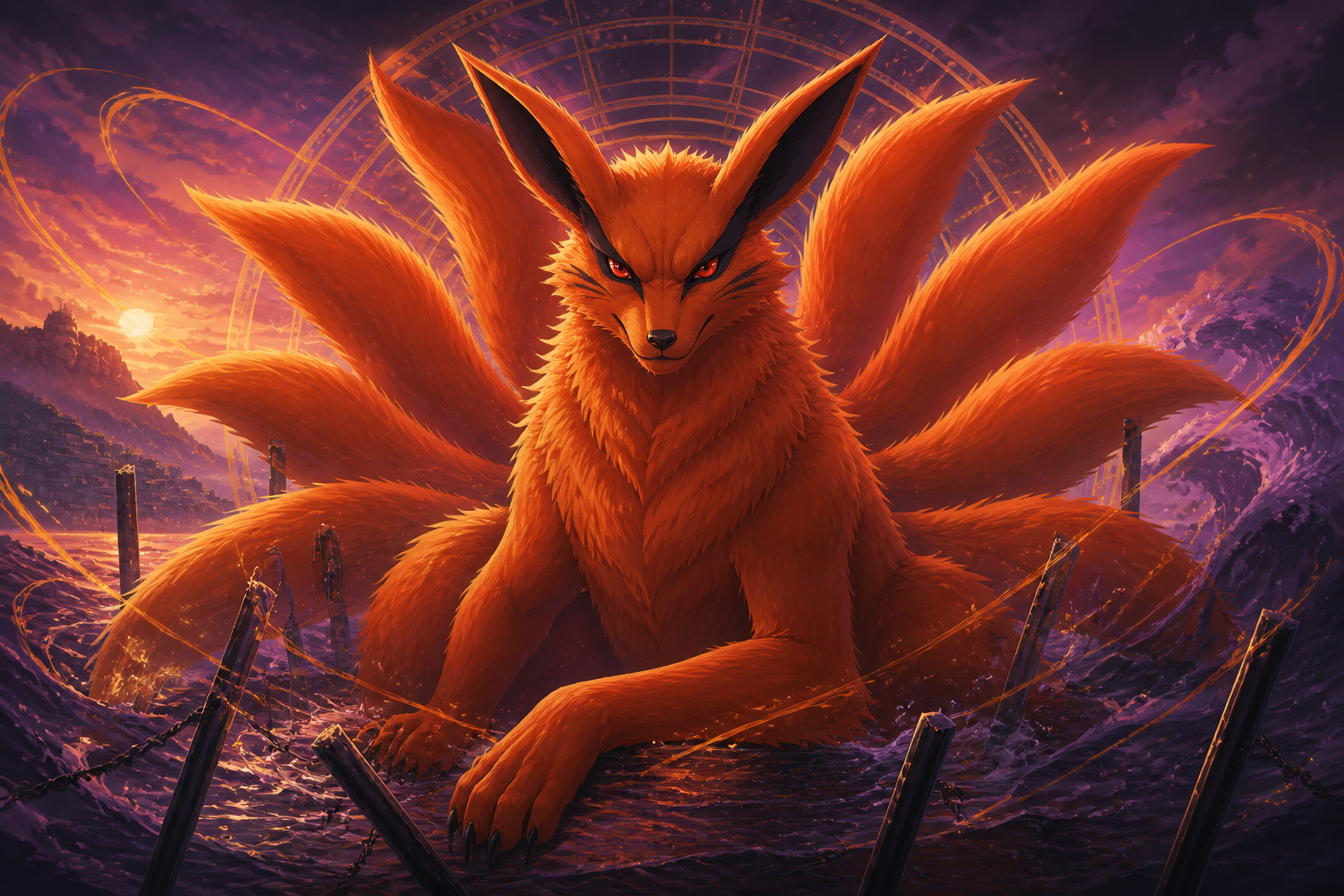
Kurama
The shinobi world calls him a natural disaster, seals him inside children, and then acts shocked when the ancient fox has trust issues.
His name is Kurama, not “the demon inside Naruto”
The series introduces Kurama through fear. Adults call him the Nine-Tailed Fox that attacked Konoha. Naruto hears “demon” before he ever hears the fox’s name. That language makes the village’s behavior easier to justify. A demon can be contained. A named person can ask who built the cage.
Kurama is one of the nine tailed beasts created from the Ten-Tails’ chakra by Hagoromo Ōtsutsuki. He is a chakra-based life-form with memory, preference, pride, humor and the ability to choose relationships. He is not an animal that wandered into the forest and became oversized. He also is not literally evil chakra. Human beings repeatedly experience his rage and then mistake the result of captivity for his natural moral state.
His design announces force before dialogue can. Orange-red fur, black eye markings, long ears, enormous claws and nine tails make Kurama readable from a silhouette. The scale changes across scenes because manga composition and animation favor emotional impact over zoological measurement. The key fact stays stable: a human settlement looks small beside him, which is exactly why every military state wants ownership.
Kurama’s name arrives late in Naruto’s life. Learning and using the name is not a cosmetic friendship upgrade. Naming changes the relationship from host and resource to Naruto and Kurama. Hagoromo named the beasts when they were young. Centuries of shinobi politics replace those names with tail counts. Naruto reverses that erasure one introduction at a time.
Hagoromo creates children, and history creates weapons
After separating the Ten-Tails’ chakra, Hagoromo creates nine individual beings through Creation of All Things. He treats them as children and gives each a name. Kurama remembers the Sage of Six Paths with real affection. The memory matters because the tailed beasts begin their lives inside a relationship, not an arsenal.
Hagoromo predicts that the beasts will one day come together again in a different form and that someone will guide them. The prediction can sound like destiny doing all the work. Kurama’s long history shows the opposite. Prophecy does not spare him captivity. Naruto still has to earn his trust through choices that contradict generations of accepted shinobi practice.
Humans gradually reduce the beasts to strategic assets. Villages count tails, rank destructive output and distribute living beings as a balance-of-power system. Hashirama Senju even treats captured tailed beasts as tools that can be allocated among villages. His goal is peace. His method assumes beings with names can be transferred without consent. Naruto is very good at making noble intentions carry ugly machinery.
Kurama’s hatred therefore has a historical foundation. He watches humans praise cooperation while chaining creatures that could refuse. His contempt becomes generalized and sometimes cruel, but the story never needs to invent an original sin to explain it. Repeated domination does the job.
Madara, Mito and the first Konoha cage
Madara Uchiha controls Kurama with the Sharingan and uses him against Hashirama at the Valley of the End. Susanoo armor turns the fox into a weapon wrapped inside another man’s power. Hashirama defeats them, and Mito Uzumaki seals Kurama inside herself. Control changes hands. Kurama does not become free.
Mito’s role establishes Konoha’s jinchūriki system. She is capable, politically central and able to contain him. She is also a human vessel carrying a being who did not consent. Kurama’s hostility toward his hosts cannot be separated from the fact that each relationship begins with imprisonment, even when the host also suffers under the arrangement.
Kushina Uzumaki succeeds Mito because her chakra and life force suit the seal. Kurama later describes her chains and temperament with no affection, yet their lives are bound by the same institution. Kushina is used as a container. Kurama is used as the contained weapon. Their suffering does not automatically make them allies because the seal forces one to restrain the other.
Obito Uchiha attacks during Naruto’s birth, extracts Kurama from Kushina and controls him with the Sharingan. Kurama attacks Konoha under command, but the village remembers the destruction as though the fox independently chose the target and timing. Minato breaks Obito’s control, then divides Kurama’s chakra. The Yin half is sealed into Minato through the Reaper Death Seal. The Yang half is sealed into newborn Naruto.
That division is bodily violence performed on a sentient chakra being. Kurama remains conscious in both halves, later reunited during the war. Fans discuss the split mainly as a power mechanic. From Kurama’s perspective, adults cut him in two and placed each half inside a different human to solve a village crisis.
Naruto spends years treating him like an emergency generator
Young Naruto does not know Kurama as a person. He experiences leaking chakra during fear, anger and mortal danger. Kurama offers power because a dead host threatens his own survival and because destabilizing the seal may create an escape. Their early exchanges are bargains between prisoners sharing one body, not secret friendship.
Kurama’s chakra heals Naruto, expands his reserves and gives him frightening combat advantages. The same chakra can overwhelm judgment, burn allies and deform Naruto’s body into increasingly destructive cloaks. Power without cooperation becomes possession by pressure. Naruto wants enough force to save people. Kurama uses the opening to push against the cage.
Jiraiya loosens access to the chakra as part of Naruto’s training. Orochimaru provokes the Four-Tails state. Pain pushes Naruto toward an eight-tailed transformation. Each event shows why “use the fox when necessary” is not a stable policy. Kurama is not a sealed scroll. Every withdrawal and every surge happens inside a contested relationship.
During the control training with Killer B, Naruto initially fights Kurama and takes chakra by force. Kushina’s preserved chakra helps restrain the fox. Naruto wins access to a chakra mode, but Kurama still rejects him. The scene is progress in technique, not yet progress in consent.
Naruto then does something the fox does not expect. He tells Kurama that he plans to deal with the hatred inside him too. The promise would be cheap if Naruto had never lived under collective hatred himself. Naruto recognizes the emotional pattern without pretending their experiences are identical. He does not ask Kurama to become pleasant first.
The handshake changes the Fourth Shinobi World War
Kurama watches Naruto exhaust himself protecting people across the battlefield. He sees the boy distribute chakra, remember names and refuse to treat allies as expendable pieces. Naruto also begins speaking to him without the cage-name language. The evidence accumulates through conduct rather than one apology.
When Naruto finally asks Kurama for power as a partner, Kurama offers a fist bump. The gesture is funny, simple and structurally enormous. A seal designed for domination becomes a space where two people negotiate cooperation. Naruto does not “tame” the fox. Kurama chooses him.
Their combined chakra mode transforms the war. Kurama helps Naruto identify hostile intent, share chakra with thousands of shinobi, form Tailed Beast Balls and face Obito, Madara and the Ten-Tails. The same power villages spent generations trying to monopolize becomes most effective when voluntarily shared.
Kurama also reconnects with the other tailed beasts. Their names, jokes and disagreements restore the social world Hagoromo intended. The war is not only a contest over who owns the Ten-Tails. The conflict also reunites people whose identities were broken into military categories.
Madara extracts the tailed beasts from Naruto and nearly kills him. Minato’s Yin half of Kurama attempts to save Naruto, and after later events the two halves reunite. Naruto finishes the war with Kurama as a whole partner rather than a divided inheritance. The physical reunion mirrors the relationship’s repair without pretending the centuries before it disappeared.
Abilities, mechanics and honest limits
Immense chakra: Kurama possesses the largest chakra reserve among the nine beasts by common story emphasis and overwhelming shown output. Tail count becomes a source of pride, especially in his arguments with Shukaku. Reserve does not equal infinite energy. Kurama can be drained, divided, sealed and exhausted.
Tailed Beast Ball: Kurama balances positive black and negative white chakra into a compressed sphere of catastrophic force. Naruto must learn the ratio and control. The attack can be redirected, countered or interrupted before release.
Chakra cloaks and avatars: Kurama can wrap Naruto in chakra, form limbs and create a gigantic avatar. Cooperative forms offer far greater precision than the corrosive cloaks of early possession. The visual upgrade represents trust as much as raw output.
Negative-emotion sensing: Naruto gains the ability to sense hostile intent while using Kurama’s chakra. The skill is valuable but not omniscience. Motive, disguise and complex emotion remain harder than a simple radar reading.
Healing and endurance: Kurama’s chakra accelerates Naruto’s recovery and supports extraordinary stamina. Healing has limits. Naruto can still suffer lethal extraction, chakra depletion and bodily damage that requires outside medical help.
Shared chakra network: During the war, Kurama helps Naruto distribute tailored chakra cloaks to the Allied Shinobi Forces. The feat demonstrates fine control, cooperation with Naruto and large-scale support rather than mere explosion power.
Baryon Mode: Kurama and Naruto fuse chakra through a process compared to nuclear fusion, creating new energy while consuming the source chakra. Contact also reduces Isshiki’s remaining lifespan. The form is brief and fatal to Kurama.
Reincarnation: Tailed beasts can reform after death because their existence is chakra-based. Kurama’s return inside Himawari confirms the principle but does not yet provide a complete technical explanation for why he reappears there.
Relationship atlas
Naruto Uzumaki: Naruto begins as Kurama’s prison and becomes his closest friend. Their relationship earns its power because neither person stays morally simple. Kurama manipulates Naruto and endangers people. Naruto steals chakra and initially treats him as a resource. Trust arrives after repeated choices, shared danger and honest recognition.
Kushina Uzumaki: Kushina restrains Kurama as his jinchūriki and later helps Naruto do the same. She is both another person used by the system and the person holding his cage shut. Their relationship never receives the repair Naruto creates. That unresolved tension should remain visible.
Minato Namikaze: Minato breaks Obito’s control, protects Konoha and divides Kurama between himself and Naruto. Kurama respects Minato’s ability while carrying the consequence of his sealing decisions. Cooperation during the war does not retroactively make the original division consensual.
Hagoromo Ōtsutsuki: Hagoromo is creator, father figure and the source of Kurama’s earliest experience of being named with affection. His hope survives inside Kurama even after centuries give the fox every reason to reject humans.
The other tailed beasts: Shukaku, Gyūki, Matatabi, Isobu, Son Gokū, Kokuō, Saiken and Chōmei are Kurama’s siblings. Kurama can be arrogant about tail count and abrasive toward them. The family bond still becomes essential to resisting the Ten-Tails system that would erase their separate selves.
Obito and Madara: Both Uchiha men use ocular control to turn Kurama into an extension of their plans. Their pain and political arguments do not change the nature of that act. Kurama is not their summon. He is a captive person forced to perform mass violence.
Himawari Uzumaki: Kurama’s later presence inside Himawari begins a new relationship with different conditions. She is not introduced as a baby selected by village leaders for sealing. The manga presents a mysterious affinity and an unexpected return. Whether that difference produces a freer partnership is now one of Boruto’s most important moral tests.
Baryon Mode is a sacrifice, not a free transformation
Isshiki Ōtsutsuki overwhelms Naruto and Sasuke with power and a short but dangerous remaining lifespan. Kurama offers Baryon Mode as the only path with a real chance. He explains that the process creates new energy by consuming their chakra, then later reveals that his own life was the price.
Kurama lies about the exact cost because he believes Naruto would refuse if he knew only Kurama would die. The deception is loving and ethically complicated. Their friendship has grown beyond ownership, yet Kurama still makes a unilateral choice about a sacrifice that will permanently change Naruto’s body and identity.
The battle works through contact rather than a larger explosion. Every hit reduces Isshiki’s remaining time. Naruto wins by discipline, economy and closeness. The franchise’s loudest power system ends one of its largest fights through a countdown that punishes wasted motion.
Kurama’s farewell removes the presence Naruto has carried since birth. Naruto does not lose a weapon. He loses the person who knew every private fear, reckless idea and lonely night from inside the same body. The anime expands the goodbye emotionally, while the manga keeps the exchange shorter. Both versions center separation rather than spectacle.
Kurama returns inside Himawari, and the rules are still unfolding
In Boruto: Two Blue Vortex, Kurama reappears within Himawari Uzumaki. The reveal confirms that his death in Baryon Mode was real and that tailed-beast reformation eventually occurred. The current manga has not supplied a complete scientific or spiritual manual for the location, timing and inheritance mechanics.
Kurama notes Himawari’s remarkable affinity with his chakra. That affinity may relate to her lineage and the unusual circumstances surrounding Naruto’s family, but confident fan theories should not be presented as settled canon. “Kurama returned” is fact. Every invisible step between death and Himawari remains partly open.
The choice of Himawari matters beyond power scaling. Naruto inherited Kurama through a village emergency and a parental decision. Himawari encounters him without elders publicly turning her into military equipment. The story now has a chance to show a tailed-beast bond beginning from recognition instead of imprisonment. Whether the shinobi world allows that freedom is the real question.
Kurama is the franchise’s personhood test
The shinobi system repeatedly decides that power erases personhood. Kekkei genkai users become assets. children become hosts. corpses become summoned soldiers. tailed beasts become village inventories. Kurama concentrates that logic into one enormous body. Everyone can see that he thinks. Political convenience still prefers the word weapon.
A Buddhist lens helps explain the cycle without excusing anyone. Hatred grows through attachment, fear and repeated harm. Kurama clings to contempt because contempt protects him from another betrayal. Humans cling to control because control protects them from a feared attack. Each response produces evidence for the other side’s fear. Naruto interrupts the cycle by accepting vulnerability before demanding obedience.
Confucian reciprocity offers another useful measure. Villages demand duty from jinchūriki and power from tailed beasts while offering secrecy, confinement and suspicion in return. The relationship lacks moral reciprocity. Naruto earns Kurama’s cooperation through conduct: listening, sharing risk, using his name and eventually opening the gate.
The creative structure also turns an internal monster trope inside out. Early Naruto treats the fox as visual shorthand for dangerous emotion. Later arcs make the “inner demon” literally a person who has his own inner life. Naruto’s maturity depends on learning that mastering himself cannot mean conquering someone else.
Fandom power debates often flatten this achievement. Kurama gets ranked by blast size, chakra percentage and matchup math. Those questions can be fun. The story’s sharper answer is that voluntary cooperation produces more power than domination ever did. Trust is not decorative character development. Trust changes the mechanics.
Tesshō Genda and the original Japanese performance
Tesshō Genda is Kurama’s original Japanese voice across the anime’s central adult portrayal. The casting gives Kurama a presence large enough for ancient rage, battlefield authority, dry irritation and reluctant affection. Genda keeps those demands inside one recognizable character, allowing rage and affection to feel like parts of the same long history.
Kurama’s animation also changes as the relationship changes. Early appearances favor teeth, shadow, bars and scale. Cooperative scenes give his face more conversational range and allow humor to sit beside danger. That shift is adaptation craft serving character development. The fox does not become less powerful when the camera allows him to look amused.
Fandom arguments that deserve better answers
“Naruto tamed Kurama”: No. Naruto first subdues and takes chakra. Their greatest power arrives only after Kurama chooses cooperation. Calling that taming repeats the ownership language the story spends years dismantling.
“Kurama caused Naruto’s childhood”: Kurama’s attack created real deaths and fear, but Obito controlled him during the Konoha assault. Adults then chose secrecy, stigma and neglect around Naruto. A captive beast cannot be the village’s excuse for every policy failure.
“Kurama became nice too quickly”: The friendship reveal feels sudden only if the audience ignores years of observation inside Naruto. Kurama sees every rescue, humiliation, promise and refusal to surrender. The fist bump is a decision at the end of accumulated evidence.
“Baryon Mode was a power-up”: Baryon Mode is a terminal exchange. Treating the form as another collectible tier erases Kurama’s death, Naruto’s loss and the strategy built around a shrinking lifespan.
“Himawari simply inherited him”: The current manga confirms Kurama’s return and their affinity. The full mechanism remains incomplete. A responsible profile distinguishes the reveal from theories built around it.
A name changes the relationship because a weapon does not need one
The shinobi world finds labels for Kurama that describe danger, size, and usefulness. Nine-Tails counts his body. Demon Fox turns fear into identity. Strategic asset explains why villages keep building cages. None of those labels requires anybody to ask what he remembers or wants.
Hagoromo gives the tailed beasts names because he recognizes separate lives where later institutions see divisible power. Naruto eventually reaches the same conclusion through relationship rather than inherited doctrine. He cannot build trust with an anonymous battery. He has to meet Kurama as somebody capable of refusal, anger, judgment, and consent.
That shift does not make Kurama harmless or erase the people killed during attacks involving his power. It changes where responsibility sits. Madara and Obito control him. Konoha seals him. Human decisions keep placing Kurama inside violence and then use the destruction as proof that the captive was always the problem.
Containment is not the same thing as safety
Every jinchūriki seal solves an immediate security problem. It also creates a person expected to carry communal danger inside a private body. Mito, Kushina, and Naruto live different lives, but each becomes part of Konoha’s weapon-management system. Kurama is confined, and the host is watched, feared, or isolated.
The arrangement trains both sides to expect betrayal. Kurama sees another jailer whenever Naruto reaches for power. Naruto experiences Kurama’s anger as a threat waiting behind bars. The village benefits from their mutual hostility because hostility keeps the relationship legible as guard and prisoner.
Killer B and Gyūki show Naruto that cooperation can replace domination. The lesson is not a friendship shortcut. Naruto still has to confront the hatred he inherited, acknowledge Kurama’s personhood, and demonstrate that he will not discard the fox once the chakra is useful. Trust appears after evidence, not because the hero gives one inspirational speech.
The fist bump is a consent scene
Kurama sharing chakra freely changes the meaning of Naruto’s power. Earlier transformations often involve leakage, theft, rage, or a contest over control. Their partnership creates coordination. Naruto asks. Kurama answers. The same energy that once tore at the seal moves through an agreement.
That consent also gives Kurama room to be difficult without being demonized. He can insult Naruto, doubt a plan, withhold cooperation, and change his mind. Friendship does not require the ancient fox to become a polite mascot. It requires both people to recognize that disagreement does not cancel the bond.
The war makes the result spectacular, but the moral victory happens before the largest attack. Kurama chooses participation. Naruto’s strength becomes collective without pretending the participants have merged into one personality.
Baryon Mode is not a free upgrade
Baryon Mode works because Kurama puts his remaining existence into the exchange while Naruto believes both of them are risking death. The deception is loving and still a deception. Kurama denies Naruto a fully informed choice because he knows Naruto may refuse the plan if he understands who will pay.
That tension belongs beside the sacrifice. Kurama once raged because humans decided what should happen to his body. At the end of his life with Naruto, he makes a unilateral decision about his own existence and withholds the cost from his partner. The situations are not morally identical, but the history makes consent impossible to ignore.
His later reformation follows the established nature of tailed beasts without turning the death scene into nothing. Naruto experiences the loss as real. Kurama makes the decision believing in the immediate cost. Himawari meets a being with an old memory and a new relationship ahead. Return is not rewind.
The standard for the next chapter should therefore stay high. Kurama is not inherited equipment passed from father to daughter. Himawari deserves her own bond, and Kurama deserves to remain a person whose long history affects what he trusts. A new host does not mean a new cage gets a softer name.
The final verdict
Kurama begins as the monster Konoha uses to explain its fear. He ends Naruto as the friend whose consent makes Naruto’s greatest feats possible. Between those points sit centuries of captivity, two Uchiha controllers, three Uzumaki vessels, a divided soul, a war, a handshake and a sacrifice.
His return inside Himawari does not cheapen Baryon Mode if the story respects the person who died and the new relationship now beginning. Tailed beasts reform. Consequences remain. Kurama remembers every cage. The next generation has to prove that remembering his name changed more than the vocabulary.
Sources and canon boundary
Naruto manga chronology controls the historical profile, with Boruto manga developments labeled as the later continuity. Anime expansions, databook material, novels, games, and films are identified rather than blended into one false record.
Primary franchise references: Naruto Official, VIZ Media Naruto, and VIZ Media Boruto: Two Blue Vortex. CVM Sekai’s conclusions about Kurama’s captivity, naming, personhood, consent, partnership, Baryon Mode, and return are editorial analysis, not invented creator quotations.