
Naruto character dossier
Minato Namikaze
The fastest man in the shinobi world saves everyone in seconds, then leaves his newborn son carrying a decision that takes sixteen years to explain.
Who Minato is behind the cloak and impossible arrival time
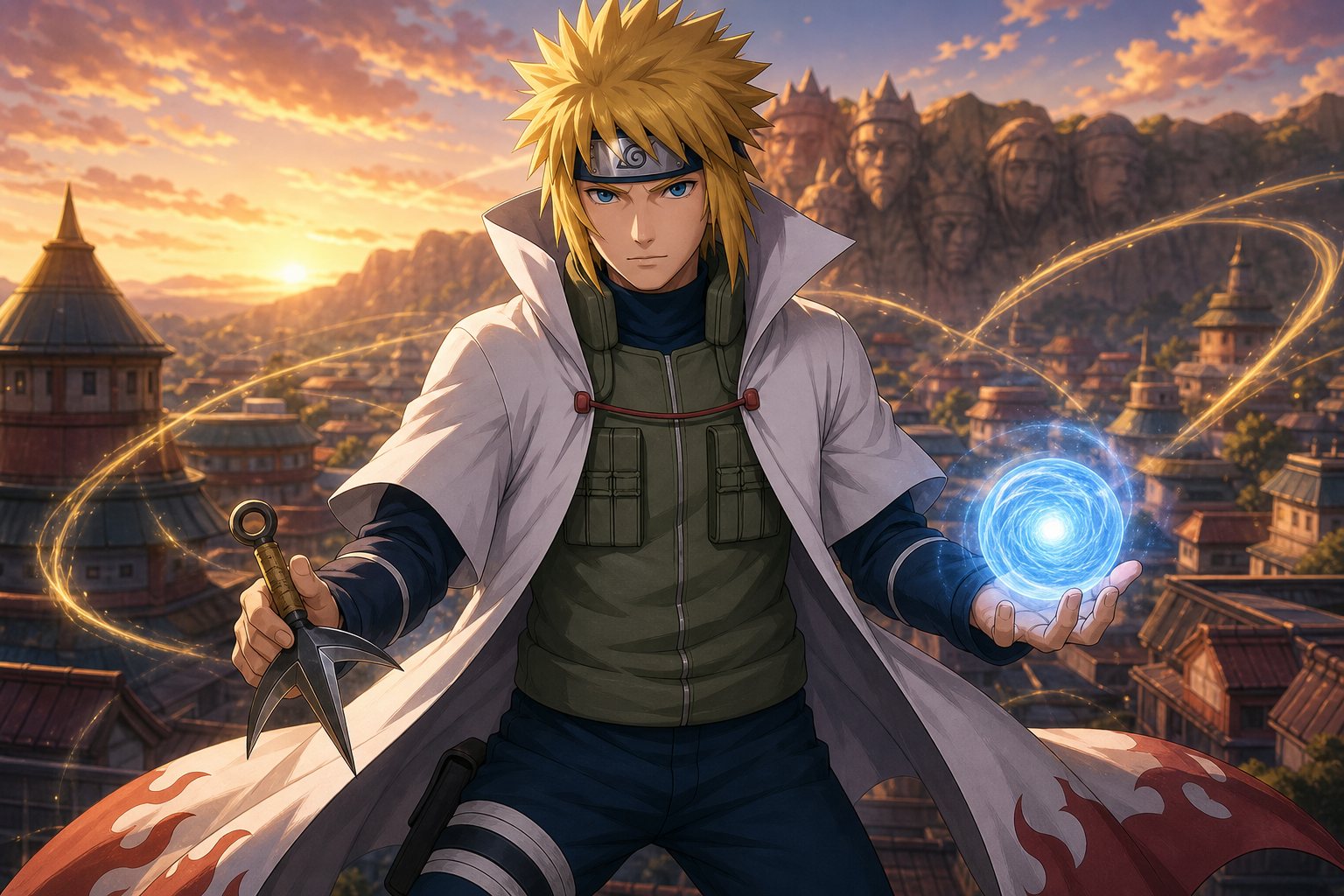
Minato Namikaze is Jiraiya’s student, Kushina Uzumaki‘s husband, Naruto’s father, leader of Team Minato, creator of the Rasengan, master of Flying Raijin Jutsu, and the Fourth Hokage. Enemy forces know him as the Yellow Flash and receive orders to flee on sight.
His reputation grows during the Third Shinobi World War, when a marked kunai can turn any battlefield into his doorway. He becomes Hokage young, dies at twenty-four during the Nine-Tails attack, and leaves half of Kurama sealed inside himself and half inside newborn Naruto.
Orochimaru later reanimates him during the Fourth Shinobi World War. Minato reaches the battlefield, reunites with Naruto, recognizes the masked attacker as his former student Obito Uchiha, and helps fight the Ten-Tails. The dead Hokage finally sees what his son became under the burden he assigned.
Minato’s legend is built around speed. His actual story is about delayed consequences. He can answer a thrown kunai instantly. He cannot answer Naruto’s questions until death, sealed chakra and war create an impossible second meeting.
A civilian-born prodigy enters a world of clan inheritances
The main story does not give Minato a famous clan, inherited dōjutsu or detailed household genealogy. The Namikaze name does not come with a catalog of secret techniques. His skill develops through learning, invention, observation and an unusual ability to solve combat problems while everybody else is still locating the problem.
Minato attends the Academy, meets Kushina and becomes Jiraiya’s student. Jiraiya recognizes extraordinary potential and later considers Minato the kind of rare genius who appears once in a generation.
His quiet manner separates him from the loud prodigy stereotype. Minato is polite, reflective and capable of genuinely awful technique names. Kushina vetoing his dramatic naming instincts may be one of Konoha’s least celebrated public services.
The one-shot Naruto: The Whorl Within the Spiral returns to Minato’s younger years and the development of Rasengan. The story grounds the famous technique in Kushina’s jinchūriki reality, Jiraiya’s training and Minato’s desire to create a power that can stand beside the force sealed inside her.
That context matters. Rasengan is not only a genius showing off perfect shape transformation. The technique begins as relational work. Minato studies the tailed beast’s rotating chakra and tries to create something usable by a human hand.
Kushina is not the red-haired prize at the end of Minato’s rescue scene
Kushina Uzumaki arrives in Konoha as a child chosen to become Kurama’s next jinchūriki. She is teased for her hair and temper, dreams of becoming Hokage, and initially sees Minato as too soft or unimpressive.
Kumogakure shinobi kidnap her because they want the Nine-Tails. Kushina drops strands of red hair along the route. Konoha’s search teams miss the trail. Minato notices, follows and rescues her near the border.
The famous moment works because Minato recognizes the feature Kushina has been taught to hate. Her hair becomes evidence she can use to save herself. Minato completes the rescue, but Kushina creates the trail.
Their relationship grows into marriage. Kushina becomes Naruto’s mother while still carrying the Nine-Tails seal. Minato designs and monitors sealing systems around her pregnancy because childbirth weakens the seal.
Love does not protect them from the village’s military use of Kushina. Their home exists inside a state secret. Her body remains national security infrastructure even during childbirth. Minato is husband and Hokage at the same time, which means tenderness and institutional responsibility cannot be cleanly separated.
The Third War turns Minato’s intelligence into an international warning label
Minato’s Flying Raijin marks let him teleport to prepared locations and targets. In war, the technique collapses distance, reinforcement time and ordinary defensive planning. A unit can believe Minato is somewhere else until he is already inside its formation.
Iwagakure forces learn to fear the Yellow Flash. The official Naruto site records a battlefield where Minato faces more than fifty enemy shinobi after Konoha allies scatter his marked kunai. The allies do not need to defeat the force. They create coordinates. Minato converts preparation into instant arrival.
He also clashes with Ay and Killer B. Minato avoids Ay’s speed, threatens with marked weapons and recognizes Killer B’s readiness to protect his partner. The encounter is not simply “Minato faster, therefore everyone else stupid.” Killer B reads the danger and prepares a mutual strike.
Minato’s war record helps end conflict and helps make him Hokage. That record also represents the hidden-village military machine at peak efficiency. Foreign shinobi are told to flee one man because Konoha has turned intelligence, sealing and teleportation into strategic terror.
The title Yellow Flash sounds glamorous inside Konoha. From the other side, the flash is the last warning before casualties appear.
Team Minato exposes the limit of being the teacher who can arrive anywhere
Minato leads Kakashi Hatake, Obito Uchiha and Rin Nohara. The team contains a rule-driven prodigy, an emotional late-blooming Uchiha and a medical-nin who holds the group together.
During the Kannabi Bridge mission, Minato divides responsibilities. He handles another front while Kakashi leads the younger team against the supply route. The assignment gives Kakashi command experience and places children inside a war whose consequences are permanent.
Rin is captured. Obito rejects Kakashi’s initial decision to prioritize the mission. Kakashi changes course. Obito is crushed while saving him and gives Kakashi his Sharingan. Minato arrives after the collapse, saves Kakashi and Rin from enemy forces, and believes Obito died.
Later, Kirigakure turns Rin into the Three-Tails’ jinchūriki as part of a plan targeting Konoha. Kakashi kills her at her own request when she moves into his Chidori. Minato does not reach them.
Minato later apologizes to Kakashi and Obito for failing to protect Rin. The apology does not claim he secretly controlled every event. His apology acknowledges a teacher’s responsibility even when the direct manipulation belongs to Madara.
Becoming Fourth Hokage turns a battlefield solution into a government
Minato succeeds Hiruzen Sarutobi as Fourth Hokage. Orochimaru had also been considered, but Hiruzen recognizes the danger in Orochimaru’s values. Minato represents youth, talent, loyalty and a future-facing alternative.
His tenure is short. That limits the policy record fans can honestly assign him. Minato does not spend decades creating ministries, reforming clans or supervising Naruto’s childhood. He dies during the crisis that defines his administration.
Yet the office matters. Minato is not merely a father improvising in private. During the Nine-Tails attack, he holds legal and military authority over Konoha. The choices about Kurama, Naruto, secrecy and succession become state acts even when made inside a family tragedy.
Fans often imagine the perfect peaceful reign Minato would have delivered. Maybe. He has intelligence and empathy. He also grows inside the same village that uses Kushina as a hidden weapon and trains his students for war. Potential is not completed policy.
Obito attacks the exact night love, labor and national security collide
Naruto is born on October 10. Kushina’s seal weakens during childbirth, so the delivery occurs under protection away from the village. Obito infiltrates the site, kills guards, takes newborn Naruto hostage and forces Minato to choose between the baby and immediate pursuit.
Minato saves Naruto. Obito extracts Kurama from Kushina and directs the fox against Konoha. Kushina survives the extraction because of Uzumaki vitality but is dying.
Minato confronts the masked man. He reads Kamui’s timing, marks Obito during contact and lands a Rasengan. He then uses the contract seal to break Obito’s control over Kurama. The sequence shows why his combat intelligence matters. Minato does not overpower Kamui through volume. He solves the access window.
Obito escapes. Minato does not recognize him as his former student. The mask, presumed death and adult power make the conclusion difficult, but the failure haunts the war reunion. If Minato had known who stood before him, could he have interrupted Madara’s work earlier? The story does not give him that second chance.
Kurama remains a village-scale threat. Minato teleports a Tailed Beast Ball away, summons Gamabunta and moves Kurama outside Konoha. He and Kushina then make the decision that will define Naruto’s life.
Saving Konoha means making Naruto a jinchūriki before he can open his eyes
Minato uses the Reaper Death Seal to divide Kurama’s chakra. He seals the Yin half inside himself and the Yang half inside Naruto using an Eight Trigrams seal. The Reaper takes Minato’s soul. Kurama’s claws pierce Minato and Kushina when they shield their baby.
Minato believes Naruto will need Kurama’s power against the masked enemy and connects the decision to Jiraiya’s prophecy about a child who can change the world. He also believes Konoha should see Naruto as the hero who saved the village.
The strategic reasoning is real. A full Kurama cannot be sealed into a newborn. The masked man remains a future threat. Destroying Kurama’s power would not offer a permanent answer because tailed-beast chakra can reform. Minato builds a seal designed for Naruto to access the chakra gradually.
The consent problem is also real. Naruto becomes a military container at birth. His parents die. The village hides his parentage, fails to protect him from stigma and allows adults to treat a child as the fox that killed their families.
Minato leaves chakra inside the seal so he can appear if Naruto approaches a catastrophic release. Kushina’s chakra also remains for a future encounter. These safeguards give Naruto moments with his parents. They do not provide food, daily protection, advocacy or an adult who can challenge the village on his behalf.
Minato meets Naruto inside the seal when rage reaches eight tails
During Pain’s assault, Naruto believes Hinata has been killed and loses control. Kurama’s power advances toward full release. Minato’s chakra imprint appears inside the seal before the ninth tail.
Naruto recognizes the Fourth Hokage, then learns Minato is his father. The reunion is not polite. Naruto strikes him and demands to know why a father would seal the fox inside his son. Good. The series allows the abandoned child to ask the question before accepting the legend.
Minato explains the masked man’s role and his belief that Naruto can answer the cycle of hatred. He restores the seal and leaves Naruto with trust rather than a complete solution.
The scene gives Naruto emotional support at a critical moment. That intervention also repeats Minato’s tendency to hand enormous historical work to his son. Naruto needs belief. He should never have needed to prove his worth by repairing every adult war.
Reanimation gives Minato one day to see the consequences and make amends
Orochimaru reanimates the previous Hokage after Sasuke demands answers about Konoha and the shinobi system. Minato senses Naruto fighting alongside Kurama and heads to the battlefield.
He arrives ahead of the other Hokage, teleports away a Ten-Tails attack and reveals that the Yin half of Kurama sealed with him has become cooperative. Reanimated Minato can use Kurama Link Mode, giving the Yellow Flash a power state he never possessed as a living Hokage.
Minato and Naruto connect the two Kurama halves and extend chakra protection across the Allied Shinobi Forces. Father and son fight together. The image is joyous and late enough to hurt.
Minato recognizes Ten-Tails Obito as the masked attacker from Naruto’s birth. Guilt hits from several directions: student lost, Rin unprotected, village attacked, son burdened. Minato briefly loses composure and later rallies.
He works with Tobirama, Naruto and Sasuke using chained teleportation tactics. Against Six Paths threats, Minato loses both arms and cannot simply restore them through the reanimated body because Truth-Seeking Ball damage interferes with the form.
After Kaguya is sealed and the Reanimation Jutsu is released, Minato meets Naruto on his son’s seventeenth birthday. Naruto gives him a message for Kushina. Minato finally wishes him happy birthday and leaves knowing the boy survived the choice that killed both parents.
Minato’s power is preparation moving at impossible speed
Flying Raijin Jutsu: Minato masters and refines the space-time ninjutsu created by Tobirama. He teleports to formulas placed on people, weapons and locations. The teleportation is instantaneous, but useful destinations require marks.
Three-pronged kunai: His custom kunai carry Flying Raijin formulas and allow allies to seed a battlefield with coordinates. The weapon is a logistics tool as much as a blade.
Rasengan: Minato creates the rotating sphere after studying tailed-beast chakra. The technique uses shape transformation without hand seals. He dies before adding a chakra nature.
Sealing techniques: Marriage to Kushina and his own study give Minato advanced sealing knowledge. He maintains and redesigns jinchūriki seals, uses the contract seal and performs the Reaper Death Seal at the cost of his life.
Sensory skill and analysis: Minato senses chakra across distance and reads unfamiliar techniques quickly. Against Obito, he identifies the short window when Kamui must become tangible.
Summoning: He can summon Gamabunta and maintains the toad contract associated with Jiraiya’s line. Summoning gives Minato large-scale support when teleportation alone cannot restrain a tailed beast or protect an entire battlefield.
Sage Mode: Minato can gather natural energy and enter Sage Mode, but admits he is not skilled at maintaining it. War circumstances give him little time to use the form.
Yin Kurama form: As a reanimated jinchūriki, Minato uses the half of Kurama sealed with him. This is a post-death war state, not part of his living Hokage baseline.
Flying Raijin does not mean Minato teleports to any thought in the universe. Marks, sensory information and tactical placement matter. Official Boruto material later compares his version with Boruto’s copycat Flying Raijin: Minato marks instantly and can teleport to his marked objects without Boruto’s material and preparation restrictions.
Relationship atlas: the people behind the monument
Kushina Uzumaki: Kushina is partner, jinchūriki, sealing expert and the person who grounds Minato’s dramatic naming habits. Their love grows through recognition and shared work. Both die protecting Naruto, but Kushina’s body carries the longest physical burden of Kurama.
Naruto Uzumaki: Naruto inherits face, Rasengan, prophecy, Kurama and an impossible public story. Minato loves him and uses him as the vessel most likely to save the future. Their relationship is love interrupted by state emergency.
Jiraiya: Jiraiya teaches Minato and sees him as a rare genius. Minato names Naruto after the hero of Jiraiya’s book. The teacher later becomes the adult bridge to Naruto that Minato cannot be.
Kakashi Hatake: Kakashi is student, survivor and later Naruto’s teacher. Minato recognizes his talent but cannot protect him from repeated childhood loss. Kakashi carries Team Minato’s lessons into Team 7.
Obito Uchiha: Obito is the student Minato believes dead and the masked enemy he fails to identify. Their war reunion makes mentorship an accountability question, not a magic excuse.
Rin Nohara: Rin is his student and the team member whose death becomes the hinge in Obito’s fall. Minato’s later apology names the teacher’s failure without erasing Madara’s engineering or Rin’s own sacrifice.
Hiruzen Sarutobi: Hiruzen selects Minato as successor and returns to office after Minato dies. The protection Naruto receives under that second administration falls disastrously short of Minato’s expectation.
Toshiyuki Morikawa gives the original Japanese Minato calm without making him weightless
Toshiyuki Morikawa performs adult Minato in the original Japanese anime. Minato’s dialogue needs to carry battlefield authority, domestic warmth, analytical speed and the awkwardness of a father meeting a teenager after death.
The role works against the obvious choice of constant intensity. Minato is often quiet while the situation around him is screaming. That calm makes the moments of guilt during the war more visible.
Morikawa keeps the role grounded through the same tension that defines Minato: calm authority on the surface and delayed emotional weight underneath.
What Minato says about genius, government and delayed consequences
Macro: the perfect operative cannot repair a broken institution alone: Minato can end a battlefield in seconds. Konoha still uses jinchūriki, child soldiers and secrecy. Exceptional competence reduces immediate casualties without automatically reforming the system creating them.
Micro: speed cannot protect every relationship: Minato’s defining ability makes his absences sharper. He cannot be at Kannabi Bridge, Rin’s death and the other front at once. The gap between capacity and responsibility becomes part of his grief.
Interpersonal: love needs infrastructure after sacrifice: Minato and Kushina love Naruto enough to die for him. Love stored in a seal cannot replace adults, food, protection and public truth. A village that celebrates sacrifice must also care for the survivor.
Confucian lens: office turns private virtue into public duty: A good ruler is judged by what happens to vulnerable people under the institution, not only by personal nobility. Minato dies too early for a long record, but Naruto’s abandonment exposes the failure of succession and administrative care.
Buddhist lens: heroic attachment and letting go: Minato entrusts the future to Naruto, yet his chakra imprint shows a parent trying to remain available at the point of greatest danger. The final birthday farewell allows him to release the son he could not raise.
Creative lens: the answer arrives before the question is fully known: The Fourth Hokage begins as a monument and mystery. Naruto admires him before learning he is his father or understanding the seal. The story then forces the icon to explain himself to the child living with the consequences.
Fandom arguments that need the full file
“Minato invented Flying Raijin.”: No. Tobirama created the technique. Minato masters, refines and applies it with extraordinary skill.
“Minato could teleport anywhere with no setup.”: He teleports to Flying Raijin formulas. Mark placement, sensory information and tactical preparation matter.
“He abandoned Naruto because he cared more about the village.”: Minato and Kushina are dying during a village catastrophe. He believes Naruto needs Kurama’s power against the masked man. The choice burdens Naruto, but ordinary abandonment is the wrong description.
“Hiruzen alone made Minato’s original decision moral or immoral.”: Minato owns the sealing decision. Hiruzen and Konoha own the later secrecy, stigma and poor care. Different adults can be accountable for different parts of one disaster.
“War Minato proves living Minato had perfect Kurama Mode.”: The cooperative Yin Kurama form appears after death in the reanimated war body. Do not add that state to every living-era power comparison.
“Minato was a perfect teacher.”: He loved his team and taught them. Two students died in his understanding of events, Rin was weaponized, Kakashi carried severe trauma and Obito became a war architect. Care and failure coexist.
Canon boundaries through Naruto, the one-shot, games and Boruto
The main spine follows Kishimoto’s Naruto manga, Kakashi Chronicles and the Fourth War. Naruto: The Whorl Within the Spiral is a Kishimoto one-shot that expands Minato and Kushina’s younger years and Rasengan development.
The anime adds missions, memories and connective scenes around Team Minato. Those expansions should be labeled rather than silently treated as manga chapters.
Movies and OVAs frequently use Minato through flashbacks, alternate scenarios, commemorative appearances or time-displaced emotional framing. Road to Ninja presents an alternate-world family context and must not be confused with the main Minato’s survival.
Games make Minato’s teleportation visually continuous through combos and ultimate techniques. Playable balance and invented chains do not establish new manga feats.
Boruto preserves his technical legacy through Naruto’s Hokage line and Boruto’s separately developed Flying Raijin. Official comparison material explicitly distinguishes Minato’s instant, unrestricted marking from Boruto’s slower metal-object system.
Legacy: Minato leaves a technique, a title and a child forced to make both humane
Minato’s face stands on the Hokage Monument while Naruto grows up beneath it without knowing the relationship. That is visual cruelty in broad daylight. The village turns the father into public stone and the son into private stigma.
Naruto later inherits Rasengan through Jiraiya, not through a living father. He transforms the technique, adds nature, shares variations and carries Minato’s invention farther than Minato could.
Kakashi carries Team Minato’s lesson into Team 7. Obito’s belief about comrades passes through Kakashi to Naruto. Minato’s legacy therefore travels through students who survived his inability to protect all of them.
The Yellow Flash remains one of the franchise’s cleanest icons. The complete man is better than the icon because the complete man has decisions worth arguing about.
Final verdict: Minato arrives instantly and understands slowly
Minato saves Kushina by reading the trail nobody else sees. He saves armies by turning preparation into speed. He saves Konoha by defeating Obito’s immediate attack and sealing Kurama.
He cannot save Team Minato from the war system. He cannot guarantee Naruto’s childhood. He cannot predict that the village will look at a newborn container and forget the baby.
When he returns, Minato does not demand a spotless legend. He apologizes, fights, follows Naruto’s lead and listens to the message meant for Kushina. The fastest shinobi finally does the slow work: facing what happened after he left.
Sources and canon boundary
Manga chronology controls this profile. Anime expansions, databook material, novels, games, films, time-travel premises, and reanimation staging are labeled instead of being blended into one false continuity.
Primary franchise references: Naruto Official and VIZ Media Naruto. CVM Sekai’s conclusions about Minato’s Hokage leadership, Kushina, Team Minato, Naruto’s seal, child protection, speed, legacy, and accountability are editorial analysis, not invented creator quotations.