
Naruto character dossier
Killer B
Kumogakure built a perfect jinchūriki, and B used the job to become a swordsman, teacher, brother, partner and gloriously unrequested rapper on his own terms.
The man inside the title
“Killer B” sounds less like a birth name than a position, and that is exactly how Kumogakure first frames him. He is selected to perform the Double Lariat beside A, the future Fourth Raikage. The letter system turns partnership into military branding. A is the commander. B is the compatible counterpart whose body, timing and loyalty make the team complete.
B refuses to stay inside that job description. He writes rhymes during conversations, treats combat as performance, seeks an enka career and records lines in a notebook even when everyone around him wants urgency. The comedy can be exhausting on purpose. B owns a private rhythm inside a life scheduled by security details, village orders and the danger of the Eight-Tails.
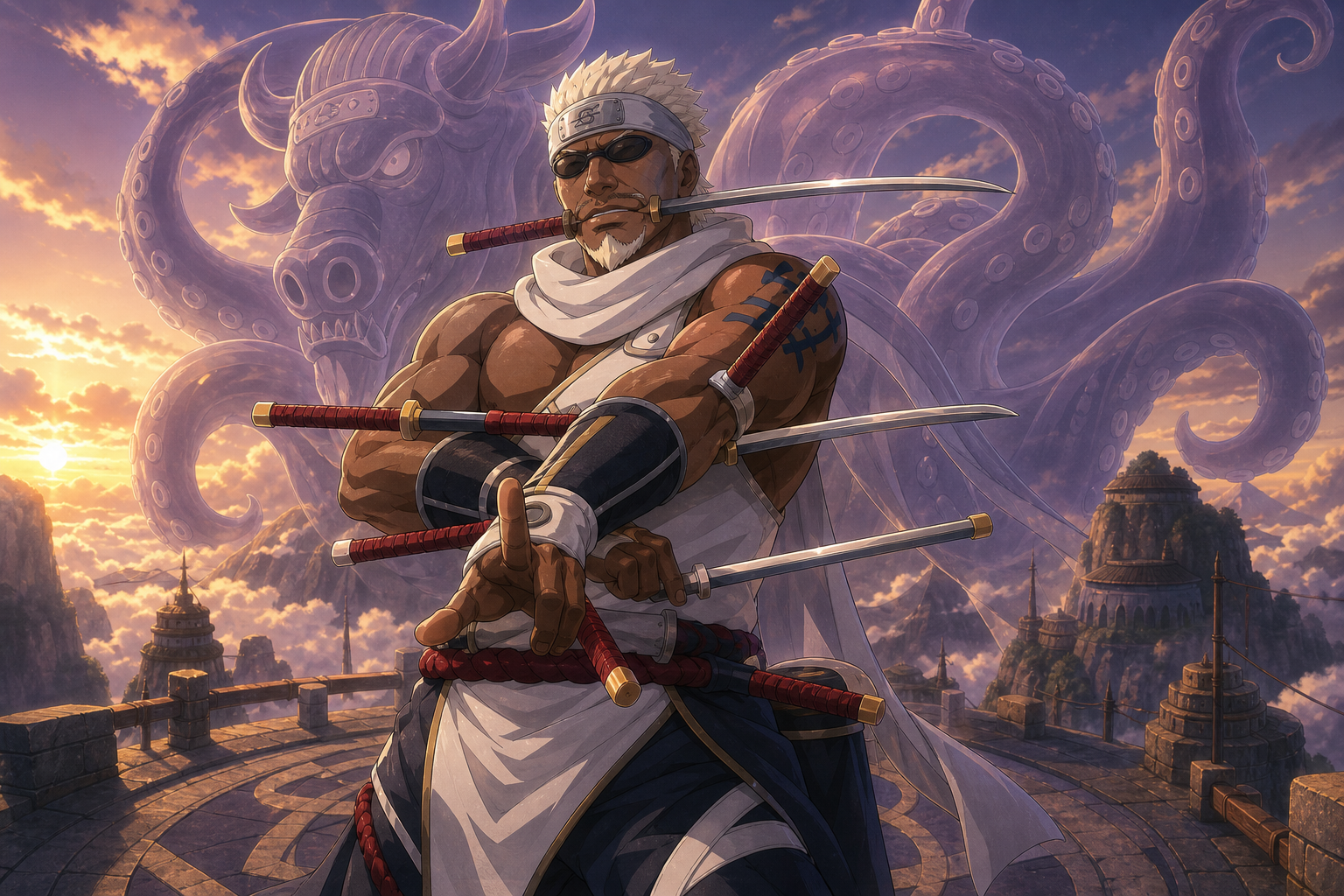
His design carries Kumogakure’s physical confidence: dark skin, white hair, sunglasses, muscular build, Cloud forehead protector, shoulder tattoo and multiple blades. The sunglasses hide his eyes without hiding his emotions. Body language, rhyme and sudden shifts in posture do the expressive work. B can look unserious while reading an opponent with frightening precision.
The official English spelling is “Killer B,” though “Killer Bee” remains common in fandom searches and older conversation. The difference matters for clean filing, not for scolding fans. This profile uses the canonical spelling and preserves the common variant in tags so both audiences can find him.
Kumogakure auditions children for brotherhood
A needs a partner capable of matching his timing and force in the Double Lariat. Children are tested, and B succeeds. A accepts him as a brother, not merely a combat accessory. Their bond becomes sincere. The selection process is still a military institution deciding which child best completes a future leader’s signature weapon.
B later becomes Gyūki’s jinchūriki after Blue B, the previous host. The role exposes him to the fear and suspicion familiar across every village. Motoi, once his friend, loses his father during an Eight-Tails rampage connected to the previous jinchūriki. Grief hardens into hatred, and Motoi attempts to kill B. B survives without treating Motoi’s worst act as the only fact of their relationship.
That forgiveness does not mean the village handled anything well. Kumogakure places a tailed beast inside a child, expects loyalty, and leaves other children to process casualties through rumor and blame. B develops emotional discipline in an environment that calls his containment successful while offering no adequate public language for the cost.
A’s love protects B and restricts him. The Raikage treats his brother as precious enough to hide, guard and order away from danger. Protection becomes another cage when B’s choices disappear underneath it. Their later confrontation works because B insists that being loved cannot mean being permanently managed.
B and Gyūki build what other villages call impossible
B becomes a perfect jinchūriki because he and Gyūki cooperate. “Perfect” describes control and synchronization, not a painless psychological state. Their partnership grows through conversation, mutual correction and shared survival. Gyūki warns him, lends power, challenges bad ideas and participates in the jokes. B listens without surrendering his own judgment.
The relationship gives B access to controlled chakra cloaks, partial transformations and the full Eight-Tails form. More importantly, the bond protects both minds. Genjutsu can be broken when one partner disrupts the other’s chakra. Combat choices can be checked by a second perspective. A sealed being becomes a teammate rather than a contaminated fuel source.
Gyūki is not B’s pet. B is not Gyūki’s owner. Their easy banter can make the political achievement look effortless, but the friendship stands against a world organized around possession. Kumogakure benefits from the power while rarely receiving credit for creating the trust. B and Gyūki do that work together.
Naruto initially sees the result and wants the technique. B makes him face the relationship underneath it. A jinchūriki cannot reach stable cooperation while denying his own hatred, treating the beast as an object or expecting trust on demand. B becomes the teacher because he has lived the answer, not because he memorized a sealing manual.
The Taka fight is funny because B is terrifying
Sasuke leads Taka to capture B for the Akatsuki. Suigetsu, Karin and Jūgo bring specialized abilities and coordinated rescue. B treats the ambush as an opportunity to collect material for his notebook. The joke does not reduce the stakes. That reaction announces the difference in experience.
B’s seven-sword style overwhelms Sasuke’s Sharingan prediction by creating attacks from elbows, armpits, mouth, knees and body rotations that do not follow ordinary sword rhythm. Sasuke can see movement. Seeing does not automatically provide a safe response to seven simultaneous threat lines backed by a body trained for chaos.
Taka survives through repeated intervention. Karin heals. Jūgo restores. Suigetsu absorbs a massive attack. Sasuke uses Amaterasu after B fully transforms. The group appears to succeed, but B substitutes a severed Gyūki tentacle and escapes. He uses an international kidnapping attempt to take a vacation from his own security detail.
The escape is peak Killer B because comedy, strategy and autonomy occupy the same move. He defeats the attackers, protects his survival, fools the Akatsuki and evades A’s supervision. The village sees a missing strategic asset. B sees a chance to pursue music.
Sasuke’s apparent victory also shapes the Five Kage Summit. Kumogakure believes its jinchūriki has been taken and seeks authorization against Sasuke. One man’s fake capture becomes an international crisis because villages do not experience jinchūriki as private citizens alone. Their bodies sit inside diplomacy and deterrence.
Samehada chooses B, but Kisame controls the trap
B encounters Kisame Hoshigaki while traveling with the enka singer Sabu. Kisame’s chakra-draining style is a direct counter to a jinchūriki who fights through enormous reserves. Samehada consumes chakra and begins favoring B’s taste, creating one of the series’ strangest weapon defections.
B must protect Sabu and Ponta while fighting an opponent designed to flood the field, merge with his sword and drain transformed chakra. The constraints matter. B cannot simply release maximum force without considering the people beside him. Power becomes rescue math.
A arrives, and the brothers execute the Double Lariat against Kisame. The victory appears complete. Kisame has actually used a White Zetsu body substitution and hidden inside Samehada to infiltrate the island. B gains the sword’s cooperation without realizing the enemy has turned the gift into surveillance.
Kisame later exposes himself and attempts to escape with intelligence. The sequence reminds fans that B’s competence does not create omniscience. Trusting Samehada is understandable because the sentient blade genuinely prefers him. Kisame exploits the relationship anyway. Intelligence work punishes the gap between a true feeling and the false conclusion built around it.
Naruto needs a teacher who cannot be impressed by his résumé
Naruto meets B on the island training site after already saving Konoha from Pain. Hero status does not shortcut the next lesson. B refuses immediate cooperation, tests Naruto’s approach and makes him confront the darkness within himself at the Waterfall of Truth.
The waterfall does not reveal a secret evil twin. The vision gives form to Naruto’s anger about being used, ignored and suddenly celebrated. B understands that resentment cannot be beaten into silence and then safely forgotten. A jinchūriki who lies to himself becomes vulnerable inside the seal.
B guides Naruto through the confrontation with Kurama. Their methods differ because their beasts and histories differ. Naruto initially takes chakra by force with Kushina’s help. B does not pretend that technical victory equals partnership. He remains close enough to intervene while allowing Naruto to discover the moral gap himself.
Gyūki also helps restrain Kurama and explains mechanics from a tailed beast’s perspective. The training therefore comes from a pair, not a lone mentor. B teaches through example. Gyūki provides the voice that shinobi instruction usually excludes.
When war begins, A and Tsunade try to keep Naruto and B away from the battlefield. B ultimately stands with Naruto and forces A to recognize that the boy’s resolve cannot be managed through confinement. B’s Double Lariat clash with his brother becomes a political argument conducted through the family technique that first defined them.
War turns the protected asset into a field leader
B and Naruto enter the Fourth Shinobi World War together. B faces reanimated jinchūriki, Obito’s control, tailed-beast transformations and enemies who treat hosts as interchangeable shells. His experience lets him identify mechanics while protecting Naruto from mistakes that raw enthusiasm cannot solve.
He helps coordinate Gyūki against the other beasts and the Ten-Tails. The battles push him from local deterrent to alliance-level fighter. Kumogakure once hid him to preserve its asset. The alliance survives because the asset disobeys and participates.
Gyūki’s relationship with the other tailed beasts also matters. B’s partnership gives those conversations a place inside military strategy. When Naruto learns their names, B is already living proof that a host can treat the sealed being as an independent source of knowledge.
Madara eventually extracts Gyūki. A severed tentacle preserves enough chakra for B to survive, repeating the substitution logic from the Taka fight under far harsher conditions. Survival depends on Gyūki’s bodily sacrifice and their shared tactical habits.
B remains present after the war rather than receiving a heroic death to validate someone else’s grief. That choice fits his character. He survives the systems, enemies and family members trying to decide his movement, then keeps making music whether the audience asked or not.
Abilities, mechanics and honest limits
Seven-sword style: B uses seven blades at once through his mouth, joints and body rotations. The style disrupts visual prediction because attack angles do not follow conventional hands-only swordsmanship. Space, balance and weapon placement still matter.
Lightning Release: He channels lightning chakra through blades to increase cutting power. The technique complements physical strength and kenjutsu rather than replacing them with generic electric spectacle.
Acrobat: B’s unpredictable sword dance combines rhythm, rotation and close-range pressure. The approach is dangerous to copy because his body conditioning, timing and Gyūki-assisted stability are exceptional.
Jinchūriki forms: B accesses cloaks, partial Gyūki features and full transformation with control. Larger forms provide scale and Tailed Beast Ball output while creating larger targets and greater environmental risk.
Tailed Beast Ball: B and Gyūki balance chakra into concentrated destructive force. Charging time, aim, collision with other beast attacks and the safety of allies limit its use.
Genjutsu disruption: Gyūki can disturb B’s chakra to break many genjutsu. The partnership is strong protection, not universal immunity against every ocular or large-scale illusion.
Ink and sealing support: Gyūki’s ink can assist with binding and battlefield tactics. The technique is useful but less central than their transformations and close-range coordination.
Samehada: The sentient sword favors B’s chakra and can provide absorption and support. Samehada retains its own appetite and choice. Possession is a relationship, not guaranteed equipment ownership.
Relationship atlas
Gyūki: Gyūki is partner, internal witness, tactical adviser and friend. Their success comes from mutual recognition. B does not become less independent through partnership. He becomes harder for the village to reduce to a container.
A, the Fourth Raikage: A is B’s chosen brother and commanding officer. Love between them is genuine. So is A’s controlling protection. Their relationship grows when A accepts that B’s life cannot be preserved by stripping him of choice.
Naruto Uzumaki: B gives Naruto the jinchūriki education Konoha never built. He teaches self-confrontation, control mechanics and the necessity of partnership. Naruto later surpasses the model in his bond with Kurama, which is exactly what good mentorship should allow.
Motoi: Motoi carries childhood friendship, grief, attempted murder, remorse and renewed loyalty. B’s response shows emotional intelligence without pretending the original harm never happened. Forgiveness becomes a boundary B chooses, not a service Motoi is owed.
Sabu: Sabu represents the artistic life B wants beyond military identity. Training in enka can be played for comedy while still expressing a serious claim: B gets to desire work that does not involve becoming a village weapon.
Sasuke and Taka: Taka underestimates B and pays for it repeatedly. B uses the encounter to reclaim time for himself. Sasuke gains a lesson in how far Sharingan analysis can fall behind lived physical mastery.
Kisame: Kisame is a dangerous mirror. Both men carry enormous chakra and work with sentient swords. B builds partnership and a self outside military function. Kisame gives himself to an organization that treats identity as expendable secrecy.
Boruto-era survival and the Momoshiki attack
During the Chūnin Exams crisis, Momoshiki and Kinshiki target tailed-beast chakra and attack B. The encounter appears to remove him, but B again survives through Gyūki and a tentacle decoy. The repeated device is not laziness inside the character logic. Their bodies have become a coordinated escape system.
B remains part of Kumogakure’s adult generation after Naruto becomes Hokage. The sequel gives him less sustained attention than his importance deserves. Reduced panel time should not be converted into an invented retirement, death or complete career record.
His continued existence matters while the franchise revisits tailed-beast personhood. B and Gyūki remain the longest-running successful partnership created before Naruto and Kurama’s reconciliation. Any future ninja policy discussion that ignores them is missing its best living evidence.
Rhythm is how B keeps ownership of time
Military institutions control schedules, names, movement and bodies. B’s rapping interrupts all four. He pauses briefings to finish lines. He renames experience through rhyme. He leaves assigned locations. He turns the body trained for war into a performing instrument.
The raps are often bad because artistic freedom does not require critical excellence. B’s right to make art cannot depend on everyone liking the art. That is the joke with teeth. A village that trusts him with a nuclear-scale beast still struggles to tolerate an embarrassing verse.
A cultural reading should stay specific. Naruto draws on hip-hop performance markers for B while placing him in a fictional Japanese ninja world. Official localization required translators and editors to preserve meaning and rhyme across languages. That production problem shows how much of B’s characterization lives in sound and rhythm rather than literal information alone.
The series sometimes risks using B’s Blackness, muscularity and rap as an easy package of “cool” difference. His writing survives that risk because he receives intelligence, family history, technical mastery, comedy, desire and moral authority. A better profile keeps the whole person visible instead of repeating the surface iconography.
Confucian reciprocity clarifies the conflict with A. Younger brother and shinobi owe loyalty, but elder brother and ruler owe recognition. A fulfills protection so aggressively that he neglects B’s adult judgment. Their reconciliation requires mutual duty rather than one-direction obedience.
A Buddhist lens helps explain B’s inner discipline. He does not eliminate insult, grief or confinement. He refuses to let those experiences define every response. The Waterfall of Truth lesson does not demand empty calm. The exercise demands honest recognition before emotion takes control of action.
Hisao Egawa and the original Japanese performance
Hisao Egawa is Killer B’s original Japanese voice in the anime. The role must move between improvised-sounding rhyme, brotherly conflict, combat instruction, comedy and battlefield command without making B feel like a different character whenever the joke ends. This profile names the verified performer and the demands written into the role. I will not invent claims about cadence, breath or musical delivery without a lawful scene-by-scene audio comparison.
Localization faces a special burden because B’s lines carry meaning, rhythm and rhyme at once. The official Naruto site has discussed the pressure involved in adapting his raps for English-language manga. That industry labor belongs in the profile even though English-dub performances do not. Translation choices shape how readers understand B’s intelligence and comic timing.
Fandom arguments that need a better beat
“B is comic relief”: He is funny. He is also the mentor who provides Naruto’s missing jinchūriki education, defeats Taka’s assumptions, survives Kisame, challenges the Raikage and anchors the war. Comedy is one tool, not his job title.
“Sasuke beat Killer B”: Taka forces B into serious transformation and uses Amaterasu. B escapes through a tentacle substitution, leaves the village by choice and uses the team as cover. Calling that a clean Sasuke victory ignores the outcome.
“A perfect jinchūriki has total control”: B and Gyūki cooperate closely. Perfection does not remove exhaustion, extraction risk, counter-techniques or disagreement. The term describes an unusually stable partnership, not invincibility.
“The rapping makes him unserious”: B can rap badly and make precise battlefield decisions in the same breath. Fans who require solemn delivery before recognizing intelligence are accepting the stereotype the character keeps defeating.
“B forgives too easily”: His response to Motoi comes from years of understanding the grief around jinchūriki violence. Forgiveness is B’s chosen strength. The village’s failure to support either child remains available for judgment.
The mentor who proves Naruto’s goal is possible
Before B, Naruto’s dream of befriending Kurama has no successful model close enough to teach. Gaara demonstrates survival after extraction and recovery through community. B demonstrates sustained daily partnership with a beast still inside him.
That model changes the franchise. B and Gyūki show that conversation can be combat preparation, consent can increase power and a jinchūriki can retain a ridiculous personal life without weakening national security. The village gains more from the man it cannot fully control.
B’s deepest legacy is therefore not a technique. He gives Naruto evidence. A tailed beast can become a partner. A host can face his own anger without becoming empty. A brother can love a leader while rejecting an order. A weapon can write bad rhymes and still be free.
A “perfect jinchūriki” is still a person, not a finished weapons program
The title sounds flattering because it recognizes Killer B’s extraordinary control. It also reveals what villages expect from hosts: contain the beast, access the chakra, obey command, and make the national weapon reliable. Perfection belongs to the institution’s checklist before it belongs to the human being carrying the burden.
B meets the military standard and keeps refusing the emotional one. He writes rhymes during briefings, leaves when A orders him to stay hidden, turns fights into performances, and insists on ambitions that do not improve Kumogakure’s strategic position. The village gets its strongest partnership because B and Gyūki build trust. It does not get to own everything that partnership makes possible.
That independence is not childish comic relief taped onto a serious soldier. It is the evidence that containment failed to erase the man. B’s art may be corny. It remains his. Nobody assigned rap as a jinchūriki duty or approved it as a tactical skill. The verses mark territory the state did not design.
Gyūki is a partner because he can disagree
B and Gyūki work because conversation includes criticism. Gyūki corrects him, warns him, argues strategy, and sometimes responds like the exhausted friend of a man who has been rhyming through an emergency. Agreement is not automatic, which is exactly why their coordination counts as trust.
A weapon does not need to understand the mission. A partner needs enough information to choose participation. When Gyūki lends chakra, helps manage transformations, or assists B’s escape, he acts from shared judgment rather than a seal simply forcing output. Their combined power grows from separate minds staying in relationship.
Naruto initially sees the result and wants the technique. B makes him confront the emotional work underneath it. Naruto cannot take Kurama’s chakra, suppress the fox’s hatred, and call the relationship complete. Killer B is useful as a teacher because he knows mastery without mutual recognition is another polished cage.
Brotherhood does not require obedience
A loves B fiercely and often expresses that love through protection so controlling it becomes confinement. The Raikage sees enemies hunting jinchūriki and wants his brother removed from risk. B sees a war where his power, experience, and bond with Gyūki matter. Both positions contain love. Only one leaves B with authority over his own life.
Their conflict makes the adopted-brother bond more credible. B does not prove devotion by surrendering judgment. A eventually has to recognize that the boy selected to stand beside him grew into a man capable of choosing where he stands. The Double Lariat began as a test of synchronized force. Their mature relationship needs synchronization without domination.
The jokes are part of the survival strategy
Killer B’s humor frustrates characters who want every dangerous situation to look appropriately solemn. That frustration is the point. Jinchūriki life asks a child to internalize communal terror, train as a weapon, and accept surveillance as care. B refuses to let the system dictate the emotional register of every room he enters.
Comedy does not mean he misunderstands danger. He reads Sasuke’s team, survives Akatsuki attacks, studies opponents, teaches Naruto, and fights through the war. The notebook can appear in the middle of combat because attention is one of the things he controls. An enemy may dictate the threat. B decides whether the threat owns the entire scene.
His music is not presented as technically flawless, and thank goodness. Perfect art would make the metaphor too neat. B values expression before approval. The same man treated as a container produces lines nobody requested, keeps revising them, and enjoys himself despite the reviews. Freedom sometimes sounds terrible. It is still freedom.
The final verdict
Killer B survives because he refuses every narrow role offered to him. Kumogakure calls him B beside A. The village calls him Gyūki’s jinchūriki. Enemies call him a chakra target. Fans call him comic relief. He answers each label with another verse and another skill they forgot to count.
His story makes Naruto and Kurama possible without making him a stepping stone. B already built the future inside himself. The partnership works, the brotherhood grows, the music continues, and the village has to catch the beat.
Sources and canon boundary
Manga chronology controls this profile. Anime expansions, databook material, novels, games, films, and supplemental music material are labeled instead of being blended into one false continuity.
Primary franchise references: Naruto Official and VIZ Media Naruto. CVM Sekai’s conclusions about Killer B’s personhood, Kumogakure’s weapon system, Gyūki, A, creative expression, consent, teaching, and accountability are editorial analysis, not invented creator quotations.