
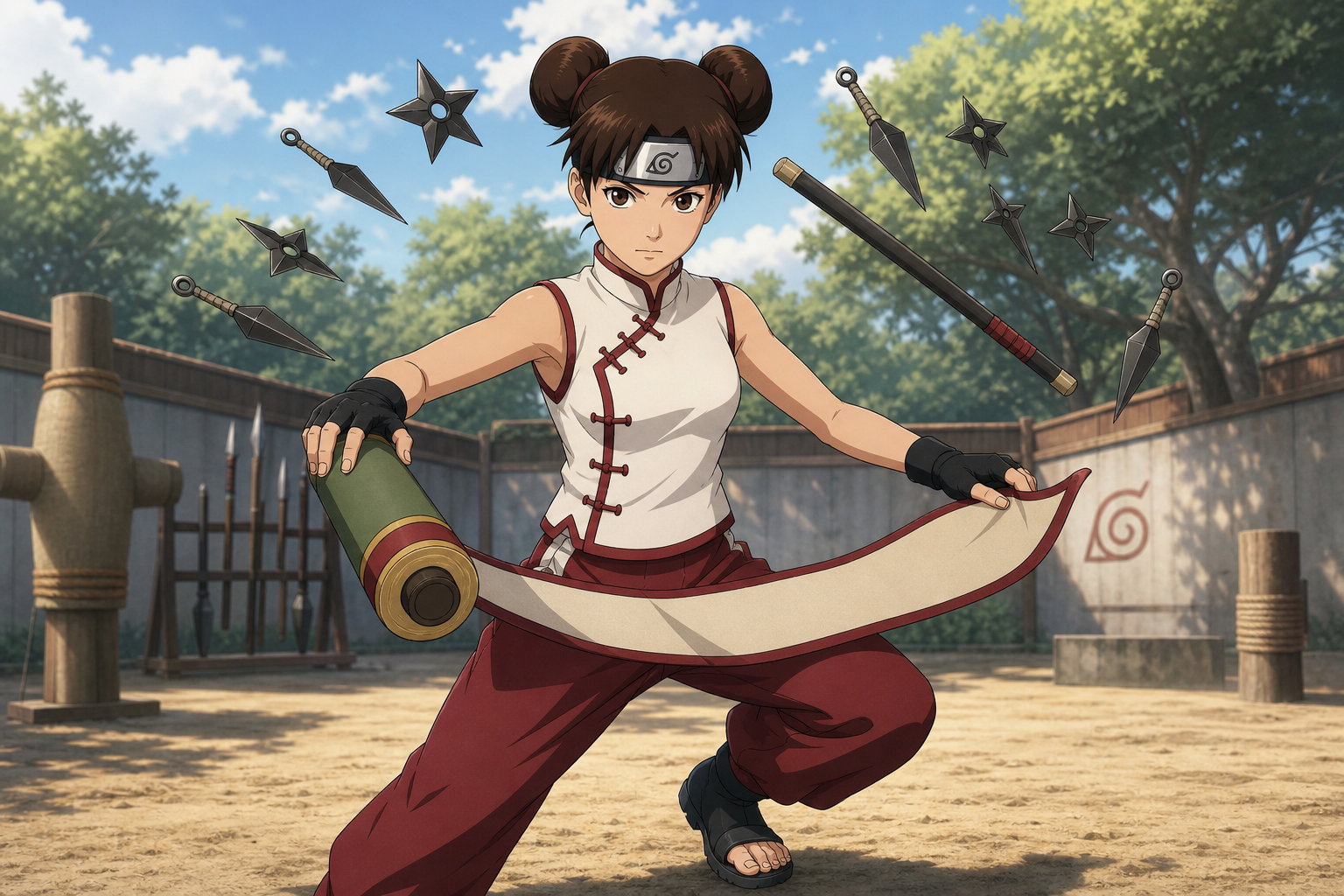
Naruto Character Encyclopedia · Complete Canon Profile
Tenten
Naruto gives Tenten professional discipline, excellent aim, a legendary weapon, and almost no interior story. The problem is not her competence. The problem is what the narrative refuses to do with it.
01
Bottom line
Tenten is not a hidden goddess fandom failed to calculate, and she is not “the useless girl who lost to Temari.” She is a credible weapons and logistics specialist in a series that repeatedly prefers magic eyes, inherited bloodlines, and enormous chakra batteries over prepared equipment. The insult is not that Tenten lacks a secret destiny. The insult is that Naruto gives her a useful profession and almost no interior life.
She trains on the same team as Rock Lee and Neji Hyūga. She becomes a chūnin, serves through a world war, handles a weapon of the Sage of Six Paths, and later owns a shop containing tools nations once fought over. Those facts describe a career. The manga still spends so little time inside her choices that fans have built entire personalities, marriages, and power systems to fill the silence.
We do not need to invent a better Tenten to explain why the existing one matters. We need to distinguish what she does from what the story bothers to dramatize. Competence and narrative attention are not synonyms. Tenten has the first. She deserved much more of the second.
02
Tenten at a glance
- Japanese name: テンテン, Tenten
- Surname: None confirmed
- Birthday: March 9
- Blood type: B
- Registration number: 012573
- Village: Konohagakure
- Team: Team Guy with Neji Hyūga and Rock Lee under Might Guy
- Rank: Genin in Part I; chūnin in Part II
- Academy graduation: Age 12
- Age: 13 to 14 in Part I; 17 to 18 in Part II
- Height: 154.3 to 155.6 cm in Part I; 164 cm later
- Weight: 42.2 to 43.1 kg in Part I; 47.3 kg later
- Manga debut: Chapter 36
- Anime debut: Episode 21
- Japanese performer: Yukari Tamura
- Specialties: Bukijutsu, stored weapons, scroll deployment, accuracy, and battlefield supply
Tenten has no canon surname. “Tenten Lee,” “Tenten Mitsashi,” and other names circulate through fan works and databases that repeat fan material. None belongs in a reference profile. Her exact databook mission and stat tables also require a direct edition check because secondary transcriptions disagree. Printing a suspicious number in a neat box only gives misinformation better posture.
03
Her design announces a weapon specialist
Tenten’s twin hair buns create one of the clearest silhouettes among the Konoha peers. Part I pairs them with a sleeveless cream Chinese-influenced blouse, red trim and closures, red trousers, gloves, sandals, and a Konoha forehead protector. Scrolls and tool pouches carry the profession into the shape.
Part II matures the same visual grammar. Her blouse, trousers, gloves, larger scrolls, and equipment load remain practical. War clothing adds Allied markers where required. The Last and New Era designs make her older without replacing the buns or Chinese-influenced styling that keeps her readable across eras.
Those visual references deserve care. Calling every frog closure or bun “Chinese aesthetic” and moving along turns a culture into wardrobe shorthand. The design draws from recognizable Chinese clothing and martial imagery while placing Tenten inside a Japanese manga’s hybrid ninja fantasy. Both facts can be true. The influence is visible; the character is not a cultural documentary.
04
Her personality lives in the negative space
Tenten is practical, observant, proud of her accuracy, and far less enchanted by Guy’s theatrics than Lee. She can admire discipline without joining every public display. Her reactions give Team Guy a tonal counterweight, but the series rarely allows those reactions to develop into decisions that change the plot.
She also takes weapons seriously as a craft. Accuracy is not simply a number attached to her biography. The identity requires patience, repetition, maintenance, and knowledge of what each tool can accomplish. Tenten wants recognition as a capable kunoichi, not as a mascot for one weapon type.
Her confidence survives embarrassment. Temari defeats her publicly and completely. Tenten does not abandon weapons, switch specialties to chase the winner, or decide one bad matchup proved her professional ceiling. She improves the system she chose.
That persistence differs from Lee’s because the writing does not stage every repetition. Lee’s labor receives sweat, flashbacks, injuries, and speeches. Tenten’s labor appears mainly as a larger scroll and a broader arsenal. The audience has to read design changes as evidence because the narrative declines to show the workshop.
05
The Tsunade dream belongs to the anime
The anime gives young Tenten an ambition to become a legendary kunoichi like Tsunade. She struggles with medical ninjutsu and shifts toward weapons, where her accuracy and preparation offer a stronger route. The material gives her something the manga rarely provides: a personal career revision.
That aspiration should not be smuggled into manga canon. The distinction does not make the anime idea worthless. The idea fits Tenten because she does not abandon ambition after one route fails. She changes method.
That is a healthier underdog story than pretending desire erases aptitude. Medical ninjutsu requires specialized chakra control, knowledge, and temperament. Tenten does not become less worthy when medicine does not fit. She finds another form of expertise.
The tragedy is that her new route receives almost no comparable mentorship drama. Sakura gets Tsunade. Lee gets Guy. Neji gets clan conflict, genius status, and eventually direct family instruction. Tenten gets scrolls and the expectation that viewers will infer the years.
06
Team Guy needs the teammate who packs supplies
Team Guy contains three distinct combat systems. Neji reads chakra networks and shuts bodies down from inside. Lee closes distance through speed and physical force. Tenten controls equipment, range, and resupply. Guy leads a team that can diagnose, pursue, strike, and keep fighting beyond the contents of one standard tool pouch.
The story regularly turns Tenten into the reaction shot when Guy and Lee become too intense. She supplies the normal human face, the exasperated comment, and the reminder that sunrise vows are not legally required. Comedy value is real, but comedy becomes containment when a woman exists mainly to frame men’s emotional spectacle.
Tenten also trains with Neji and supports his technique development in adaptation material. Their familiarity shows in coordinated Team Guy work. Nothing in canon confirms a romance. Friendship and professional intimacy do not become less meaningful because nobody kisses.
After Neji dies in the war, Team Guy loses its center of technical precision and one of Tenten’s longest relationships. The manga barely lets her grief breathe. That absence belongs in the profile because consequences include the scenes a story refuses to give.
07
Weapons are stored labor
A kunai does not appear from pure confidence. Someone mines metal, shapes the blade, balances the weight, maintains the edge, transports the stock, seals the equipment, and learns how to release and throw the tool without stabbing a teammate. Tenten’s specialty makes that invisible labor visible.
Her scrolls compress logistics. A shinobi unit can carry more weapons and specialized equipment than normal bodies could transport. That capacity matters on long missions and chaotic battlefields even when a single flashy duel does not pause to applaud the quartermaster.
Tenten’s accuracy converts stored objects into controlled space. Barrages restrict movement. Explosive tags change routes. Wires can alter trajectories or create traps. Polearms and chained weapons answer different ranges. Preparation is her chakra nature, metaphorically speaking. Please do not quote that sentence as a new databook classification.
The series’ power escalation gradually devalues ordinary tools. When mountains explode and eyes rewrite dimensions, a well-placed blade receives less narrative respect. That change reflects scale, not stupidity. Most shinobi do not fight gods every Tuesday. Equipment remains essential to the military world the plot uses as background.
08
Temari is a terrible matchup, not a career verdict
Tenten faces Temari during the Chūnin Exam preliminaries. She launches her weapon assault. Temari uses wind and her giant fan to reject the entire approach, then defeats her decisively. The manga devotes little space to the match. The anime expands the choreography, including Tenten’s scroll display and named technique material.
Temari does not merely throw harder. She controls an area. Wind changes the path and usefulness of airborne metal, preventing Tenten from establishing the ranged pressure her style needs. That is a tactical mismatch.
Fandom treats the loss like a complete résumé because the story gives Tenten no later solo manga fight of equal dramatic weight. Imagine judging every shinobi by the first opponent specifically equipped to delete their plan. Kakashi would never survive the performance review.
Tenten still loses. We do not need to invent a secret counter or claim the anime cheated her. The honest criticism targets narrative allocation. Kishimoto establishes a limitation and rarely returns to show how she adapts.
09
What Tenten can actually do
Bukijutsu
Tenten handles a wide range of ninja tools and conventional weapons with high accuracy. Her arsenal includes thrown blades, staffs, chained weapons, polearms, wire, explosive tags, and other mission equipment depending on medium. Proficiency with many tools is the point. A long list does not mean every item receives equal manga demonstration.
Scroll storage and release
She stores weapons in scrolls and releases them in volleys or selected combinations. Storage reduces carrying limits and enables rapid deployment. Secondary sources sometimes label all of this space-time ninjutsu. That category needs a licensed receipt for each claim. Fūinjutsu and storage are the safer factual description where the page lacks one.
Twin Rising Dragons
The anime gives Tenten Twin Rising Dragons, a visually memorable technique that launches scrolls and weapons into a coordinated aerial barrage. The choreography belongs to anime continuity. A clean profile labels the technique instead of retroactively drawing the dragons into manga panels.
Guidance, tags, and preparation
Anime and supplemental material expand wire-guided trajectories, explosive combinations, defensive deployments, and oversized stored objects. Each expansion belongs on an adaptation shelf. Games add more spectacular versions for playable balance and visual clarity. A controller input is not a chapter citation.
Limits
Tenten needs equipment, preparation, range, and enough chakra to release or control her arsenal. Wide-area wind can reject projectiles. Durable defenses can absorb them. Close pressure can interrupt scroll deployment. Mythic tools drain reserves beyond an ordinary human scale. Her specialization produces flexibility, not immunity from physics.
10
Precision is not the same as infinite ammunition
Weapons specialists face a material question chakra avatars can hide: where does the equipment come from? Scroll storage solves transport, not production. Blades still require manufacture. Explosive tags still require preparation. Wire tangles. Edges dull. A long mission can consume inventory faster than a beautiful opening barrage suggests.
That supply logic makes Tenten valuable beyond duels. She can carry mission-specific tools, replace lost equipment, and shift a team’s options without asking every teammate to haul a warehouse. The manga rarely pauses for logistics because logistics interrupt the fantasy of effortless motion. Real campaigns collapse when food, medicine, tools, and replacement parts do not arrive.
The skill also has a class dimension. Famous clans inherit secret techniques. Jinchūriki carry national weapons inside their bodies. Tenten’s power depends on access to manufactured objects and the time to master them. Money, village supply, craft networks, and storage knowledge shape her ceiling. Calling her “just a weapons user” ignores the economy required to put a weapon in anybody’s hand.
Preparation creates vulnerability too. An opponent who learns the inventory can choose distance or defense accordingly. Surprise shrinks after the first scroll opens. Tenten’s best unseen development would not be a magic bloodline. Better reconnaissance, traps, mixed ranges, team resupply, and tool design already grow from the profession the story established.
11
Kazekage Rescue gives the team work, not Tenten a plot
Team Guy joins the mission to rescue Gaara. They face a proxy carrying part of Kisame’s power, remove seals around the Akatsuki hideout, and trigger a trap that produces duplicate versions of themselves. The team wins by exceeding the level recorded when the copies formed.
Tenten contributes to the mission and fights her duplicate. The sequence confirms Part II competence and improved endurance. The sequence does not explore her interior life. She remains part of a functional unit while the emotional center belongs elsewhere.
That distinction matters. A woman can appear in action scenes without receiving a character arc. Counting frames does not measure narrative ownership.
12
The duplicate fight exposes the writing problem
Team Guy’s duplicate opponents copy the abilities the team possessed when the trap activated. Victory requires the originals to exceed their recorded selves. The concept fits a training-centered squad beautifully. Each teammate must demonstrate growth that cannot be solved by memorizing yesterday’s strength.
For Lee and Neji, viewers already understand what improvement means. Their techniques, rivalries, and limits have received explanation. Tenten’s growth is harder to read because the series has not given her equivalent benchmarks. More weapons, faster release, better accuracy, stronger reserves, and smarter combinations are all plausible. The sequence does not spend enough time making one answer emotionally hers.
The team wins because the plot states and shows increased effort. Tenten participates fully. Yet the very mechanism underlines her missing archive. A duplicate can copy the Tenten we previously saw. The audience barely knows what changed inside the Tenten who returned.
13
The war finally hands her a legendary weapon
During the Fourth Shinobi World War, the Sage of Six Paths’ treasured tools return through Kinkaku and Ginkaku. Tenten finds the Bashōsen, a fan capable of generating attacks from the five basic elemental natures. She uses the fan to destroy at least one of Kakuzu’s elemental masks.
For one brief moment, the weapons specialist receives a tool worthy of the story’s inflated scale. Then the chakra cost arrives. The Bashōsen consumes enormous reserves, enough that ordinary users can die. Tenten exhausts herself after limited use.
That consequence is perfect for her profile. The legendary object does not transform an underwritten supporting character into a secret demigod. The tool recognizes no inspirational fairness. Power has an operating cost, and Tenten’s body pays.
The moment also exposes the franchise’s chakra economy. Bloodline heirs and jinchūriki can feed systems ordinary shinobi cannot sustain. Skill gets Tenten’s hands on the weapon and lets her use the weapon correctly. Reserves still limit duration. Training cannot negotiate every material constraint.
14
The Sage’s tools carry an older story
The treasured-tool set draws names and concepts from Journey to the West, where the Gold Horn and Silver Horn demon kings possess magical objects including a fan, gourd, rope, sword, and purifying vessel. Naruto relocates that vocabulary into the Sage of Six Paths mythology and the Kinkaku-Ginkaku conflict.
Tenten’s contact with the Bashōsen therefore joins her practical weapon identity to a much older East Asian literary shelf. The connection should be named without pretending she becomes a Journey to the West adaptation. Kishimoto borrows, remixes, and assigns new rules.
The choice is creatively sharp. Tenten spends most of the series working with manufactured tools that stronger characters overlook. Mythic history suddenly drops the largest possible version of her specialty into her hands. The joke and tragedy arrive together: she knows what to do, but the artifact’s appetite exceeds an ordinary human body.
15
Possession is not mastery
Later in the war, more treasured tools move through Madara’s body and back into Team Guy’s reach. Tenten seals or carries tools including the Benihisago and Kohaku no Jōhei before Infinite Tsukuyomi interrupts the battlefield. Chapter 700 shows several legendary objects displayed in her shop.
That chain establishes custody. Custody does not prove complete mastery of every sealing ritual associated with Kinkaku and Ginkaku. The rope, sword, gourd, fan, and pot work through different conditions. Fandom often hands Tenten the whole system because ownership feels close enough. Close enough is not a receipt.
Her later stewardship is still remarkable. A girl introduced losing a weapon match becomes custodian of artifacts tied to the Sage of Six Paths and Cloud history. The manga places that development in the background like a clearance sticker. Ma’am, those objects once helped accelerate an apocalypse. Maybe the shop deserves two pages.
16
Neji’s death leaves a team-shaped hole
Neji dies protecting Naruto and Hinata during the war. The death carries Hyūga caste questions, Naruto’s emotional crisis, Hinata’s intervention, and the larger battle’s bodily cost. Tenten also loses a teammate she has trained beside since before the Rookie Nine entered their exam cycle.
The manga gives her almost no space to process that loss. Team Guy continues, but the original triangle cannot be restored. Neji was the precision fighter who balanced Lee’s momentum and Tenten’s range. He was also a person whose moods, habits, and growth she knew outside the central protagonist’s view.
We should not invent a private memorial scene and call the invention canon. We can state what the structure means. A military story that kills a teammate and skips a surviving woman’s grief uses her resilience as free labor. She remains available for the next panel because the story never grants her time to break.
The New Era shop full of preserved objects gains another possible meaning beside commerce. Tenten keeps, catalogs, and controls material history. Whether she connects that practice to Neji is interpretation, not fact. The interpretation fits a character whose profession has always involved holding what other people throw away.
17
A weapons shop in a peace economy
Chapter 700 shows adult Tenten operating a weapons shop. The New Era anime expands the joke that business struggles because peace reduces demand. On the surface, the scene treats her dream as a sales problem. Underneath sits one of the franchise’s cleanest economic consequences.
Shinobi villages built labor systems around conflict. Weapons move when missions, fear, and war create demand. Naruto’s peace project should disrupt that market. Tenten’s slow shop is evidence that fewer children need blades, which is good for society and complicated for the craft worker whose expertise formed inside the old system.
The shop can also function as archive, repair space, and controlled storage. Displaying the treasured tools reframes objects of conquest as supervised history. The story does not fully develop that reading, so RaeRae interpretation must stay labeled. Still, a custodian who understands weapons may be exactly the person who knows why the worst ones should remain behind glass.
Adult anime material also uses Tenten as a Chūnin Exam proctor. The role fits her experience and offers institutional continuity. Shopkeeper does not mean retired weakling. People can own businesses and remain professionally dangerous. Ask any auntie guarding the good inventory.
18
Gendered competence without interiority
Tenten represents a common writing pattern for women in ensemble action stories. The text calls her competent, gives her a specialized visual language, and keeps her nearby. The camera then invests its emotional resources in the men around her.
Lee receives a disability-access arc, a mentor bond, a famous loss, surgery, and recovery. Neji receives caste violence, ideology, family truth, rivalry, growth, and death. Tenten receives one decisive defeat, team participation, and scattered tool upgrades.
The answer is not to pretend her existing scraps secretly equal their development. The answer is to name the imbalance. A character can be designed well enough that viewers see unrealized possibility. That response is not delusion. The gap exists because the setup promises functions the plot declines to explore.
Gender matters because Naruto repeatedly lets male peers convert goals into long causal chains while women receive abbreviated aspirations, romantic framing, support labor, or offscreen competence. Tenten escapes some romantic reduction only because the story barely gives her romance at all. Freedom through neglect is a sad little prize.
19
The marriage and motherhood fandom invented
Tenten is not canonically married to Rock Lee. She is not confirmed as Metal Lee’s mother. No revealed surname, wedding, family record, or creator statement closes that gap.
Fans connect the characters because they share a team, remain present in the New Era, and Metal resembles the Guy-Lee training lineage. The pairing is a reasonable fan possibility. Reasonable possibility and established biography are different shelves.
Promoting Tenten into wife and mother without evidence can look like giving her more life. The move also reduces her unexplored adult identity to filling a man’s missing family slot. She already has a profession, expertise, history, and grief. A profile should protect those confirmed facts before adopting fandom’s domestic paperwork.
20
Confucian reciprocity and Team Guy
Team Guy reflects a teacher-student hierarchy where loyalty grows from sustained investment. Guy trains each student and expects discipline. Lee receives the most visible emotional reciprocity. Neji eventually receives care through team and family repair. Tenten’s side of the exchange remains less documented.
That absence raises a useful question: does a good leader distribute care equally, or according to visible crisis? Guy saves Lee because Lee’s need is obvious. Tenten appears self-sufficient, so her development becomes easy to overlook. Competent children often receive less support precisely because they make neglect convenient.
Reciprocity also binds teammates after loss. Neji’s death should alter how Lee and Tenten understand Team Guy, duty, and survival. The manga prioritizes the central war plot. A culturally serious reading can name the missing mourning without inventing private scenes.
21
Buddhist nonattachment and changing tools
The anime’s Tsunade aspiration gives Tenten a useful nonattachment arc. One path fails. She does not decide her life has failed. She releases a specific form of achievement and commits to another practice.
Her later shop complicates attachment to professional identity. Peace makes weapon demand fall. A craft built for war must change purpose or become a museum piece beside the artifacts on display. Impermanence is not always poetic. Sometimes impermanence is rent due on a shop full of inventory nobody needs.
The treasured tools reinforce the point. Objects carry enormous power, history, and prestige. None grants permanent control. Owners change. Wars end. Chakra empties. A fan can destroy a monster and nearly destroy the user in the same motion.
22
Yukari Tamura in Japanese
Yukari Tamura performs Tenten in the original Japanese anime and across relevant franchise animation and game projects. Her credit is verified through official game cast material and franchise records. The role moves among dry reaction comedy, battle calls, team concern, frustration and adult professionalism.
I am not inventing pitch, breath or timing analysis without the heard Japanese scenes. A cast credit identifies the performer. Memory dressed as close listening is not criticism.
23
Manga, anime, films, games, and parody
The manga provides Tenten’s core chronology but relatively little solo material. The television anime expands her Chūnin match, early ambition, technique list, missions, war actions, dream material, shop comedy, and adult proctor work. Those additions can enrich the profile only when labeled as adaptation continuity.
Tenten appears in franchise films such as Naruto Shippūden the Movie: The Will of Fire, Road to Ninja: Naruto the Movie, and Boruto: Naruto the Movie. Alternate-world behavior in Road to Ninja belongs to that film’s premise, not the main Tenten’s personality.
Games turn her scrolls and weapon barrages into broad playable move sets. OVAs use Team Guy for event comedy and ensemble missions. Rock Lee & His Ninja Pals exaggerates her reactions and team dynamics inside a parody universe. None of those shelves gets to backfill manga feats without a label.
24
Seven fandom shortcuts that need to retire
“Tenten is useless”
She becomes a chūnin, serves on major missions, fights through a world war, uses Bashōsen, and later holds legendary tools. The writing underuses her. That is not the same claim.
“Tenten is secretly overpowered”
No. Her versatility is real. Chakra, matchups, defense, range, and screen receipts still limit her.
“Temari exposed her whole career”
Temari exposed a severe matchup weakness in one preliminary. The story failed to give Tenten a later solo manga answer.
“Twin Rising Dragons is a manga feat”
The named choreography is anime material.
“Owning the Sage tools means she mastered them all”
Custody, one demonstrated fan use, and full system mastery are different claims.
“She married Lee”
Canon has not confirmed that marriage.
“She is Metal’s mother”
Canon has not identified Metal Lee’s mother.
25
The final verdict
Tenten builds a real career from preparation, accuracy, storage, and objects other characters treat as disposable. She adapts, advances, survives, and eventually becomes custodian of weapons larger than the story ever lets her feel.
Her greatest limitation is not chakra. Her greatest limitation is narrative allocation.
Calling her useless repeats the writing’s neglect as though neglect were evidence. Calling her secretly invincible tries to repair that neglect with fanfiction wearing a lab coat. The honest Tenten is more interesting: a capable woman whose arsenal keeps proving how much story could have fit inside those scrolls.
Sources and canon boundary
Editorial record: Manga chronology controls. Anime expansions, novels, films, OVAs and games are labeled instead of blended into canon.
Primary franchise references: Naruto Official and VIZ Media Naruto. CVM Sekai’s conclusions about weapon specialization, sealing, Team Guy, Temari, the Sage tools, business, fandom myths, and the story’s limited investment are editorial analysis, not invented creator quotations.