Naruto · Complete Character Profile
Zaku Abumi
Orochimaru finds a child who survived by attacking first, gives his anger machinery, and calls the result rescue.
The bottom line
Zaku believes Orochimaru saved him because nobody taught him that rescue which requires permanent ownership is recruitment.
His cruelty is real. So is the deprivation that made domination feel like security. Zaku does not enter the story as a secret gentle soul waiting to be excused. He enters as a boy who has learned that humiliation travels downward: if he cannot be the person threatened, he will become the person others fear.
Childhood: survival without a witness
Zaku’s anime-expanded history depicts him as an orphan surviving through theft. When he is caught, other children beat him. He has no stable protector, clan resources or village institution committed to his development.
Orochimaru intervenes and recruits him. To a child whose prior social lesson was that weakness invites group violence, the offer of power can resemble moral recognition.
Zaku becomes fiercely loyal because Orochimaru appears at the exact point where abandonment has made ordinary care unimaginable. He does not have a healthy relationship against which to measure the terms.
The predator’s genius is timing. He arrives when the victim will call possession belonging.
The body as weapons laboratory
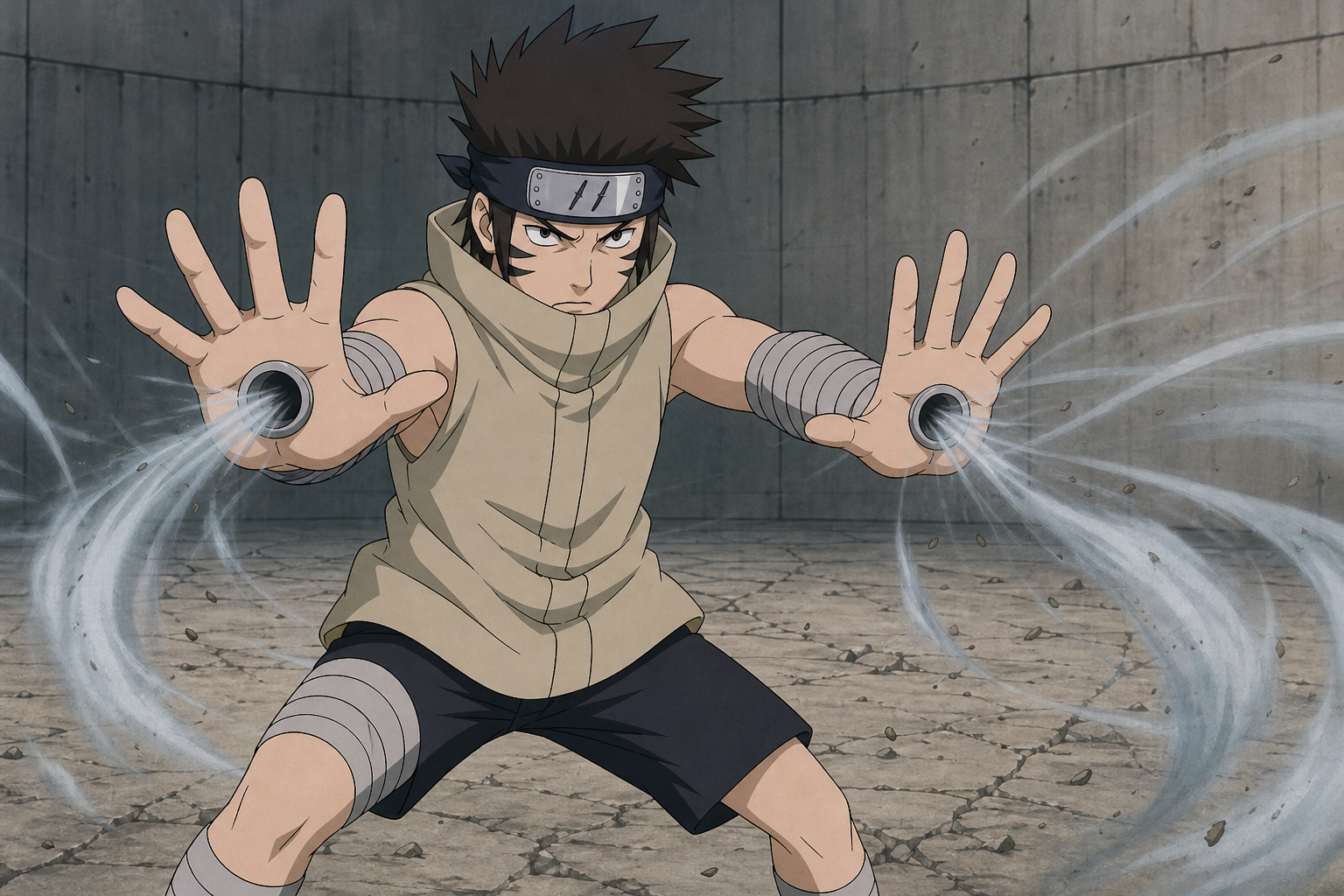
Tubes are implanted along Zaku’s arms with openings in his palms. By sending chakra and air through them, he creates pressure waves capable of striking, deflecting projectiles and tearing through terrain.
The modification gives his gestures an unnerving literalism. An open hand usually signals vulnerability or peace. Zaku’s palms contain weapons.
The series provides little attention to recovery, consent or maintenance. That silence reflects Hidden Sound’s operating logic. A body is evaluated by output; pain matters only when it interrupts the mission.
Zaku’s confidence is inseparable from the modifications. Power validates the adult who altered him and the self that survived alteration.
Decapitating Airwaves
Zaku controls air pressure and, according to his own explanation, can manipulate sound waves as part of the attack. He uses the palm tubes to create destructive blasts and alter pressure.
Offense
Compressed air can knock opponents backward, damage bodies and tear through surrounding material.
Defense
Pressure can deflect incoming weapons or reduce the effectiveness of an attack.
Range
The technique lets a physically grounded fighter threaten opponents without closing to ordinary striking distance.
Weakness
The palm openings and internal tubes are required pathways. Obstructing them turns pressure inward.
Episode 23: entering as a village’s threat display
In the examination room, Dosu Kinuta, Zaku and Kin confront Kabuto Yakushi after his intelligence cards reduce participants,including the unfamiliar Sound entrants,to organized data.
The team’s aggression establishes Hidden Sound publicly. Zaku contributes visible menace while Dosu’s Melody Arm produces the actual physiological disruption.
They believe they are defending their village’s honor. The irony is brutal. The “village” is Orochimaru’s structure, and Kabuto secretly serves the same master. Children perform rivalry while the adult intelligence network already crosses both sides.
Forest of Death: attacking the exhausted
The Sound team finds Team 7 after Orochimaru has marked Sasuke and left Naruto unconscious. Sakura has spent the night protecting both teammates.
Zaku mocks vulnerability and uses his airwaves with little restraint. His behavior is cruel, but also consistent with the worldview through which he survived: weakness is an invitation, and power exists to ensure he is never again the body on the ground.
When Rock Lee uses the Front Lotus on Dosu, Zaku blasts air beneath the impact, cushioning his teammate’s fall.
The rescue demonstrates functional teamwork. His violence is not proof that he is incapable of attachment. It is proof that attachment has been confined to those inside the weapon unit.
Sakura fights back
Sakura uses traps, substitution and direct physical resistance to defend Naruto and Sasuke. Kin grabs her hair, turning a feature Sakura has cultivated partly for Sasuke’s approval into a restraint.
Sakura cuts her hair and escapes. For Zaku’s team, the target who looked weakest keeps refusing the role assigned to her.
Team 10’s intervention further transforms the battlefield. Ino’s childhood bond with Sakura becomes more important than the exam’s encouragement of competition.
Zaku responds with contempt because mutual defense contradicts the social logic he knows. If people can choose solidarity with the vulnerable, then his own abandonment was not inevitable,it was a failure committed by others.
Sasuke breaks his arms
Sasuke Uchiha awakens under the cursed seal’s influence. His chakra and aggression terrify everyone present.
Zaku attacks and attempts to assert that he will not be intimidated. Sasuke seizes him and breaks both arms.
The scene is often remembered as a cathartic display of Sasuke protecting Sakura. It is also a child modified by Orochimaru being mutilated by another child currently altered by Orochimaru.
The architect does not need to enter the fight. His power circulates through both bodies, converting pain into experimental data.
Zaku’s scream collapses the identity built around invulnerability. The weapons implanted to prevent helplessness now terminate in limbs he cannot use.
Preliminaries: Zaku versus Shino
Despite his injuries, Zaku enters the preliminary match against Shino Aburame. He hides that one arm remains usable, hoping to create a decisive surprise.
Shino offers him a chance to withdraw. Zaku interprets restraint as condescension and refuses.
Shino’s kikaichu insects enter and obstruct the air tubes. When Zaku releases pressure through both palms, the blocked pathways force the effect back into his arms, rupturing them.
The counter is elegant because it does not overpower Zaku’s output. It understands infrastructure. Shino studies where power must travel and makes the system betray the person carrying it.
Shino and Zaku: two childhoods joined to nonhuman systems
Both boys fight through living or engineered systems attached to the body, but their relationships to those systems are radically different.
Shino’s kikaichu insects live within him through an Aburame clan practice established from birth. The arrangement is strange and demanding, yet it exists inside family knowledge, inherited technique and a social role he understands.
Zaku’s tubes are the product of Orochimaru’s intervention after abandonment. They grant spectacular output without a community invested in his long-term health.
The match is therefore not “bugs versus wind” alone. It is one infrastructure encountering another. Shino has been taught to observe ecosystems, pathways and resource use. Zaku has been taught to maximize discharge.
One boy asks where the opponent’s power must travel. The other assumes sufficient force can make the question irrelevant.
Why Zaku refuses to surrender
Withdrawal could protect his body, but surrender threatens the narrative that made his suffering meaningful. If Orochimaru rescued him by making him strong, then admitting weakness risks returning psychologically to the child beaten in the street.
Zaku therefore treats persistence as identity preservation rather than tactical judgment.
The Chūnin Exam rewards this pathology until it punishes it. Candidates are told to risk everything, display resolve and represent their villages. They are then individually blamed when obedience to those values destroys them.
Shino’s warning offers an exit. Zaku cannot perceive it as care because no trusted authority taught him that care can include permission to stop.
Relationship atlas
| Person | Relationship | What it reveals |
|---|---|---|
| Orochimaru | Recruiter, modifier and owner | Zaku mistakes weaponization after abandonment for rescue. |
| Dosu Kinuta | Teammate and tactical leader | Zaku can protect a teammate even while operating through cruelty. |
| Kin Tsuchi | Teammate and fellow sacrifice | Both are ultimately consumed by the organization they represent. |
| Sasuke Uchiha | Assigned target and attacker | Orochimaru’s chosen vessel breaks the arms of Orochimaru’s disposable prototype. |
| Shino Aburame | Preliminary opponent | Patient systems analysis defeats uncontrolled output. |
| Sakura Haruno | Forest target | The person he classifies as weak demonstrates that vulnerability and resistance can coexist. |
Death as a component
After losing in the preliminaries, Zaku remains within Orochimaru’s control. He and Kin are used as human sacrifices when Orochimaru performs Impure World Reincarnation during the Konoha invasion.
The technique requires living bodies as vessels for resurrected dead. Zaku’s body becomes the medium for a former Hokage.
This fate completes the logic of his recruitment. His arms were modified as infrastructure. His missions used him as stimulus. Finally, his entire body becomes ritual material.
Orochimaru never needed Zaku to become a complete person. Every stage of the relationship converts him into a component for someone else’s desired result.
The exam’s responsibility
The Chūnin Exam places Zaku in an arena and treats him as an ordinary foreign genin even though his arms display invasive military modification. Nobody publicly asks who performed the procedures, whether he consented, or what the new Sound Village is doing to children.
This is partly the success of Orochimaru’s cover. It is also evidence of what the multinational exam is designed to notice. Officials assess combat, information control, leadership potential and village prestige. Welfare investigation is not the central mission.
When Zaku’s arms are destroyed, the event becomes a match result. The institution can record Shino’s tactical superiority without confronting the conditions that made Zaku’s body a pressure weapon.
The examination produces knowledge about who can win. It does not automatically produce curiosity about what winning candidates have survived.
Personality
Aggressive
He attacks status threats quickly and uses intimidation to control uncertainty.
Proud
Power functions as proof that his rescued identity deserves recognition.
Cruel
He mocks weakness and participates in attacking exhausted opponents.
Loyal
His devotion to Orochimaru and operational concern for teammates are genuine, even when built inside coercion.
Resourceful
He uses air pressure defensively and conceals remaining ability before the Shino match.
Unable to retreat
Stopping feels like returning to the powerless child he has built his identity against.
His name keeps the whole team inside the ear
Abumi connects to the Japanese term for the stapes, the stirrup-shaped bone in the middle ear. Zaku’s given name is written in katakana and can evoke a sharp cutting or chattering sound. The naming fits Team Dosu’s shared sound vocabulary without turning a child into a dictionary exercise.
Dosu’s name points toward the incus, Zaku’s toward the stapes, and Kin’s bells complete the team’s sound field. Orochimaru creates the appearance of a coherent village culture while treating the children as equipment. The naming is clever. The institution underneath it is rotten.
That tension belongs in the profile because aesthetics can hide ownership. Matching headbands, techniques, and names make a team look socially rooted. None of those things proves the village will protect them after the mission.
The first databook records talent, labor, and a brutal ceiling
Zaku’s first-databook ratings are ninjutsu 3.5, taijutsu 2, genjutsu 2, intelligence 1, strength 1, speed 2.5, stamina 1, and hand seals 1. The 14-point total creates a clear specialist shape: strong technique output, useful speed, low endurance, and weak tactical judgment.
His mission record lists 23 D-rank and 12 C-rank missions, with no B-, A-, or S-rank completions. Those totals are not glamorous, but they are important. Zaku has done real village labor before the Chūnin Exam. Orochimaru did not pick up a child yesterday and teleport him directly into Konoha’s arena.
The personality notes describe a desire for attention and loyalty. That combination lands hard beside the backstory. Recognition is not extra decoration for Zaku. It is the emotional salary making dangerous work feel like belonging.
Databook numbers are not destiny. They do explain why his strongest attack can coexist with terrible decision-making and limited resilience. Output is the one category the system invested in.
Appearance and design make the palms impossible to ignore
Zaku wears spiky dark hair, a Sound forehead protector, a high-collared beige sleeveless tunic, dark shorts, and bandaging around his arms and legs. The most important detail is not the clothing. It is the circular opening in each palm.
Hands normally read as contact, labor, help, surrender, or vulnerability. Zaku’s hands have been rebuilt as vents. Even an open palm announces force. The design turns his body language into a permanent weapons display.
The bandaging around the arms suggests maintenance and injury without giving a complete surgical file. Canon does not document consent, recovery time, or who performed each step of the procedure. That missing medical record is part of the ethical record. Hidden Sound cares about discharge pressure, not informed consent.
After Sasuke breaks his arms and Shino blocks the tubes, the design’s promise collapses. The feature proving he is powerful also creates the path through which the body fails.
Decapitating Airwaves: pressure, ultrasound, and mechanical limits
Zaku channels chakra through implanted tubes and controls air pressure and sound in varying ratios. Decapitating Airwaves creates a destructive blast able to knock back bodies, deflect projectiles, and tear through material. Extreme Decapitating Airwaves increases the output.
The system requires clear pathways through the arms and open vents in the palms. Shino wins by attacking that infrastructure. Kikaichū enter the tubes, block the outlets, and convert Zaku’s own pressure into internal damage. The counter does not prove the airwaves are weak. It proves a strong system can still have a catastrophic dependency.
Zaku claims more precise control than simply firing straight ahead, but the story never gives him a broad demonstration of intricate shaping. The honest shelf separates what he says from what he shows.
His stamina and judgment limits matter too. High output cannot replace patience, environmental awareness, or the willingness to withdraw. A device designed around maximum force becomes dangerous when pride treats every warning as disrespect.
The anime childhood is an adaptation layer, not manga memory
The anime expands Zaku’s childhood as an orphan stealing to survive and being beaten by other children before Orochimaru intervenes. That material clarifies why power and rescue become fused in his mind. It belongs to anime continuity unless the manga supplies the same scene elsewhere.
The distinction does not weaken the reading. The manga already shows a modified fourteen-year-old fiercely invested in Orochimaru’s recognition. The anime provides one explicit route into that attachment. Readers can use it when discussing the adaptation without quietly inserting every frame into the manga biography.
Sōichirō Hoshi performs the child version in that anime-expanded material, while Keijin Okuda performs the primary role. The two credits belong to different age contexts, not competing versions of the same scene.
Sasuke and Shino expose two failures in Orochimaru’s design
Sasuke breaks Zaku’s arms through overwhelming violence under the cursed seal. Shino later defeats him through patient systems analysis. The first failure is force meeting greater force. The second is architecture meeting somebody who asks where the power must travel.
Zaku learns the wrong lesson from the first encounter. He hides the remaining usable pathway and enters the preliminary believing surprise will restore the identity Sasuke shattered. Shino offers withdrawal. Zaku hears humiliation because the system has trained him to treat bodily preservation as cowardice.
The backfire is more than a clever bug counter. Orochimaru has built a weapon into a child without giving the child a relationship to limits. Shino understands limits and waits. Zaku understands output and fires.
The manga depicts particularly severe bodily damage, while the anime moderates some of the gore. Both versions preserve the mechanical consequence: blocked tubes make the pressure rupture the arms instead of reaching the opponent.
Impure World Reincarnation completes the conversion from child to component
Orochimaru later uses Zaku and Kin as living sacrifices for Impure World Reincarnation during the Konoha Crush. The ritual binds dead souls into living vessels. Zaku’s body becomes material for resurrecting a former Hokage.
This is not an honorable battlefield death and not a final mission he chooses. The adult who called him valuable removes his personhood completely once the body has a more useful assignment.
The sequence links early modification to later necromancy. Arms become channels, missions become experiments, and finally the whole body becomes infrastructure. Orochimaru’s research philosophy remains consistent even when the technique changes.
Zaku’s death also places a hard boundary around redemption fantasies. The story does not reveal a post-exam escape, secret survival, or repaired future. Games and OVAs can reuse the recognizable fighter without rewriting the manga’s sacrifice.
Eight fandom shortcuts that flatten Zaku
“He naturally has holes in his hands”
No. The air tubes are invasive body modifications tied to Orochimaru’s Sound program.
“He is just the loud idiot beside Dosu”
He is more impulsive than Dosu, but he can protect a teammate, use pressure defensively, hide a remaining option, and execute a powerful technique system.
“Sasuke kills him”
Sasuke breaks his arms. Zaku survives the Forest encounter and preliminary loss before Orochimaru sacrifices him.
“Shino wins because bugs are stronger than wind”
Shino wins by blocking required vents. The matchup is about infrastructure and observation, not an elemental ranking chart.
“Orochimaru saved him”
The anime shows intervention after abandonment. The same adult modifies, deploys, and ultimately sacrifices him. Material relief does not erase ownership.
“His loyalty proves he consented”
Attachment to a recruiter who arrives during deprivation is not informed consent to permanent bodily use.
“He had no real bond with Team Dosu”
The record is limited, but Zaku protects Dosu during Front Lotus and fights inside a coordinated unit. Limited intimacy is not zero relationship.
“His death is irrelevant because he was minor”
The sacrifice shows exactly how Orochimaru values child operatives once another technique needs a body.
Team Dosu’s three endings expose one labor system
Dosu discovers the team was used as stimulus for Sasuke and dies trying to prove greater value. Zaku loses his weapons through the match infrastructure and is later sacrificed. Kin loses her preliminary, disappears into custody, and becomes the other living vessel in Orochimaru’s ritual. Different personalities lead into the same ownership structure.
The trio’s labor produces information about Sasuke, pressure on Team 7, spectacle for the exam, and bodies for a forbidden technique. Orochimaru keeps every benefit. The children keep injury, defeat, and death. That is not simply villainy in the abstract. It is a distribution system.
Dosu at least recognizes the fraud before dying. Zaku’s loyalty stays attached to the rescue story. Kin receives the least interior space of all. The unequal attention should not be turned into unequal humanity. Narrative silence is not consent.
The team also foreshadows the Sound Four and later research subjects. Otogakure repeatedly turns vulnerable people into technique platforms, then calls the platform a family, village, or opportunity. The vocabulary changes. The extraction stays familiar.
Masculinity, humiliation, and the terror of being small again
Zaku performs masculinity through volume, threat, and refusal to retreat. He mocks weakness before anyone can locate his own. The posture makes sense for a child whose anime backstory associates public helplessness with group violence.
That context explains the behavior without redeeming it. Sakura, Lee, Team 10, and other exhausted children absorb the cruelty. Trauma can create a reason for domination and still leave domination wrong.
His inability to surrender becomes especially sharp against Shino. A medically sensible retreat would preserve what remains of his arms. Accepting it would also mean letting another boy define the boundary of his power. Zaku would rather risk the body than occupy that smaller social position.
A Buddhist attachment lens helps without turning the fight into a sermon. Zaku is attached not merely to victory but to the identity of the rescued, chosen, powerful boy. When evidence contradicts that identity, he increases force. Release would require surviving the feeling that weakness has returned. Nobody in his life taught him how.
The consequence is literal. The machinery meant to push danger away bursts inward. Naruto symbolism is rarely shy, but this one earns the volume.
Media record and continuity boundaries
Kishimoto’s manga controls Zaku’s Chūnin Exam mission, Forest of Death violence, Sasuke encounter, Shino defeat, and sacrifice. The anime expands his childhood and adjusts some bodily staging. Those additions stay labeled.
Zaku appears in the licensed OVA Finally a Clash! Jōnin vs. Genin!! Indiscriminate Grand Melee Tournament Meeting!! and in games including Naruto: Path of the Ninja, Naruto Mobile, and online or mobile battle titles. Playability does not create a later canon career.
The small shelf is still worth recording because adaptation history shows which minor designs remain memorable. Palm vents and pressure waves translate cleanly into game mechanics even when the character’s biography ends early.
Original Japanese performance
Keijin Okuda performs Zaku in the original Japanese anime, and Sōichirō Hoshi performs him as a child in anime-expanded material. Those credits are verified for their respective age contexts.
The role covers exam-room bravado, Forest of Death cruelty, pain, defensive loyalty, and the preliminary collapse. A cast list can establish the performers and contexts. It cannot prove pitch, breath, timing, or delivery, so this profile does not invent scene-level criticism from credits alone.
No English-dub material belongs in this profile.
Common misconceptions
“Zaku naturally produces wind from his hands.”
His techniques rely on surgically implanted air tubes running through the arms and opening at the palms.
“Shino simply overwhelms him with more chakra.”
Shino blocks the required outlets. Zaku’s own pressure damages him when the internal system cannot vent.
“Sasuke kills Zaku.”
Sasuke breaks his arms. Zaku survives the preliminaries and is later sacrificed by Orochimaru.
“Orochimaru rescued him out of kindness.”
Orochimaru recruits a vulnerable child, modifies him and ultimately uses his living body as ritual material.
What Zaku is really telling us
Zaku is an argument about how power can become emotionally indistinguishable from care.
Orochimaru finds him when society has failed to protect him. The offered strength produces real changes: food, affiliation, capability and a position from which other children cannot easily beat him. Those benefits do not make the relationship non-exploitative. They make exploitation harder to name.
Existentially, Zaku builds a self through negation: never weak again, never pleading again, never the body surrounded by attackers. Because the identity contains no positive destination beyond dominance, every setback threatens annihilation.
His palms embody the contradiction. Orochimaru gives him the capacity to push the world away, then ensures the mechanism remains a point through which the world can destroy him.
Zaku needed power. He also needed someone who could give power without demanding his body in return.
Sources and canon boundary
Manga chronology controls this profile. Anime staging, databook material, novels, games, and later appearances are labeled instead of being blended into one false continuity.
Primary franchise references: Naruto Official and VIZ Media Naruto. CVM Sekai’s conclusions about implanted weapons, childhood exploitation, Team Dosu, humiliation, Orochimaru’s disposable labor, and Zaku’s death are editorial analysis, not invented creator quotations.