
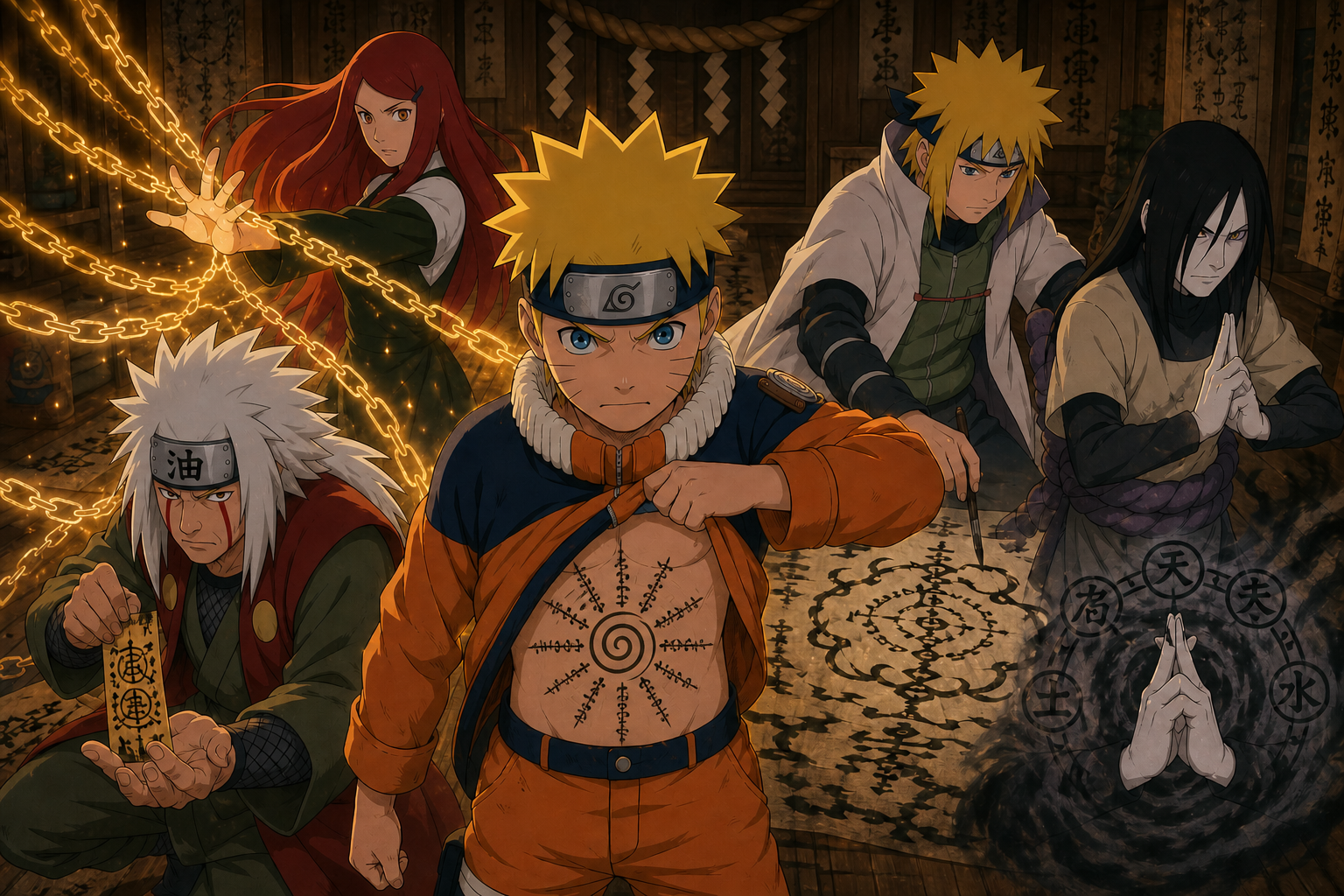
Seals & Fūinjutsu
A seal can imprison a tailed beast, lock away a technique, suppress another seal, store weapons, bind a soul, mark a body, or turn a person into national infrastructure. Naruto’s sealing arts are where calligraphy becomes engineering,and where protection becomes indistinguishable from possession.
The one-sentence truth
Fūinjutsu binds, stores, restricts, suppresses, or releases a target through formulas; juinjutsu imposes a controlling mark or curse. Both show the ninja world writing political decisions directly onto bodies.
Fūinjutsu
Sealing techniques that contain, store, restrict, suppress, or release chakra, objects, beings, and sometimes souls.
Juinjutsu
Cursed-seal techniques imposed to control, punish, transform, or constrain a target, such as the Caged Bird Seal and Orochimaru’s marks.
Barrier ninjutsu
Methods that detect, isolate, or prevent passage through an area. Barriers can overlap with sealing knowledge without making every barrier fūinjutsu.
Hand seals
Finger formations used to mold chakra. Despite the English word “seal,” ordinary hand seals are not automatically sealing techniques.
English terminology creates half the mess. “Seal” can mean an inscription, a hand sign, a barrier, a curse mark, a storage method, or the state of something being contained. The categories touch, but they are not one giant calligraphy drawer.
The practical test is function. What is the formula doing? What is being bound or stored? Where is the medium? Who can activate, maintain, alter, or release it? What happens if the bearer refuses? Naruto’s sealing system becomes clear when we stop staring at the ink and follow authority through it.
How a sealing formula works
Naruto never supplies a complete classroom manual, but repeated examples establish a working grammar. A formula identifies what is being acted upon, creates a boundary or container, applies a rule, and provides conditions for activation, suppression, or release. Ink, tags, scrolls, bodies, gates, masks, and physical structures can carry formula work.
Chakra supplies force. Inscription supplies instruction. Knowledge determines whether the seal stores a shuriken, blocks speech, captures active flame, manages a living mass of hostile chakra for years, or binds souls to a death god.
A formula is not decorative calligraphy. Its marks behave like executable constraints. Damage, interference, incorrect compatibility, a stronger technique, or a missing key can weaken or alter the result. The user still needs chakra and control. Writing the correct symbol is not a cheat code if the body cannot power the system.
Seals also have administrators. A clan head can activate the Caged Bird Seal. Jiraiya can read and adjust Naruto’s containment. Minato leaves a key. Orochimaru knows how to release the Reaper Death Seal through an Uzumaki mask. Technical access decides whose interpretation of the formula becomes reality.
That access gap is political. Naruto carries one of the village’s most important systems but grows up unable to read it. Experts discuss his body in a language he was never taught. The seal protects him and Konoha while reproducing dependency on the adults who understand the controls.
Naruto’s Eight Trigrams seal
On the night of Naruto’s birth, Minato Namikaze uses the Reaper Death Seal to divide Kurama’s chakra. He seals the yin half within himself and places the yang half inside his newborn son through the Eight Trigrams Sealing Style.
The design layers two Four Symbols Seals. Rather than creating a perfectly closed prison, Minato intends small amounts of Kurama’s chakra to mix with Naruto’s own. The seal is containment system, power interface, security risk, and long-term inheritance plan at once.
Minato leaves portions of his and Kushina Uzumaki’s chakra within the structure so their impressions can appear at critical moments. Naruto’s abdomen becomes prison, emergency archive, family memorial, and a conversation space that two dead parents scheduled before he had language.
The design works remarkably well. Naruto survives, Konoha survives, Kurama’s chakra gradually becomes accessible, and built-in interventions stop catastrophic release. Technical brilliance deserves the credit. It does not erase the ethical fact that an infant cannot consent to becoming a jinchūriki.
Minato faces an impossible attack and makes a sacrificial choice under minutes of pressure. The answer is not to flatten him into monster or saint. He saves thousands by assigning lifelong risk to his son and imprisonment to Kurama. Love, strategy, desperation, and violation occupy the same formula.
The seal space: architecture inside the self
Naruto experiences the Nine-Tails behind enormous bars in an internal flooded chamber. The visible paper seal on the gate represents the containment formula, while the chamber dramatizes a psychological relationship that changes across the story.
Early Naruto approaches the cage in desperation and bargains for power. The fox exploits anger and loosening control. Later, the internal space becomes a site of confrontation, memory and eventually cooperation.
The architecture matters: Naruto does not simply “have” Kurama’s chakra. He lives beside another consciousness separated by a structure built into him. Mastery cannot remain a mechanical act forever because the prisoner can speak back.
Minato, Kushina and the Uzumaki inheritance
Minato’s precision
Minato combines advanced formula work, barriers, contract sealing, and Flying Thunder God marks under catastrophic pressure. His genius lies in making systems cooperate.
Kushina’s chains
Kushina’s Adamantine Sealing Chains restrain Kurama even after extraction and childbirth. They are an Uzumaki ability associated with extraordinary binding force.
The Uzumaki legacy
Uzushiogakure’s Uzumaki clan is renowned for vitality and fūinjutsu. Other powers fear its sealing mastery, and the clan scatters after its homeland’s destruction.
An inherited archive
Naruto inherits the clan name and a seal central to Uzumaki history without growing up inside the culture that could explain either.
Do not turn “the Uzumaki were sealing masters” into “every Uzumaki downloads fūinjutsu at birth.” Vitality and special chakra can be inherited. A technical tradition still requires teachers, records, practice, and community. Naruto has the surname while being denied the archive.
Kushina’s role is often reduced to compatibility. She is selected as Kurama’s host because of unusual chakra and vitality, brought from Uzushiogakure, and expected to bear a national weapon. She later teaches Minato sealing knowledge and restrains Kurama during the attack. The container is also an expert, mother, migrant, and person whose knowledge outlives the village that produced it.
Uzushiogakure’s destruction turns knowledge loss into geopolitics. A feared sealing culture scatters; survivors and descendants carry fragments elsewhere. Konoha displays the Uzumaki spiral while Naruto grows up ignorant of the people behind it. Symbols preserve alliance more easily than institutions preserve children.
Jiraiya reads and repairs the system
Jiraiya recognizes the structure of Naruto’s seal and understands Minato’s intention. He can suppress leaked Nine-Tails chakra with a tag and later adjusts the seal to help Naruto access more power during training.
This makes Jiraiya more than a combat teacher. He is one of the few adults able to read the technology governing Naruto’s body. That access creates responsibility: changing a containment system changes Naruto’s emotional and physical risk.
Jiraiya’s key-based design is eventually entrusted to Naruto, turning authority over the seal toward its host. The transition is incomplete and dangerous, but symbolically essential. A body governed by other people’s formulas begins to acquire its own administrator.
Orochimaru’s Five Elements Seal: sabotage written onto a child
During the Chūnin Exams, Orochimaru places the Five Elements Seal over Naruto’s existing seal. Its elemental scheme disrupts the even balance of the Eight Trigrams structure, damaging Naruto’s chakra control and destabilizing access to Kurama.
Jiraiya later removes the interference with Five Elements Unseal. The sequence proves seals can be layered, diagnosed, and countered. It also shows Orochimaru’s characteristic violence: another person’s body is a writable surface and an obstacle in someone else’s experiment.
The attack is nearly invisible to observers who cannot read formula work. Naruto appears clumsy or deficient while an imposed mechanism is disrupting him. That is not merely metaphor. It is the practical reason a teacher must diagnose the learner before prescribing more discipline.
Ebisu accurately identifies Naruto’s poor control and begins water-walking instruction. Jiraiya identifies the additional sabotage and removes it. Both observations can be true at different layers. Saying Jiraiya “fixed bad teaching” misses the specific seal. Saying the seal explains every earlier control problem erases Naruto’s real learning curve.
Orochimaru’s act also previews the cursed mark placed on Sasuke. He does not persuade children through equal exchange. He changes what their bodies can do, makes the altered power feel useful, and lets dependency argue for him.
Cursed seals are not one single system
| Mark | Purpose | Mechanism | Political meaning |
|---|---|---|---|
| Orochimaru’s Heaven/Earth marks | Power amplification, survival test, and influence | Jūgo-derived senjutsu enzyme plus Orochimaru’s chakra | Predatory recruitment disguised as gifted potential |
| Hyūga Caged Bird Seal | Control branch members and protect Byakugan after death | Forehead mark activated by main-family authority | Family security enforced through pain and bodily ownership |
| Danzō’s tongue seal | Prevent Root members revealing secrets | Paralyzes those who attempt disclosure | Institutional secrecy converted into involuntary silence |
| Sasori’s memory suppression | Hide an agent’s true allegiance | Blocks selected memories until removed | Espionage that colonizes identity itself |
These marks are not morally identical. Orochimaru amplifies power while planting influence and accepting death as a screening method. The Hyūga seal enforces hereditary hierarchy. Danzō suppresses testimony. Sasori rewrites access to memory. The shared logic is authority that does not trust the marked person to remain free.
Sasuke chooses to pursue the cursed mark’s power after the initial assault, but later choice does not retroactively legalize the assault. Desire can grow inside coercion. That is why Orochimaru’s recruitment works: the mark creates capability and fear, then offers the abuser as the person best equipped to explain both.
The Sound Four’s second-stage ritual makes the dependency explicit. Sasuke is sealed in a death-like state while his body adapts. The group carries him as cargo toward Orochimaru. Power arrives through a process designed to detach him from every relationship likely to challenge the recruiter.
Storage seals: the everyday logistics of impossible lives
Not every seal is apocalyptic. Scrolls store weapons, puppets, corpses, supplies, clothing and enormous objects in portable form. Tenten’s fighting style depends on rapid weapon summoning; medical and military units rely on storage techniques for field logistics.
Storage fūinjutsu quietly supports the ninja economy. Teams can cross difficult terrain without carrying visible arsenals. A puppeteer transports a workshop. A shinobi can prepare a technique in advance and release it under pressure.
The spectacular world works because unglamorous systems move matter, preserve equipment and reduce weight. Sealing arts are as much infrastructure as superpower.
Contract seals, suppression and release
Contract Seal
Minato severs Obito’s control over the Nine-Tails by breaking the summoning contract. A seal can dissolve a relationship rather than imprison an object.
Fire Sealing Method
Jiraiya captures Amaterasu’s black flames inside a scroll, showing that even an active technique can become stored evidence and contained hazard.
Four Black Fogs Formation
The Sound Four use barrier and sealing preparation to protect Sasuke during the second-stage cursed-seal transformation.
Unsealing
Release is part of design, not an afterthought. Keys, blood, commands, chakra signatures and prepared gestures determine who can open a system and when.
Dead Demon Consuming Seal: victory billed to the soul
The Reaper Death Seal summons the Shinigami, which cuts out and consumes a target’s soul together with the caster’s. Hiruzen uses it against Orochimaru; Minato uses it during Kurama’s attack.
The technique embodies Will of Fire sacrifice at its most severe: leadership protects the village by spending the leader’s own afterlife. Yet the cost never ends with the volunteer. Minato’s use determines Naruto’s childhood and divides Kurama. Hiruzen’s use leaves Orochimaru alive but disables his arms, shifting danger rather than ending it.
Hiruzen cannot extract Orochimaru’s whole soul before his strength fails, so he seals the soul from the arms. The limit matters. A technique marketed by fandom as absolute still depends on the caster’s condition, target resistance, timing, and what portion can be reached.
Later, Orochimaru uses an Uzumaki mask to release consumed souls by cutting open the Shinigami’s stomach, paying with the host body he occupies. Even an apparently final seal has a key, a location, and a procedure. “Forbidden” does not mean the universe signed a no-appeal clause.
The cultural image draws on death-spirit and ritual vocabulary without functioning as a simple ancient Japanese doctrine. Naruto builds its own fictional death god and contract. The responsible reading can discuss the visual lineage without calling the technique a documentary on Shinto.
Why seals fail
- Design intention: Naruto’s seal is meant to leak controlled chakra, so permeability is not automatically malfunction.
- Emotional pressure: rage and despair increase Naruto’s reliance on Kurama and strain containment.
- Outside interference: Orochimaru overlays a disruptive formula; others deliberately loosen or suppress seals.
- Damage or removal: destroying the medium or extracting the contents can break the arrangement.
- Knowledge asymmetry: a person unable to read a formula may not understand what has been done to them.
- A stronger relationship: Naruto’s eventual cooperation with Kurama changes the need for coercive containment.
Common confusions
Are all written symbols fūinjutsu?
No. Summoning formulas, explosive tags, barriers and technique markings can use inscriptions without belonging to exactly the same category.
Is Naruto’s seal the same as Orochimaru’s cursed seal?
No. Naruto’s contains Kurama and regulates chakra exchange. Orochimaru’s cursed seals introduce power, senjutsu material and the creator’s influence.
Did Minato put the entire Nine-Tails in Naruto?
No. Minato divided Kurama, sealing the yang half in Naruto and the yin half in himself. The halves reunite much later.
Is every Uzumaki automatically a sealing master?
No. The clan possessed a major sealing tradition, but knowledge still requires preservation and teaching. Naruto grows up largely separated from that archive.
What fūinjutsu is really telling us
Seals turn invisible authority into visible design. A village decides a child will contain a weapon; a clan decides one branch may punish another; a teacher decides when access should widen; a defector brands recruits with dangerous potential. The formula makes the decision operational.
They also complicate self-contained identity. Naruto’s body includes Kurama, his parents’ chakra impressions, Minato’s engineering, and generations of Uzumaki knowledge. He remains himself, but the self is not an isolated object. It is a negotiated house full of inherited occupants and rules.
Confucian duty asks whether the author of a boundary accepts reciprocal responsibility. Minato leaves protection, information, and future access, but Naruto still grows up without ordinary care. Hiashi’s clan preserves the Byakugan while making branch relatives bear the cost. Danzō asks silence and offers no humane relationship back.
A Buddhist lens asks whether containment serves compassionate boundary or fearful attachment. Not every lock is oppression. A barrier can protect patients. A storage seal can make medicine portable. A suppression tag can stop immediate harm. The danger begins when leaders cling to ownership and call another person’s body the natural place for their fear.
The mature answer is not to smash every lock. Ask who authored it, who bears the cost, whether the contained being has a voice, and whether the person carrying the seal can ever revise the terms. A boundary that cannot be renegotiated may be a prison with excellent penmanship.
A seal makes policy physical
Fūinjutsu can store, restrict, transfer, suppress, release, or contain, but the most important question is always who decided the rule. Naruto’s Eight Trigrams seal is a brilliant piece of engineering placed on an infant who could not consent. The Caged Bird Seal protects the Byakugan by giving the main house power over branch-family bodies. Orochimaru’s cursed seals promise strength while invading identity and choice.
The formula may be neutral as technique. Its use is not. A storage seal on a scroll and a control seal on a person belong to the same broad vocabulary while carrying radically different moral stakes. Treating every mark as a cool diagram erases the body underneath it.
Containment creates a relationship, even when nobody admits it
A tailed beast sealed inside a host does not become an object. Kurama remains conscious, angry, observant, and capable of choice. The seal controls access, yet Naruto’s eventual partnership requires communication beyond the mechanism. Tightening the cage can produce temporary security. It cannot manufacture trust.
This pattern repeats across the franchise: institutions prefer a technical solution because technical solutions look final. The body keeps living with the arrangement after the officials leave. Every flare of chakra, attempted takeover, injury, and negotiation reveals that containment is an ongoing political relationship, not a completed procedure.
Breaking a seal is not automatically liberation
Release can save a person, expose them, unleash danger, or transfer control to somebody worse. Context decides. Removing Orochimaru’s influence from Sasuke protects him, while opening Naruto’s seal carelessly risks both Naruto and everyone nearby. A responsible reading asks what the seal holds, why it was placed, whether the subject can choose, and who will bear the consequence of release.
RaeRae’s bottom line
Learn the formulas and categories, because the mechanics matter. Then read every seal as a record of authority. Somebody wrote a command onto an object, a space, or a body. The real story begins when we ask whether they had the right, and whether the marked person ever had a meaningful choice at all.
Source shelf and continuity boundary
Naruto’s Eight Trigrams Seal, Orochimaru’s interference, Jiraiya’s diagnosis, the Hyūga mark, and Reaper Death Seal use the core manga/anime record and official Naruto retrospectives. The official Naruto retrospective supports the major host and seal turning points. Analysis and judgment are original to CVM Sekai.
Licensed translations vary among sealing, formula, curse mark, and technique names. Anime and games add formulas and uses. This guide separates core mechanics from adaptation additions and does not infer that every written mark is fūinjutsu. Where canon leaves the exact syntax unexplained, the boundary stays unexplained instead of receiving fake code.