
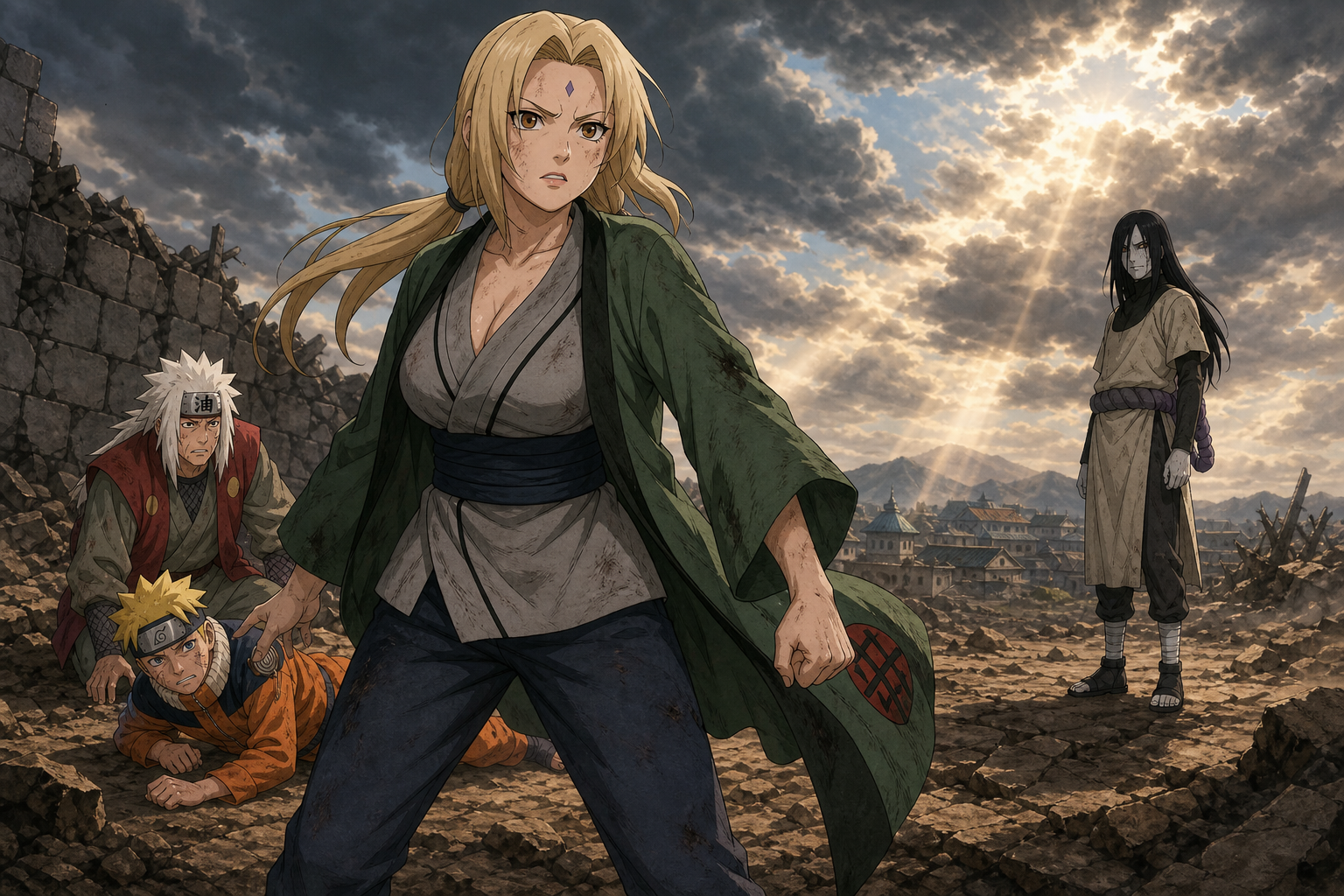
Search for Tsunade
Konoha goes looking for a Hokage and finds a woman who has survived too much to believe in heroic titles. Naruto goes looking for a stronger technique and discovers that persistence is not the same as blind optimism. Between them stands the question this arc will not stop asking: after grief has proved hope dangerous, what could make a person choose it again?
The one-sentence truth
Search for Tsunade is an arc about adults who turned trauma into escape routes. The loud, grieving child whose impossible faith reminds them that refusing to care is still a choice.
- Anime episodes: 81–100
- Manga material: chapters 139–171
- Primary locations: Konoha, Tanzaku Quarters, roadside towns and the Three-Way Deadlock battlefield
- Central objective: recruit Tsunade as Fifth Hokage
- Naruto’s breakthrough: Rasengan
- Major antagonists: Orochimaru and Kabuto Yakushi
- Previous arc: Konoha Crush
- Next major arc: Sasuke Recovery Mission
The village has lost its face
Hiruzen’s funeral closes Konoha Crush, but the political problem survives the mourning clothes. A hidden village is not simply a neighborhood with shinobi in it. It is a military state whose leader authorizes missions, maintains alliances, controls secrets, symbolizes continuity and reassures civilians that somebody is watching the wall. Konoha has lost all of that at once.
The elders first approach Jiraiya. He refuses, and the refusal matters. Jiraiya is powerful enough to occupy the chair but too restless, skeptical and compromised by his own failures to accept it. He understands that strength alone does not make a Hokage. His alternative is Tsunade, the last active member of the Legendary Sannin who combines battlefield power, medical brilliance, administrative intelligence and the bloodline symbolism of the First Hokage’s granddaughter.
That résumé sounds perfect because résumés do not record nightmares. Tsunade has spent years moving from town to town with Shizune, drinking, gambling, accruing debt and refusing every path that might make her responsible for another life. Konoha calls this absence. The arc slowly reveals it as scar tissue.
Before Tsunade: Itachi brings the wider world to the door
The search begins under the shadow of a different arrival. Itachi Uchiha and Kisame Hoshigaki enter Konoha wearing the Akatsuki cloak, instantly widening the series beyond village rivalries. Naruto is no longer merely a troublesome Konoha genin. The Nine-Tails sealed inside him makes his body an international target.
Itachi’s return also detonates Sasuke’s fragile recovery. Sasuke has built himself around one future encounter with his brother, but hatred is not training and obsession is not readiness. Itachi defeats him with humiliating ease, then traps him inside Tsukuyomi’s repeated memory of the Uchiha massacre. The cruelty is not simply physical. Itachi forces Sasuke to inhabit the event that created his identity and proves that the identity has not made him strong enough.
Jiraiya protects Naruto with the Toad Mouth Bind, while Itachi escapes using Amaterasu. These techniques are spectacle, but their narrative purpose is scale: Naruto and Sasuke have reached the edge of conflicts older and larger than Team 7. Sasuke responds by comparing himself to Naruto. That comparison will become the fault line under the next major arc.
Three Sannin, three ways to survive failure
Jiraiya: keep moving
Jiraiya converts guilt into motion. He travels, gathers intelligence, trains students, writes, jokes and rarely remains anywhere long enough to be held by what he could not prevent. His humor makes him readable; his evasiveness keeps him lonely.
Tsunade: stop believing
Tsunade converts grief into refusal. She rejects the village, the title of Hokage and the dreams attached to it. If hope is a wager, she has seen the house collect too many bodies to place another bet.
Orochimaru: defeat mortality
Orochimaru converts fear into control. Bodies become containers, students become experiments and death becomes a technical problem he believes genius can solve. Where Tsunade withdraws from attachment, Orochimaru destroys its moral meaning.
The Legendary Sannin are not just Konoha’s famous former teammates. They are three philosophies produced by war. All three have witnessed talented young people die. All three respond by trying to outmaneuver loss: through distance, numbness or conquest. Naruto’s presence is disruptive because he has every reason to adopt one of those strategies and keeps choosing connection instead.
Tsunade’s necklace is a graveyard disguised as an heirloom
The necklace once belonged to Hashirama Senju, the First Hokage. Tsunade gives it first to her younger brother Nawaki when he announces that he wants to become Hokage. He dies the next day in war. She later gives it to Dan Katō, the man she loves, when he shares the same dream. He dies in her arms despite her attempts to save him.
Objects in Naruto often carry inherited desire: forehead protectors, clan crests, scrolls, weapons. Tsunade’s necklace carries desire poisoned by repetition. The people who accept it die. The Hokage dream begins to sound less like civic purpose than a curse that recruits idealists into an institution designed to consume them.
Dan’s death creates Tsunade’s hemophobia, commonly rendered as a fear of blood. The detail is sometimes treated as an ironic weakness for a medical ninja, but the deeper wound is not disgust. Blood is the instant in which her extraordinary knowledge became useless. Her hands remember failing. Her body collapses before her intellect can intervene.
Orochimaru offers to resurrect Nawaki and Dan if she heals the arms Hiruzen sealed. He knows precisely where to press because he remembers the people involved. His bargain is monstrous and emotionally intelligent: trade the future of a village for one impossible revision of the past.
Naruto calls her dreamless because he cannot yet understand exhausted hope
Naruto’s anger at Tsunade is partly moral and partly personal. She mocks the Hokage title that organizes his entire future. To him, becoming Hokage means forcing the village to acknowledge the person it rejected. To her, the title is connected to two corpses and decades of organized violence.
Both are speaking honestly from incomplete experience. Naruto mistakes despair for cowardice because his survival depends on believing effort can change other people. Tsunade mistakes aspiration for naïveté because intimacy taught her that the future can punish anyone foolish enough to imagine it.
Their wager over the necklace turns this disagreement into action. Naruto claims he can master the Rasengan in one week. Tsunade bets against him. On the surface she is gambling, her famously terrible luck inviting the joke. Underneath, she is testing whether the dream she buried can survive inside somebody else.
The Rasengan: difficult because it asks for control, not rage
Jiraiya teaches the Rasengan through three stages. Naruto must rotate chakra strongly enough to burst a water balloon, increase the power enough to rupture a rubber ball and then contain rotation and power inside a stable sphere. The technique was created by the Fourth Hokage, though Naruto does not yet understand how personally that inheritance belongs to him.
Rotation
Naruto learns to make chakra move in multiple directions. The cat observation and the mark on his palm turn an abstract lesson into a tactile problem. His improvisation is not a workaround for intelligence; it is how his intelligence operates.
Power
The rubber ball stage demands concentrated force. Naruto uses memory, frustration and stubborn repetition, but emotional intensity alone cannot complete the jutsu. Power must become organized.
Containment
The final balloon should remain intact around the rotating chakra. Naruto compensates for imperfect one-handed control by using a shadow clone to shape the sphere. The solution previews one of his defining habits: if one Naruto cannot do it, cooperation, including cooperation with himself, changes the equation.
Meaning
The Rasengan is power without hand seals, but its lesson is restraint. Naruto must hold violence in his palm without letting it scatter. That is the opposite of the uncontrolled Nine-Tails eruption others expect from him.
Kabuto is the arc’s most unsettling kind of talented
Kabuto Yakushi has spent the Chūnin Exams looking like a helpful older participant. Here, the mask becomes thinner. His medical ninjutsu can heal, analyze and disable; the same anatomical knowledge that saves bodies lets him sever muscles and nerves with chakra scalpels. Naruto repeatedly asks whether power makes someone worthy of trust. Kabuto demonstrates that competence has no moral alignment of its own.
His battle with Tsunade is built around expertise. She disrupts his nervous system, forcing him to consciously relearn the relationship between thought and movement. He adapts with frightening speed. Then he spills blood deliberately, weaponizing her trauma. Kabuto does not overpower only her body. He reads the hidden injury and turns it into terrain.
Naruto steps into that terrain despite being outclassed. He traps Kabuto’s hand by accepting the blade through his own palm, then completes the Rasengan with a shadow clone. It is reckless, inventive and emotionally exact: Naruto proves the technique not in training but while protecting the woman who bet against his future.
The Three-Way Deadlock is a reunion without innocence
When Tsunade refuses Orochimaru’s bargain and decides to defend Naruto, the former teammates summon their signature creatures. Jiraiya calls Gamabunta, Orochimaru calls Manda through Kabuto, and Tsunade calls Katsuyu. The Three-Way Deadlock of slug, snake and toad transforms a personal argument into mythic scale.
The summons reflect their users. Manda demands sacrifice and cooperates through intimidation. Gamabunta is proud and argumentative but can be persuaded into partnership. Katsuyu divides herself to protect and heal, extending Tsunade’s care across many bodies. The clash is not just about which enormous creature hits harder. It visualizes three models of relationship: exploitation, negotiated alliance and distributed care.
Tsunade trembles when blood appears, but Naruto’s resemblance to Nawaki and Dan does not merely trigger grief. It gives grief somewhere to move. She places herself between Naruto and Orochimaru, absorbs attacks meant for him, overcomes her paralysis and activates the Strength of a Hundred-style regeneration associated with the seal on her forehead. Healing is no longer the reminder of the life she could not save. It becomes the power she chooses to use now.
Why Tsunade accepts the hat
Naruto does not persuade Tsunade with a speech polished enough to erase decades of pain. He persuades her by behaving like the dreams she thought were dead: ridiculous, vulnerable, persistent and willing to stand back up after the world has supplied excellent reasons not to.
Accepting the position of Fifth Hokage does not mean she has healed completely. That would cheapen the arc. She returns while still grieving, still gambling, still carrying the necklace and the memories attached to it. Courage here is not the absence of trauma. It is consenting to responsibility while knowing attachment may hurt again.
Her first great act for Naruto is not symbolic. It is medical. She heals him, gives him the necklace, and later directs Konoha’s recovery as both administrator and physician. The village does not just receive a stronger fighter. It receives a leader whose authority is built around keeping people alive.
Character and relationship atlas
Naruto Uzumaki ↔ Tsunade
He initially reads her as a cynical adult insulting his sacred dream. She reads him as another child volunteering for the machinery that killed Nawaki. Their bond forms when each recognizes the other’s grief without surrendering the future to it.
Jiraiya ↔ Tsunade
Old teammates carry familiarity, irritation, trust and shared mourning without romantic simplification. Jiraiya recruits her because he understands both her capability and the wound beneath her refusal.
Tsunade ↔ Orochimaru
Orochimaru offers the fantasy every bereaved person understands: undo the moment. Tsunade’s refusal chooses imperfect living people over perfect remembered ones.
Orochimaru ↔ Kabuto
The partnership joins ambition to utility. Kabuto heals Orochimaru, interprets his intentions and supplies the precision his damaged arms cannot. Their coordination is intimate without being safe.
Tsunade ↔ Shizune
Shizune is assistant, student, family and witness. She has spent years managing Tsunade’s debts and protecting the boundary between survival and self-destruction, even when loyalty requires opposing her.
Naruto ↔ Jiraiya
Their training relationship begins in comedy and neglectful-looking errands, but Jiraiya watches how Naruto solves problems. The Rasengan becomes their first major shared language of inheritance.
The linked character files below expand the relationships that turn a search mission into a fight over grief, succession, and the future of Konoha.
Easter eggs, inheritances and details worth keeping
- The number on Tsunade’s back: the kanji for “gamble” makes her self-destructive reputation visible, but the arc redefines the wager. Returning to Konoha is the largest bet she makes.
- Jiraiya’s warning: he tells Tsunade he will kill her if she betrays Konoha. The line reminds us that affection among legendary shinobi exists inside political obligations.
- Orochimaru’s arms: Hiruzen’s Reaper Death Seal leaves the skin visibly necrotic and the pain escalating. His desire for Tsunade’s healing directly carries Konoha Crush into this arc.
- Naruto’s necklace: Tsunade’s heirloom passing to Naruto connects the First Hokage’s will, Nawaki’s dream, Dan’s dream and Naruto’s ambition in one object.
- The Fourth Hokage’s technique: Jiraiya teaches Naruto Minato’s Rasengan before explaining the family connection. The inheritance reaches Naruto through practice before biography.
- The deadlock: slug, snake and toad imagery draws on a traditional Japanese three-way struggle in which each creature has an advantage over another, preventing simple dominance.
- Tsunade’s transformation: her youthful appearance is maintained through chakra. When her reserves collapse, age surfaces, making the body itself a record of the energy required to hold her public identity together.
- Itachi’s restraint: his avoidance of a prolonged confrontation with Jiraiya can be read tactically on first viewing and acquires additional ambiguity as the series reveals more about his motives.
The Hokage search is also a fight over what leadership is for
Konoha does not go looking for Tsunade because the elders suddenly discover feminism. The village is injured, its Third Hokage is dead, its military credibility has taken a public beating, and its next leader needs enough name recognition to reassure allies and warn enemies. Tsunade offers all of that. She is a Sannin, a direct descendant of Hashirama Senju, a famous medic and one of the few people alive whose reputation can stand beside Orochimaru’s. The office needs her legend. The village also needs the actual work hidden inside that legend.
That work is care. Tsunade helped change shinobi teams by arguing that medical specialists belonged in the field. She understands that a village cannot treat its people like disposable kunai and still call the result strength. Her argument is not soft. It is logistical. Injured ninja who receive skilled care survive, return home and preserve years of training. Civilians caught inside invasion need treatment too. A Hokage who understands medicine sees the human cost that mission ledgers flatten into success and failure.
This makes her refusal more serious than simple cowardice. Accepting the hat means accepting an institution that already took Nawaki and Dan from her. It asks her to place another loved dream in the same machinery and trust herself to change the outcome. Naruto cannot solve that history for her. What he does is provide fresh evidence that the dream of Hokage still belongs to living people, not only to the graves she carries. His stubbornness does not magically heal her. It forces her to decide whether grief will remain the final authority over her public life.
The elders’ practical need and Naruto’s emotional challenge meet in the same choice. Tsunade returns because Konoha needs treatment, reform and a leader who knows heroism has a body count. That is why her appointment matters beyond the title. The village does not merely replace Hiruzen. It changes the kind of expertise sitting behind the desk.
How the anime turns a leadership crisis into a body-level argument
The anime adaptation has to carry several tones without making them feel like different shows stitched together. It begins in the shadow of Itachi and Kisame, shifts into travel comedy and Rasengan training, enters Tsunade’s grief, then ends with a Sannin-scale battle full of summons, blood and medical counterplay. The through-line is the body. Sasuke is injured. Kakashi is incapacitated. Naruto tears up his hand to complete the Rasengan. Tsunade freezes at the sight of blood. Kabuto weaponizes anatomy. Katsuyu turns healing into a battlefield system. Even the jokes about drinking and gambling sit beside a woman trying to manage pain through habits that cannot actually repair it.
Original Japanese performance is central to that balance. Masako Katsuki gives Tsunade enough authority that her fear never turns her into a helpless prop. Junko Takeuchi lets Naruto sound rude, young and absolutely sincere, which is important because a polished speech would not reach Tsunade. Hōchū Ōtsuka plays Jiraiya’s looseness beside the alertness of a man watching an old teammate approach a dangerous decision. Kujira’s Orochimaru stays intimate and poisonous. Nobutoshi Canna’s Kabuto can sound useful and controlled even while his actions expose how thoroughly he has made competence serve cruelty.
The fight choreography also refuses a clean power ranking. Kabuto can exploit Tsunade’s trauma and counter medical attacks, but he cannot carry the force of her recovered conviction. Naruto can land a Rasengan, but only after protection, instruction and costly practice. Jiraiya is impaired. Orochimaru cannot use his arms. The summons depend on their contracts and partners. Everybody arrives powerful and limited. That is a much better story than a spreadsheet declaring one Sannin the winner.
Fans often remember the spectacle of Gamabunta, Katsuyu and Manda because the scale is delicious. Keep the quieter direction beside it: hands shaking, the necklace changing owners, Tsunade choosing where to stand, Shizune watching old grief reopen, and Naruto refusing to release the promise he made. The arc earns its giant creatures because the emotional decision happened first.
What the arc is really saying
Hidden villages speak constantly about inherited will. Search for Tsunade asks who pays for that inheritance. Nawaki and Dan believed in the Hokage ideal and died. Hiruzen believed in the village and died defending it. Orochimaru looks at this pattern and concludes that mortality must be conquered. Tsunade concludes that belief must be abandoned. Naruto reaches a third answer: inherit the dream, but keep arguing with the systems that made its cost seem inevitable.
The arc is also unusually clear that care is power. Medical ninjutsu is not placed outside combat as secondary “support.” It determines who can move, who survives, whose nerves obey them and whether a village can recover. Tsunade’s leadership matters precisely because she understands bodies as lives rather than replaceable tools.
Existentially, Tsunade cannot prove that choosing hope will not hurt her again. Naruto cannot prove he will survive the road to Hokage. The meaningful choice arrives without proof. That is why the wager matters: not because optimism guarantees victory, but because living requires placing something valuable into a future that refuses to promise repayment.
Consequences that carry forward
- Tsunade becomes the Fifth Hokage and begins rebuilding Konoha’s leadership and medical capacity.
- Naruto masters the Rasengan, gaining both a signature technique and an unrecognized piece of his father’s legacy.
- Orochimaru remains unable to use his arms normally and continues pursuing Sasuke as the body that can restore his ambitions.
- Sasuke’s encounter with Itachi and Naruto’s visible growth deepen the insecurity that will pull Team 7 apart.
- Akatsuki’s interest establishes Naruto’s jinchūriki status as a long-term international threat.
- Shizune returns to Konoha beside Tsunade, bringing another elite medical ninja into the village’s core administration.
Sources and adaptation boundary
This guide follows the anime arc while keeping manga and adaptation differences visible. Analysis and editorial judgment are original to CVM Sekai.