
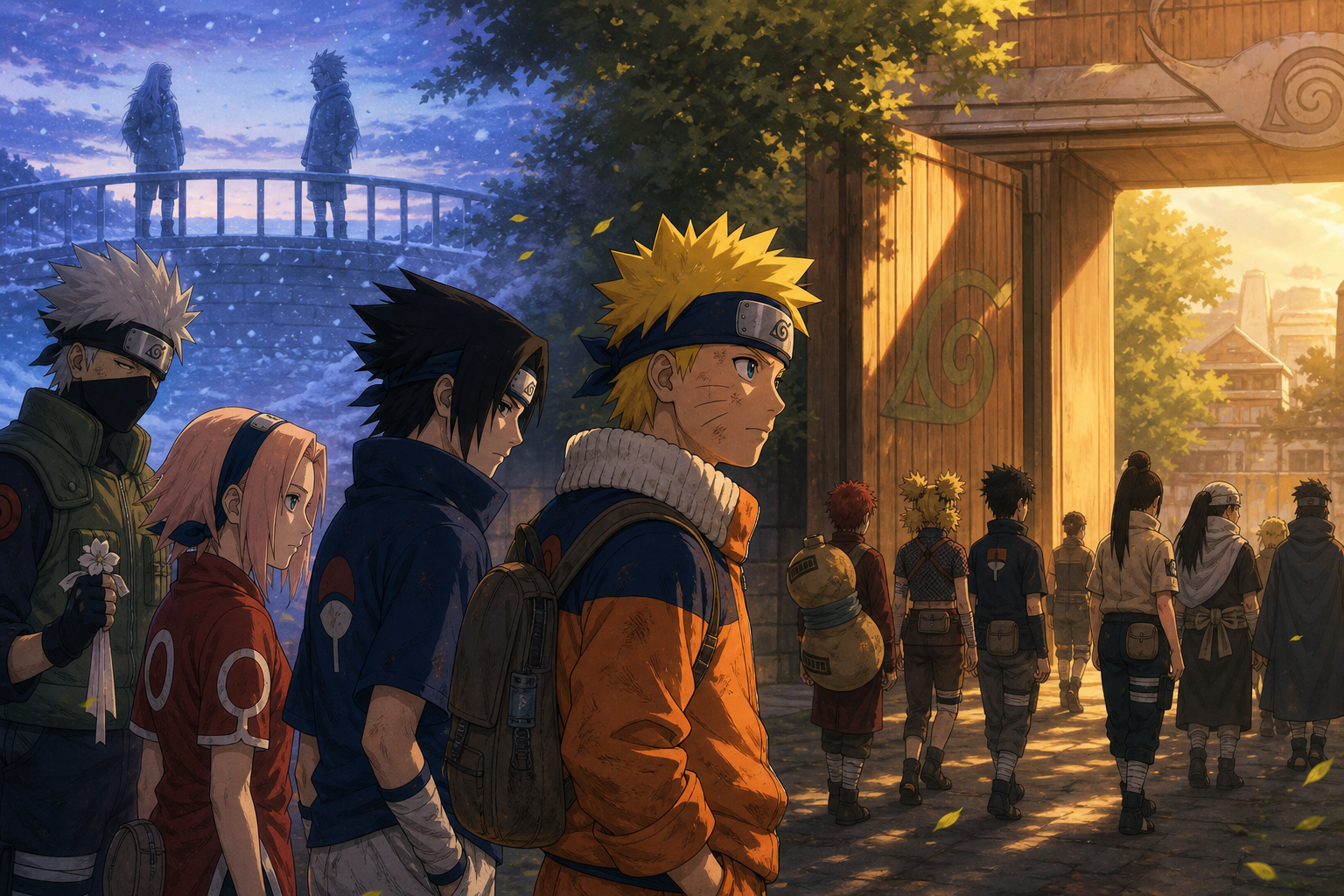
They return to the same village as different children.
Team 7 comes home carrying Wave inside them. Routine missions now feel too small, familiar walls feel less complete, and the arrival of foreign genin reveals that the world Naruto glimpsed beyond Konoha is about to walk through the front gate.
Home is unchanged, and that is the problem
Naruto Uzumaki, Sasuke, Sakura, and Kakashi return from the Land of Waves having completed their mission. The village still has streets, errands, rank structures, and adults ready to assign new work. Team 7, however, has crossed a distance that cannot be measured only in miles.
They have seen a child become a weapon, a businessman isolate a nation, a teammate apparently die for another teammate, and ordinary people discover collective courage. Konoha’s routine now sits beside that knowledge.
The recap: after the extraordinary, the ordinary feels false
Team 7 resumes lower-level missions. The tasks are legitimate parts of village life, but Naruto experiences them as repetition without growth. Before Wave, completing basic assignments could be understood as progress toward becoming Hokage. After Wave, he knows how little the academy and errands prepared him for the world beyond the gate.
His restlessness is partly adolescent impatience. Naruto wants stronger enemies and visible advancement. Yet the complaint also contains a serious recognition: the mission system classifies difficulty, but classification cannot fully predict moral reality. A supposedly simple escort exposed Team 7 to forces far beyond their rank.
Naruto now understands that powerful opponents exist everywhere. Zabuza and Haku were not final bosses waiting at the edge of the world. They were the first evidence that the world is larger than Konoha’s internal hierarchy.
Sasuke carries the same discovery differently. His new Sharingan, protective reflex toward Naruto, and encounter with Haku have expanded the field against which he measures himself. The quiet does not mean the experience has vanished. Sasuke turns experience inward, where it can become discipline or deepen isolation.
Sakura’s return is also complicated. She performed her duty by protecting Tazuna, but much of the decisive fighting occurred beyond her capacity. That gap between knowledge and power becomes increasingly difficult to ignore. Home gives her space to interpret the feeling, though the series has not yet given her equal room to act on it.
Kakashi observes the team with the perspective of someone who knows that survival changes students unevenly. A teacher cannot simply declare the mission complete and assume the emotional consequences have been filed with the report.
The episode’s apparent calm is therefore not emptiness. The opening movement is decompression. Team 7 is trying to fit expanded selves back into familiar roles.
Then new figures begin appearing in Konoha. Young shinobi from other villages arrive as representatives for the Chunin Exam. Their clothes, headbands, manner, and chakra signatures make the wider political world visible.
The exam is framed as advancement. Genin can become chunin by demonstrating readiness for greater responsibility. But the gathering is more than a school test. Hidden villages place their future operatives in one location, observe rivals, display talent, and convert children’s performance into institutional prestige.
Naruto initially sees opportunity. Strong opponents mean chances to prove himself and become stronger. His enthusiasm is understandable after the frustration of routine work.
Yet Wave has given the audience reasons to question the excitement. Haku became extraordinarily capable through danger and lost childhood. Sasuke’s Sharingan awakened while protecting Naruto from lethal force. Strength gained under pressure is real, but the systems producing it are not morally neutral.
The arrival of foreign genin also disrupts Naruto’s village-centered imagination. He has treated Hokage as the peak of the world because Konoha was the only social universe he knew. Now other villages arrive with their own elites, histories, ambitions, and definitions of strength.
Home becomes one position among many. This does not diminish Naruto’s dream. The wider field makes Naruto’s dream more complex. Leading Konoha will require understanding how Konoha exists in relation to people beyond its walls.
The episode closes on anticipation rather than conflict. A new chapter begins because Team 7 has become capable of perceiving the doorway. Before Wave, the Chunin Exam might have looked like a tournament. After Wave, it looks like an institution through which the shinobi world reproduces itself.
Why routine feels insulting after trauma
People returning from intense experiences often discover that ordinary life has continued without them. Familiar tasks can feel unreal, trivial, or even offensive because the internal scale has changed.
Naruto expresses this as boredom and hunger for strength. He does not yet possess language for grief integration, survivor guilt, or post-adrenaline restlessness. “These missions will not make me stronger” is the vocabulary available to him.
The danger is mistaking intensity for meaning. Wave mattered because relationships, injustice, and courage were at stake, not because the mission was deadly. If Naruto learns to seek danger simply to feel growth, the shinobi system will gladly provide it.
The healthier lesson is that ordinary competence and emotional processing are also forms of strength. Returning a pet or helping a neighbor will not look heroic beside Haku’s mirrors, but a village worth protecting depends on unremarkable care.
The Chunin Exam is not merely a test
A chunin rank promises increased authority, harder missions, and leadership responsibilities. The exam therefore claims to measure judgment as well as combat ability.
But bringing villages together turns evaluation into diplomacy and spectacle. Each candidate represents an institution. Individual performance becomes evidence of collective military capacity.
This creates conflicting incentives. A responsible leader should protect teammates and know when retreat is necessary. A village displaying strength may reward risk, dominance, and techniques impressive enough to intimidate observers.
The exam will test more than Team 7. The exam will expose what the hidden villages believe a successful young shinobi should become. Wave has already given Naruto a counter-standard: strength must remain connected to the humanity of the person using it.
Home after the bridge
The Great Bridge is eventually associated with Naruto because his courage helped Wave reclaim hope. Yet Naruto returns to Konoha without fully understanding the scale of that legacy.
This is important. Heroism does not always deliver immediate self-knowledge. Naruto changed Inari and Zabuza while still feeling like an impatient genin overlooked by his own village.
The contrast protects the story from easy triumph. Public significance elsewhere does not automatically heal private wounds at home. Naruto still wants Konoha’s recognition, and the Chunin Exam appears to offer a stage where recognition can be won visibly.
That desire will make him brave and vulnerable. If he treats ranking as proof of worth, the exam can reproduce the same conditional logic that trapped Haku. Naruto’s challenge is to compete fiercely without allowing evaluation to define his right to belong.
Team 7’s four different thresholds
He wants stronger challenges and recognition, but now carries the seed of an ethic that sees enemies as people.
The Sharingan and his sacrifice prove growth is entangled with bonds he still resists naming.
She returns aware that intelligence and discipline must become greater agency in the field.
He must decide whether advancement honors the team’s growth or feeds them too quickly into the same system that produced Haku.
The village becomes a diplomatic stage where children carry adult political meanings.
We can enjoy the coming competition while remembering what shinobi advancement costs.
Easter eggs and craft details
Team 7 once crossed outward into ignorance. Now outsiders cross inward, bringing the larger world to Konoha.
Naruto’s comedy masks a credible response to returning from sustained danger.
A C-rank mission exceeded its classification, warning that credentials cannot make the world predictable.
Village symbols turn individual children into visible representatives of political systems.
The absence of Haku and Zabuza from daily Konoha life emphasizes how privately Team 7 must carry them.
The transition changes pace while preserving the ethical questions developed on the bridge.
RaeRae reacts: baby, you do not need a stronger enemy, you need a nap and therapy
Naruto returns from one of the most emotionally devastating first missions imaginable and immediately complains that ordinary missions will not make him stronger. Sir. Please sit down. Eat ramen. Process one feeling.
But I understand him. After Haku and Zabuza, chasing pets must feel like someone shrank reality. Naruto has discovered that he can matter in enormous ways. Routine cannot immediately satisfy that expanded sense of possibility.
The arrival of foreign genin is delicious because the story opens all its doors at once. Konoha is no longer the whole map. New faces carry new villages, techniques, rivalries, and political histories.
Still, Wave changes how I watch the excitement. These are children being displayed as future military leaders. I want the fights, the drama, and the iconic introductions, but I am not letting the system sneak past me wearing tournament music.
What the author is really telling us
Episode 20 examines the instability of home after knowledge. Naruto cannot return to being the child whose only horizon was the Hokage Monument. The world beyond the gate has entered his moral imagination.
Existential growth often feels like dissatisfaction because former structures no longer contain the self. Naruto interprets the feeling as a need for stronger missions. The deeper need is a way to integrate what Wave revealed about strength, grief, and responsibility.
The Chunin Exam offers a socially approved path forward. Institutions are skilled at capturing personal restlessness and translating it into rank competition. The exam may cultivate genuine leadership, but it also tells young people that advancement will resolve uncertainty.
Naruto’s task is to participate without surrendering authorship. He can seek chunin status, test his strength, and meet the world while still asking whether the values measured are the values worth living.
This episode is a threshold because the series itself matures. The first arc proved Naruto can change individual hearts. The next will ask what happens when many children, clans, and villages collide inside a system designed to compare them.
The danger of mistaking escalation for development
Serialized action stories naturally promise larger tests after a completed arc. Episode 20 acknowledges that appetite through Naruto. He wants the next thing to be harder because hardness feels like evidence that life is moving.
But development is not identical to escalation. A stronger opponent can expose new ability without producing greater wisdom. Haku and Zabuza changed Naruto because he allowed their lives to complicate his worldview, not merely because they were dangerous.
This distinction should become part of the CVM Sekai episode lens going forward. We will track techniques and victories, but also ask whether characters metabolize experience. Does a battle widen empathy, clarify values, change a relationship, or expose an institution? If not, more power may be spectacle without growth.
Naruto’s restlessness is therefore a promise and a warning. His hunger will keep him moving when others surrender. That hunger can also make Naruto vulnerable to systems that equate pain with merit. The Chunin Exam is perfectly designed to reward that confusion.
The mature version of Naruto’s ninja way will need to say: I will not give up, and I will not assume suffering is valuable simply because I survived it.
Konoha looks ordinary because the children are carrying the change
Team 7 returns from a mission that exposed assassination, economic control, child exploitation, and death. The village streets have not transformed to acknowledge any of it. Shops open, people talk, and the mission system continues. The dissonance is the point. Home can remain visually familiar while the people returning to it no longer fit the version they left.
Naruto wants movement because stillness would require processing what happened. Sasuke turns inward because his new power and his sacrifice complicate the revenge story he uses to organize himself. Sakura resumes routine while carrying knowledge that routine cannot name. Kakashi understands more than he says.
The Chūnin Exam converts growth into institutional measurement
The exam promises advancement, recognition, and stronger opponents, but it is not a neutral school test. Hidden villages display young shinobi, compare military capacity, and place children under escalating pressure in front of political audiences. Promotion is personal for the genin and strategic for the institution.
Naruto hears opportunity. He wants proof that the village must acknowledge him. Sasuke hears a field of rivals who might move him closer to the strength he needs. Sakura has to decide whether belonging to Team 7 is enough reason to enter a process she understands may expose the gaps between them.
Kakashi’s recommendation carries trust and risk
Recommending the entire team signals that Kakashi believes they have changed since the bell test. He has watched them cooperate under real danger, improvise against Zabuza, and continue after the mission exceeded its rank. That evidence matters.
So does the fact that their survival was narrow. Sasuke appeared dead. Naruto lost control of the Nine-Tails chakra. Sakura was repeatedly placed in a defensive role without equivalent combat experience. Advancement may honor what they achieved, but achievement under a broken assignment is not proof that more danger is what they need next.
Iruka’s concern is not lack of faith
Iruka knows Naruto’s determination and understands how desperately Naruto wants acknowledgment. That is precisely why he worries. A child who experiences promotion as proof of worth may accept danger without asking whether the institution has earned that sacrifice.
Protectiveness can become condescension if it refuses to see growth, but skepticism can also be care. Iruka represents the adult question the arc transition needs: are these genin ready, or have adults become impressed by how well children survived what they should not have faced?
Konohamaru’s comedy mirrors Naruto’s old performance
Konohamaru enters with noise, schemes, and a hunger to establish identity beyond the Hokage’s grandson. Naruto recognizes the performance because he built his own reputation from pranks when ordinary requests for attention failed.
The humor gives the episode air after the bridge, but it also shows how quickly children learn to perform a self loud enough to interrupt inherited labels. Konohamaru wants to be seen apart from family prestige. Naruto wants to be seen apart from the beast sealed inside him. Their methods are childish because they are children.
The new rivals expand the map without erasing Team 7
The approaching exam introduces genin with different village histories, team cultures, and relationships to power. Naruto’s world widens beyond the classmates and adults who have defined his ambitions. Every new face can be competitor, threat, ally, or evidence that Konoha is not the center of every story.
That expansion raises the stakes for the site’s editorial work too. A tournament arc can flatten people into matchups. The stronger reading asks what each village trained its children to believe, what each team owes its institution, and who benefits when their abilities become public evidence of national strength.
Escalation is not the same as recovery
Anime momentum encourages us to celebrate the next challenge immediately. RaeRae is pausing there. Team 7 has barely returned from watching Haku and Zabuza die. Naruto learned that an enemy can be kind. Sasuke moved as if Naruto’s life mattered more than his revenge. Sakura guarded the mission while unable to reach them. None of that disappears because a new application form arrives.
Recovery is not laziness, and readiness is not proved by craving another test. The series moves forward quickly because adventure demands it. The emotional record should remain visible even when the schedule does not make room.
RaeRae’s final take
Episode 20 succeeds as a threshold. The Land of Waves changed Team 7, while Konoha offers a system prepared to convert that change into rank. Naruto sees acknowledgment ahead. Sasuke sees stronger measuring sticks. Sakura faces a decision about whether she can remain beside them. Kakashi places professional confidence behind all three.
The Chūnin Exam will be thrilling, but the invitation carries an institutional question from the beginning. When children survive an assignment adults misjudged, should the reward be time to heal, or proof they can survive something worse?
Naruto is ready to shout his answer. The episode leaves enough room for us to wonder whether readiness and hunger have been mistaken for the same thing.
Sakura’s hesitation makes the team decision more honest
Naruto and Sasuke can make the exam sound inevitable because each boy already sees advancement as part of his private destination. Sakura has more reason to pause. Her chakra control is excellent, but the Land of Waves exposed how unevenly combat confidence and narrative attention are distributed across Team 7.
Her choice should not be reduced to keeping up with boys. Entering means trusting her own preparation, accepting responsibility for teammates who attract danger, and deciding that fear will inform her without making the decision for her. That interior threshold is as important as any new opponent waiting outside the classroom.
The exam begins long before the first proctor speaks. It begins when each child decides what advancement is supposed to prove, and whose expectations that proof is meant to satisfy.
Episode file
| Episode | 20 |
|---|---|
| Title | A New Chapter Begins: The Chunin Exam! |
| Arc position | Land of Waves aftermath and Chunin Exam introduction |
| Key conflict | Team 7 struggles to fit expanded experience into routine as foreign genin arrive for the Chunin Exam. |
| Emotional center | Home feels smaller after the world has entered you. |
| Official guide | Naruto Official Episode 20 guide |
| Watch officially | Crunchyroll · Netflix availability varies by region |
Final verdict
Episode 20 succeeds because it refuses to treat a new arc as emotional amnesia. Team 7 returns home carrying the bridge, the snow, and the people they could not save. The Chunin Exam arrives not as a reset but as the next institution through which their new selves must move.
Rating: 9/10. A deceptively quiet threshold that turns restlessness into world expansion.