
The Oath of Pain
Kakashi disappears inside a transparent prison, Naruto refuses the safety of retreat, and two rivals invent a plan whose most important weapon is their willingness to understand each other.
Naruto’s oath matters only when it stops being a sentence about who he wants to be and becomes a decision that another person can rely upon.
The Mirror Cracks
Episode 7 ended with Kakashi apparently inside Zabuza’s rhythm. The Sharingan copied movement, anticipated speech, and made the assassin question whether his thoughts belonged to him. Episode 8 opens by showing why apparent mastery is never the same as control.
Zabuza’s frustration is real, but it is also useful. He allows Kakashi to believe the psychological advantage has settled the battle. Their mirrored movement leads into water, where Zabuza’s environment can close around the Copy Ninja.
The reversal is important because the Sharingan reveal could otherwise flatten danger. Kakashi has a legendary eye and a thousand copied techniques, but no gift removes the possibility of being read in return. Zabuza cannot duplicate the Sharingan, so he copies its strategic function: let the opponent see the pattern you want him to follow.
The battle becomes a hall of mirrors. Kakashi copies Zabuza’s hand signs. Zabuza copies Kakashi’s confidence. Each fighter tries to turn the other’s perception into a trap.
Inside the Water Prison
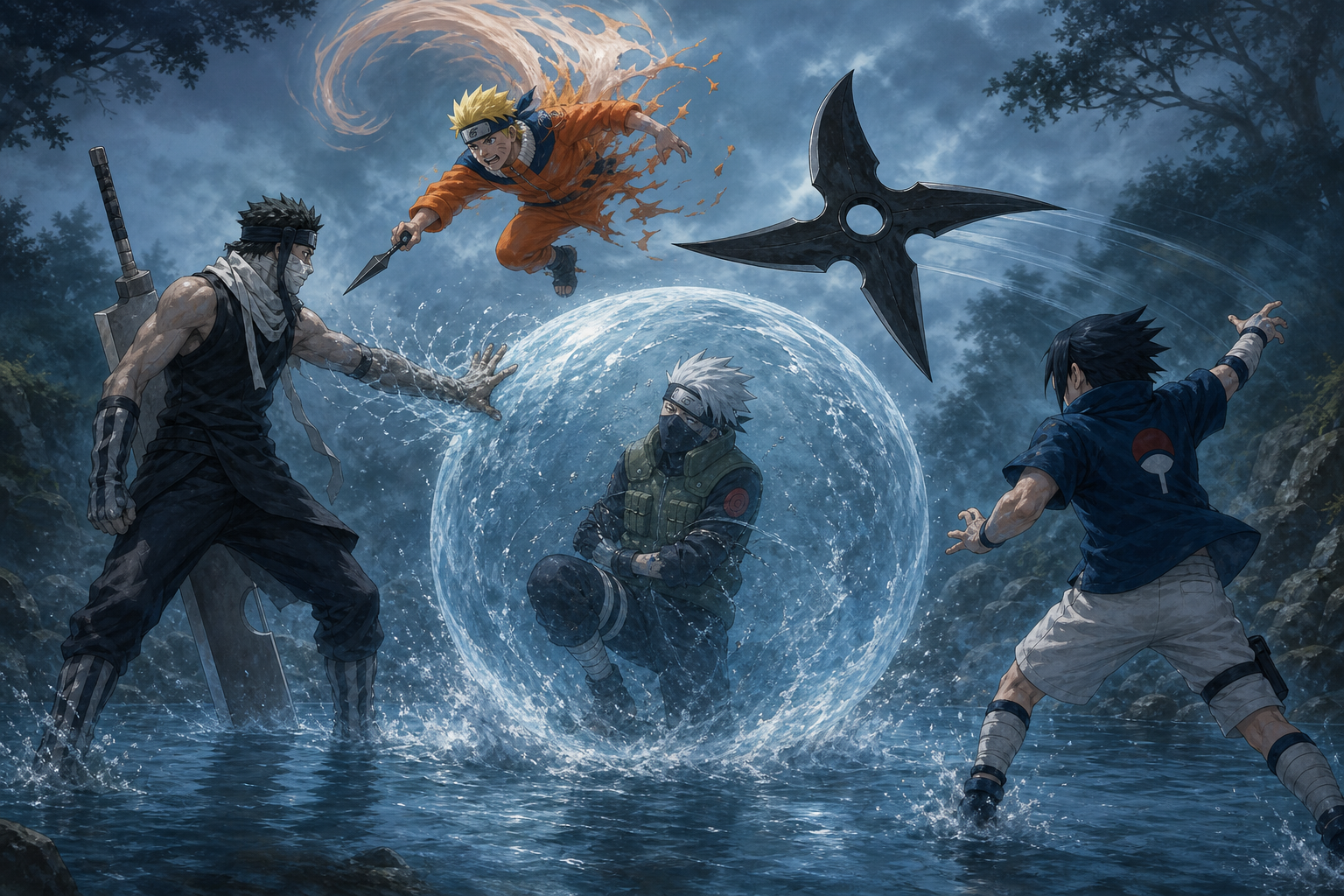
Zabuza captures Kakashi in a sphere of rotating water sustained by direct contact. The prison is almost perfectly transparent. Kakashi can see his students, and they can see him, but visibility does not create access.
That image is quietly cruel. The adult protector remains conscious, present, and able to speak, yet physically unavailable. Team 7 has not lost Kakashi to death. The team has lost the assumption that his strength can always reach them.
For the children, the distinction may be worse. A dead protector cannot issue instructions. Kakashi continues explaining the danger from inside the very technique proving that he cannot solve it alone.
Zabuza must keep one hand in the sphere, which creates a limitation. He answers it by producing a water clone with enough power to attack the genin and Tazuna. The original remains at the prison. The clone carries his violence outward.
The technique therefore divides responsibility without dividing intention. Zabuza can imprison the strongest enemy and threaten the vulnerable group at the same time. Team 7’s defensive formation becomes the only barrier between the client and an assassin’s copy.
Kakashi Orders Retreat
Kakashi tells the genin to take Tazuna and run. The order is rational. The mission has exceeded its rank, the jonin is immobilized, and the children have no realistic basis for defeating Zabuza directly.
Retreat would not be cowardice. Leaving would preserve the client, which remains the mission objective. Kakashi is willing to remain imprisoned so the others can escape the consequence of Tazuna’s deception.
This complicates Naruto’s refusal. The series does not present “never run” as universally intelligent. A shinobi who cannot retreat becomes easy to manipulate. Courage without judgment can kill the people it claims to protect.
Naruto stays because the order collides with a promise formed after the Demon Brothers. He vowed never to freeze and abandon himself again. He also understands, even if he cannot articulate it calmly, that leaving Kakashi would violate the team ethic that earned them their headbands.
The question is whether he can transform refusal into strategy before refusal becomes another form of selfishness.
The Forehead Protector in the Dirt
Zabuza’s clone knocks Naruto down and sends the forehead protector Iruka gave him spinning into the mud. The metal plate is not ordinary equipment. The forehead protector is the first public symbol that an adult inside Konoha recognized Naruto as worthy of belonging.
Naruto crawls toward it while the enemy stands above him. The movement resembles a child reaching for pride, but the emotional object is deeper. Iruka’s gift contains a memory of being seen accurately. Naruto retrieves the protector because he needs access to the self Iruka believed could exist.
He ties it back on and declares that he will not run. The vow alone cannot defeat a water clone. What matters is the next movement: he turns toward Sasuke.
Episode 8 distinguishes identity from performance with exquisite precision. Putting on the headband does not make Naruto brave. Asking another person to build a plan with him does.
Shadow Clones as Deliberate Noise
Naruto fills the field with shadow clones and rushes Zabuza’s copy. The attack looks like familiar excess: more bodies, more shouting, more insistence that quantity will overcome skill.
The water clone destroys or disperses the assault. Yet failure is built into the tactic. The clones occupy attention, create visual noise, and allow Naruto to move an object through the confusion.
This is an early sign that Naruto’s apparent chaos can contain structure. Opponents dismiss the clones as undisciplined repetition because the surface resembles Naruto’s personality. He learns to use that expectation. Loudness becomes camouflage.
The strategy also reframes the technique introduced in Episode 1. Against Mizuki, the crowd was direct force and emotional reversal. Here, the crowd is misdirection supporting cooperation. The same jutsu develops because Naruto’s relationship to other people is developing.
The Folded Shuriken
Naruto passes a folded Demon Wind Shuriken to Sasuke. He does not explain the whole plan. Sasuke looks, understands enough, and begins moving.
The exchange is tiny compared with the spectacle that follows, but it is the episode’s true center. Naruto trusts Sasuke’s technical precision. Sasuke trusts that Naruto’s impossible idea contains a second layer he cannot yet see.
These boys still communicate through insults more easily than honesty. Under pressure, however, their attention to one another is exact. Rivalry has made each boy a devoted observer of the other. The same comparison that causes pain also gives them a shared tactical language.
Teamwork does not require emotional harmony. Cooperation requires enough recognition to predict what another person can and will do.
Operation Windmill
Sasuke throws the giant shuriken toward Zabuza’s original body. Because the assassin must maintain contact with the Water Prison, any attack that forces his hand away from the sphere can free Kakashi.
Zabuza reads the first weapon and avoids it. A second shuriken emerges from its shadow. The technique creates a hidden attack inside the silhouette of the obvious one.
Zabuza avoids the second weapon too.
Then the shuriken becomes Naruto.
Naruto transformed himself into the concealed projectile before Sasuke’s throw. In human form, airborne and close, he releases a kunai toward Zabuza’s extended arm. The attack does not need to defeat an elite assassin. The kunai only needs to force a reflex.
Zabuza removes his hand from the prison. The sphere collapses. Kakashi is free.
The satisfaction of the reveal comes from layered purpose. The clones conceal the handoff. The first shuriken conceals the second. The second conceals Naruto. Naruto’s kunai conceals the real objective: interrupt contact rather than inflict decisive damage.
The Body as a Hidden Weapon
Naruto literally transforms into a weapon. In a shinobi story, the move is clever and exhilarating. The transformation is also thematically dangerous.
The hidden village trains people to become tools. Missions assign bodies to objectives. Bloodline abilities become strategic assets. Zabuza’s sword and Kakashi’s copied techniques create identities organized around usefulness in violence. Naruto’s transformation makes the metaphor visible: the child becomes the projectile.
What prevents the scene from feeling purely dehumanizing is relationship and consent. Naruto is not thrown by an owner who sees him as disposable. He develops the risk with Sasuke. Sasuke recognizes the choice and performs his part. Their goal is to free a comrade who would otherwise sacrifice himself for them.
Agency does not erase danger, but it changes its moral structure. Naruto can become a shuriken without accepting that “weapon” is the whole of his identity. He transforms back, chooses, speaks, and remains someone worth protecting.
Why the Plan Works
The tactic succeeds because Naruto and Sasuke contribute different intelligences. Naruto generates the premise Zabuza will not imagine: a person hidden inside an object hidden inside another object’s path. Sasuke supplies timing, throwing skill, and the calm required to make the deception credible.
Naruto alone might reveal the trick too early. Sasuke alone might choose a precise attack Zabuza can read. Together, unpredictability receives form.
This is the first major proof of Kakashi’s bell-test lesson. Teamwork is not simply helping or sharing. Cooperation creates an outcome that does not exist inside any individual member.
The boys do not become less themselves. Naruto remains reckless and inventive. Sasuke remains controlled and exact. Cooperation does not erase difference. The plan composes difference.
The Oath of Pain
The episode title reaches back to Naruto stabbing his poisoned hand and promising never to hesitate again. The pain was intended as proof. He wanted the body to remember the identity he had chosen.
Episode 8 quietly improves the oath. The meaningful proof is not the wound. The plan carries the proof.
Self-inflicted pain can dramatize resolve, but pain alone teaches nothing specific. Naruto’s collaboration with Sasuke turns shame into attention, creativity, timing, and trust. He does not merely endure the memory of freezing. He builds a different response.
This is an existential act of authorship. Naruto cannot erase the moment when fear immobilized him. He can decide what that memory will produce. The past remains factual without becoming destiny.
Kakashi’s Vulnerability as a Team Lesson
Kakashi’s imprisonment exposes the limits of the fantasy that a powerful mentor can permanently absorb danger for children. He promised to protect them, and he means it. Meaning cannot make him invulnerable.
When Naruto and Sasuke free him, the direction of protection reverses. The students do not surpass their teacher. They make his ability available again.
This reciprocal structure matters. A team is not a ladder where strength flows downward forever. Even the strongest member can become dependent on the attention and action of the least experienced.
Kakashi’s authority is not diminished because he needed them. Need makes his lesson more credible. He taught interdependence and then, unwillingly, had to live inside it.
Character Pulse Check
Naruto
He converts the oath from bodily punishment into collaborative invention. His refusal to run becomes courage only after he accepts that Sasuke’s skill is part of the answer.
Sasuke
He reads Naruto’s incomplete communication and executes the throw without demanding control of the entire idea. Precision becomes trust.
Sakura
She continues guarding Tazuna while the boys attack. Her role preserves the mission’s center and prevents the entire team from chasing spectacle.
Kakashi
His legendary eye cannot prevent capture. He chooses the students’ escape over his own safety, then becomes the beneficiary of the teamwork he demanded.
Zabuza
He turns Kakashi’s apparent advantage into confinement and manages simultaneous threats through a clone. His defeat in this episode is positional, not total.
Tazuna
The children are risking themselves inside danger his lie concealed. Their decision to continue does not erase his responsibility for the imbalance.
Easter Eggs and Rewatch Echoes
Objects that are people
Naruto repeatedly defeats rigid perception by crossing categories. A clone can be physical. A shuriken can be a child. The boy whom the village reduced to a container for the Nine-Tails develops a fighting style that punishes anyone who assumes containment defines identity.
The first deep Naruto-Sasuke combination
The boys do not need a friendship speech. They share a tactical grammar. Later conflicts will make their inability to speak emotionally devastating precisely because their bodies once understood one another this well.
Kakashi inside a transparent boundary
The Water Prison makes visible a recurring emotional condition. Kakashi often remains near the people he protects while sealed behind grief, secrecy, or role. They can see him without having access to everything he carries.
The hand that must move
Zabuza’s technique depends on contact. The entire plan is built around a single physical constraint. Naruto’s genius frequently begins with noticing that an overwhelming power still has one rule it cannot escape.
The Hidden Village and Chosen Instrumentality
Shinobi society turns people into instruments, but Episode 8 distinguishes imposed use from chosen service. Zabuza’s clone is an obedient extension. Kakashi’s body is trapped by another man’s technique. Naruto transforms himself voluntarily to free someone.
The distinction does not make the system harmless. Children are still learning military tactics in lethal conditions. Yet the episode locates a pocket of freedom inside the machinery. A person can choose how ability enters relationship.
Naruto will never escape being useful to institutions, villages, friends, and enemies. His deeper struggle is to remain the author of what his power serves.
Reaction: Rivalry Becomes Recognition
Operation Windmill is one of those early Naruto sequences that survives memory almost intact. The second shuriken appears, Zabuza avoids it, and then the object breaks open into Naruto. The trick is clever in exactly the way the series is best at: the surprise reveals character rather than interrupting the scene.
Naruto does not win by suddenly matching Zabuza’s strength. He wins a narrow objective by understanding limitation. Sasuke does not save the day alone. He allows Naruto’s strange imagination to use his precision.
What moves me most is how little they say. These are lonely children whose emotional language is still under construction. Combat gives them a temporary vocabulary. Naruto hands over possibility. Sasuke gives it direction.
The oath is fulfilled not when Naruto proves he feels no fear, but when fear no longer prevents him from seeing what another person can contribute.
Episode Verdict
Emotional core: Naruto retrieves the headband and turns a private promise into a plan Sasuke can complete.
Best character beat: Sasuke understanding the folded shuriken without needing the entire strategy explained.
Big idea: The self can become an instrument without becoming nothing but a tool when service is chosen through relationship.
Rewatch value: Exceptional. The Water Prison, headband, layered shuriken reveal, and early Naruto-Sasuke fluency all deepen with hindsight.
CVM Sekai rating: 9.7/10. A nearly perfect tactical episode whose action is inseparable from character growth.
Continue the Naruto Journey
Operation Windmill works because rivalry becomes trust
Naruto and Sasuke do not pause for a friendship speech. Sasuke throws the giant shuriken, Naruto hides inside the transformed second weapon, and both boys depend on the other to execute a plan Zabuza will not read in time. The tactic works because their competitive attention has become operational knowledge.
Sasuke knows Naruto will attempt something reckless. Naruto knows Sasuke can place the throw. Neither could free Kakashi alone. The bell test asked whether they could reject manufactured competition. Operation Windmill proves they can build with each other’s strengths while still arguing about who looks cooler.
Naruto’s oath tries to turn pain into control
The wound on Naruto’s hand from the Demon Brothers already showed how quickly shame can make him attack his own body. In Episode 8, pain becomes part of his promise again. He refuses to remain frozen, refuses to abandon the mission, and refuses to accept the identity of a frightened child.
The determination is thrilling. It is also the beginning of a pattern where Naruto treats endurance as evidence that he deserves to stay. His body becomes the receipt he offers whenever people doubt him. The franchise will celebrate that resilience for years, but good coverage has to keep asking why a child believes suffering is the fastest way to prove belonging.
Kakashi’s freedom restores the adult scale of the fight
Once the Water Prison breaks, Kakashi can confront Zabuza directly. The students’ plan does not make them equal to the Demon of the Hidden Mist. It creates the opening that lets their teacher resume responsibility. That boundary matters. Children contribute courage and ingenuity; the jōnin still owes them protection against the elite killer.
Kakashi’s copied movements and psychological pressure unsettle Zabuza because the Sharingan appears to reach beyond imitation. The direction turns prediction into horror. Zabuza, who built authority through fear and professional certainty, experiences the panic of being read before he acts.
Weapon language keeps hiding people in plain sight
Zabuza speaks through utility, threat, and mission logic. Kakashi answers with his own professional fluency. Naruto and Sasuke are praised when they function effectively inside the same violent system. The episode makes that competence exciting while the larger arc prepares to ask what happens when a human being accepts “tool” as a complete identity.
Haku has not yet received the full emotional file, but the theme is already in position. A body can be trained, rented, sealed, copied, or sacrificed. The story’s moral argument begins when somebody insists the body still belongs to a person.
Sakura holds the objective while the boys get the camera
Sakura stays with Tazuna because protecting him remains the mission. The action choreography gives Naruto and Sasuke the clever rescue and Kakashi the elite duel. Her assignment is less glamorous and still necessary. Leaving the client unguarded so everyone can join the flashy fight would be failure dressed as enthusiasm.
This does not excuse how little the early series gives her to do. It clarifies the difference between limited spectacle and no contribution. Sakura performs the task. The writing should have trusted her with more.
RaeRae’s final take
Episode 8 delivers the first Team 7 combination that feels earned. Naruto’s transformation, Sasuke’s precision, and Kakashi’s recovery connect into one continuous answer to Zabuza’s control. The boys do not win the battle. They prove they can change it.
The “oath of pain” title lands because courage and self-punishment remain tangled inside Naruto. He will protect people. He will also keep offering his body as collateral until somebody teaches him that survival does not need to be purchased every time.
Official Viewing and Episode Guide
Streaming availability varies by region. Watch through an official licensed service carrying the original Naruto series, including Crunchyroll or Netflix where available. Episode continuity was checked against the official Naruto Episode 8 guide.
Editorial note: CVM Sekai’s Naruto coverage centers the original Japanese series and original Japanese performances. English dub casting is outside this project’s scope.