
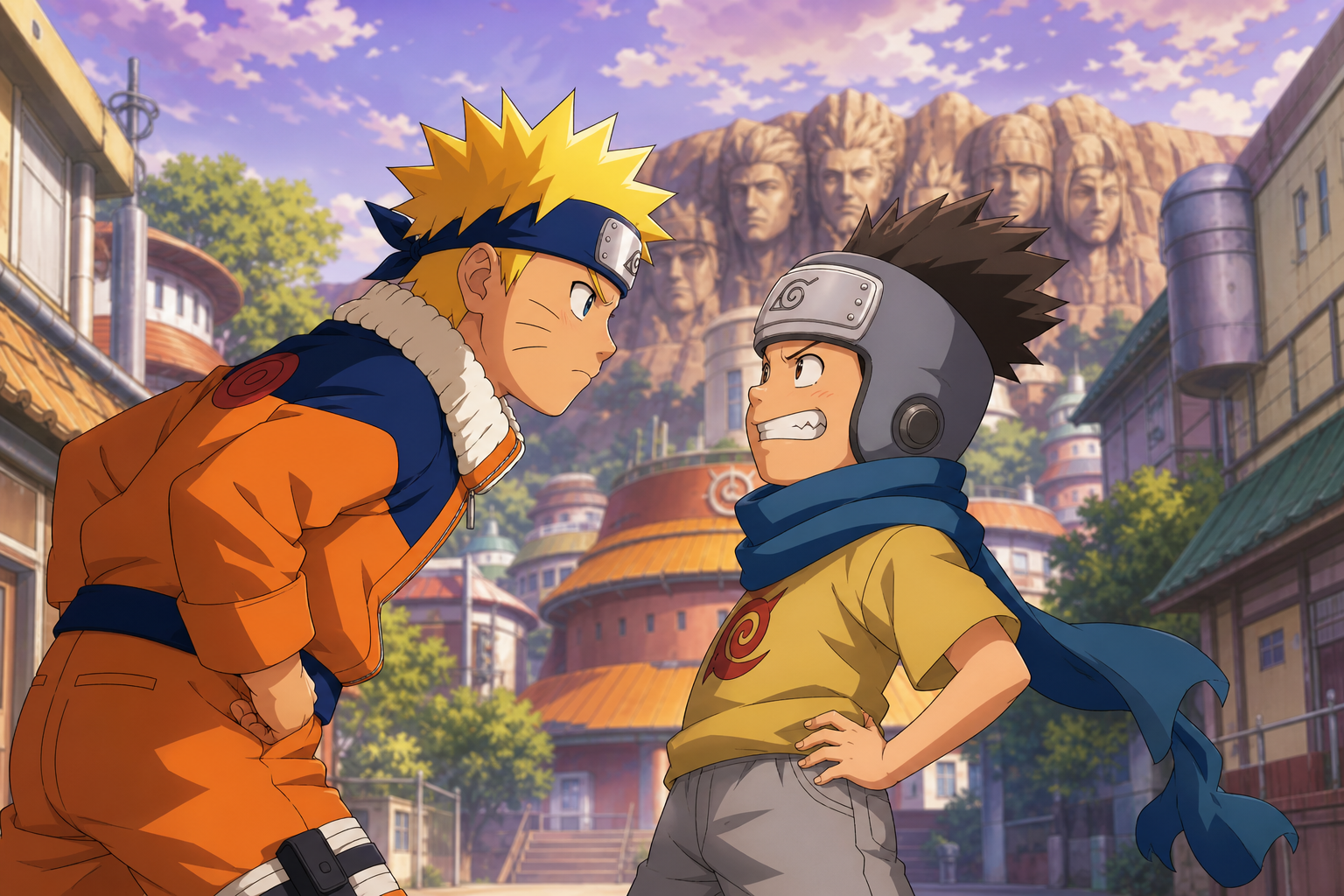
My Name Is Konohamaru!
One episode after Naruto finally receives a symbol of belonging, he meets Konohamaru Sarutobi, a smaller boy trapped by the opposite problem: everyone sees the title around him, and almost no one sees him.
The Feeling You Remember
Episode 2 is louder, sillier, and more openly juvenile than the premiere, with pratfalls, a child stalking Naruto, Ebisu‘s offended dignity, and the return of the Sexy Jutsu. On a distant rewatch, it can blur into “the episode where Naruto meets the Hokage’s grandson.” Watching closely reveals a surprisingly careful emotional rhyme.
Naruto has spent his childhood wanting the village to attach importance to his name. Konohamaru has spent his childhood wanting the village to stop attaching someone else’s importance to his. Naruto believes recognition is absent. Konohamaru experiences recognition as misrecognition. Everyone bows, indulges, corrects, and protects him because he is “the Honorable Grandson.” The title fills the room so completely that the child inside it cannot breathe.
The episode’s comedy works because Naruto is almost uniquely incapable of honoring that script. He trips over Konohamaru and responds as he would to any irritating kid. He does not become deferential when he learns the family connection. From an adult perspective, Naruto is rude. From Konohamaru’s perspective, rudeness feels like oxygen.
Scene-by-Scene Recap
A grandson launches an ambush
Konohamaru bursts into the Hokage’s office trying to catch his grandfather off guard and tumbles into Naruto’s orbit instead. The introduction establishes aspiration before competence. Like Naruto’s failed clone in Episode 1, Konohamaru’s failed attack is funny because the ambition is enormous and the execution is painfully small.
The adults around him rush to interpret the collision politically. Naruto does not. He is already furious about how long official business takes and does not see why one small child should be protected from the consequences of starting a fight. Konohamaru notices the difference immediately. He has found someone who can see a boy before seeing a dynasty.
The shadow that follows Naruto
Konohamaru trails Naruto through the village with comically transparent disguises. Naruto notices every attempt. The sequence repeats the episode’s concern with visibility. Konohamaru thinks he is hidden when he is obvious, yet feels unseen when adults stare directly at him. Physical concealment and social invisibility are not the same thing.
When confronted, Konohamaru declares Naruto his boss and asks for the secret technique that defeated the Third Hokage. The misunderstanding is perfect kid logic. Naruto’s transformation did not defeat Hiruzen politically or physically. Naruto disrupted adult composure. To a child living beneath ceremonial authority, the ability to make the great Hokage lose control looks revolutionary.
Sexy Jutsu as forbidden education
Naruto tries to teach Konohamaru the Sexy Jutsu. The joke is deliberately immature, but the training scene establishes a serious pattern: Naruto teaches through staged attempts, blunt feedback, and persistence. He is only one day removed from graduation, yet someone already treats his improvised knowledge as expertise.
Konohamaru’s transformations fail in ridiculous ways. Naruto does not tell him that lineage should make the technique easy. He makes him repeat it. This is the episode’s first correction of inherited privilege. Being the Hokage’s grandson can secure access to tutors, but it cannot perform chakra control on his behalf.
Ebisu arrives with the proper curriculum
Ebisu enters as the official elite tutor, visually controlled and convinced of the difference between respectable instruction and Naruto’s chaos. His contempt is understandable at the level of classroom content. Naruto is teaching a younger child a vulgar technique. Yet Ebisu also participates in the environment Konohamaru resents. He speaks to the grandson as a future elite whose path is already organized by family significance.
Ebisu’s devotion to credentials cannot perceive the emotional lesson occurring outside his curriculum. Naruto has not yet taught Konohamaru a useful combat technique. He has shown him what it feels like to fail without the failure being converted into a statement about the Sarutobi name.
The truth beneath “Honorable Grandson”
Konohamaru finally explains his anger. People do not call him by his name. They call him the grandson of the Third Hokage. He wants to defeat Hiruzen and take the title because he imagines victory will force the village to recognize Konohamaru as an individual.
Naruto understands the hunger and rejects the shortcut. Becoming Hokage will not happen by beating one old man in a surprise attack. The entire village must acknowledge the person. The statement is partly projection, because Naruto is describing his own dream. The statement also becomes his first meaningful act of mentorship. He refuses to flatter Konohamaru with an easy route even though flattery would preserve the boy’s admiration.
Naruto gives Konohamaru the lesson Iruka gave Naruto: care is not the promise that belonging will be easy. Care is refusing to turn someone else’s pain into a comforting lie.
A ridiculous victory with a real consequence
Ebisu attempts to drag Konohamaru back to the approved path. Naruto intervenes, and the confrontation culminates in the Harem Jutsu. The technique defeats Ebisu through comic overload. The gag also demonstrates Naruto’s signature ability to recombine ordinary tools into something opponents cannot anticipate. Transformation plus shadow clones becomes a new technique because Naruto thinks laterally.
Konohamaru is impressed, but Naruto does not accept him as a passive follower. He defines them as rivals for the Hokage title. That move grants equality while preserving challenge. Konohamaru is no longer an honored child beneath Naruto or a disciple behind him. He is another person with a name and a road.
Character Reaction
Naruto
He is impatient, vulgar, generous, perceptive, and newly confident. The forehead protector changes how he occupies the village. He now has something to teach because someone trusted him with belonging.
Konohamaru
His arrogance is armor around erasure. He does not want less love from his grandfather. He wants a self that can survive outside the relationship.
Ebisu
He represents competence distorted by hierarchy. His training is legitimate, but his certainty prevents him from seeing why Konohamaru gravitates toward Naruto.
Hiruzen
The Hokage is amused, embarrassed, and politically distant even within family. His office gives Konohamaru privilege while making ordinary recognition harder.
What Episode 2 Is Really Saying
A name can disappear beneath praise
Naruto is wounded by stigma. Konohamaru is wounded by honorifics. The symmetry prevents the series from treating recognition as simple positive attention. A community can praise the role and still fail to know the person. “Honorable Grandson” sounds respectful, but repeated as a substitute for Konohamaru’s name it becomes a soft form of erasure.
The hidden village manufactures identity
Konoha organizes people through clan, rank, family, mission record, and proximity to office. These categories are useful. They are also dangerous when they become conclusions. Naruto is categorized as a monster. Konohamaru is categorized as an heir. Both boys must struggle against identities created before their actions can speak.
This is the political underside of the Hokage Monument. Leadership becomes literal ancestry carved into the landscape. For Naruto, the faces represent a public memory he wants to enter. For Konohamaru, one face is also a grandfather whose shadow follows him into every classroom and conversation.
Existence must be practiced
Konohamaru wants one decisive victory to establish who he is. Naruto tells him identity cannot be won through a single ambush. The lesson has an existential edge: a person becomes legible through repeated choices, labor, failure, relationship, and responsibility. There is no secret technique that can perform a life.
Naruto has not fully learned this himself. He still imagines Hokage recognition as a finish line that will heal loneliness. Yet teaching the principle to Konohamaru begins changing the teacher. Sometimes we articulate a truth for someone else before we are ready to live all of it.
Mentorship begins before mastery
Naruto is an absurd mentor. He has just graduated, lacks formal discipline, and starts with a sexual gag. The episode nevertheless gives him one authentic qualification: he recognizes the wound. Expertise matters, but teaching is not reducible to superior technique. Naruto reaches Konohamaru because he knows what it means to have an entire village use a category instead of a name.
The Two Children Beneath the Monument
Episode 1 asks whether a child can survive being treated as the village’s worst memory. Episode 2 asks whether another child can survive being treated as the village’s future possession. Naruto and Konohamaru meet between those pressures. One has no inherited public place. The other has a public place so complete that it crowds out private discovery.
This makes their rivalry more generous than it first appears. Naruto does not tell Konohamaru to abandon the Sarutobi legacy, hate his grandfather, or pretend family advantage is unreal. He relocates meaning from inheritance to practice. Konohamaru may inherit access, instruction, and expectation. He cannot inherit the village’s genuine acknowledgment. That must emerge from the person he repeatedly chooses to become.
The distinction will matter across Naruto. Sasuke inherits the Uchiha name and its annihilated history. Hinata inherits a clan position structured by hierarchy. Neji inherits the consequence of a branch-family system. Gaara inherits a weaponized political purpose. Naruto himself eventually learns that he inherited far more than the orphan narrative initially suggests. None of these inheritances are imaginary. The moral question is whether they function as resources, wounds, obligations, excuses, or final verdicts.
Konohamaru’s introduction makes that question comic and small enough to hold. He does not need to solve the shinobi world today. He needs someone to call him a rival, demand effort, and use his actual name. The series understands that political transformation often begins as a change in address.
Production and Adaptation Notes
The episode follows the early manga material that establishes Konohamaru and places him in direct thematic relation to Naruto. Animation leans into elastic expressions and broad timing, giving the story a lighter surface after the pilot’s lethal betrayal. That tonal relaxation is strategic. Naruto’s life does not become solemn the moment viewers learn his trauma. Comedy is one of the ways he converts pain into contact.
The repeated transformations also let the production demonstrate a basic technique before later battles make transformation tactically complex. Viewers learn its rules through comedy. Naruto’s Harem Jutsu then establishes the series’ habit of allowing “low” humor and genuine tactical invention to occupy the same move.
Voice performance carries the relational turn. Naruto must sound genuinely irritated before he sounds unexpectedly wise. Konohamaru must remain bratty enough that sympathy feels discovered rather than demanded. Ebisu’s outrage needs precision because he is not evil; he is an adult whose sense of proper order cannot read the children in front of him.
Easter Eggs and Payoff Seeds
- Naruto becomes an Iruka figure almost immediately. He rejects Konohamaru’s shortcut, identifies the deeper need, and offers recognition joined to effort.
- Konohamaru’s name finally becomes audible through rivalry. Naruto does not free him from expectation. He gives him an expectation attached to his own choice.
- The Harem Jutsu is recombination. Naruto’s future innovation often works by combining mastered pieces rather than following the intended form.
- Ebisu will later revise his opinion. The arrogant tutor’s relationship to Naruto and Konohamaru develops beyond this humiliating introduction.
- The Hokage dream now has two social meanings. For Naruto it promises public recognition; for Konohamaru it promises escape from inherited recognition.
RaeRae Reaction
This episode is ridiculous in exactly the way early Naruto should be ridiculous. The comedy does not interrupt the character work. The comedy smuggles the character work past our defenses. We laugh at a tiny child in a bad disguise, then realize he is hiding because the village has never permitted him to arrive without his grandfather’s title entering first.
What hits harder on rewatch is Naruto’s refusal to give him an easy answer. Naruto desperately wants someone to admire him, and Konohamaru is ready to do it. A more insecure Naruto could preserve that worship by selling another shortcut. Instead he risks losing the follower and creates a rival. That is growth one day after graduation.
The score is not about grand action. The score measures thematic efficiency. Episode 2 takes inherited privilege, loneliness, dirty jokes, educational authority, and the politics of naming, then fits them into a child-sized conflict.
Mission scorecard
Emotional impact: 8.4/10
Character depth: 8.8/10
Comedy: 8.7/10
Worldbuilding: 8.2/10
Existential aftertaste: 9/10
Overall: 8.6/10
Where to Watch Officially
Availability varies by region. Check VIZ’s official Naruto viewing options or the official Naruto series page on Crunchyroll.
Konohamaru inherits a title before he earns a self
Everybody around Konohamaru knows who his grandfather is. That sounds like the opposite of Naruto’s problem, but both boys are trapped inside an identity adults prepared for them. Naruto is reduced to the monster sealed inside him. Konohamaru is reduced to the Third Hokage’s grandson. One child is denied a name; the other cannot make people use his without hearing the family office attached.
His challenge to Hiruzen is childish, theatrical, and completely serious. Konohamaru wants the Hokage title because he believes defeating the current holder will make the village recognize him as an independent person. Naruto understands the hunger immediately. He also recognizes the shortcut, because he has been trying his own version through pranks and loud declarations.
Naruto’s first mentorship works because he refuses fake respect
Ebisu approaches Konohamaru through hierarchy, curriculum, and protection of elite expectations. Naruto approaches him as another annoying kid with an impossible dream. He does not bow to the grandson title or flatter him because of Hiruzen. That lack of ceremony gives Konohamaru something rare: an interaction that belongs to him rather than his lineage.
Naruto is not suddenly a polished teacher. His methods include bad advice, competitive posturing, and a transformation gag designed to overwhelm adult dignity. Still, he gives Konohamaru the lesson nobody else will state plainly. Becoming Hokage requires earning recognition through work and relationship. The title cannot be inherited like furniture.
That advice is richer because Naruto has not yet achieved it himself. He teaches from need rather than mastery. Sometimes the person who understands a wound best is the one still trying to survive it.
The comedy is crude, but it is doing structural work
Episode 2 leans hard on the Sexy Jutsu. The joke is adolescent and repeated longer than some viewers will enjoy. It also punctures institutional performance. Hiruzen, Ebisu, and the dignified office of Hokage are defeated by embarrassment and appetite, while the two children nobody takes seriously briefly control the room.
The gag does not erase the gender problems attached to turning a transformed female body into a weapon for male reaction. That discomfort belongs in the reading. Comedy can expose hypocrisy and still carry its own lazy assumptions. Naruto will keep making that bargain, sometimes brilliantly and sometimes like the writers discovered one joke and refused to release it.
Hiruzen sees the pattern and still leaves too much undone
The episode invites sympathy for Hiruzen as a grandfather and leader. He understands that Konohamaru needs room to become himself, and he recognizes Naruto’s influence. Yet the parallel between the boys also sharpens the question of Naruto’s care. Hiruzen can observe both children’s loneliness. Only one has a family home, a tutor, and a publicly acknowledged relationship to the Hokage.
That difference does not make Konohamaru’s pain fake. Privilege and loneliness can coexist. It does make the village’s treatment of Naruto harder to excuse. The institution knows how to surround a politically important child with adults. It simply does not extend comparable care to the child carrying its greatest burden.
The episode begins a relationship that outlives the joke
Konohamaru does not remain a one-episode nuisance. Naruto becomes his rival, model, teacher, and evidence that a disregarded child can define himself. Their bond grows because Naruto never asks Konohamaru to worship him. He expects the boy to work, fail, improve, and keep his own dream.
That makes this small episode more important than its plot summary suggests. Naruto receives recognition from Iruka in Episode 1. In Episode 2, he turns around and offers recognition to somebody else. Healing begins to become practice rather than private reward.
RaeRae’s final take
“My Name Is Konohamaru!” is messy, funny, juvenile, and smarter about inherited identity than its comedy lets on. Konohamaru needs somebody who will say his name without attaching a grandfather. Naruto needs proof that he can matter to another child before the village changes its mind about him. They give each other exactly that, between terrible disguises and one deeply unserious defeat of an elite tutor.
Konohamaru also gives Naruto a preview of leadership
Naruto says he wants to become Hokage because he wants the village’s respect. Konohamaru forces him to practice a smaller version of the job before he has authority. He has to see another child clearly, tell an uncomfortable truth, and resist using admiration as a shortcut. That is leadership without the hat.
The episode does not pretend Naruto has solved responsibility. He still performs, competes, and enjoys being followed. What matters is the direction of travel. Recognition stops being something he only demands and becomes something he can give. The franchise will spend years testing whether he can scale that instinct from one lonely boy to a village full of competing needs.
Konohamaru’s stubbornness makes the exchange mutual. He does not become a passive admirer. He declares rivalry and keeps his own goal. Naruto’s best influence works that way: he makes people feel seen without asking them to become smaller copies of him afterward. That difference matters to both boys and their futures.