
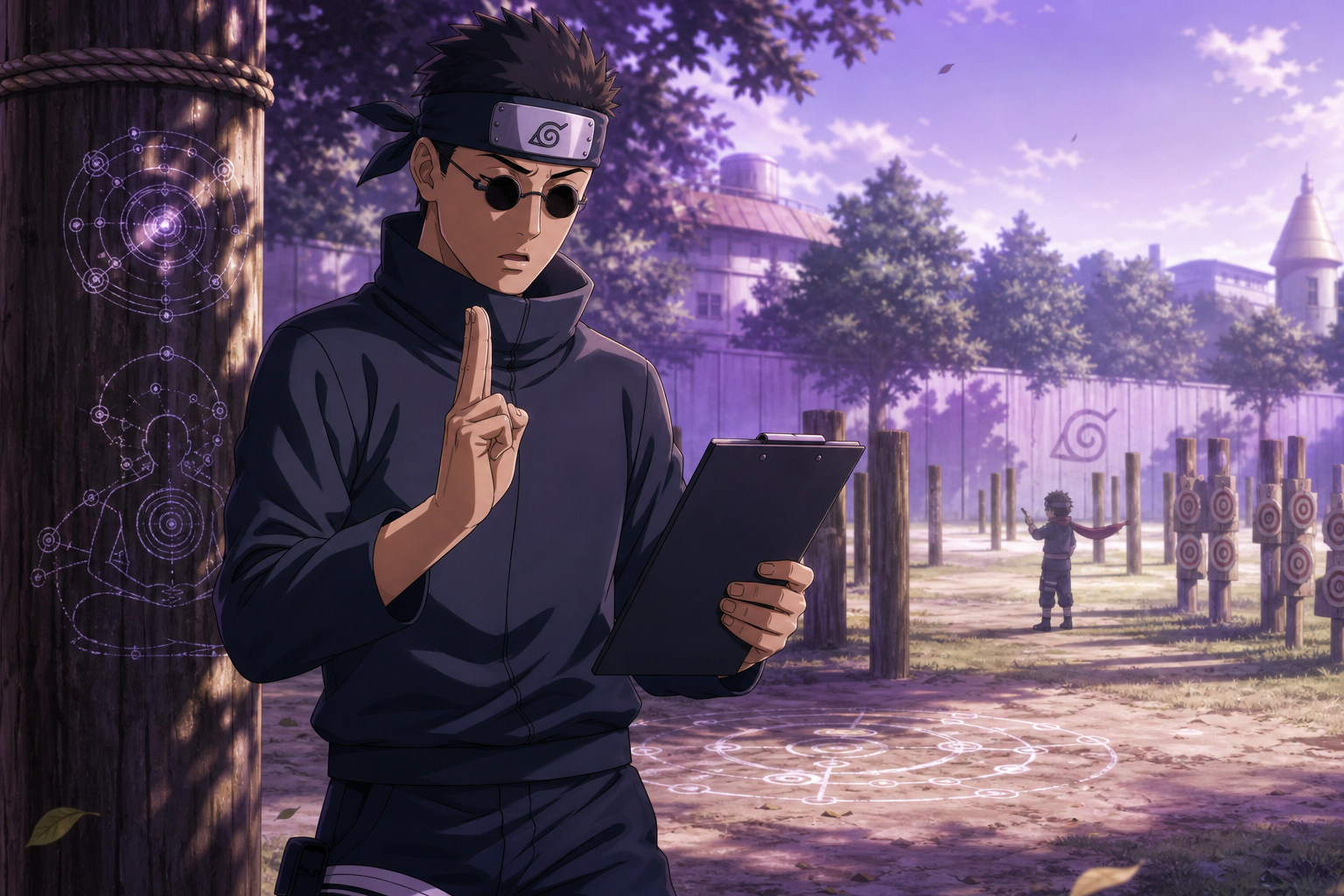
Ebisu
The joke says Naruto knocked him flat with cleavage. The story says Konoha trusted him to teach Hokage candidates, diagnose broken chakra control, and die before betraying the student he once despised.
Ebisu is the teacher whose prejudice gets corrected by evidence.
Ebisu enters Naruto looking like the human form of an admissions committee. He has the sunglasses, the elite-tutor title, the correct posture, the important client, and a very firm opinion that Naruto Uzumaki is an embarrassing container for a demon. Then Naruto beats him with Harem Technique. The gag is ridiculous. The character arc underneath is not. Ebisu watches Naruto influence Konohamaru, studies Naruto’s actual training needs, and eventually risks death rather than reveal Naruto’s location to Pain.
That movement from status judgment to earned respect makes Ebisu more important than his fight record. He represents the ordinary Konoha professional who absorbed the village’s prejudice without thinking deeply about the child carrying the burden. Unlike adults who cling to the first story because changing would bruise their pride, Ebisu changes. He does not become Naruto’s best friend or retroactively erase the harm. He becomes a better teacher because reality defeats his bias.
Verified identity, rank and career record
- Name: Ebisu (エビス)
- Birthdate: March 8
- Age: 28 in Part I; 32 to 33 in Part II
- Height: 181.4 cm
- Weight: 67.5 kg
- Blood type: A
- Ninja registration: 010777
- Village: Konohagakure
- Rank: Tokubetsu jōnin
- Specialty: Elite personal instruction
- Academy graduation: Age 10
- Chūnin promotion: Age 17
- Teams: Team Chōza; later leader of Team Ebisu
- Affiliation: Konoha and Allied Shinobi Forces
- Manga debut: Naruto Chapter 2
- Anime debut: Naruto Episode 2
- Movie appearance: Naruto the Movie: Blood Prison
- OVA record: Hidden Leaf Village Grand Sports Festival!
- Game debut: Naruto: Konoha Ninpōchō
- Status: Alive through the last confirmed Naruto-era record
Ebisu’s record contains a small continuity wrinkle. Flashback art places him in older village scenes wearing ranks and equipment that do not align perfectly with the stated promotion timeline. The safest treatment is to preserve the databook ages and note the visual inconsistency rather than invent a secret promotion or pretend production continuity never slips.
The main manga gives Ebisu relatively little combat spectacle. Anime and game material expand his techniques, including Fire Release and shadow clones. A complete profile should record those demonstrations while labeling the medium. “Ebisu can do nothing because the manga rarely shows him fighting” and “every game animation is core manga canon” are equally lazy conclusions wearing different headbands.
The god of luck name belongs to a man obsessed with proper preparation
Ebisu shares his name with one of Japan’s Seven Lucky Gods, commonly associated with fishermen, commerce, prosperity, and good fortune. Naruto does not turn the tutor into a literal religious allegory. The name supplies a comic cultural echo around a man assigned to cultivate future success. Konoha gives its “lucky” tutor the Hokage’s grandson, and Ebisu spends much of his introduction discovering that luck cannot substitute for work.
He has dark hair, brown eyes, trademark small circular sunglasses, and a Konoha forehead protector worn wide like a bandanna. His usual clothing follows standard dark shinobi attire without the flak jacket, although mission and flashback material sometimes adds the vest. Academy-age Ebisu has side-swept hair, the signature glasses, a dark suit, and a tied brown shoulder wrap. The adult silhouette becomes stricter as he moves into professional instruction.
The sunglasses are a perfect visual joke because Ebisu begins by seeing Naruto badly. His eyes stay hidden while his assumptions remain exposed. The character’s growth does not require removing the glasses for a sentimental reveal. Naruto keeps the design stable and changes the judgment behind the lenses. Subtle work, babes. The man can learn without a makeover montage.
Tokubetsu jōnin means specialist, not discount jōnin
Ebisu is a tokubetsu jōnin, often translated as special jōnin. The rank identifies a shinobi with jōnin-level expertise in a narrower professional area rather than an all-purpose elite commander who matches Kakashi across every category. Ebisu’s specialty is education: analyzing foundations, choosing drills, teaching complex skills in sequence, and preparing high-potential students for leadership.
Kakashi recommends Ebisu to Naruto because teaching and fighting are different competencies. Kakashi can copy techniques, read battlefield intent, and protect a squad at extraordinary levels. Ebisu can look at Naruto’s movement and identify the basic chakra waste blocking further growth. The recommendation is not sarcasm. Kakashi recognizes that a student with terrible foundations needs a technical instructor more than another demonstration from a genius.
Fans often grade every adult through tournament logic. Could Ebisu defeat Kakashi? Could Ebisu solo an Akatsuki member? Wrong department. Konoha needs intelligence analysts, interrogators, medics, barrier specialists, examiners, and teachers as much as front-line celebrities. A village where every qualified adult chases cinematic combat while nobody teaches children how to walk on water would collapse before lunch.
Teaching the Hokage’s grandson means teaching through privilege
Hiruzen assigns Ebisu as Konohamaru’s private tutor because the child has Hokage ambitions and access to the Sarutobi household. The appointment confirms Ebisu’s professional reputation. Konoha does not hand the Third Hokage’s grandson to a random man with a clipboard. Ebisu is expected to cultivate technique, discipline, etiquette, and a future leader’s public bearing.
The arrangement also produces the wrong early incentives. Konohamaru is surrounded by adults who call him “Honourable Grandson” and protect the prestige attached to his family. Ebisu participates in that hierarchy. He tries to steer the child away from Naruto partly because Naruto looks improper, dangerous, and socially contaminating. Respectability becomes more important than asking why Konohamaru keeps rebelling.
Naruto reaches the emotional problem faster because Naruto does not defer. He tells Konohamaru that no shortcut can create a Hokage and treats the boy as an annoying rival rather than a delicate heir. Ebisu initially reads that approach as corruption. Later, he recognizes that Naruto gives Konohamaru honest motivation the formal program lacked. Good teaching requires enough humility to notice when somebody outside the institution has reached your student.
Ebisu does not disappear once Naruto becomes inspirational. He provides daily instruction, leads the team with Moegi and Udon, and supplies the basics that let Konohamaru turn admiration into usable skill. Naruto gives fire. Ebisu builds the stove. Pretending only one contribution matters is how fandom confuses charisma with education.
Ebisu first sees the Nine-Tails, then learns to see Naruto
During the earliest Konohamaru storyline, Ebisu refers to Naruto through the stigma of the Nine-Tailed Fox. He treats the child as a dangerous influence and assumes proximity will damage an elite student. The belief reflects Konoha’s wider social failure. Adults obey the rule against openly discussing the seal while communicating disgust through avoidance, whispers, and unequal expectations.
Harem Technique defeats Ebisu physically and punctures his dignity. The joke exposes a “closet pervert” weakness that later comedy repeats, but humiliation alone does not create his moral development. The real change comes from observing Naruto. Konohamaru becomes more serious about effort. Naruto refuses to surrender during the Chūnin Exams. A student dismissed as talentless keeps demonstrating persistence and social influence that elite pedigree could not manufacture.
When Kakashi later recommends Ebisu for Naruto’s one-month training period, Ebisu accepts the assignment and performs a proper diagnostic. He no longer treats Naruto as contamination. He treats him as a shinobi with a concrete technical problem. That move from category to person is the quiet moral hinge. Prejudice speaks in nouns. Teaching has to study verbs.
Water walking reveals waste before power
Ebisu analyzes Naruto’s chakra use and identifies poor control. Naruto spends too much chakra to produce ordinary results because his output and molding remain inefficient. The problem affects clone quality, endurance, and access to more advanced training. Ebisu begins with water walking, an exercise that demands continuous adjustment through the feet on a surface less stable than a tree.
The lesson is brief because Jiraiya interrupts and takes over Naruto’s training, but Ebisu’s diagnosis remains correct. Jiraiya discovers Orochimaru’s Five Elements Seal disrupting Naruto’s existing seal and removes that additional interference. These discoveries are complementary. Ebisu sees the operational symptom. Jiraiya identifies a hidden cause unavailable to an instructor who has not examined the seal architecture.
Naruto’s progress after the correction should not be used to mock Ebisu. A specialist can accurately diagnose inefficient control without possessing the unique knowledge needed to inspect the Eight Trigrams Seal and Orochimaru’s sabotage. Medicine works the same way. The physical therapist did not fail because the surgeon found a second problem.
The water-walking sequence also proves why fundamentals matter in Naruto’s power system. Chakra quantity cannot replace precision forever. Massive reserves let Naruto survive waste, yet survival is not mastery. Ebisu’s teaching language is not sexy, which means the story literally sends in Jiraiya to make the episode louder. The unglamorous lesson remains part of every later achievement.
Moegi and Udon turn private tutoring into public responsibility
Ebisu eventually leads Konohamaru, Moegi Kazamatsuri, and Udon Ise as Team Ebisu. The team transforms a privileged tutoring assignment into ordinary village training. Konohamaru must work beside peers. Moegi and Udon receive the same leader. Ebisu’s classroom expands beyond one politically important child.
Each student brings a different learning rhythm. Konohamaru is impulsive, ambitious, and drawn toward shortcuts before effort catches up. Moegi is assertive and socially grounded. Udon is cautious, observant, and less hungry for attention. Ebisu must build formation from different temperaments rather than producing three miniature versions of his preferred student.
The later careers of all three students strengthen his teaching record. Konohamaru becomes a jōnin and leads the new Team 7. Moegi becomes a jōnin responsible for her own generation. Udon also advances into team leadership. Their adult accomplishments do not belong exclusively to Ebisu, because Naruto, missions, peers, family, and personal work all matter. Still, three students becoming capable leaders is stronger evidence of an instructor’s value than one flashy duel.
Ebisu refuses to sell Naruto’s location to the Naraka Path
During Pain’s assault, the Naraka Path interrogates Konoha shinobi for Naruto’s location. Ebisu draws the enemy away when Konohamaru risks discovery. Pain threatens death. Ebisu refuses to betray Naruto and prepares to fight despite a massive power gap. The man introduced as somebody who reduced Naruto to the fox now protects Naruto as one of Konoha’s finest shinobi.
The refusal is not empty because Ebisu has no credible expectation of winning. His anime-expanded taijutsu and techniques cannot erase the Naraka Path’s advantages. He chooses the village’s trust and his student’s safety over survival. That is the purest test of his revised judgment: no audience, no career reward, and no guarantee Naruto will ever know.
Konohamaru returns and saves him with Rasengan. The teacher’s two major relationships meet inside one exchange. Naruto’s technique, Konohamaru’s courage, and Ebisu’s willingness to die create the victory together. Ebisu once feared Naruto’s influence on Konohamaru. Pain’s assault proves that influence has become one reason both teacher and student refuse cowardice.
A Confucian reciprocity lens fits cleanly here. The teacher protects the student. The student returns to protect the teacher. Both honor the absent mentor whose location they refuse to reveal. Hierarchy becomes ethical only when duty moves in more than one direction.
Funerals, Allied service and the wedding
Anime material places Ebisu at Asuma Sarutobi’s funeral, connecting his professional life to Konoha’s cycles of instruction and loss. He later appears within the Allied Shinobi Forces era and village-defense record. His role remains supporting rather than front-line spectacle, which matches a specialist whose value lies in preparation and continuity.
Flashbacks show a younger Ebisu around Team Chōza-era material and older Konoha history. Those scenes broaden his generational placement but create the promotion-timeline wrinkle noted earlier. The useful conclusion is modest: Ebisu trained and matured inside the same institutional network that produced many of Naruto’s adult mentors. The available record does not support inventing a secret best-friend bond with every face in the flashback.
During the Blank Period, Konoha Hiden places Ebisu at Naruto and Hinata’s wedding with Konohamaru. The appearance closes a lovely circle. Ebisu once tried to pull Konohamaru away from Naruto. Years later, teacher and student attend Naruto’s wedding as part of the community Naruto helped build. No speech is required. Presence carries the consequence.
High intelligence, hand seals, teaching skill and bounded combat
The first databook rates Ebisu most strongly in intelligence and hand seals, both at 4.5, with ninjutsu at 4, taijutsu and genjutsu at 3.5, speed and stamina at 2, and physical strength at 1. The total profile describes a technically knowledgeable specialist whose mind and execution exceed his raw body. Databook numbers are comparison tools, not mathematical laws, but the shape matches his narrative role.
Core material emphasizes his knowledge from basic to advanced shinobi skills, diagnostic teaching, leadership, and precise seals. Anime continuity demonstrates Shadow Clone Technique, Fire Release: Fire Dragon Bullet, other fire applications, summoning, and capable taijutsu during the Pain assault. He can fight. The series simply does not build his identity around winning headline battles.
His limits are visible. Harem Technique exploits his comic weakness. Jiraiya removes him from Naruto’s training with overwhelming authority and force. The Naraka Path outclasses him. Low physical strength and moderate stamina reduce his margin against elite combatants. None of those facts cancels specialist rank. A teacher can understand a technique better than a prodigy who performs the technique more violently.
Ebisu’s greatest ability is sequencing. He identifies the missing foundation, chooses an exercise, explains the mechanism, watches the result, and adjusts. Naruto frequently skips that labor through montage or genius mentorship. Ebisu represents the professional scaffolding most shinobi would actually need.
Ninja villages survive through teachers nobody puts on monuments
Konoha celebrates Hokage faces, clan founders, war heroes, and battlefield legends. The village cannot reproduce itself through monuments. Somebody has to teach chakra control, formation, discipline, mission procedure, and the emotional habits that keep talented children from becoming liabilities. Ebisu performs that invisible infrastructure.
The character also separates information from education. Knowing many hand seals does not automatically make someone a good teacher. Ebisu improves because he learns to study the person receiving the lesson. Early Ebisu has information and status. Later Ebisu has evidence-based respect. The change turns expertise into relationship.
An industry lens explains why he receives less fan attention. Battle shōnen rewards visible escalation, distinctive bloodlines, dramatic trauma, and attacks that look good in animation. Instructional competence is harder to merchandise. Ebisu’s sunglasses become more famous than his pedagogy because comedy produces faster recognition than curriculum design. The story still leaves receipts: Kakashi’s recommendation, Konohamaru’s growth, Team Ebisu’s adult careers, and the Pain refusal.
Respectability, hierarchy and the courage to revise a judgment
Ebisu’s early elitism reflects a familiar institutional temptation. Adults charged with cultivating leadership can confuse polished behavior with moral worth. Konohamaru has pedigree and formal access. Naruto has disorder, stigma, and terrible manners. Ebisu initially reads the first package as promise and the second as threat. The series then makes the “threat” teach the privileged child what effort means.
A Buddhist lens can focus on attachment to reputation. Ebisu identifies as an elite tutor and reacts defensively when Naruto’s crude method reaches Konohamaru. Growth begins when he releases the need to be the only valid source of knowledge. He does not lose authority by learning from an outsider’s success. Authority becomes less brittle.
The name Ebisu adds a cultural wink around fortune and prosperity, but the deeper reading concerns cultivation. Luck may place a gifted child in front of a teacher. Ethical work determines whether the teacher protects potential or protects hierarchy. By the Pain arc, Ebisu chooses people over rank.
Nobuo Tobita lets pomposity mature into conviction
Nobuo Tobita performs adult Ebisu in Japanese, balancing nasal formality, comic indignation, wounded pride, technical explanation, and later courage. The early performance makes Ebisu easy to laugh at without turning him into a meaningless clown. His speech tightens around rank and proper conduct because the man trusts systems before he trusts Naruto.
During the Pain material, Tobita strips away much of the comic fussiness. Ebisu’s refusal sounds like a professional making a final decision, not a speech engineered to steal the episode. The continuity in voice matters because the same man who dismissed Naruto now names Naruto’s value under threat of death.
Manami Hanawa performs child Ebisu in Japanese flashback material. CVM Sekai records the original Japanese performances only. No English-dub material belongs here. Performer links should be added on first mention only after substantial performer profiles exist.
Manga, anime, movie, OVA and game record
Ebisu debuts in Naruto Chapter 2 and Episode 2 through Konohamaru’s introduction. Core manga appearances cover the early rivalry, Naruto’s Chūnin Exam training handoff, Pain’s assault, flashback material, and later village continuity. Anime episodes expand Team Ebisu instruction, Fire Release, shadow clones, taijutsu, funerals, and Allied-era presence.
His credited movie record includes Naruto the Movie: Blood Prison through village-memory material. His OVA record includes Hidden Leaf Village Grand Sports Festival!, and he appears within wedding-era Konoha Hiden continuity through the novel and anime adaptation. These are supporting appearances, not secret solo arcs.
Game history begins with Naruto: Konoha Ninpōchō and continues across console and mobile titles, including Naruto Mobile, Ultimate Ninja Blazing, Shinobi Collection, Shippū Ranbu, and Ultimate Ninja Online. Some games make Ebisu playable and build attacks around teaching or comedy. Game mechanics should remain labeled rather than smuggled into manga power scaling.
The confirmed record does not give Ebisu a major Boruto-era arc, romantic biography, named children, death, or Hokage candidacy. Silence is a boundary. A complete profile checks the shelf and refuses to fill empty space with confident nonsense.
The “useless teacher” joke ignores every student outcome
“Naruto taught Konohamaru everything important.”
Naruto teaches emotional courage, Sexy Technique, clones, and Rasengan. Ebisu supplies long-term fundamentals, formal team leadership, and daily structure. Konohamaru’s development has multiple causes. Treating mentorship like a winner-take-all trophy misunderstands education.
“Pain nearly killed him, so elite tutor is fake.”
The Naraka Path nearly kills many capable shinobi. Ebisu’s specialty is training, not defeating Akatsuki bodies in solo combat. The scene exists to test loyalty and courage under a mismatch. He passes that test before Konohamaru changes the outcome.
“Harem Technique proves he is only a pervert gag.”
The weakness is canon comedy and deserves side-eye. The same character later diagnoses Naruto correctly, leads three future professionals, refuses Pain’s interrogation, and attends Naruto’s wedding. One gag exposes hypocrisy. One gag does not erase a career.
My read: Ebisu earns respect precisely because the story does not pretend he started enlightened. He begins smug, class-conscious, and prejudiced. Evidence reaches him. He revises the judgment. Naruto changes the village partly by defeating monsters and partly by forcing ordinary adults to see what their institutions trained them not to see.
Ebisu matters because teaching is not a consolation prize
Ebisu never gets the grand tragic mythology that follows Kakashi, Jiraiya, or the Hokage line. That is exactly why his work deserves a harder look. Konoha needs instructors who can explain fundamentals before a crisis turns every lesson into battlefield triage. He studies a student, identifies the practical gap, and teaches toward it. With Naruto, that means chakra control rather than another flashy technique. With Konohamaru, Udon, and Moegi, it means staying present long enough for three children to become shinobi with responsibilities of their own.
The series first frames him as a snob who mistakes pedigree for promise. Naruto breaks that assumption in public. Ebisu does something many adults in this story refuse to do: he updates his judgment when the evidence humiliates him. That correction does not make the earlier prejudice harmless. It makes the later loyalty meaningful because it came through accountability instead of instant sainthood.
His stand during Pain’s assault completes that argument. Ebisu cannot overpower the enemy interrogating him. He can still refuse to trade Naruto’s location for his own safety. Then Konohamaru acts with the courage and technique passed through the same chain of teachers Ebisu once dismissed. The moment is not proof that Ebisu secretly carried the whole franchise. It is proof that patient instruction travels farther than the person who delivered it. Naruto changed Ebisu, Ebisu kept teaching Konohamaru, and Konohamaru carried that inheritance into the next generation.
Viewing and reference shelf
Begin with Naruto Chapter 2 and Episode 2, continue to the Chūnin Exam training material around Episode 52, and revisit the Pain assault sequence centered on Ebisu and Konohamaru. Watch the Japanese-language performance for the tonal shift from comic elitism to mortal refusal.
Profile facts were cross-checked against official character-data records and the cited manga, anime, film, OVA, novel, and game references summarized by established Naruto databases. Anime-only techniques and timeline inconsistencies are labeled. Cultural, educational, institutional, Buddhist, Confucian, and industry readings are CVM Sekai interpretation rather than invented creator intent.
No unsupported family, romance, death, Boruto office, hidden jutsu, or secret promotion history is claimed. The profile separates confirmed manga facts, anime expansions, game mechanics, and editorial analysis.