
Memory, Sorrow, and Thorn · Canonical Character Profile
Lector Velligis
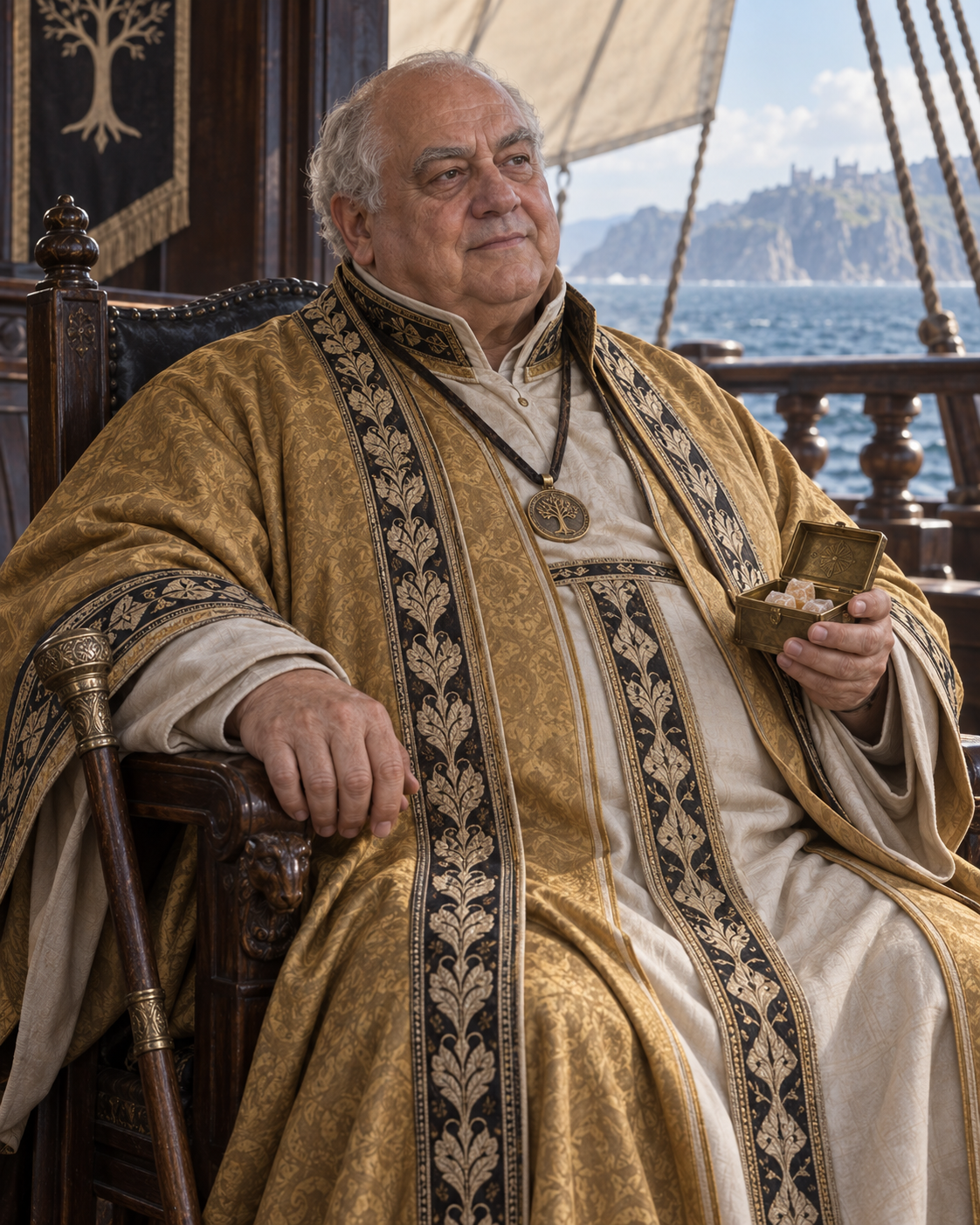
Velligis begins as a great round escritor in gold robes, carrying Ranessin’s peace mission and a brass box of sugar-sweets aboard Leobardis’s warship. He ends as Ranessin’s successor, ceremonially restoring Camaris only after victory makes recognition safe. The distance between those offices is where the Church’s caution starts looking suspiciously like appetite.
At a Glance
The peace emissary who inherits the Seat—and all its compromises
- First office
- Escritor, a senior official of Mother Church
- Later office
- Lector and occupant of the Church’s highest Seat
- Appearance
- Great, round, elderly, and increasingly unsteady on his legs
- Signature object
- Small brass casket of sugar-sweets
- Political method
- Caution, ceremony, and institutional survival
- End status
- Alive at last direct report
The Visual Receipt
Gold robes, round dignity, sugar at hand, and sea legs nobody would call heroic
Velligis is an elderly Nabbanai churchman of great round build. As escritor, he wears golden robes and keeps a small brass casket of sugar-sweets nearby. His legs have grown increasingly unsteady, a practical vulnerability aboard Emettin’s Jewel and during the Crannhyr landing.
The details make him immediately specific. He is not the thin ascetic priest, not the sinister skeleton in ecclesiastical velvet, and not comic relief simply because he likes sweets. His body and habits belong to an old administrator whose authority has accumulated indoors while war drags him onto decks, docks, and contested roads.
The approved identity makes him distinguished and attractive in an age-correct way: a genuinely great round elderly body, full olive-toned face, intelligent brown eyes, heavy silver brows, broad nose, clean-shaven cheeks, short silver-white hair around a balding crown, old-gold robes, sturdy staff, and one small brass sweet-casket. The sweets remain character texture rather than a joke.
The books establish his advanced age, great round build, golden escritorial robes, increasingly unsteady legs, and brass casket of sugar-sweets. Exact age, face, coloring, hair, eyes, robe ornament, staff, chair, Church medallion, ship architecture, coast, and light are editorial reconstruction. This one identity connects the funeral-era Church, peace embassy, Sancellan banquet, succession to Ranessin, and Camaris ceremony.
Book 1 · The Dragonbone Chair
Before he appears, powerful men wait for him—and he does not come
Isgrimnur and Count Eolair meet secretly in the Hayholt’s Hall of Records while expecting Velligis. They assemble a frightening picture: catastrophic winter in the north, dry wells, fallow farms, displaced people, plague at Meremund, escalating taxes, noble tournaments, and Elias consuming the realm piece by piece.
Velligis does not attend. Eolair reports vague Church positions and says Elias has snubbed the escritor. The ledger does not establish why Velligis stays away. Fear, prudence, scheduling, institutional discipline, and political calculation remain possible; the profile must not choose one as fact.
His absence still has meaning. A senior churchman considered trustworthy enough for Ranessin’s service is missing from the room where allies compare the evidence of systemic collapse. The Church is nearby, informed, and not yet prepared to stand inside the conspiracy forming against Elias.
Ranessin’s Church
Trusted enough to advise a king, conventional enough to worry Dinivan
When Ranessin considers how to steady the newly crowned Elias, Velligis is one of the men he imagines as a trustworthy adviser. That judgment is important evidence. Ranessin already recognizes Elias’s temper, carelessness, violent companions, and Bishop Domitis’s foolish influence; he wants a counterweight, not a court ornament.
Dinivan’s joke offers a different angle. While supporting Ranessin through the dangerous Kynslagh crowd, the secretary remarks that Velligis would not understand letting the Lector fall. The line suggests an accountability chain and Velligis’s expectation of proper protection. It does not establish hostility between them.
Together, the receipts place Velligis inside Ranessin’s serious institutional circle. He is not introduced as a Pryrates creature. His later compromises matter precisely because the earlier Church sees him as credible.
Aboard Emettin’s Jewel
He brings a peace argument into a war already moving beneath his feet
Velligis travels as Ranessin’s emissary with Duke Leobardis toward Crannhyr. The Church’s position is clear: marching armies cultivate catastrophe. He invokes Mother Church, Usires, Sutrines, and Ranessin while urging restraint.
Leobardis answers that Elias has already transformed inaction into a choice for disaster. This is the central problem with Velligis’s peace mission. The warning against war is morally serious—armies do multiply suffering—but the duke is facing confiscated ships, coercion, and a king destroying old alliances. “Do not march” cannot be neutral when the other side is already marching.
Velligis is uneasy when Leobardis warmly greets Nin Reisu, the small dark-robed Niskie seawatcher long attached to the flagship. The text gives unease, not its full cause. It may reflect religious, cultural, or supernatural suspicion; certainty would outrun the receipt.
He does not immediately go ashore. His unsteady legs and preference for controlled movement contrast with Leobardis’s energetic disembarkation among roughly two thousand Nabbanai. The peace emissary is physically and politically aboard a campaign he cannot stop.
Hlafmansa Eve
He is present when Ranessin draws the line, but the surviving record does not make the response his
Velligis attends the Sancellan banquet where Pryrates tells Ranessin that Mother Church may claim souls but cannot interfere with a legitimate king’s control of bodies. Benigaris is visibly nervous; Count Aspitis attends as Elias’s newly elevated envoy.
Ranessin rejects the demand and excommunicates Pryrates, Elias, and all who knowingly follow them. Pryrates later murders Ranessin and Dinivan and replaces confrontation with a Fire Dancer cover story.
The ledger confirms Velligis’s presence at the ultimatum. It does not record him sharing Ranessin’s excommunication, resisting the subsequent occupation, aiding the murder, or witnessing the private killings. Those boundaries matter because his later elevation tempts an easy retrospective verdict. Survival near atrocity raises questions; it does not answer all of them.
Book 4 · To Green Angel Tower, Part II
The old escritor becomes Lector and discovers Camaris after everybody else has won
By the war’s end, Velligis occupies the Lector’s Seat. He ceremonially recognizes Camaris only after victory. The legendary knight has already been found, restored, carried into the alliance, and exhausted by a role he no longer desires.
Isgrimnur sees the ceremony as Church opportunism. His judgment fits the timing: an institution that could not protect Ranessin now attaches its authority to the triumphant symbol of Camaris. Recognition costs less after the danger has passed.
Camaris makes a finer distinction. Respect for the Seat does not require affection for its occupant. He accepts the institution’s sacred place without pretending Velligis personally inspires him. That sentence may be the cleanest assessment of the new Lector available.
Connections
The office changes; the people around it reveal what survived
Ranessin
Lector who trusts Velligis as a possible royal adviser and sends him to argue for peace before Pryrates murders him.
Father Dinivan
Ranessin’s secretary, whose joke places Velligis inside the Church accountability structure without proving personal hostility.
Duke Leobardis
War leader who hears Velligis’s warning and insists that Elias has made inaction its own catastrophe.
Nin Reisu
Niskie seawatcher whose cordial welcome from Leobardis visibly unsettles Velligis for reasons the ledger does not resolve.
Camaris
Returned knight whom Velligis recognizes after victory; respects the Lector’s Seat without claiming affection for its occupant.
Isgrimnur
Blunt northern duke who reads the Camaris ceremony as institutional opportunism and says the quiet part out loud.
Why He Matters
He shows how an institution survives a moral hero—and risks surviving the hero’s morality too
Velligis is not built as Ranessin’s equal-and-opposite villain. The text gives a cautious senior official who warns against armies, is trusted with serious missions, survives the Sancellan crisis, becomes Lector, and later chooses a conspicuously safe moment for recognition.
That arc is more useful than a simple corruption label. Institutions require people who preserve continuity, but continuity can become its own morality. Ranessin spends the Church’s voice when silence would be complicity. Velligis inherits the voice after the speaker is murdered. The question is not only whether he survives, but what of Ranessin’s line survives in him.
The final record offers skepticism rather than a verdict. Isgrimnur distrusts the timing. Camaris separates sacred office from personal warmth. Velligis remains alive, legitimate, and not especially loved. For a Church emerging from magical assassination and political capture, that may be stability—and it may be the beginning of forgetting.
On the Record
Scope, titles, status, and unresolved gaps
This is Velligis’s one canonical full-spoiler profile. He appears or receives meaningful political treatment in Books 1, 2, and 4. His titles change from Escritor to Lector. He remains alive at the last direct report.
The evidence confirms his elderly, great round build, golden escritorial robes, unsteady legs, sweet-casket, absence from the Hall of Records meeting, place in Ranessin’s trusted circle, peace embassy, presence at Pryrates’s ultimatum, succession, and Camaris ceremony. It does not establish why he skipped the secret meeting, what caused his unease around Nin Reisu, how he survived the Sancellan takeover, or the precise path by which he became Lector.
Visual state: approved and locked. Future hero, shipboard, Sancellan, Lector, Camaris, directory, and social imagery must preserve this exact age-correct Nabbanai churchman: round face, silver hair, great substantial body, unsteady mobility, gold-and-cream ceremonial vocabulary, staff, and brass sweet-casket. Featured image, visible hero, directory cards, and Rank Math social image must share the same local attachment. His body remains substantial and dignified; the sweets are a human detail, never permission to caricature him.