
Naruto · Complete Character Profile
Udon Ise
Udon begins as the quiet, bespectacled child standing beside louder dreams. He grows into the jōnin responsible for Metal Lee, Iwabee Yuino and Denki Kaminarimon, proving that patient observation and unglamorous competence can become real authority.
Udon Ise at a glance
| Full name | Udon Ise |
|---|---|
| Japanese name | 伊勢ウドン |
| Birthday | April 3 |
| Age | 8 in Part I; 12 in Part II; adult in the New Era |
| Height | 127.5 cm in Part I; 142.9 cm in Part II; about 176 cm in the New Era record |
| Weight | 26.5 kg in the Part I record |
| Blood type | O |
| Village | Konohagakure |
| Rank | Academy student, then genin, then jōnin |
| Teams | Konohamaru Corps; Team Ebisu; adult leader of Team 5 in anime continuity |
| Nature transformation | Water Release in anime continuity |
| Students | Metal Lee, Iwabee Yuino and Denki Kaminarimon |
| Manga debut | Chapter 34 |
| Anime debut | Episode 20 |
| Young Japanese performer | Tomo Shigematsu |
| Adult Japanese performer | Ikuji Nose |
| Core specialty | Observation, team leadership and precise Water Release through Nose Water Tree |
| Status | Alive in the New Era record |
The bottom line
Udon’s story is quiet growth with receipts. The sniffly Academy kid becomes the adult trusted with three students who measure talent in completely different ways. His most memorable technique uses nasal mucus, because Naruto never met dignity it could not poke with a stick, but the joke should not erase the skill. Udon turns an embarrassing childhood trait into controlled Water Release and turns years of being overlooked into the patience required to see overlooked children.
Appearance across generations
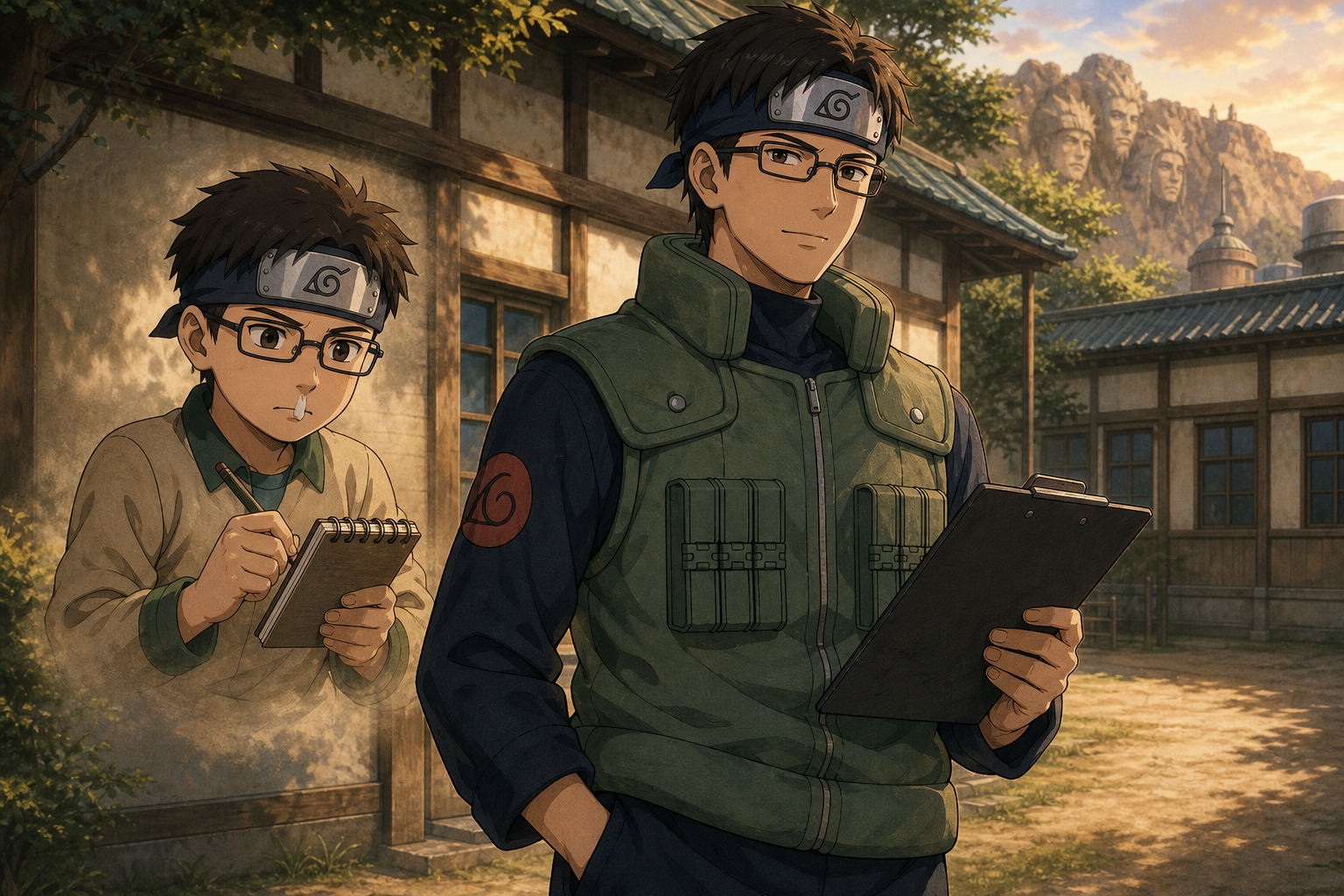
Young Udon is immediately recognizable through rectangular glasses, short brown hair and the persistent nasal drip used as a comic marker. His clothing is modest and practical, visually quieter than Konohamaru’s long scarf and more subdued than Moegi’s bright pigtails.
The design tells us where the camera expects attention to go. Konohamaru announces himself; Udon waits at the edge of the composition. That does not make him empty. It makes attention itself part of the character’s problem.
As an adult, Udon retains the glasses and restrained demeanor while wearing standard Konoha shinobi equipment and a flak jacket. The continuity matters. He does not become valuable by being redesigned into a glamorous stranger. The overlooked child becomes authoritative without abandoning the features by which viewers first underestimated him.
Konohamaru Corps: friendship outside hierarchy
The childhood trio calls itself the Konohamaru Corps, a name organized around Konohamaru Sarutobi. Konohamaru carries the Third Hokage’s surname and resents being treated as a title before being treated as a boy.
Udon and Moegi Kazamatsuri give him something the village’s deferential adults cannot: ordinary peerhood. They can follow his schemes, question his judgment and remain unimpressed by inherited prestige.
For Udon, the trio offers visibility without demanding performance. He does not have to be the loudest person to remain included. The friendship becomes a tiny counterculture inside a village obsessed with ranking, family reputation and exceptional talent.
Episode 26: the reporter at the gate
In “Special Report: Live from the Forest of Death!”, Konohamaru, Moegi and Udon cover the Chūnin Exams for the Ninja Academy newspaper. The episode uses their interviews to revisit Naruto Uzumaki and Team 7’s earlier adventures.
Udon has not yet entered the exam. He stands outside the gate as a younger child asking older participants to translate experience into a record. That distinction is richer than the recap structure initially appears.
A shinobi village runs on reports. Missions are narrated after they happen; intelligence travels through documents; institutional memory is made from selective accounts. A school newspaper is a child-sized version of that machinery.
Udon’s notebook rehearses the labor he will later perform as a leader: gather partial testimony, separate useful information from noise and decide what another person needs to know before acting.
The ethics of being a witness
Recap episodes are often treated as disposable because audiences already possess the footage. Udon’s role asks a different question: who within the world knows what the audience knows?
Naruto’s pain, bravery and improvisation do not automatically become public understanding. Someone must listen, remember and retell. Every retelling can flatten a person into a headline or restore context to an event.
As a child reporter, Udon occupies the boundary between spectacle and memory. He is learning that a heroic story contains fear, mistakes, embarrassment and people who were almost lost.
The work is not glamorous. That is precisely why it fits him. Udon repeatedly embodies necessary labor that does not announce itself as destiny.
From Academy student to working shinobi
The original series gives Udon’s intermediate development limited attention. He eventually advances beyond the Academy and serves Konoha, but the narrative does not provide an uninterrupted ladder of examinations, signature battles and private turning points.
An honest profile does not invent that missing bridge. It observes what the endpoints establish: the child who watched older genin becomes an adult qualified to command his own team.
That promotion implies years of missions, training, evaluation and survival. Rank in Konoha may be imperfect, political and narratively uneven, but jōnin responsibility is not handed to an Academy mascot.
Udon’s off-screen growth exposes a larger truth about long-running worlds. History continues beyond the camera. Supporting people acquire expertise even when the protagonist is elsewhere.
Adult Udon and Team 5
In the next generation, Udon leads Team 5: Metal Lee, Denki Kaminarimon and Iwabee Yuino. Unlike an inherited clan formation, Team 5 is a collision of temperaments, backgrounds and kinds of intelligence.
Metal is an intensely trained taijutsu specialist whose anxiety can sabotage the precision his body possesses. Denki comes from a technologically powerful civilian family and initially lacks conventional physical confidence. Iwabee is physically capable and experienced but struggles with academic advancement and frustration.
Udon’s team is therefore not united by one famous technique. Its central problem is translation. Each child’s competence appears in a form the others, and sometimes the institution, may misread.
The quiet boy once dismissed by visual shorthand becomes exactly the adult this team needs.
Mentoring three incompatible measurements of talent
Metal Lee
His body knows disciplined movement, but being watched can turn attention into panic. He needs guidance that treats anxiety as real without mistaking it for weakness.
Denki Kaminarimon
His engineering intelligence expands what shinobi problem-solving can mean. He needs a leader capable of valuing tools without surrendering judgment to them.
Iwabee Yuino
His combat ability and practical instincts coexist with academic difficulty. He needs standards, but also an adult who understands that one institutional metric cannot describe an entire child.
Udon’s task
Turn difference into interdependence: strength protects thought, technology extends perception and disciplined practice gives improvisation a reliable foundation.
Why Udon is an apt teacher for Team 5
Every member of Team 5 risks being reduced to a single visible trait. Metal becomes “the anxious one.” Denki becomes “the tech kid.” Iwabee becomes “the repeat student.” Udon knows what reduction feels like.
His earliest identity in the audience’s memory is often “the boy with the runny nose.” Adulthood does not erase the joke, but it proves the joke was never a complete person.
This gives his leadership an implicit ethical foundation. A mentor must distinguish a recurring difficulty from a permanent definition. He must see the capacity hidden behind the label without pretending the difficulty is imaginary.
Team 5 makes that skill operational. Their success depends on being read accurately before they can learn to read one another.
Water Release and an unglamorous signature
Later-era material associates Udon with Water Release and turns the nasal motif of his childhood into an unexpectedly functional combat idea. The franchise’s humor can be broad, but the underlying transformation is thematically neat: a feature used to make him look ridiculous becomes something he controls.
The important point is not that bodily fluid is secretly majestic. It is that mastery changes the relationship between a person and what others use to define him.
Udon does not need an inherited eye technique or legendary bloodline to make his own body tactically meaningful. His ability emphasizes restraint and capture rather than spectacular destruction, which suits a teacher responsible for ending danger without always escalating it.
Specific adaptations differ in how prominently they demonstrate or name his techniques, so this profile does not inflate a limited showing into an enormous invented arsenal.
Intelligence without spectacle
Naruto often makes intelligence visible through prodigious strategy, encyclopedic technique knowledge or inherited genius. Udon represents a quieter form: sustained attention.
He stays with a group, takes notes, watches stronger people and eventually accepts responsibility for students whose gifts require different languages of evaluation.
Sustained attention is not passive. It resists the shinobi world’s appetite for immediate sorting. Academy grades, combat wins, clan names and first impressions all provide information; none provides a complete human being.
Udon’s adult position tells us that patience can mature into command. The person who listens longest may notice the option everyone performing brilliance has missed.
Relationship atlas
| Person | Relationship | What it reveals |
|---|---|---|
| Konohamaru Sarutobi | Childhood teammate | Udon provides ordinary friendship to a boy trapped inside inherited prestige. |
| Moegi Kazamatsuri | Childhood teammate | Their quieter partnership helps make the trio more than one child’s fan club. |
| Naruto Uzumaki | Older model | Naruto’s influence reaches Udon through Konohamaru and through stories the children record. |
| Metal Lee | Student | Udon must protect real skill from being eclipsed by performance anxiety. |
| Denki Kaminarimon | Student | He validates technological intelligence inside a profession defined by tradition. |
| Iwabee Yuino | Student | He must reconcile practical talent with the Academy standards Iwabee resents. |
Personality
Reserved
Udon rarely competes with Konohamaru for the center of a scene.
Observant
His reporting role and later leadership both depend on gathering before declaring.
Loyal
His childhood bonds endure as all three friends acquire separate professional identities.
Patient
Team 5 requires an adult who can recognize progress occurring at different speeds.
Practical
His known combat identity favors control and usefulness over theatrical grandeur.
Underestimated
This is how others and the narrative frame him, not the limit of his ability.
Original Japanese performance
Tomo Shigematsu gives young Udon a subdued, congested delivery that supports the visual joke without making him interchangeable with the trio’s other children.
The restraint matters. Konohamaru supplies forward momentum; Moegi often supplies energetic reaction; Udon’s quieter sound leaves space around the group’s loudest impulses.
Only the original Japanese performance is covered here under this project’s cast policy.
Common misconceptions
“Udon is Konohamaru’s brother.”
No. He is Konohamaru’s Academy friend and childhood teammate.
“He never becomes a serious shinobi.”
He becomes a jōnin and leads Team 5 in the next generation.
“Team 5 is a new clan formation.”
No. Metal, Denki and Iwabee come from markedly different traditions and skills.
“His childhood gag is his entire identity.”
Later material deliberately turns the visual shorthand into only one element of an adult teacher and field leader.
“Episode 26 is his Chūnin Exam debut.”
He attends as an Academy newspaper reporter, not as an exam candidate.
“A limited move list means no expertise.”
Leadership rank and team responsibility establish professional growth even when the series does not catalogue every mission.
What Udon is really telling us
Udon asks whether a person can outgrow the story other people tell on first sight.
As a child, his body provides a joke before his voice provides an idea. He stands next to a famous grandson and an expressive girl, easy to remember but easy not to know.
As an adult, he becomes responsible for children facing the same violence of simplification. Metal is not only anxiety. Denki is not only technology. Iwabee is not only academic failure.
A hidden village sorts people because sorting is efficient. It assigns ranks, teams, specialties and mission classes. Efficiency keeps institutions functioning, but labels become dangerous when they pretend to be souls.
Udon’s quiet success is therefore existential. He becomes more than the category offered to him, then gains the authority to keep categories from swallowing his students.
He does not overturn the shinobi world through a legendary battle. He changes what three children may become by reading them more carefully than the world once read him.
Why he matters
Iconic worlds need supporting lives to feel inhabited. If only destined heroes mature, time has not truly passed; the set has merely changed costumes.
Udon’s promotion makes Konoha’s history tangible. The Academy reporter grew older while Naruto’s central story unfolded. He trained, worked and acquired enough judgment for the village to place children under his care.
His biography also broadens the definition of legacy. Konohamaru inherits a celebrated surname. Moegi receives an extraordinary unexplained nature transformation. Udon’s most meaningful inheritance is attention: he watched, learned and eventually became the watcher responsible for others.
That is not lesser heroism. It is the daily infrastructure that lets spectacular heroes have a village worth returning to.
Name, noodles and the joke that follows him
Udon is the name of the thick Japanese wheat noodle. Ise names a historically and culturally important place associated with Ise Province, Ise Bay and the city of Ise. The combination gives the character a food name with geographic weight, because Naruto enjoys making a tiny side character sound like lunch and a travel itinerary at the same time.
The name does not establish a noodle clan, secret chef family or Ise-based bloodline. Those would be inventions. What the food joke does establish is the comic register surrounding him from the start. He stands beside Konohamaru’s grand surname and Moegi’s brighter visual design with a runny nose and a bowl-of-noodles name.
Fans often mistake comic framing for a ceiling. Naruto repeatedly lets silly names and habits coexist with professional growth. Udon does not have to escape the joke by becoming grim. He grows until the joke belongs to a jōnin, which is honestly funnier and more humane.
Appearance chronology: the child is still visible in the teacher
Part I Udon is eight years old, with round glasses, short dark hair, simple Academy clothing and the constantly running nose that becomes his most repeated visual gag. He is usually positioned beside Konohamaru and Moegi rather than at the center of the frame.
Part II makes him taller and gives him the forehead protector and clothing of a working genin on Team Ebisu. The change is quiet because his function remains supporting, but the design records the promotion. He is no longer merely following a friend’s pretend corps.
Adult Udon wears Konoha field clothing appropriate to jōnin leadership, keeps the glasses and carries a more composed silhouette. The glasses preserve instant recognition without trapping him in childhood. He looks like the same observant person after experience taught him how to use stillness.
The design refuses the usual makeover logic. Udon does not become valuable because the series removes every trait once coded as awkward. He becomes an adult while remaining recognizable. That matters for a character whose leadership strength comes from understanding that development is not the same as erasure.
Team Ebisu: learning that instruction is a specialty
Udon, Moegi and Konohamaru become genin under Ebisu during the gap between Part I and Part II. Ebisu’s early comedy hides a serious professional identity: he is a tokubetsu jōnin recognized for elite instruction. That makes Team Ebisu an apprenticeship in teaching as much as combat.
Konohamaru receives most of the spotlight because his family name and Naruto relationship pull narrative gravity. Udon’s later career shows that learning still happened off-center. He becomes a jōnin leader in his own right rather than a permanent assistant in Konohamaru’s biography.
The three friends distribute their childhood bond across Konoha’s next generation. Konohamaru leads Team 7. Moegi leads Team 10. Udon leads Team 5 in the anime. Their Academy play becomes teaching infrastructure. The village’s future is not carried only by legendary heirs; it is carried by the peers who grew beside them and learned how to keep a team together.
Team 5: three incompatible definitions of talent
Adult Udon leads Metal Lee, Iwabee Yuino and Denki Kaminarimon in the Boruto anime. On paper, they look less like a natural unit than a school counselor’s dare.
Metal possesses serious taijutsu training but can lose control when he feels watched. Iwabee has physical ability and Earth Release talent but struggles with academic measures and the shame of being held back. Denki begins with technical intelligence, corporate access and limited traditional shinobi confidence. Each boy is talented. Each has also been taught by some part of the system to believe the wrong weakness cancels everything else.
Udon is an apt leader because he grew up as the quiet child beside more obvious charisma. He knows what it means to be present without receiving narrative applause. That does not automatically make him a perfect mentor, but it gives the team thematic coherence: a once-overlooked adult is responsible for children whose abilities are easy to misread.
His work is not to turn Denki into Iwabee, Iwabee into Metal or Metal into his father. It is to make physical skill, academic growth, technology, chakra control and emotional regulation cooperate. Team 5 tests whether Konoha can recognize multiple kinds of shinobi competence without ranking every child through one inherited ideal.
Metal Lee: skill under observation pressure
Metal’s anxiety can make public performance collapse even when his training is real. A shallow teacher calls that inconsistency. A useful teacher understands that the body is responding to social threat rather than forgetting every movement.
Udon’s own childhood reserve gives him a reason to value competence that does not announce itself easily. Team leadership requires creating conditions where Metal can practice exposure without humiliation becoming the curriculum.
The relationship also challenges fandom’s obsession with dramatic motivation speeches. Some students need a witness. Others need the witness to stop feeling like a firing squad. Patience, repetition and specific feedback can be more radical than screaming about youth at maximum volume.
Iwabee Yuino: strength cannot substitute for every literacy
Iwabee begins with strong combat potential and weak academic progress. Being held back turns education into a public identity wound. He resents a system that seems to ignore what he can already do, yet shinobi work also requires reading missions, understanding instructions and making decisions beyond force.
Udon’s job is not to shame physical talent until book skill appears. It is to show why both matter. A team cannot afford an excellent fighter who misreads the objective, and a village should not discard a capable child because one educational method failed to reach him.
This is where institutional critique needs an actual answer. Saying “school is unfair” is not enough. Udon must translate knowledge into relevance, help Iwabee close gaps and refuse the comforting lie that talent in one lane makes every other responsibility optional.
Denki Kaminarimon: technology belongs in the shinobi future
Denki enters with analytical intelligence and technology access but less traditional combat confidence. His presence asks whether the ninja world can expand its definition of useful skill without treating tools as moral corruption.
Udon is not a legendary clan head defending an inherited technique market. That makes him well positioned to evaluate Denki by outcomes, judgment and teamwork. Technology can extend communication, mapping and analysis. It can also fail, be hacked or become a crutch. The educational task is integration, not worship or panic.
Denki’s later growth demonstrates that physical training and technical intelligence do not have to compete for one identity slot. Udon leads a team where a laptop, Earth Release and taijutsu can all belong in the same mission plan. That is what a modernized village should look like when it is not busy yelling at the future.
Nose Water Tree: gross, controlled and genuinely clever
The Boruto anime gives adult Udon a Water Release technique commonly rendered as Nose Water Tree. He forms hardened streams from nasal mucus and uses them as precise projectiles. Yes, it is gross. No, “gross” is not the same word as “useless.”
The technique completes a long character joke. Childhood Udon cannot control the runny nose that marks him visually. Adult Udon converts the same bodily association into chakra-shaped Water Release. The trait that once made him easy to dismiss becomes something he directs.
That is not a reason to invent medical claims about mucus composition or declare him an elite bloodline user. The technique is anime continuity, and its demonstrated value is precision and surprise. It is memorable because the weapon emerges from the exact feature opponents and viewers are most likely to underestimate.
Fandom often celebrates heroes who turn pain into power while refusing the same dignity to embarrassment. Udon’s technique says bodily awkwardness can also be reclaimed. He does not become cool by pretending the joke never happened. He makes the joke report to him.
Complete ability and continuity shelf
| Ability | Established use | Boundary |
|---|---|---|
| Water Release | Adult Udon uses water-nature chakra in anime continuity. | The manga does not establish a broad named Water Release arsenal for him. |
| Nose Water Tree | He shapes nasal fluid into hardened, controlled projectiles. | The technique is an anime addition, not a retroactive Part I manga feat. |
| Observation | His reporter role and quieter childhood presence support attention to people and events. | Observation is professional skill, not supernatural sensory classification. |
| Team leadership | He guides Metal, Iwabee and Denki as Team 5’s jōnin leader. | Team 5 is primarily an anime-continuity formation. |
| General shinobi competence | His adult rank supports field fundamentals, command and mission responsibility. | Rank alone does not prove an unseen elite combat catalog. |
| Academy-era comic techniques | Anime comedy includes childish group techniques and Naruto imitation. | Comedy material should be labeled instead of inflated into serious power scaling. |
The honest profile does not need to rescue Udon by inventing a secret elemental library. His demonstrated adult specialty, leadership and growth already make the point.
Media and appearance record
Udon debuts in Naruto manga chapter 34 and anime episode 20. Episode 26 places him with Konohamaru and Moegi as a Ninja Academy newspaper reporter covering the Chūnin Exams. That reporting material belongs to the anime presentation and establishes observation before combat.
His licensed prose shelf includes Naruto Retsuden: Naruto Uzumaki and the Spiral Destiny. His film shelf includes Naruto the Movie: Blood Prison. His OVA record includes Finally a Clash! Jōnin vs. Genin!! Indiscriminate Grand Melee Tournament Meeting!!. His game debut is recorded in Naruto: Konoha Ninpōchō.
The Boruto anime supplies most of Team 5’s teaching material and Udon’s adult Water Release display. Manga establishes his survival into the New Era and adult village presence but does not duplicate every classroom, mission or team episode. Continuity labels keep a complete franchise profile from becoming soup.
Eight fandom shortcuts that miss Udon
“He is Konohamaru’s brother.”
No. He is an Academy peer, childhood teammate and later fellow jōnin.
“The runny nose is his whole character.”
It is a recurring gag later transformed into a controlled Water Release technique.
“Gross means weak.”
Precision, surprise and chakra control do not disappear because the material is embarrassing.
“He never grows past genin.”
New Era Udon is a jōnin and Team 5 leader.
“Team 5 is a manga mainstay.”
Its detailed formation and mentoring record belong mainly to the Boruto anime.
“Denki is not a real shinobi.”
Technology and traditional training can coexist inside a modern mission system.
“Iwabee only needs combat freedom.”
Strength matters, and so does the literacy required to understand missions and consequences.
“Metal only needs confidence.”
Performance anxiety requires specific support, not a generic demand to stop feeling it.
Reciprocity, education and the dignity of unglamorous work
A Confucian reading places Udon inside reciprocal hierarchy. Ebisu’s authority carries a duty to prepare him. Adult Udon inherits the same obligation toward Team 5. Students owe effort, honesty and cooperation. Teachers owe methods capable of seeing the actual child rather than only the easiest metric.
That matters because each Team 5 student can be misclassified. Metal’s visible failure can hide practiced skill. Iwabee’s academic delay can hide field ability. Denki’s technology can be dismissed as non-shinobi competence. Udon’s own childhood taught him how quickly one comic surface can become an entire public identity.
A Buddhist lens makes the technique gag unexpectedly useful. Shame depends on attachment to a polished self-image. Udon stops needing the embarrassing trait to vanish before he can act with authority. He turns it into a tool, which is less glamorous than enlightenment and much funnier.
The industry lens is sharper. Long-running franchises promote side children into adult mentors because continuity makes the world feel lived in, then often deny those adults the screen time needed to prove the promotion. RaeRae’s profile cannot manufacture episodes. It can show the full record and refuse to treat limited spectacle as evidence of limited worth.
Where to continue
Sources and canon boundary
Manga chronology controls this profile. Anime staging, databook material, novels, films, games, and later franchise appearances are labeled instead of being blended into one false continuity.
Primary franchise references: Naruto Official and VIZ Media Naruto. CVM Sekai’s conclusions about the Konohamaru Corps, Team 5, Water Release, quiet leadership, teaching, and Udon’s role across Naruto and Boruto are editorial analysis, not invented creator quotations.