
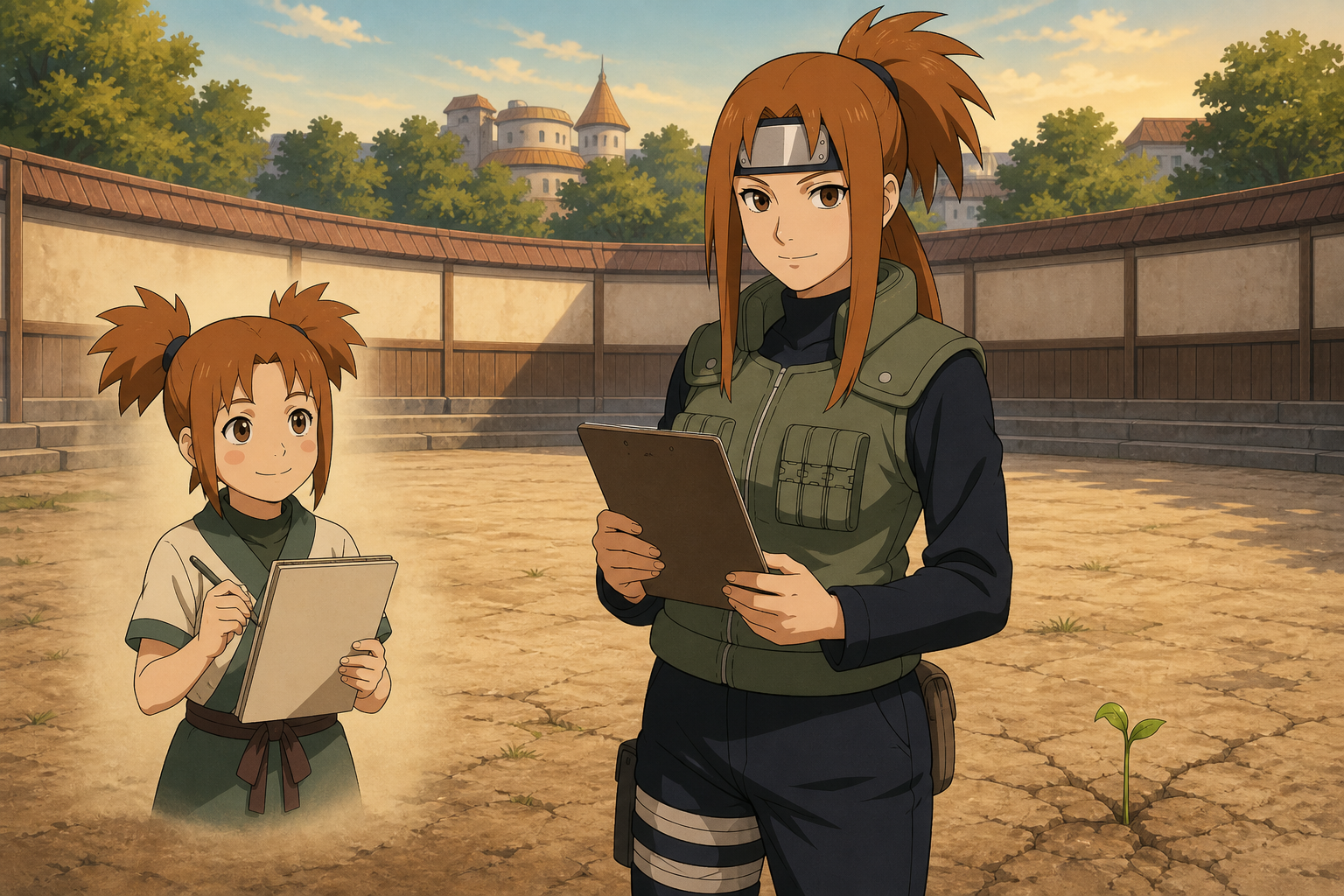
Naruto · Complete Character Profile
Moegi Kazamatsuri
Moegi begins as the girl holding a notebook beside Konohamaru. She grows into the jōnin responsible for Shikadai, Chōchō and Inojin, acquires one of Naruto’s rarest nature transformations and finally becomes central to a Divine Tree crisis the story could no longer keep at the edge.
Moegi Kazamatsuri at a glance
| Full name | Moegi Kazamatsuri |
|---|---|
| Japanese name | 風祭モエギ |
| Birthday | June 8 |
| Age | 8 in Part I; 12 in Part II; adult in the New Era |
| Height | 121.8 cm in Part I; 139 cm in Part II; about 165 cm in the New Era record |
| Weight | 22 kg in the Part I record |
| Blood type | A |
| Village | Konohagakure |
| Rank | Academy student, then genin, then jōnin |
| Teams | Konohamaru Corps; Team Ebisu; adult leader of Team 10 |
| Classification | Sensor type |
| Nature transformations | Earth Release, Water Release and Wood Release |
| Students | Shikadai Nara, Chōchō Akimichi and Inojin Yamanaka |
| Manga debut | Chapter 34 |
| Anime debut | Episode 20 |
| Japanese performer | Noriko Shitaya |
| New Era crisis | Converted into a tree by a Claw Grime; Matsuri formed from her chakra; later freed with Matsuri’s Thornsoul |
| Status | Alive after rescue in the current Two Blue Vortex record |
The bottom line
Moegi is what happens when a background child actually grows up. The Academy reporter becomes the adult evaluating other children, the friend inside Konohamaru’s orbit becomes a leader with her own team, and the apparently ordinary kunoichi is officially credited with Wood Release without receiving an origin story worthy of that fact. Her profile has to respect both the growth and the neglect. We do not invent roots because canon forgot to show them.
Appearance across generations
As a child, Moegi has short orange-brown hair tied into two high pigtails, large eyes and distinctive flushed cheeks. Her early clothing includes a light top layered over a darker shirt, shorts and the practical simplicity of an Academy student.
She visually balances Konohamaru’s louder design and Udon’s subdued one. The pigtails and blush make her immediately readable even when the trio appears briefly.
As an adult, her hair is longer and styled more practically for field work. She wears Konoha shinobi clothing and the flak jacket associated with command-level responsibility.
The shift is not a transformation into a different archetype. The observant child remains visible inside the composed team leader.
Before she was “the girl in Konohamaru’s group”
Early Naruto gives Moegi less private interior material than Konohamaru. The trio is organized around his name, his grandfather and his admiration for Naruto.
That structure can make Moegi and Udon feel like accessories, but their presence gives Konohamaru something essential: peers who know him outside inherited status.
Moegi is willing to participate in his schemes, argue with him and share the imaginative play through which Academy children rehearse adulthood. She is not one of the adults treating him as “the Honorable Grandson.”
Their friendship offers ordinary belonging to a child suffocated by extraordinary lineage.
Episode 26: reporter before combatant
In “Special Report: Live from the Forest of Death!”, Konohamaru Sarutobi, Moegi and Udon arrive to cover the Chūnin Exams for the Ninja Academy newspaper.
The episode uses interviews to review Naruto’s journey. Moegi’s role matters precisely because she is not yet a participant in the exam. She belongs to the generation watching older children enter the machine they will eventually inherit.
Reporting converts admiration into questions. The children must ask what happened, decide which details matter and arrange experience into a story another audience can understand.
For Moegi, this becomes an early rehearsal for leadership. A team leader also gathers accounts, evaluates partial information and decides what version of events should guide action.
Why a recap episode belongs in her biography
Episode 26 is often dismissed because it reuses earlier footage. Within Moegi’s life, however, it establishes her as a witness and interpreter.
Shinobi society depends on reports. Missions become records; records become intelligence; intelligence shapes assignments and institutional memory.
The Academy newspaper is childish compared with classified reports, but the underlying act is related. Someone who was not present must receive an account. The reporter decides whose voice enters the record.
Moegi’s first substantial function is therefore not “cute teammate.” It is mediation between lived action and public memory.
Konohamaru Corps
The children call themselves the Konohamaru Corps, a name that openly centers one member. Moegi accepts that structure when they are young, but adulthood proves that none of them remains merely a satellite.
Konohamaru becomes a jōnin leader with a direct emotional inheritance from Naruto Uzumaki. Udon develops his own leadership role. Moegi leads a team carrying the combined legacy of three major Konoha clans.
The trio’s success reframes their childhood play. They were not pretending to be shinobi because their games lacked meaning. They were practicing identities the village would later make consequential.
Moegi’s growth is quiet because the story rarely centers the transition. The distance between notebook and flak jacket remains real.
Pain’s assault and civilian protection
By the time Pain attacks Konoha, Moegi and her childhood teammates are genin with responsibilities beyond admiration.
Their work includes helping guide civilians toward safety. This is not the spectacular combat through which fandom usually measures importance, but evacuation is one of the clearest forms of shinobi service.
A village is not defended only by defeating the attacker. It is defended by moving frightened people, communicating routes and preventing chaos from multiplying casualties.
Moegi’s contribution fits the leadership she later assumes: protection as coordination rather than personal glory.
The war and the value of noncombat contribution
Anime material surrounding the Fourth Shinobi World War again places the Konohamaru Corps near reporting and support work.
The children want to prove usefulness in a culture that makes combat the most visible evidence of adulthood. Older shinobi redirect them toward forms of contribution suited to their position.
This tension is central to Naruto’s world. A militarized village teaches children that protecting home is honorable, then must sometimes convince them that immediate battle is not the only honorable service.
Moegi’s reporting history gives the alternative credibility. Information, morale, evacuation and public understanding can protect a community without placing every young body on the front line.
Adult Moegi: leader of Team 10
In the next generation, Moegi becomes the jōnin leader of Shikadai Nara, Chōchō Akimichi and Inojin Yamanaka.
This team inherits the Ino to Shika to Chō formation through three clan heirs. Their family techniques have long histories of coordinated use, and their parents possess both political importance and strong personalities.
Moegi’s authority therefore cannot depend on eclipsing their inherited expertise. Her task is to help three legacies become one contemporary team.
She evaluates readiness, mediates different temperaments and participates in decisions about Chūnin Exam recommendations. The child once reporting on older candidates becomes the adult deciding whether her own students should enter that test.
That circularity is the richest fact in her biography.
Mentoring Shikadai, Chōchō and Inojin
Shikadai Nara
A gifted strategist whose boredom and reluctance can conceal the emotional burden of seeing too many outcomes.
Chōchō Akimichi
A confident, expressive powerhouse whose self-definition refuses the shame outsiders attach to appetite and size.
Inojin Yamanaka
An artist and sensory-clan heir balancing sharp observation, emotional reserve and techniques inherited from both parents.
Moegi’s task
Preserve individual growth while building the timing and trust that make inherited coordination more than repetition.
Team 10’s parents know the formation intimately. Moegi contributes an outside leadership perspective, protecting the children from becoming mere reenactments of their families.
Wood Release: established ability, missing explanation
Later official character information attributes Wood Release to Moegi alongside Water and Earth Release.
That fact is striking because Wood Release is one of the franchise’s rarest combined nature transformations, famously associated with Hashirama Senju and later artificial acquisition.
The story does not provide a satisfying on-page origin for Moegi’s ability. It does not establish secret Senju ancestry, implantation, Hashirama-cell treatment or a hidden Orochimaru experiment.
Those ideas are fan theories, not biography.
The honest conclusion is both exciting and frustrating: Moegi possesses an extraordinary ability, while canon has not given her the narrative space to explain, demonstrate or emotionally contextualize it at the level such rarity deserves.
Nature transformation and tactical implications
Wood Release combines earth and water natures. In principle, it can create and manipulate vegetation, offering restraint, terrain control, protection and construction possibilities.
For a team containing long-range art, shadow control and body-expansion techniques, environmental control could be enormously useful.
Roots or barriers could narrow movement for Shikadai’s shadows, protect Inojin while he scouts and create stable lanes for Chōchō’s physical power.
This is tactical inference from the known ability, not proof of specific named techniques Moegi has demonstrated. A complete profile can explore implications without pretending an unwritten battle happened.
Leadership without a famous surname
Moegi leads students descended from the Nara, Akimichi and Yamanaka clans without being introduced through an equally famous family legacy of her own.
That position can be a strength. She is not the guardian of one clan’s preferred version of Team 10. She can evaluate how three inherited traditions function in the present rather than treating repetition as the goal.
Her authority demonstrates that Konoha’s next generation is not led only by the children of its most celebrated heroes. Supporting children also grow into adults whose judgment shapes the village.
The narrative would be stronger if it showed more of that judgment. The absence is a reason to ask better questions, not permission to replace her with pedigree.
Relationship atlas
| Person | Relationship | What it reveals |
|---|---|---|
| Konohamaru Sarutobi | Childhood teammate | Moegi offers peer belonging outside the prestige and pressure of his surname. |
| Udon Ise | Childhood teammate | The quieter partnership helps form a trio whose members later lead teams independently. |
| Naruto Uzumaki | Older role model | His influence reaches Moegi through Konohamaru and the stories the children report. |
| Shikadai Nara | Student | She mentors a strategist carrying clan and political expectations. |
| Chōchō Akimichi | Student | She guides a powerful child whose confidence does not require shrinking herself. |
| Inojin Yamanaka | Student | She helps an observational artist integrate two family traditions. |
Personality
Observant
Her early reporting role and later evaluation responsibilities both depend on noticing what matters.
Grounded
She often functions as a stabilizing presence beside Konohamaru’s louder ambition.
Loyal
Her childhood friendships persist across changing ranks and responsibilities.
Protective
Her service during crisis and later team leadership emphasize coordinated care.
Underexplored
This describes narrative allocation, not her inner worth: canon gives major facts without equal interior development.
Professionally mature
She becomes responsible for judging when talented children are ready for risks she once watched from outside.
Original Japanese performance
Noriko Shitaya performs Moegi in the original Japanese anime from the Academy-era child through her adult New Era appearances. The credit is verified. The role spans childhood enthusiasm, newspaper reporting, crisis support and the steadier authority of a jōnin responsible for three strong personalities.
I am not inventing pitch, breath or timing analysis without the heard Japanese scenes. A correct performer credit with honest scene context is better than fake criticism. Moegi’s animation record already shows the required shift: she must remain recognizable as the observant child while sounding credible as the adult who can evaluate and command Team 10.
What Moegi is really telling us
Moegi represents institutional memory changing hands.
As a child, she records the achievements of older genin. As an adult, she assesses children preparing to repeat the same examination cycle.
The shift from audience to authority creates responsibility. She knows how exciting the shinobi world looks from outside the gate. She also knows that villages can convert excitement into risk before children understand the terms.
Her unexplained Wood Release becomes an accidental metaphor for the way the franchise treats supporting characters. A remarkable capacity appears, but the roots remain off-page.
The answer is not to invent roots. It is to insist that unexplained does not mean unimportant.
Moegi’s life exceeds her screen allocation: friend, witness, evacuee guide, kunoichi, rare-nature user and mentor to three heirs whose teamwork may shape Konoha’s future.
Name, color and the problem of invented clans
Moegi can evoke fresh green growth or a yellow-green color, which is almost suspiciously neat for a character later credited with Wood Release. Kazamatsuri can be read through wind and festival associations. The complete name gives fans real linguistic texture without proving a Wood Release clan.
That boundary matters because fandom hates an unexplained rare ability. The temptation is to turn her surname into a hidden Senju branch, an experiment file or a bloodline clue the text never confirms. Moegi has no established Kazamatsuri clan history explaining Wood Release. A name association can be meaningful without functioning as a DNA test.
The growth image still fits her biography beautifully. She is introduced as a small supporting child and later appears as a full jōnin, team leader and sensor. Her story is less a sudden transformation than a plant the main plot forgot to watch until it was already tall.
Appearance chronology from notebook to flak jacket
Part I Moegi is eight years old, with orange-brown hair divided into two high pigtails, flushed cheeks, large goggles and simple Academy clothing. The goggles visually connect the Konohamaru Corps to the version of Naruto they admire. She looks like a child rehearsing a shinobi identity, because that is exactly what she is.
Part II makes the growth visible. Her hair and clothing mature, she becomes a genin on Team Ebisu and the forehead protector replaces childhood costume play with village rank. The transition is not accompanied by a giant personal arc, but the design records it.
Adult Moegi wears her longer hair in a practical style and carries Konoha field gear appropriate to a jōnin leader. The flak jacket matters because it places her inside the same professional grammar as the adults who once supervised her. She is no longer visiting an exam to report on older children. She is responsible for whether her own genin are ready to enter one.
Two Blue Vortex changes the stakes without giving her a costume victory lap. A Claw Grime turns her into a tree, and the body of the mentor becomes a living containment site. Matsuri then emerges as a separate Divine Tree person built from Moegi’s chakra and attachments. Her design legacy is no longer just visual. It becomes biological and narrative source material for an enemy.
Complete ability and continuity shelf
| Ability | What is established | Boundary |
|---|---|---|
| Sensor classification | Later records classify Moegi as a sensor-type shinobi, supporting scouting and team awareness. | The story does not give her the exhaustive sensory mechanics established for every specialist clan. |
| Earth Release | Earth is one of her listed natures. Anime material gives her earth-based defensive and projectile applications. | Named anime techniques must stay labeled as adaptation material. |
| Water Release | Water is the second nature associated with her combined Wood Release potential. | The manga does not provide a long solo combat catalog. |
| Wood Release | Official later character material credits Moegi with the rare combined transformation. | No confirmed origin, named manga Wood Release technique or Hashirama-cell procedure explains it. |
| Earth Release: Gravel | The later manga record associates the technique with her chakra-derived Matsuri, reinforcing the earth nature line. | Matsuri is a separate Divine Tree person, not proof that every Matsuri feat was performed by Moegi herself. |
| Team leadership | She leads Shikadai, Chōchō and Inojin, evaluates readiness and coordinates inherited specialties. | Leadership competence should not be replaced by imaginary off-panel battles. |
| Reporting and observation | Anime reporting, evacuation and support work establish information handling before her adult command role. | These scenes belong to anime continuity where the manga is quieter. |
The most important line is the Matsuri boundary. A Divine Tree person can inherit chakra traits, memories and attachments from a human source while becoming a separate actor. Moegi’s profile should discuss what Matsuri reveals about her without handing Moegi every Rinnegan, Claw Mark or Divine Tree feat.
Team Ebisu and the long apprenticeship
After the Konohamaru Corps phase, Moegi and Udon become genin under Ebisu alongside Konohamaru. Ebisu is easy to remember as the offended adult from Naruto’s early comedy, but his actual specialty is elite instruction. That makes him a sensible teacher for three children whose future value depends on discipline catching up with enthusiasm.
Moegi’s adulthood reflects that apprenticeship more than fandom usually notices. She does not become a miniature Ebisu in personality. She inherits the idea that teaching is a technical profession. Recommending a genin for the Chūnin Exams means evaluating judgment, teamwork and risk tolerance, not merely liking the student or admiring a flashy technique.
The three childhood friends then become three adult leaders. Konohamaru leads the new Team 7. Moegi leads the new Team 10. Udon leads Team 5 in the anime. Their childish “corps” grows into a distributed teaching network inside Konoha. The village survives partly because peers who once played at adulthood become the adults assigned to make it safer.
Team 10: inheriting a formation without becoming a museum
Shikadai, Chōchō and Inojin inherit the Nara, Akimichi and Yamanaka formation. Their parents already know how Ino to Shika to Chō is supposed to work, which means Moegi leads a team carrying three families’ expectations before anyone throws a punch.
Her advantage is precisely that she does not belong to one of those clans. She can respect the formation without treating the children as museum replicas. Shikadai’s analysis needs motivation and room to choose. Chōchō’s physical confidence should not be disciplined into shame. Inojin’s art and sensory inheritance require emotional engagement, not only correct technique.
A less careful leader could turn the team into a nostalgia machine. Moegi’s job is to make inherited coordination useful now. That requires seeing where the children differ from their parents and where the old formation still gives them language for trust.
The relationship is reciprocal. Moegi offers judgment, safety and outside perspective. The students give her leadership real consequence. She is not important because three famous surnames stand behind her. Their development matters partly because she is the adult standing in front of them.
Wood Release, receipts and the hole canon leaves
Moegi’s Wood Release is established in later official character information alongside Earth and Water Release. That is the receipt. The origin is not.
Canon does not confirm Senju ancestry, secret Hashirama-cell treatment, Orochimaru experimentation, Yamato-style survival or a hidden parent with the same kekkei genkai. Each idea may fuel fun theory. None belongs in the fact column until the story says so.
The absence is especially loud because Wood Release is not ordinary flavor text. Hashirama’s ability reshapes landscapes, suppresses tailed beasts and becomes the biological obsession behind decades of experimentation. Crediting a supporting woman with that nature and refusing to dramatize even one clear original technique is not mystery writing. It is narrative underinvestment.
Fans sometimes solve that frustration by inflating Moegi into an unseen Hashirama-level powerhouse. That creates a different lie. Possessing a nature transformation does not prove equal scale, reserves, technique library or combat experience. Moegi deserves more than erasure and more than power-scaling fanfiction.
Two Blue Vortex: Moegi becomes the person the plot must recover
In the Two Blue Vortex era, a Claw Grime bites Moegi and converts her into a tree. She is incapacitated rather than simply declared dead. The event gives the Divine Tree threat a human cost attached to Team 10 and Konohamaru instead of leaving it as abstract monster escalation.
Matsuri emerges as a self-aware Divine Tree person sourced from Moegi’s chakra. She carries Earth, Water and Wood associations and develops an intense target relationship around Konohamaru. That attachment is evidence of what the Divine Tree process draws from its human source, but Matsuri is not Moegi walking around with a villain filter. She possesses her own consciousness and choices.
The distinction protects both characters. Moegi is the human trapped by the process. Matsuri is the new being whose desires, violence and identity grow from stolen material without collapsing into the source. Calling them identical erases Moegi’s victimization and Matsuri’s separate agency at the same time.
After Matsuri is defeated, her Thornsoul becomes the key to reversing Moegi’s tree state. Team 7 and Team 10 return it to Konoha, and Konohamaru uses it to free Moegi in the current published record. The rescue closes the immediate captivity without making the experience emotionally trivial. A woman was turned into infrastructure, had a hostile person grown from her chakra and returned to a village that now knows the threat can copy what a person carries inside.
Media and appearance record
Moegi debuts in Naruto manga chapter 34 and anime episode 20. Episode 26 gives the Konohamaru Corps a school-newspaper reporting function around the Chūnin Exams. That recap structure belongs to anime presentation, but it contributes real character work by making Moegi a witness before she becomes a professional leader.
Her licensed prose shelf includes Naruto Retsuden: Naruto Uzumaki and the Spiral Destiny. Her film shelf includes Naruto the Movie: Blood Prison. Her OVA record includes Finally a Clash! Jōnin vs. Genin!! Indiscriminate Grand Melee Tournament Meeting!!. Her game debut is recorded in Naruto: Konoha Ninpōchō.
Those appearances do not all occupy one undifferentiated canon level. Manga establishes the central timeline. Anime adds reporting, teaching and mission material. Novels, films, OVAs and games belong in a complete franchise shelf with their labels intact. A playable command is not proof of an unshown manga technique.
Boruto manga and anime make adult Team 10 leadership part of her New Era identity, while Two Blue Vortex brings the Claw Grime, Matsuri, Thornsoul and rescue sequence into the current manga spine.
Eight fandom shortcuts that flatten Moegi
“She is Konohamaru’s sister.”
No. She is his Academy peer, close friend and childhood teammate.
“She never becomes important.”
She becomes a jōnin, Team 10 leader and central human source in the Divine Tree conflict.
“Wood Release proves Senju blood.”
No confirmed family history establishes that explanation.
“She must have Hashirama cells.”
That remains theory. Official material establishes the ability, not the procedure.
“Wood Release makes her Hashirama-level.”
A shared nature does not establish equal scale, reserves or technique mastery.
“Matsuri is evil Moegi.”
Matsuri is a separate Divine Tree person formed from Moegi’s chakra source.
“Reporting episodes add nothing.”
They establish observation and institutional memory before Moegi becomes an evaluator.
“Team 10 belongs only to its clans.”
Inherited formation still needs an adult leader capable of protecting three individuals from becoming replicas.
Culture, reciprocity and the adult who remembers watching
A Confucian reading makes Moegi’s transition from student to teacher a transfer of reciprocal duty. As a child, she receives instruction, protection and a place among peers. As an adult, she owes her students more than orders. She must make authority legible through care, correction and preparation.
The Chūnin Exam circle sharpens that duty. Moegi once watched older children enter the test from outside. She later recommends her own students. The memory of admiration should make her sensitive to what children cannot yet see: status looks glamorous before consequence becomes bodily.
A Buddhist lens fits the Wood Release argument. Fans attach to a complete explanation because rarity feels as though it must carry a hidden destiny. Honest reading lets the uncertainty remain. Moegi’s value does not depend on solving her into secret ancestry, and the absence of an origin does not erase the ability.
Her reporting past also carries a media lesson. The person who records events decides whose work enters public memory. Moegi’s own biography suffers from the opposite problem: major responsibilities happen with little interior narration. RaeRae’s job is not to fabricate a private diary. It is to refuse the assumption that limited panels equal a limited life.
Where to continue
Sources and canon boundary
Manga chronology controls this profile. Anime staging, databook material, novels, films, games, and later franchise appearances are labeled instead of being blended into one false continuity.
Primary franchise references: Naruto Official and VIZ Media Naruto. CVM Sekai’s conclusions about the Konohamaru Corps, Team 10, Wood Release, leadership, Matsuri, and Moegi’s role across Naruto and Boruto are editorial analysis, not invented creator quotations.