
Towser / Cruinh
The court calls him a fool because that is safer than admitting the smallest man beside the throne remembers where the swords went, what conquest cost, whom the king loved, and which songs make powerful men cry.
Profile
The fool is the court’s least protected historian, which means every truth he preserves survives through timing, melody, and nerve
Towser is Prester John’s elderly jester, singer, confidant, campaign companion, keeper of Bright-Nail’s final instruction, living witness to the conquest of Naarved, mentor to Sangfugol, comforter of Simon, and the accidental archive key who remembers that Camaris entrusted Thorn to Colmund before disappearing. The Book 1 appendix connects him to the name Cruinh; the narrative identifies Sigmar as the northern woman he loved and left behind.
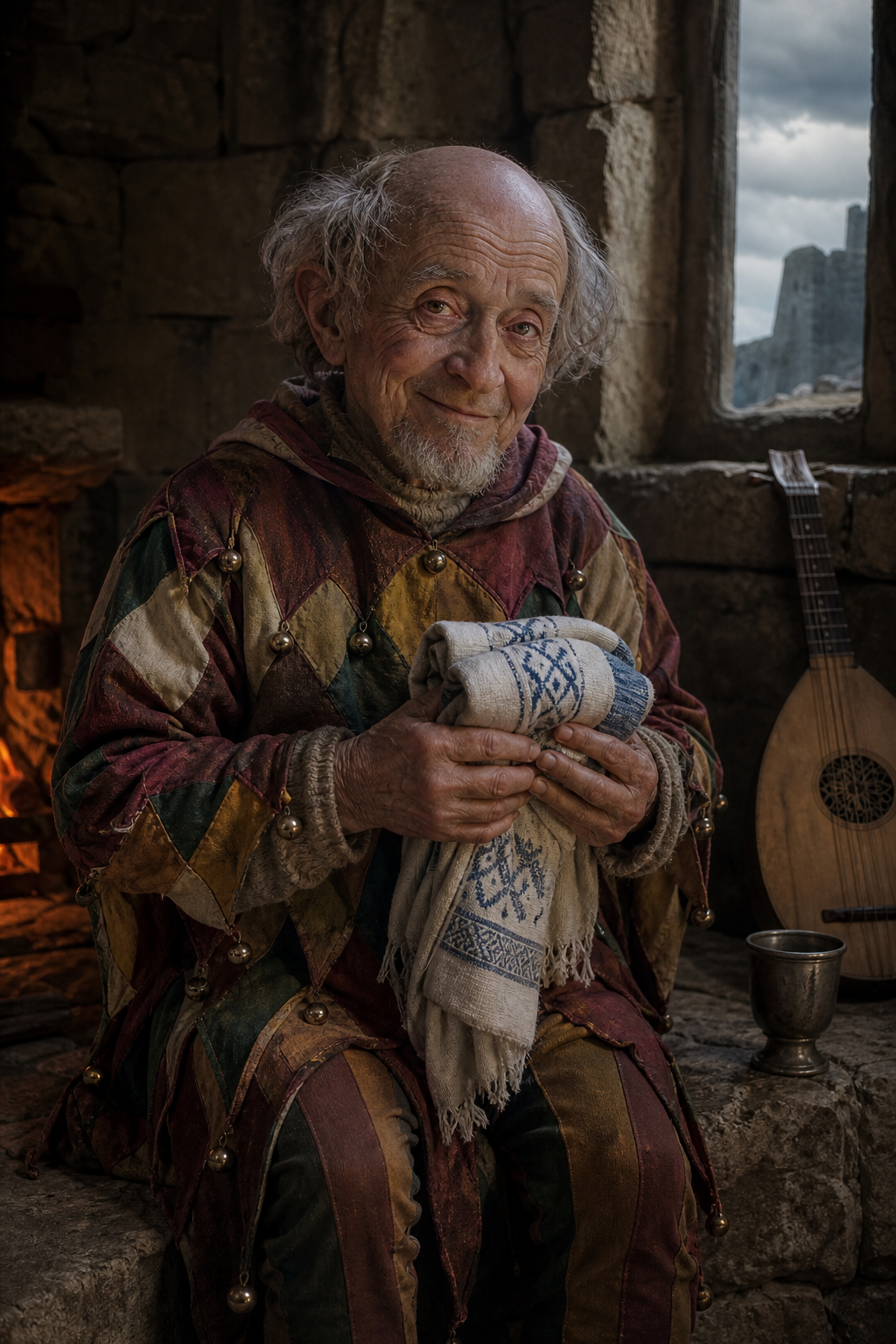
He is physically small, increasingly old, and visibly worn: a wrinkled smile, grizzled fringe around a bald crown, white bristles at his chin, battered checkered motley with bells, and the recurring smell of wine. Age makes him forgetful without making him empty. The details others treat as rambling remain stored in him because he lived beside John before history polished every rough edge.
Towser’s humor is not evidence that pain slides off him. It is how he carries pain without demanding that every room stop and admire the burden. His songs let rulers hear mortality and succession in forms they can briefly tolerate. When power stops tolerating them, the same songs expose exactly how frightened the court has become.
The Dragonbone Chair · Verified chronology
A dying king, a buried sword, a song that almost starts a stabbing, one white scarf, a northern memory, and the forgotten route to Thorn
Towser gives mortality a melody because the king cannot say it plainly by himself
Book 1 opens its royal story with Prester John seated on the bones of Shurakai and Towser beside him. The old jester sings of rain, river, wind, movement, and the terrible command to wait. John weeps. The dragon-slayer who unified kingdoms cannot command time, and the court’s smallest figure supplies the language that lets him admit it.
The intimacy matters. Towser is not merely summoned entertainment. John trusts him near fear. When the king speaks of dying, Bright-Nail, Elias, and what must follow, Towser becomes witness to an inheritance nobody else receives in full.
The fool receives the instruction because the official system cannot be trusted to carry it intact
John directs Towser to give Bright-Nail to Elias if the king dies before his heir returns. The sword, scabbard, and accompanying meaning pass through a jester rather than council or priest. Towser obeys. Elias takes the weapon, says it twists, drops it, turns pale, and refuses it.
Elias then orders the relic buried with John and forces Josua to place it on the corpse. Towser cannot overrule the new king. His duty is narrower and still essential: he carries the message faithfully enough that later readers can distinguish John’s intention from Elias’s refusal.
“King Hemlock” turns entertainment into diagnosis, so naturally somebody reaches for a sword
At Elias’s court, Towser sings the old succession story of King Hemlock. The song resembles the royal family too closely. Courtiers laugh because mockery is safe when directed downward. Miriamele does not. Guthwulf draws steel, and Elias drives the old jester from the room.
The scene measures the court more accurately than any proclamation. A regime that claims renewal cannot tolerate an elderly entertainer pointing out the shape of inheritance. Towser’s vulnerability makes the reaction uglier: armored men answer song with weapon because truth has become treason even when it rhymes.
Isgrimnur goes to the old witness when the palace refuses to explain itself
Before dawn, Isgrimnur finds Towser while trying to understand Josua’s sudden disappearance. The jester does not solve the political mystery, but his location in the information network matters. Servants, fools, companions, and old friends notice movement that formal authority conceals.
Towser’s seeming marginality repeatedly places him near the seam between private decision and public consequence. The king’s brothers may command gates and armies; the jester knows who left, who cried, what was promised, and which old objects changed hands.
He reaches the fortress by the last caravan, older, grayer, more forgetful, and still capable of finding the person who needs him
Towser arrives at Naglimund after the final caravan fights its way north through worsening roads and bandits. He is wine-scented, worn down, and visibly aged. Simon encounters him after Miriamele enters the Raed as a princess and the boy flees in humiliation.
Towser does not solve Simon’s heartbreak with a slogan. He offers company, wine, memory, and a story about a choice that never became simple merely because decades passed. The old man treats adolescent pain seriously without pretending it is the first pain love ever invented.
The conquest story contains a woman who refused to become part of the conqueror’s moving court
Towser keeps a white scarf woven with dark-blue Rimmersgard runes spelling Sigmar. She was a nearly white-haired young woman cleaning the occupied hall after John’s conquest of Naarved. Towser courted her and imagined marriage. She refused to leave land and family. He chose to remain with John and later learned she had died.
He also recounts the heroic version of Naarved: John crosses the wall, opens the portcullis, kills Jormgrun, and Bright-Nail flashes like holy silver. Towser’s account is affectionate testimony, not omniscience. He was in the campaign, not beside every blow. The scarf beside the battle story prevents conquest from becoming clean. John gains a kingdom; Towser loses the life he might have chosen inside it.
An old man everyone wants to hurry remembers what the archive cannot find
The private sword council tracks Camaris, Colmund, Rodstanby, Saint Skendi, Harcha, and the missing blade through partial texts and competing traditions. Towser provides the decisive living-memory receipt: Camaris gave Thorn to his squire Colmund before being swept overboard.
The clue redirects the search toward Colmund’s later journey north and ultimately Igjarjuk’s mountain. Towser does not discover Thorn with magic. He remembers a handoff other people failed to preserve. The heroic quest begins because somebody finally listens to the rambling old fool.
Motley survives where armor, walls, and episcopal certainty fail
When the Norns, Hunën, Bukken, and Red Hand destroy Naglimund, Towser escapes with Josua, Vorzheva, Gutrun, Deornoth, Isorn, Einskaldir, Strangyeard, Sangfugol, and a small remnant. He carries no military authority and remains part of the company because memory, affection, and old witness are forms of survival infrastructure.
Book 1 leaves him alive in the darkness beyond the burning fortress. The old court is gone. The jester remains, carrying John’s contradictions into the rebellion forming under Josua’s raised fist.
Memory, performance, and evidence
Towser is not a database. He is a human archive with wine on its breath, grief in its indexing system, and songs where official minutes should be.
His testimony requires care. Towser remembers what he witnessed, what he heard, what he loved, and what decades have arranged into meaning. He calls camp proximity nearly equivalent to watching John’s every stroke at Naarved. That does not make him a liar. It marks the difference between loyal memory and omniscient record.
The series needs both the archive and the witness. Manuscripts preserve names, dates, prophecy, and contested histories. Towser preserves texture: the king crying, worn boots, the feel of Bright-Nail’s rejection, Sigmar’s refusal, the social danger inside a song, and the fact that Camaris handed Thorn to Colmund. Memory is vulnerable to distortion. Records are vulnerable to omission. Truth emerges through contact between them.
His role also exposes class. Court historians decide which reigns matter; a jester carries what powerful people said when they were afraid. Lords discuss war; Towser remembers the woman cleaning the conquered hall. Scholars reconstruct the sword; the old entertainer remembers who physically held it next.
Relationships
He builds his place through loyalty, mentorship, memory, and the dangerous privilege of making powerful men hear themselves
Prester John
Towser loves John as person and ruler, carries his private Bright-Nail instruction, and chooses the king’s moving life over Sigmar’s northern home. Loyalty gives him belonging and leaves an old grief no heroic story can reimburse.
Sigmar
Sigmar accepts Towser’s affection but refuses to abandon family and land after conquest. Her white scarf survives in his hands. The Book 1 appendix’s naming connection must be preserved without inventing an unverified reason or timeline.
Simon
Towser meets Simon’s humiliation with memory rather than ridicule. He also provides the Thorn clue that sends Simon north, meaning comfort and quest logistics arrive from the same underestimated source.
Prince Josua
Josua inherits Towser along with John’s unresolved realm. The jester’s presence connects the rebellion to the old king without turning continuity into automatic legitimacy.
Sangfugol
Towser once encouraged the younger harper without obligation. Sangfugol’s later loyalty is repayment made personal: artistic mentorship becomes eldercare when the teacher’s body and memory begin failing.
Duke Isgrimnur
Isgrimnur and Towser remember John from different heights of the same long campaign. Both understand that love for the dead king does not require pretending the inheritance is functioning.
King Elias
Elias rejects Bright-Nail and later rejects Towser’s song. In both moments the jester becomes witness to a ruler who experiences inherited truth as threat.
Sir Camaris
Towser remembers Camaris entrusting Thorn to Colmund. That ordinary human handoff prevents the legend from swallowing logistics and gives the later search a recoverable route.
Colmund of Rodstanby
Colmund enters the quest because Towser remembers him as Thorn’s bearer. One name reconnects Camaris’s disappearance to the northern expedition that followed.
Fandom notes and what the fact box misses
He is not comic relief. He is grief management with bells attached.
Towser is funny. That should not be edited away in pursuit of seriousness. His jokes, wine, wandering delivery, and performance instincts are how he remains socially mobile inside dangerous rooms. Humor does not cancel his intelligence. It lets intelligence arrive before the guards decide to stop it.
He is also not a magical truth machine. His Naarved account loves John. His Sigmar memory loves the life he did not choose. His age alters recall. Treating those conditions as flaws misses the series’ larger argument: every source has position. Towser’s position is unusually valuable because official history rarely records the fool’s angle at all.
The portrait should honor age without making it grotesque
Towser is small, bald, grizzled, wrinkled, and old. The visual brief preserves all of that while keeping the face warm, charismatic, and lovable. He should look like a person whose smile survived because it had work to do, not a carnival mascot or fantasy dwarf assembled from genre shorthand.
The name Cruinh remains carefully labeled
Book 1’s narrative identifies Sigmar as the Rimmersgard woman whose scarf Towser keeps. The appendix separately identifies Cruinh as Towser’s original name. This profile preserves both receipts without merging two people.
Canonical identity and milestone art
Very small, very old, bald-crowned, grizzled, bell-worn, clever-eyed, and never turned into Generic Medieval Clown
Towser’s canonical Book 1 image fixes a tiny elderly man in his seventies or early eighties with a deeply lined expressive face, clever kind eyes, wrinkled mischievous smile, grizzled fringe around a bald crown, short white-gray chin bristles, compact stooped body, and worn checkered motley in muted wine, faded gold, green, and cream. Small tarnished bells, a lute, wine cup, cold Naglimund window, and Sigmar’s white-and-blue scarf complete the context.
Future art may place him beside John, Bright-Nail, Simon, Sangfugol, the Raed, or the Harrowing. It must preserve facial structure, apparent age, tiny stature, hair pattern, beard, and worn motley language. Youth milestone art may age him backward only when the chronology demands it.
On the record
What this profile can prove today
This canonical profile covers Towser through The Dragonbone Chair: his appearance, songs, relationship with Prester John, the king’s mortality scene, Bright-Nail instruction and rejected handoff, “King Hemlock,” Isgrimnur’s inquiry, journey to Naglimund, comfort of Simon, Sigmar’s scarf and Naarved memory, the Colmund and Thorn breakthrough, Sangfugol connection, and escape from the Harrowing.
Source: owner-accessed Kindle edition of The Dragonbone Chair, verified front-to-back through page 652 of 652 and reconciled with the complete Book 1 character manifest. Later-volume evidence will be added only after sequential reading verifies it.
The Dragonbone Chair hub → · Book 1 characters → · Prester John → · Simon → · Series hub →