
Susanna
She receives one scene, loses nearly everything before it begins, and still performs the first sovereign act in Simon’s life: she looks at the premature child everyone is deciding over and names him Seoman.
Profile
She is not a womb attached to the hero’s secret. She is the first person who gives him an identity on purpose.
Susanna is a young Hayholt chambermaid, widow of the fisherman Eahlferend, mother of Simon, and the woman who gives him his birth name Seoman, meaning “waiting.” She dies after premature labor nearly fifteen years before the main chronology. Book 1 preserves her through Rachel’s memory, Morgenes’s grief and concealment, Simon’s parentage, the unexplained shining object, and the name the household later reshapes into Simon.
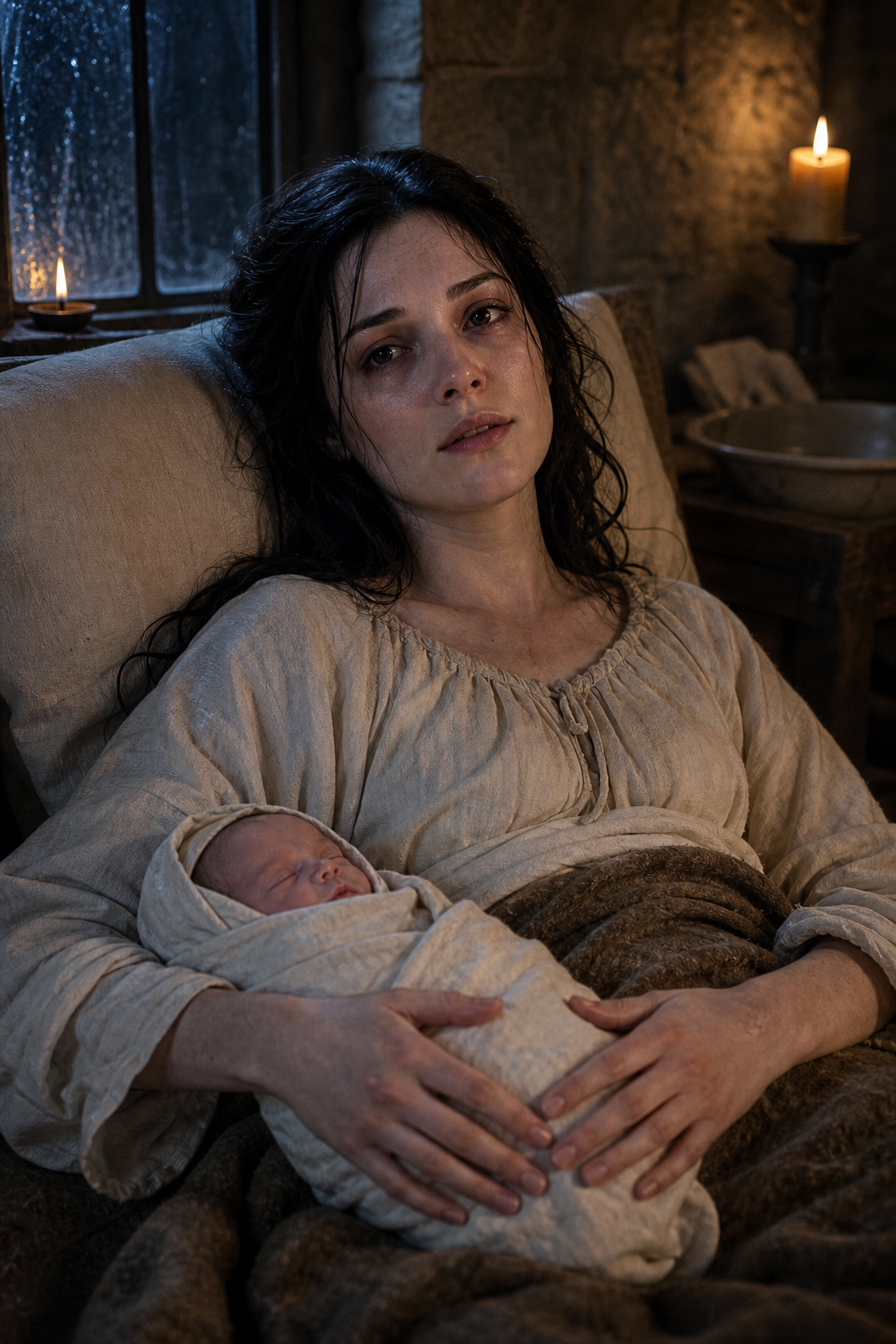
She has dark hair and is described during labor as young, snow-pale, gravely weakened, and bleeding. The text does not turn physical beauty into immunity from class or medical danger. She lies in a servant’s chamber with an older attendant, Rachel, and Doctor Morgenes arguing over whose life can still be saved.
Susanna speaks very little because her body is failing. That scarcity makes each action matter more, not less. She appears to assent when Morgenes shifts from trying to save her toward saving the premature child. She receives the baby, names him, and dies. A full profile must hold the dignity of that choice beside the brutal fact that other people are interpreting a dying woman whose capacity to speak is already disappearing.
The Dragonbone Chair · Verified chronology
A drowned husband, a rainy night, premature labor, one contested medical choice, the name Seoman, a shining object, and a household mother who stays
Eahlferend is already dead, and Susanna enters labor carrying questions nobody in the room explains
Susanna is the widow of Eahlferend, a fisherman who drowned before their son was born. Rachel remembers that he visited Morgenes repeatedly for conversations whose subject remains unknown. The doctor’s reaction to his name proves recognition deeper than ordinary acquaintance without revealing the agreement between them.
Susanna therefore arrives at the birth already inside a network of concealed knowledge. That does not convert her into a secret princess or authorize a parentage conspiracy. Book 1 proves fisherman, chambermaid, marriage, widowhood, repeated visits, and emotional reaction. Everything beyond those receipts remains a question.
Rachel fetches Morgenes because ordinary household experience recognizes the crisis
Nearly fifteen years before Simon’s apprenticeship, Rachel brings Morgenes to Susanna during premature labor. Elispeth, an older calm attendant, is already helping. The scene places medical expertise beside domestic knowledge rather than treating servants as decorative witnesses.
Susanna has lost dangerous amounts of blood. She is snow-pale and weak. The baby is early. No available option is clean. The room becomes a collision among medicine, faith, consent, class, grief, and the future protagonist’s survival before anyone knows he will become important.
Rachel invokes duty to the child; Morgenes initially fights for the mother
Rachel insists the child must be saved. Her reasoning includes religious duty, but it also comes from the person accustomed to preserving fragile lives through work. Morgenes initially argues for Susanna’s life. Neither position deserves cartoon treatment. The crisis does not offer enough time, blood, technology, or certainty for morally spotless choices.
The danger lies in how quickly a dying woman can become the object of other people’s principles. Susanna can barely communicate. Morgenes appears to read assent from her before changing course. The text gives that moment weight while leaving room to ask how consent functions when pain, blood loss, urgency, and unequal authority compress every possibility.
Morgenes saves the premature infant and loses the mother
The baby lives. Susanna receives him. The scene does not pretend survival erases cost. A newborn is placed into arms already losing the strength to hold him. Elispeth, Rachel, and Morgenes witness the transition from medical emergency to irreversible bereavement.
Morgenes’s grief is terrible and personal. His response to Eahlferend, Susanna, and the object she carried indicates history the chapter refuses to explain. The lack of answer should not swallow Susanna’s visible story. Mystery belongs around her; it does not replace her.
She spends her remaining breath choosing “waiting”
Susanna names the child Seoman. The name means “waiting.” Book 1 does not tell us precisely what she believed he was waiting for, what she knew, or whether the name carries private agreement with Eahlferend and Morgenes. Those are compelling questions, not facts available for promotion.
What is certain is agency. The baby is not yet Simon, kitchen boy, apprentice, fugitive, sword seeker, dragon-marked survivor, or knight. In his mother’s hands he is Seoman because she says so. Naming is the last relationship she can give him directly.
Something falls from her hand; Morgenes hides it; the reader is not given permission to guess the answer
After Susanna dies, a small shining object falls from her hand. Morgenes reacts with visible devastation and conceals it. Rachel notices but does not challenge him. During the later attack on Morgenes’s house, one silver sparrow carries a shining, ringlike bauble tied to a promise made to Eahlferend.
The connection is strong enough to track and still incomplete. Book 1 does not name the object, its origin, recipient, or function. Susanna’s profile records custody, timing, and reaction. It refuses the fandom habit of turning an attractive theory into settled genealogy.
The woman who demanded the child’s survival accepts the invoice
Rachel and the chambermaids raise the orphan. Rachel converts Seoman into the household form Simon, preserving and altering Susanna’s gift at once. She disciplines, feeds, protects, frustrates, and loves him. Nearly fifteen years later, when she believes him dead, memory returns to the hour his mother died.
This matters ethically. Rachel does not argue for an abstract child and disappear once the crisis ends. She becomes the person who stays. Her severity must be read beside a guardianship she chose without romance, title, or reward.
He grows up knowing the occupations and almost none of the people
Morgenes tells Simon that his father was a fisherman and his mother a chambermaid. The boy receives class facts without the emotional archive held by Rachel and the doctor. He fantasizes about heroic ancestry because ordinary parentage feels too small for his hunger to matter.
The irony is not that Susanna and Eahlferend were secretly valuable only if later mystery makes them grand. The irony is that Simon cannot yet see the magnitude inside fisherman, chambermaid, widow, name, and chosen household. Book 1 begins correcting that blindness long before it explains the shining object.
Consent, medicine, faith, and class
The scene is difficult because everybody is trying to save a life while Susanna is losing the ability to control how salvation gets defined
It would be easy to make Rachel the religious zealot and Morgenes the rational doctor. The chapter resists. Rachel’s insistence comes from faith and from the laboring woman’s understanding that somebody must act for the infant. Morgenes’s defense of Susanna comes from medicine and personal knowledge, yet he also possesses secrets nobody else can evaluate.
Susanna’s apparent assent changes the decision without transforming the conditions into ideal consent. She is bleeding, exhausted, in pain, and near death. The profile should neither erase her choice nor pretend the surrounding pressure disappears because her eyes or movement communicate agreement.
Class sharpens every part of the room. Susanna is a chambermaid and fisherman’s widow. There is no royal physician corps, public memorial, dynastic record, or political crisis attached to her death. Morgenes’s grief and Rachel’s memory become the archive because institutions will not build one for her.
Names, inheritance, and the two mothers
Seoman comes from Susanna. Simon comes from Rachel. Neither name cancels the woman who gave the other.
“Seoman” means waiting. It carries Susanna’s final intention and the mystery of what she may have known. “Simon” is the Warinsten household form Rachel and the chambermaids use while doing the daily work of keeping him alive. The protagonist begins with two names from two mothers: one biological and dying, one chosen and enduring.
This is not a rivalry. Susanna does not need Rachel minimized to remain important. Rachel does not need Susanna forgotten to become Simon’s mother in practice. Their contributions meet in one life. The name most readers know is already a translation produced by care.
Later titles and identities will accumulate around the same boy. Book 1 alone supplies Seoman, Simon, scullion, apprentice, fugitive, Mooncalf, sword seeker, and Snowlock. Susanna’s name remains the earliest. It arrives before achievement and therefore cannot be earned or revoked.
Relationships
One brief scene creates a family network the epic keeps carrying after every original member is gone
Simon / Seoman
Susanna gives Simon life, the birth name Seoman, and an unresolved inheritance. He grows up without conscious memory of her, which makes other people’s custody of truth about her especially consequential.
Eahlferend
Book 1 identifies Eahlferend as Susanna’s husband and Simon’s father. His repeated visits to Morgenes and the promise associated with the shining object remain unexplained.
Doctor Morgenes
Morgenes knows both parents, tries to save Susanna, saves the baby after her apparent assent, grieves, conceals the shining object, and later sends it outward during his final defense.
Rachel the Dragon
Rachel fetches help, argues for the child, notices Morgenes’s concealment, and raises Simon. Her practical motherhood fulfills the future Susanna cannot personally provide.
Elispeth
Elispeth assists through the dangerous labor and presents the baby to Susanna. Her quiet competence is part of the servant-class care network keeping the scene from becoming a duel between Rachel and Morgenes.
The chambermaids
Simon is raised by a household of women he later dismisses as knowing nothing about great matters. Their work is the uncredited condition beneath every adventure he survives to have.
The shining bauble
It falls from Susanna’s hand, passes into Morgenes’s concealment, and later leaves with a silver sparrow. Its identity remains unknown at the Book 1 boundary.
The Hayholt
The castle is not only kings, towers, and dragon bones. Susanna’s death occurs inside the servant world that feeds, cleans, births, mourns, and raises the people official history names later.
Rachel’s recollection
The flashback makes Susanna visible because Rachel remembers. Maternal history survives through another woman’s grief rather than a court genealogy.
Fandom notes and what the fact box misses
Do not turn her into Secret Bloodline Packaging. The mystery is interesting because a person is holding it.
Susanna attracts genealogy theories because the shining object, Eahlferend’s meetings, Morgenes’s reaction, Seoman’s meaning, and later silver sparrow form an obvious unanswered cluster. Tracking that cluster is good fandom. Declaring the answer before the text provides it is not.
Her value does not depend on the object proving royal, Sithi, magical, prophetic, or otherwise prestigious. A young chambermaid naming her son while dying is already consequential. If later evidence changes the family history, it expands her context. It should not retroactively become the only reason she mattered.
The portrait preserves the final moment without exploiting it
Susanna’s canonical image shows dark hair, snow-pale skin, weakness, simple clothing, rain, candles, and the fully swaddled newborn. There is no visible blood or childbirth spectacle. The face carries exhaustion and choice. She remains beautiful because youth and beauty are text-compatible, not because death needs romantic decoration.
Historical profiles still deserve JIN depth
A character does not need five hundred pages of action to merit a full profile. Susanna’s single scene governs Simon’s names, parentage record, Rachel’s motherhood, Morgenes’s secret, the shining-object mystery, and the ethical frame around whose lives ordinary institutions preserve. Short presence is not small impact.
Canonical identity and milestone art
Young, dark-haired, snow-pale, servant-class, beautiful, dying—and never transformed into a glamorous fantasy queen to make the mystery feel important
Susanna’s canonical Book 1 image fixes a beautiful young adult woman in her early twenties with dark loosened hair, snow-pale skin, dark exhausted eyes, fine expressive features, and a simple cream linen shift beneath a modest wool blanket. Rain, candlelight, rough stone, and the fully swaddled premature Seoman identify the final night.
Future historical art may show Susanna before labor, with Eahlferend, working among chambermaids, or speaking with Morgenes only when verified evidence supports the scene. It must preserve this face, age, hair, skin tone, servant-class visual world, and relationship to Simon’s infancy.
On the record
What this profile can prove today
This canonical profile covers Susanna through The Dragonbone Chair: her dark hair and final condition, marriage to Eahlferend, premature labor, Rachel and Elispeth’s presence, Morgenes’s initial attempt to save her, apparent assent to save the child, naming Seoman, death, the shining object and Morgenes’s concealment, Rachel’s guardianship, and the later connection between the object and a promise to Eahlferend.
Source: owner-accessed Kindle edition of The Dragonbone Chair, verified front-to-back through page 652 of 652 and reconciled with the complete Book 1 character manifest. Later-volume evidence will be added only after sequential reading verifies it.
The Dragonbone Chair hub → · Book 1 characters → · Simon → · Rachel → · Doctor Morgenes → · Series hub →